Can Bearded Dragons Eat Microgreens?
Cal HewittPublished Updated Checked
- bearded dragons
- reptiles
- animal feeding
- safety
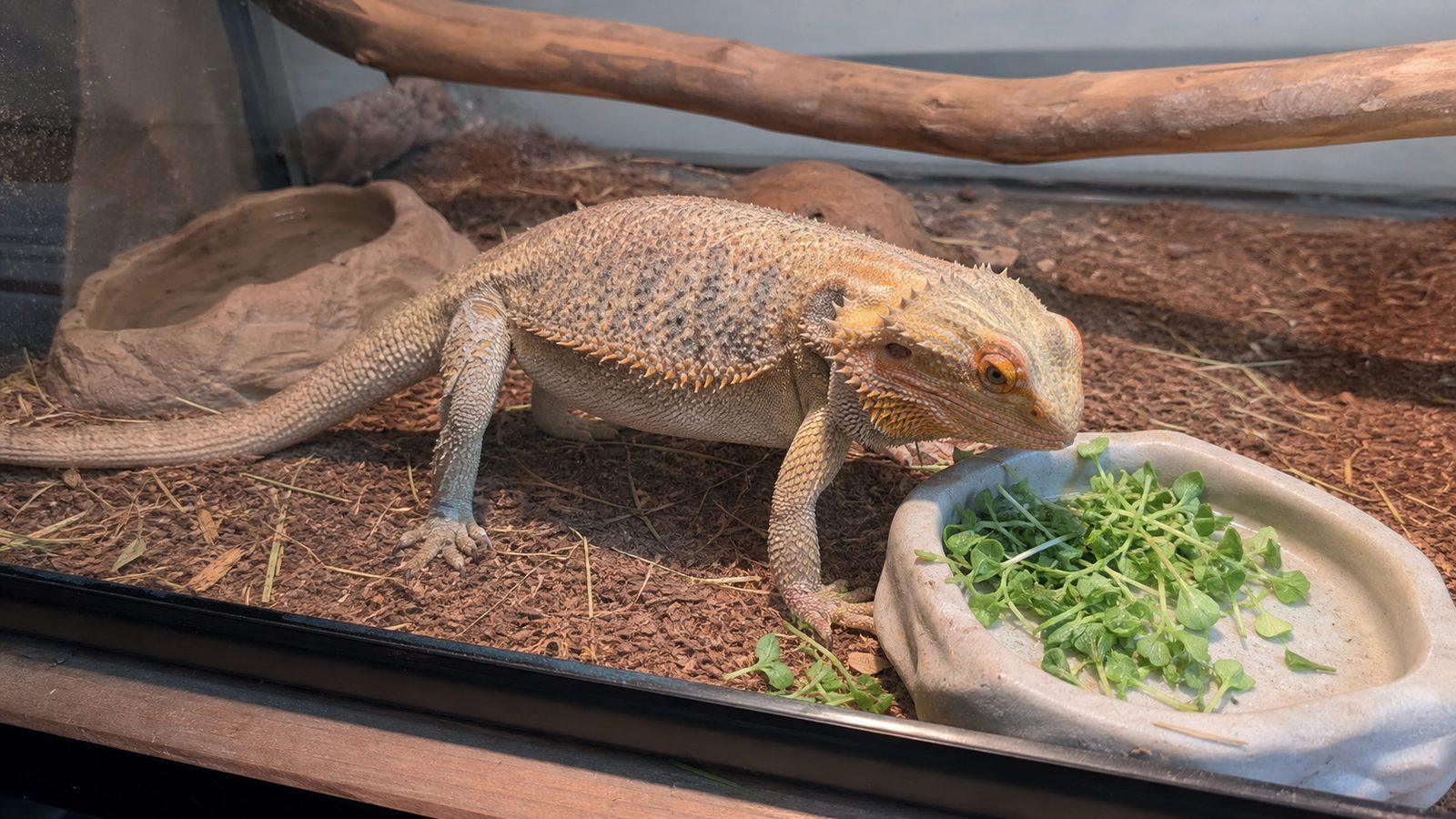
Almost certainly yes, as part of the leafy green share of the salad. What nobody can tell you is which microgreens, in what quantity, or how often.
There is no controlled feeding study of any microgreen in Pogona vitticeps. Not one. Every crop-level recommendation in this category is imported from the mature vegetable, and the mature-vegetable advice does not even agree with itself: VCA recommends broccoli and kale for bearded dragons while UC Davis calls broccoli high in goitrogens and kale high in calcium oxalates, both occasional treats. Where the vets disagree about the adult plant, a confident verdict about the seedling is guesswork.
Start with the thing that actually kills them
Metabolic bone disease. It is preventable, it is dietary, and it governs every other decision on this page.
Merck's reptile nutrition chapter says food should be at least 1:1 calcium to phosphorus, and preferably 2:1. VCA links MBD in bearded dragons to diets high in phosphorus, low in calcium, or short on vitamin D3 and UVB, and notes juveniles are most at risk. The mechanism is simple enough: too little usable calcium and the body takes it out of the skeleton.
Nobody has published calcium-to-phosphorus values for most of these crops at microgreen stage. So, the ratio that decides whether a food is appropriate for this animal is unmeasured for most of the crops below. You can follow the principle. You cannot check any specific tray against it.
What to be careful with, and one thing that does not transfer
Oxalates. VCA says mature swiss chard, spinach and beet greens should be fed sparingly, because oxalates bind calcium and trace minerals and a diet built on them causes deficiency. That is exactly the calcium mechanism above, arriving by a second route. It applies to swiss chard, spinach and beet as mature plants. At microgreen stage the concentration is unknown, so the defensible instruction is qualitative: do not let an oxalate-flagged crop become the monotonous base of the salad.
Goitrogens. VCA cautions against excessive mature cabbage, kale and mustard; UC Davis adds spinach, broccoli and parsley. Goitrogens interfere with iodine uptake and thyroid function. No source gives a dose, iodine status, thyroid data, or any glucosinolate threshold at microgreen stage, so "goitrogen" here is a mechanism to respect and not a limit to obey.
The alliums are the one group where the popular answer outruns the evidence. Onion, garlic, chives and leek are genuinely and repeatedly documented as toxic to cats and dogs. The ASPCA garlic entry names N-propyl disulfide and hemolytic anemia in dogs, cats and horses. It does not name reptiles, and no reptile allium toxicology source, dose, or clinical case could be found. So, for a bearded dragon the honest verdict is not established in either direction. That is not permission. It means the confident "alliums are toxic to your beardie" line is being carried across from a different animal, and so would a confident "they are fine".
Every crop people ask about
Hover or tap a row to highlight it.
| Crop | Microgreen verdict | The nearest real evidence, which is about the mature plant |
|---|---|---|
| Arugula | Not established | Not named in the veterinary diet lists at all |
| Broccoli | Not established | VCA recommends it, UC Davis calls it high in goitrogens. The sources disagree |
| Radish | Not established | UC Davis: low in nutrition, occasional treat. Not a poison classification |
| Kale | Not established | VCA recommends with a goitrogen caution, UC Davis flags calcium oxalates |
| Mustard | Not established | UC Davis puts it among the main salad greens, VCA cautions on goitrogens |
| Pak choi | Not established | VCA lists mature bok choy as recommended |
| Cilantro | Not established | VCA lists mature cilantro as recommended |
| Beet | Not established | VCA recommends beet greens but sparingly, on oxalates |
| Wheatgrass | Not established | Not named in any reviewed reptile source |
| Collard | Not established | UC Davis: mature collards should be the great majority of the salad |
| Turnip | Not established | Mature turnip greens are a main salad green in both sources |
| Endive | Not established | Endive and escarole are named main salad greens, mature |
| Spinach | Not established | Sparingly, on oxalates, and high in goitrogens |
| Swiss chard | Not established | Sparingly, on oxalates that bind calcium |
Fourteen crops and fourteen identical verdicts, because the right-hand column is all the feeding evidence there is. Collard greens are the backbone of a bearded dragon salad according to UC Davis, and that tells you nothing reliable about a collard microgreen, because composition changes as a plant develops. Chia is the clearest case of how far it can change: the seed is roughly thirty percent fat and the one study on chia microgreen material puts it near seven.
Not established is not a warning. None of these is flagged as dangerous. It means that if you feed collard microgreens because collards are the recommended green, you are making a reasonable inference and you should know it is an inference.
Can Bearded Dragons Eat Broccoli Microgreens? What Vets Say
No veterinary source has published a verdict on broccoli microgreens for bearded dragons, in either direction. The guidance that does exist is about mature broccoli, and the two vet sources that name it give different instructions. VCA lists broccoli among its recommended vegetables. UC Davis puts broccoli with spinach and parsley among foods fed sparingly as occasional treats, because of goitrogens. Neither one names a microgreen, a sprout, or any particular part of the plant. So, if you offer broccoli microgreens, you're working from mature-plant advice plus a few plant measurements, and the sections below show you exactly what each of those covers.
What VCA and UC Davis say about broccoli
Two veterinary sources mention broccoli by name for bearded dragons, and the difference between them is the reason you keep getting mixed answers.
VCA's bearded dragon feeding handout lists broccoli in its run of recommended vegetables, next to alfalfa hay, bok choy, collard greens, dandelion greens, kale, turnip greens, and watercress (VCA). VCA does carry a goitrogen caution, but the vegetables that caution names are cabbage, kale, and mustard greens. Broccoli isn't one of them.
UC Davis takes the other position. Its 2019 bearded dragon care page, written by John Gardiner, says "spinach, broccoli, and parsley are high in goitrogens which decrease thyroid function," and places those three among the foods to feed sparingly as occasional treats (UC Davis, 2019). A goitrogen is a compound that can interfere with iodine uptake and thyroid function, which is a different problem from calcium absorption.
Side by side, this is where the two line up and where they part ways:
Hover or tap a row to highlight it.
| VCA | UC Davis (2019) | |
|---|---|---|
| Where broccoli appears | Recommended vegetables | Occasional treats, fed sparingly |
| Reason given for broccoli | None | High in goitrogens |
| Amount or frequency for broccoli | None | None beyond "occasional" |
| Plant part or growth stage named | None | None |
Both sources treat mature broccoli as something a dragon may be fed. Both also put members of the cabbage family into their cautions, though only UC Davis names broccoli itself. Where they disagree is whether broccoli belongs in the regular vegetable rotation or sits outside it as a treat. Neither source settles that for you, and neither gives a number you could portion from.
Both instructions are about mature broccoli
Every word in those two lists refers to ordinary vegetables. Neither VCA nor UC Davis says leaf, floret, sprout, root, or microgreen, so the most either statement can tell you about is ordinary mature broccoli, with the exact part unstated.
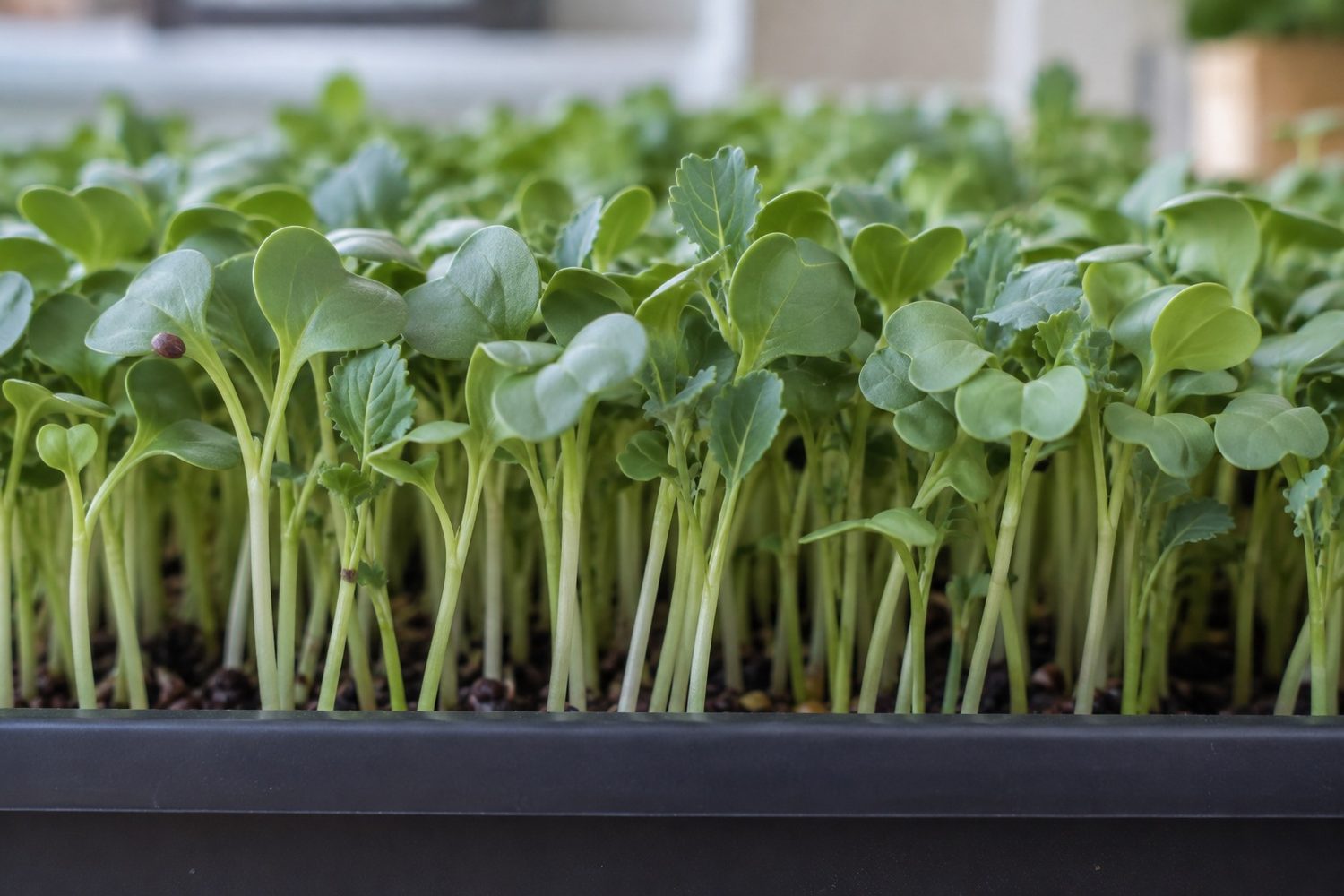
The stages really are different foods. A microgreen is the young plant's stems and leaves, harvested after the first true leaves appear, which is how UConn Extension defines it (UConn Extension). A sprout is a germinated seed grown in warm, moist conditions and often eaten with the seed and root still attached. A mature leaf and a floret come from the fully grown plant. VCA does mention generic "sprouts" in a smaller-percentage vegetable group, but it doesn't say broccoli sprouts, and it doesn't mention microgreens at all.
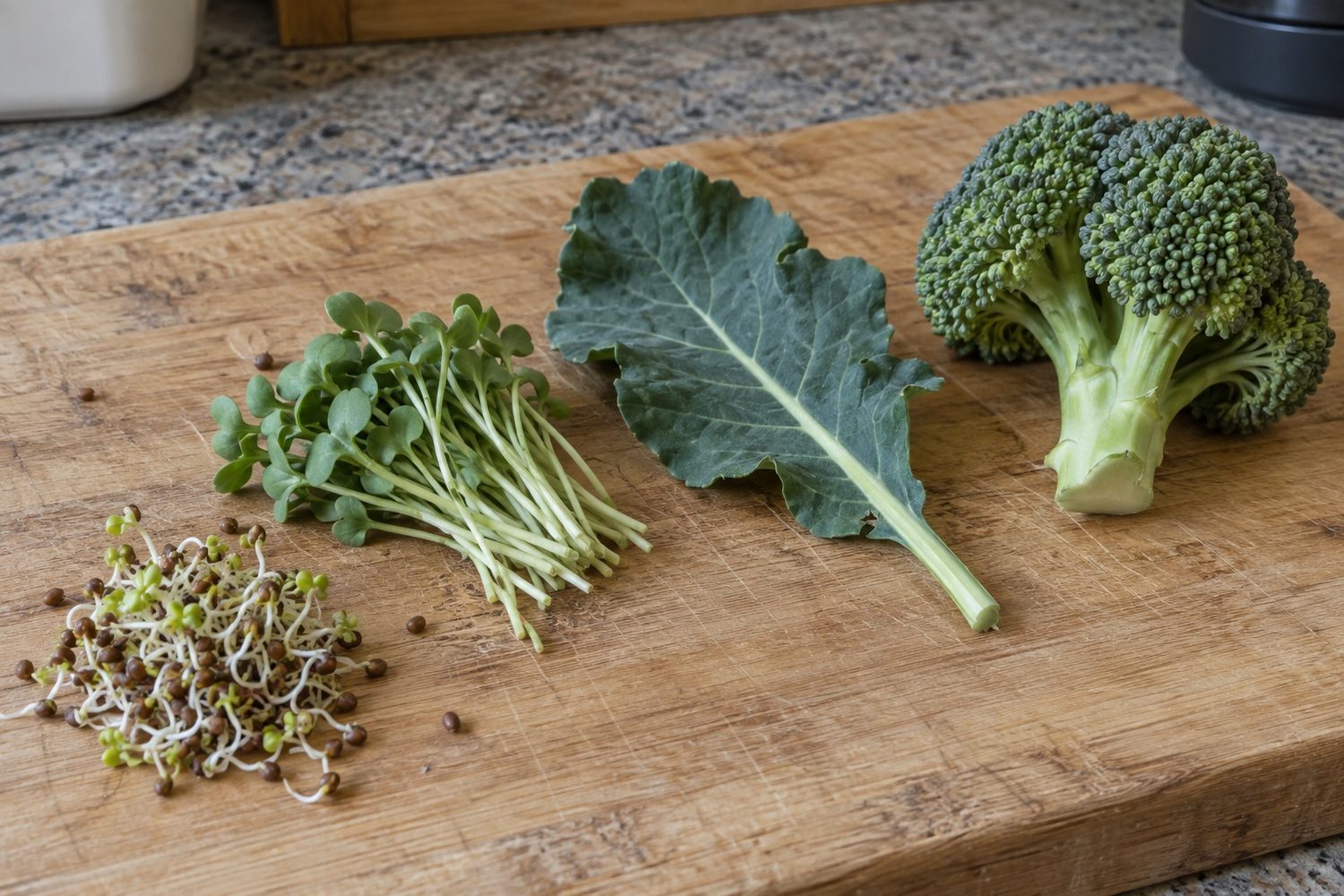
This matters because the chemistry shifts with age. USDA ARS reports that Lu et al. (2017) found broccoli microgreens had four-fold greater total aliphatic glucosinolates than mature leaves and florets, and that the dominant compounds differed: glucoerucin sat mainly in the microgreens, glucoraphanin mainly in the mature leaves and florets (USDA ARS, 2017). A seedling isn't a small floret, so neither vet's instruction carries over to it automatically, the recommendation or the caution.
What plant researchers have measured in broccoli microgreens
The numbers below come from plant composition studies. They describe particular trays grown in particular ways, and none of them was measured against a bearded dragon's needs. Read each one with its basis attached, because fresh weight and dry weight figures can't be compared directly.
Calcium and phosphorus
One 2025 peer-reviewed study measured 111.83 mg of calcium and 27.7 mg of phosphorus per 100 g fresh weight in its broccoli microgreen lot (Balik et al., 2025). Divide one by the other and that lot comes out at about 4.04 to 1 calcium to phosphorus.
For mature raw broccoli leaves, the USDA FoodData Central record (FDC 169329, released April 2018) lists 48 mg of calcium and 66 mg of phosphorus per 100 g, which works out to about 0.73 to 1 (USDA FoodData Central). That record is for leaves, not florets.
The Merck Veterinary Manual gives a general target for reptiles of at least 1 to 1 calcium to phosphorus, preferably 2 to 1 (Merck, reviewed Sept. 2025). The microgreen lot sits above that target and the mature leaf record sits below it, but treat that as two data points, not a pass and a fail. The microgreen figure is one lot from one growing system, the two numbers come from different datasets, and your own tray could measure differently.
Glucosinolates
Glucosinolates are sulfur-containing compounds in broccoli and its relatives that break down into biologically active products once the plant tissue is damaged. A 2022 experiment measured untreated broccoli microgreen shoots at 6,478 ± 418 µmol of total glucosinolates per 100 g dry weight, including 1,944 µmol of glucoraphanin, 1,456 µmol of glucoerucin, and 1,252 µmol of progoitrin per 100 g dry weight (Foods, 2022).
Those are dry weight figures, so don't set them beside the fresh weight calcium numbers above. UC Davis doesn't say which compound in mature broccoli its goitrogen warning refers to, and no one has published the level at which glucosinolates from any broccoli stage affect a bearded dragon's thyroid.
Oxalate and nitrate
A 2024 open-access study reported oxalic acid at 55.04 mg per 100 g fresh weight in its broccoli microgreens (2024 study). There isn't a matched figure for mature broccoli leaves to set it against. VCA's oxalate caution, meanwhile, names mature Swiss chard, spinach, and beet greens rather than broccoli.
The 2025 study also measured nitrate at 149.09 mg per kilogram fresh weight in its broccoli microgreens (Balik et al., 2025). Note that this one is per kilogram, not per 100 g. No bearded dragon source flags nitrate, sulforaphane, or other glucosinolate breakdown products in broccoli microgreens as a concern, and none clears them either.
What hasn't been studied
No feeding trial, toxicology report, or veterinary statement names broccoli microgreens or broccoli sprouts for bearded dragons (Pogona vitticeps). That leaves the question unpublished, not settled either way.
Specifically, there is no published amount or frequency for broccoli microgreens or sprouts. There isn't one for mature broccoli from VCA or UC Davis either; VCA simply lists it and UC Davis calls it an occasional treat. There's no threshold for goitrogens, oxalate, or nitrate in a dragon, no study of dragons grazing from a living tray, and no report of how dragons respond to broccoli microgreens in particular. Any exact portion or weekly schedule you come across for broccoli microgreens is someone's practice rather than a published figure.
What would answer it is a controlled feeding study in bearded dragons that reports the plant stage and cultivar, how much was eaten, calcium status, thyroid and iodine measures, clinical signs, and how long the trial ran. Until that exists, don't borrow a number. If you decide to offer some, write down the date, what you offered, whether it was eaten, and your dragon's appetite and stool afterward. That record is something a reptile vet can actually work from.
Where broccoli fits in the diet vets describe
The vet sources are far more specific about the whole diet than about any single vegetable. Everything in this section is general bearded dragon feeding guidance. None of it is a broccoli rule, and none of it converts into grams of one leaf.
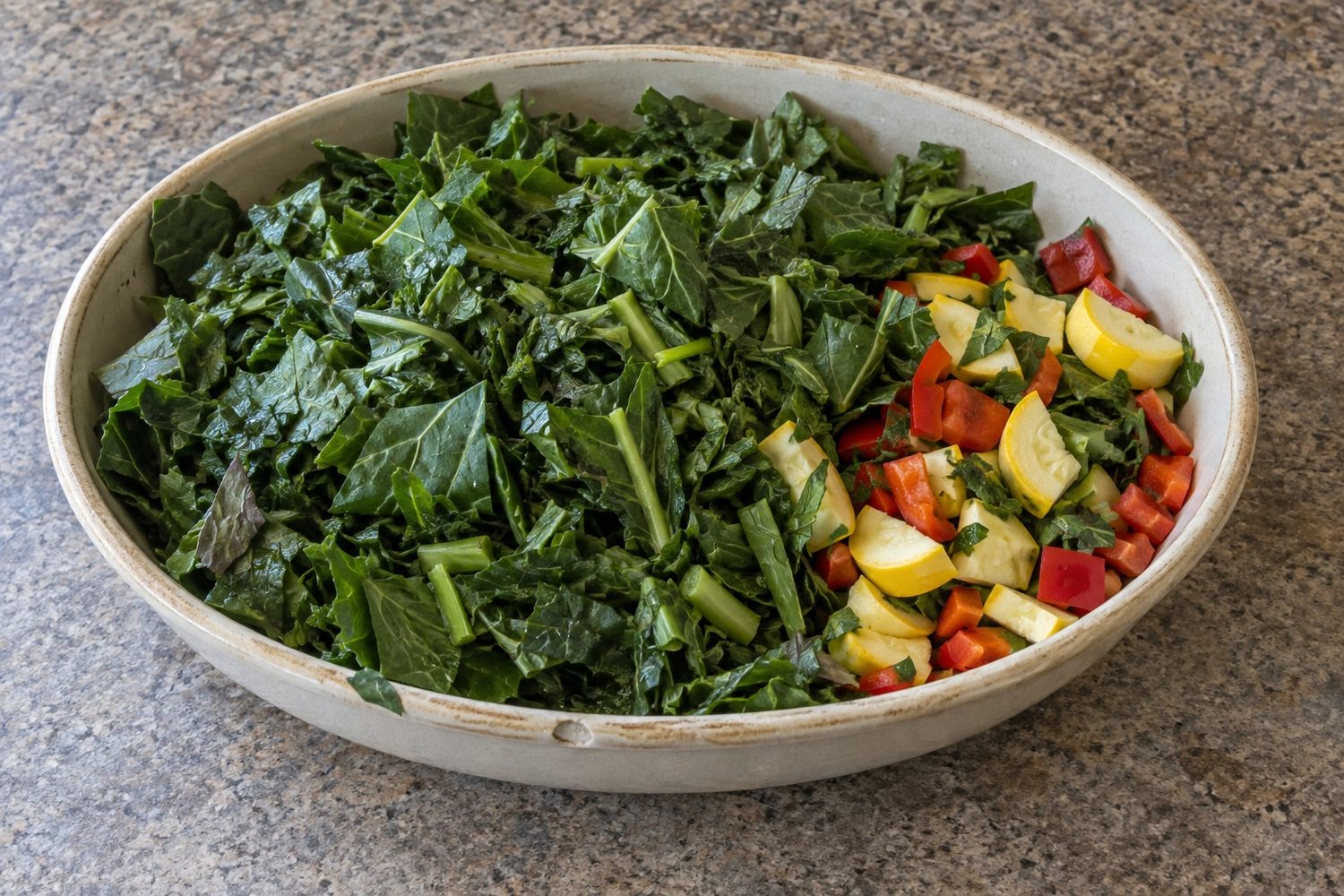
VCA says the diet should generally be about half plant material and half animal material such as insects, varying with age, and that 80 to 90 percent of the plant material should be leafy greens (VCA). NC State Veterinary Hospital gives a practical split for adults: 50% dark leafy greens, 20% chopped vegetables, 25% animal matter, and a maximum of 5% fruit (NC State).
UC Davis says a salad of calcium-rich leafy greens and vegetables should be offered daily, and that collards, dandelion greens and flowers, escarole, endive, grape leaves, mustard and turnip greens, and watercress should make up the great majority of it (UC Davis). On timing, VCA says young dragons eat once or twice a day and adults may eat every 24 to 72 hours, while NC State says adults may be fed daily or every other day.
VCA also calls for phosphorus-free calcium daily and calcium with vitamin D3 two to three times a week, and it links dietary imbalance to low blood calcium and metabolic bone disease. Your vet can tell you which supplement routine fits your dragon.
Put that together and a daily salad has a clear base, and broccoli in any form isn't part of it. If you follow the more cautious of the two sources, UC Davis, mature broccoli sits outside that base as an occasional treat, and remember that instruction was written about mature broccoli. If your dragon has metabolic bone disease, suspected thyroid or kidney disease, abnormal calcium levels, or a poor appetite, talk to a reptile veterinarian before adding anything new, broccoli microgreens included.
Preparing broccoli microgreens before you offer them
No bearded dragon source compares cut tops, roots, hulls, or a whole living tray. The steps below come from human food production guidance and general bearded dragon husbandry advice, applied to a tray you're about to cut. They're sensible handling, not evidence that roots or hulls cause harm.
- Check the seed. Penn State Extension advises against pesticide-treated seed for microgreens because the seed coats can stay on the plants and get eaten (Penn State Extension). EPA guidance on treated seed says it is for planting only: "Do not use for food, feed, or oil purposes" (EPA). If the packet says treated, that tray isn't a dragon food. If you're buying seed for this, look for packets labeled untreated and sold for microgreens or sprouting.
- Cut above the growing medium. UConn Extension describes microgreens as the stems and leaves, advises removing hulls, and says to compost the roots and substrate after harvest (UConn Extension). UC Davis notes that bearded dragons may swallow small loose particles and advises against sand, wood chips, and gravel as bedding. Taken together, that points to cutting cleanly above the soil or mat and picking off any hulls or loose medium you can see.
- Leave out anything moldy. UConn's microgreen food safety advice calls for clean medium, reputable seed, and no mold.
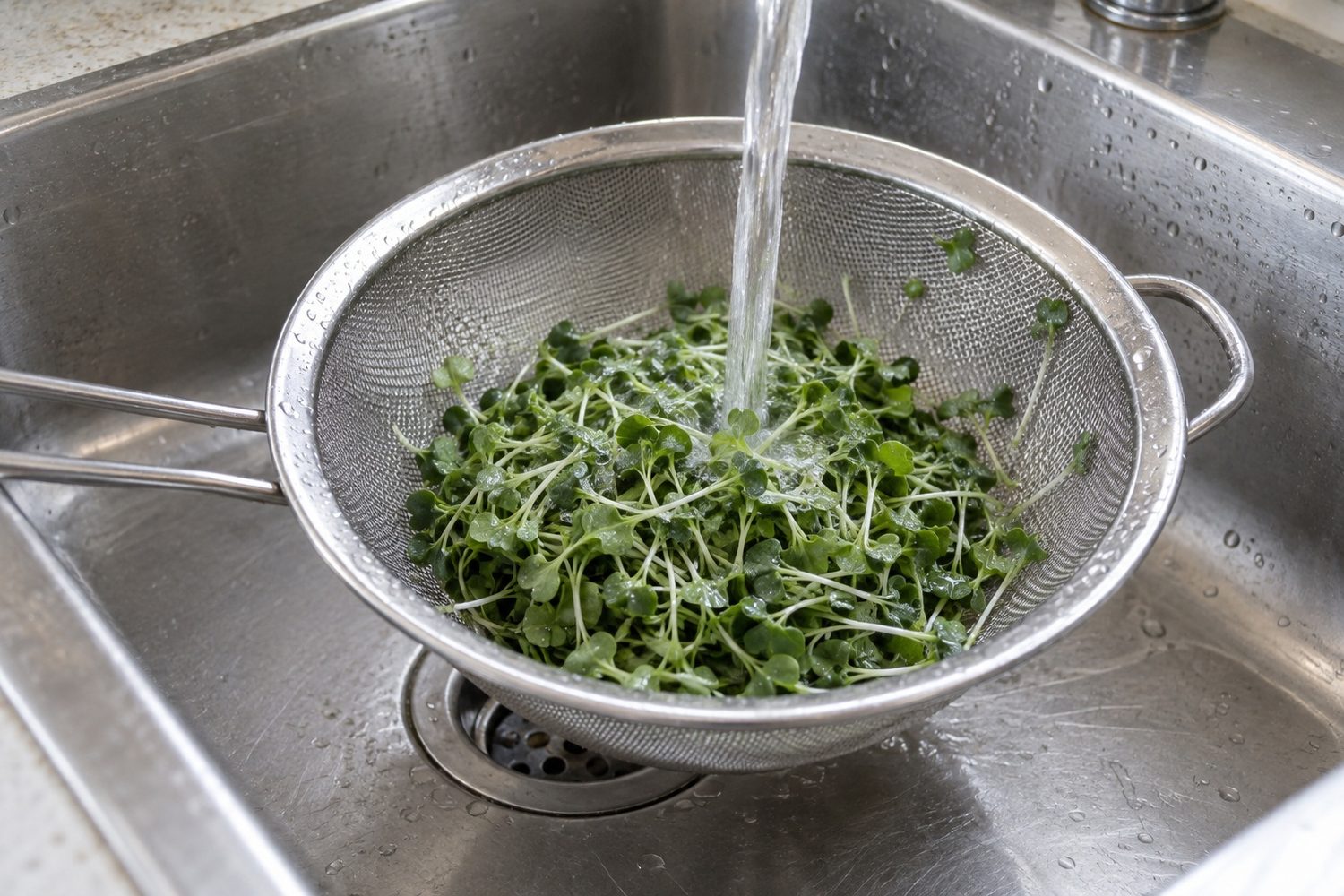
- Rinse under running water. The FDA says to wash produce, including home-grown produce, under running water without soap or detergent, and notes that washing reduces bacteria but doesn't remove all of them (FDA). That's human food safety guidance, used here for handling.
- Don't use a living tray as a feeding dish. A tray left in the enclosure means you can't tell how much was eaten, and your dragon can reach roots, hulls, medium, and any mold. Nobody has studied dragons grazing that way. Cut what you intend to offer and remove the rest.
Signs to watch for after any new food
There's no reaction profile specific to broccoli in bearded dragons, so watch for the general signs vets use. VCA's urgent care guidance says a pet needs prompt assessment for more than two vomiting events in 24 hours, loss of appetite or lethargy, multiple soft or watery stools, or blood in the stool, and emergency care if it is severely ill or can't stand or walk (VCA Urgent Care). Merck lists lethargy, poor appetite, reluctance to move, and fractures among the possible signs of bone disease in reptiles. If you suspect your dragon has eaten something harmful, the ASPCA says to contact a veterinarian or poison control immediately (ASPCA).
Before you open the tray
The vets split on mature broccoli: VCA recommends it, and UC Davis limits it to an occasional treat because of goitrogens. Neither addressed the microgreen, and no study has tested broccoli microgreens or sprouts in bearded dragons, so the mineral and glucosinolate numbers are measurements to consider rather than a ruling. If you do offer some, start from untreated seed, cut above the medium, leave out mold and loose substrate, rinse the cut greens, keep a note of what happened, and build the everyday salad from the staple greens the vets name.
Can Bearded Dragons Eat Radish Microgreens?
Nobody has published a study of radish microgreens fed to bearded dragons, so there is no tested amount, frequency or method to follow. The closest veterinary guidance comes from the UC Davis School of Veterinary Medicine, which puts radishes and sprouts in a group of foods that are low in nutrition and "fed sparingly as occasional treats." That page never mentions microgreens. If your dragon already goes for radish microgreens, the careful reading is to keep them in that occasional group, offer clean cut shoots grown from untreated seed, and build the rest of the bowl from the greens your vet recommends.
What UC Davis says about radishes and sprouts
The UC Davis bearded dragon care page, written by John Gardiner and dated 12 April 2019, lists corn, cucumbers, radishes, sprouts and zucchini as low in nutrition and says they should be fed sparingly as occasional treats (UC Davis Bearded Dragon Care). It is guidance written for this species by a university veterinary school, and it is the only institutional source that names radish for bearded dragons at all.
Read it closely before you apply it to your tray, though. The page says "radishes" without saying whether it means the root, the leafy tops, or both. It says "sprouts" without naming which plant they come from. And it never uses the word microgreen. It is also a statement about how much a food contributes to the diet, not a poison classification. The ASPCA's plant lists rate plants for dogs, cats and horses, not bearded dragons, so they give no verdict on Raphanus sativus either way, and a plant's absence from a general list does not clear it for a reptile.
What UC Davis does give you is a clear place for radish in the diet: at the edges, not in the daily salad. That is a sensible starting point for radish microgreens, even though the page was not written about them.
Four radish foods, not one
Radish reaches a dragon's dish in four forms, and they are not nutritionally interchangeable. Keep them separate whenever you read a feeding claim.
A microgreen is a young seedling cut above the growing medium after its seed leaves (cotyledons) open, and often after the first true leaves appear. A sprout is earlier, and is usually eaten with the seed and cotyledons still attached. A mature leaf is the full-sized radish top. A mature root is the familiar red or white radish.
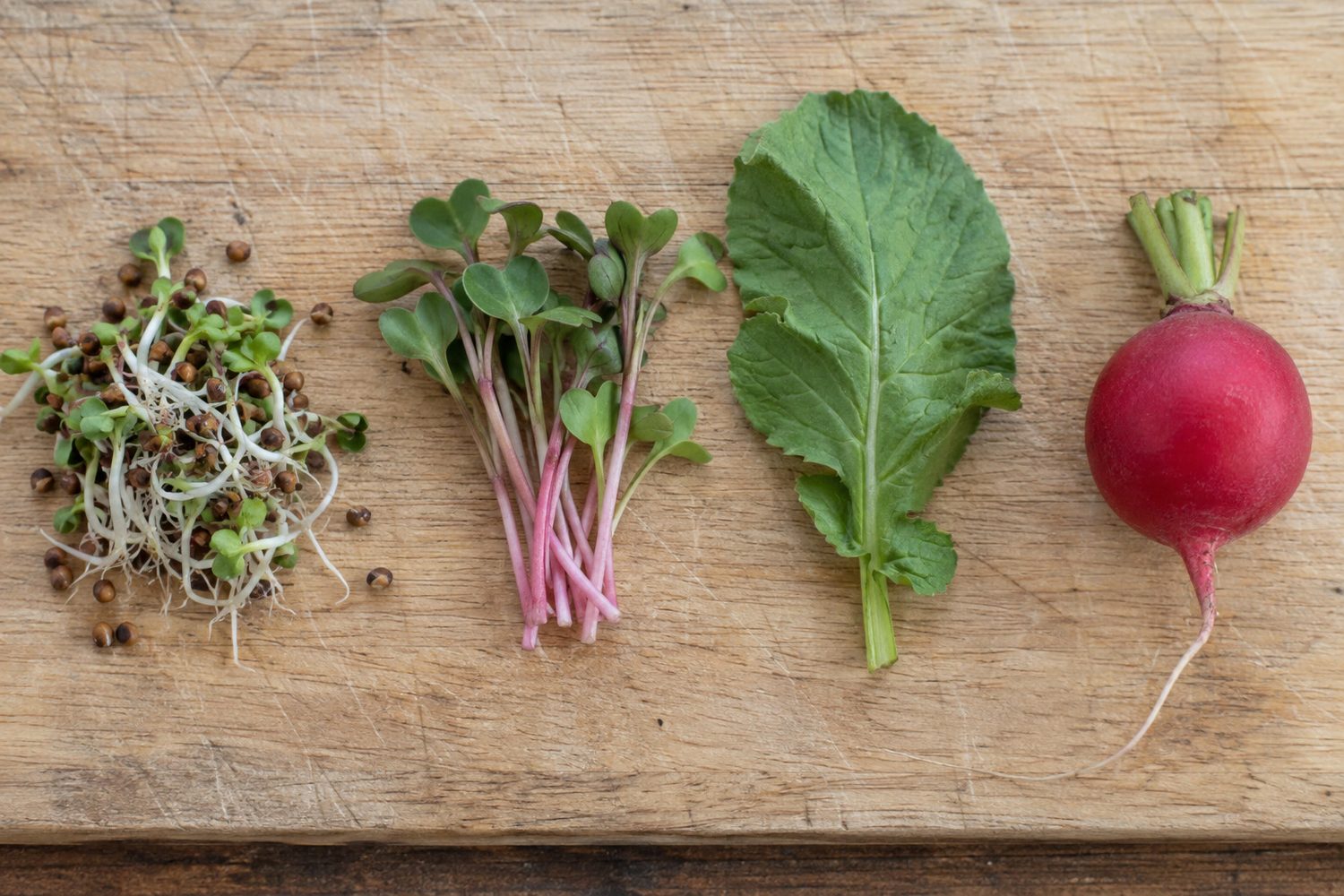
The difference between stages is measurable. In a 2011 study of eight radish varieties, sprouts had 3.8 times the total glucosinolates, 8.2 times the isothiocyanates and 6.9 times the phenolics of their own mature taproots (Hanlon & Barnes, 2011). That compared sprouts with roots, not microgreens with anything, and it was lab chemistry rather than an animal study. It does show why a figure for one stage should never be carried over to another.
What the calcium and phosphorus numbers show
Bearded dragons need more calcium than phosphorus, particularly while young, and an imbalanced diet can lead to low blood calcium and metabolic bone disease (VCA Feeding Bearded Dragons). That is why keepers ask about the calcium to phosphorus ratio of every green.
For radish microgreens, one measured sample exists. Balik and colleagues (2025) reported a black radish microgreen at 93.94 mg calcium and 31.3 mg phosphorus per 100 g fresh weight, which works out to a ratio of about 3 to 1 (Balik et al., 2025). The same sample had 33.37 mg vitamin C per 100 g and 391.75 mg nitrate per kg, both on a fresh weight basis. That is one cultivar under one set of growing conditions, not a number every radish microgreen will match. The paper did not report water, fiber or vitamin A for black radish, so leave those blanks empty rather than filling them with mature radish data.
For mature radish leaves, a 2025 review's food composition table lists 238 mg calcium and 32 mg phosphorus per 100 g, a ratio of about 7.4 to 1 (radish leaf review, 2025). For the mature root, a general animal nutrition handout gives 1.2 to 1, and names 1.5 to 1 up to 2 to 1 as an ideal dietary ratio (calcium and phosphorus handout). That handout is not a reptile study, and no reptile veterinary source gives a single required ratio for bearded dragon greens.
Three stages, three very different results. The spread is the useful part, because it shows that a verdict on the root cannot decide anything about the microgreen. It also does not prove the microgreen is better or worse than the leaf. The two figures come from separate studies and cultivars, not a side-by-side test. Keep in mind, too, that a ratio is simply calcium mass divided by phosphorus mass in one sample. It does not tell you how much of that calcium your dragon absorbs, and neither paper was written as feeding advice.
Oxalates, goitrogens and the cabbage family
Veterinary warnings about oxalates and goitrogens name specific foods. VCA says to feed spinach, Swiss chard and beet greens sparingly because oxalates can prevent calcium and mineral absorption, and to be cautious with cabbage, kale and mustard greens because goitrogens can affect iodine uptake and thyroid function when fed in excess (VCA). UC Davis lists cabbage, chard and kale as occasional foods because of calcium oxalates, and spinach, broccoli and parsley as occasional because of goitrogens (UC Davis).
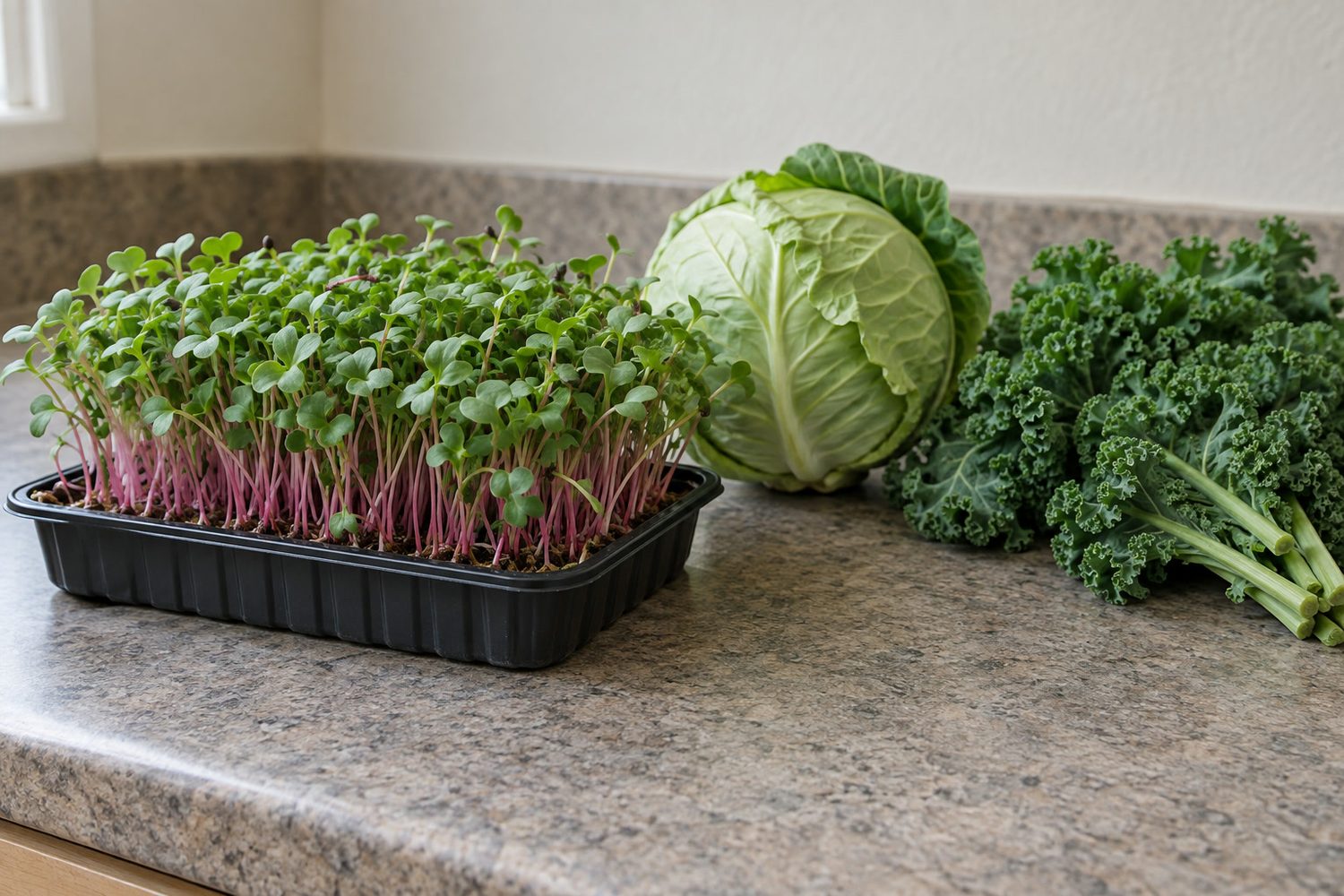
Radish is not on either list. It does belong to the same plant family as cabbage and kale, which is why it tends to come up in these discussions. Family membership is a reason for caution, but it does not answer the radish question on its own, and neither source bans the whole family.
The plant studies add some detail without settling anything. A 2024 study of microgreens grown in soilless media measured Sango radish microgreens at 58.94 mg oxalic acid per 100 g fresh weight, the highest of its seven samples, and noted that the growing medium changes those levels (Gunjal et al., 2024). A study of five radish microgreen cultivars harvested at day 10 reported glucoraphasatin from 14.21 to 31.53 µg/g and glucoraphenin from 1.50 to 16.17 µg/g, on a dry weight basis (radish microgreen glucosinolate study). Dry weight figures cannot be compared with fresh weight figures without moisture data, and the cultivar spread means there is no single glucosinolate level for radish microgreens.
None of these papers studied reptiles, and none established a harmful dose. No bearded dragon veterinary source flags radish nitrate or isothiocyanates specifically. So, the plant chemistry tells you radish microgreens are not a blank slate, and it stops there.
How much and how often
No published source gives grams, bites or a schedule for radish microgreens, for any age of dragon. Do not borrow a number from a mature root recommendation or from a sprout, and do not treat a figure you find online as tested unless it names its study.
What does exist is general whole-diet guidance, and it helps you see how little room a treat occupies. These figures describe the overall diet, not radish:
- UC Davis calls for a varied diet with a daily salad whose great majority is calcium-rich dark greens, other vegetables mixed in, and substantial insects (UC Davis).
- VCA says 80 to 90% of plant material should be leafy greens, that young dragons eat once or twice daily, and that adults eat every 24 to 72 hours (VCA).
- PetMD, in a veterinarian-authored guide published 9 July 2026, gives juveniles about 70% insects and 20 to 30% vegetables, adults about 20 to 30% insects and 70 to 80% vegetables, and fruit at 5% or less (PetMD).
Age changes the margin for error. UC Davis recommends calcium supplementation three times a week for juveniles and weekly for adults, and metabolic bone disease matters more in a growing dragon. If your dragon is young, or already has bone disease, kidney disease, poor appetite or abnormal stools, ask a reptile vet before adding any new food. No source sets a special radish microgreen amount for those animals.
The practical approach, then, is to let your vet approve the introduction, keep radish microgreens out of the daily greens slot, and write down what you offered, on which day, and how your dragon's appetite and stool looked afterward. That record is more useful at a vet visit than any number copied from a forum.
Preparing radish microgreens for a dragon
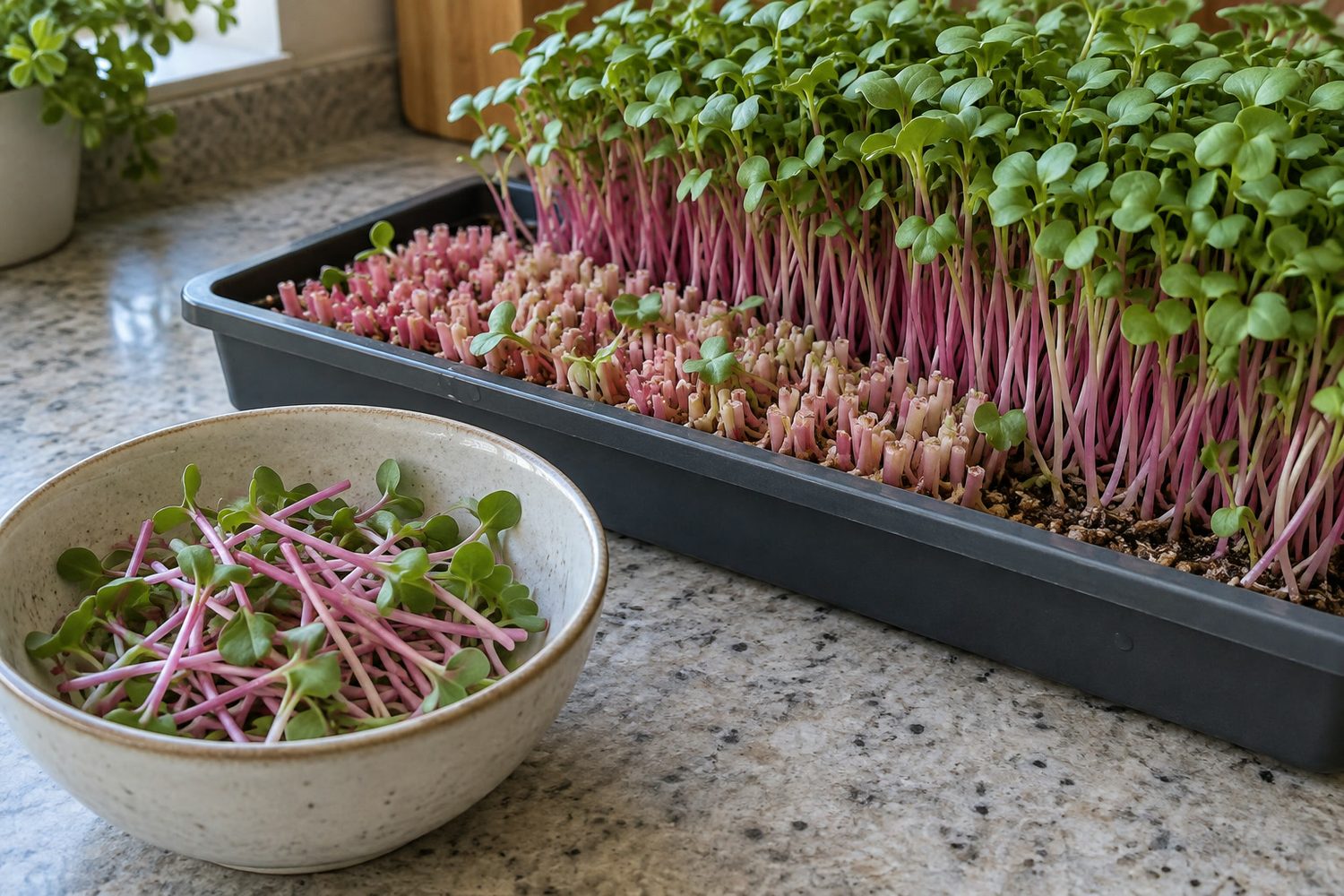
The one handling point with real support behind it is what goes in the dish. Offer clean shoots cut above the growing medium. Do not deliberately feed roots, seed hulls or the medium itself, because no reptile data support any of them.
Seed matters more than anything else here. The National Pesticide Information Center says: "Never consume treated seeds or use them for animal feed" (NPIC treated seed guidance). Treated seed may carry a pesticide coating, and seed coat can stay on young shoots. If you grow your own, buy seed sold untreated for sprouting or microgreens, as Penn State Extension advises (Penn State Growing Microgreens). If you buy a clamshell at the store, you usually cannot confirm the seed history, which is one more reason to keep it occasional.
Wash the shoots under running water with clean hands, and skip soap, detergent and commercial produce wash. FDA advice applies whether the produce is home-grown or bought, and it notes that washing reduces bacteria but does not eliminate them. Throw out anything rotten (FDA produce guidance). Sprouts and microgreens are moist crops, and FDA counted 52 sprout-associated outbreaks and more than 2,700 illnesses in people between 1996 and 2020, with seed a likely source in many of them (FDA seed guidance update). Those are human figures, but they are a good reason not to assume a home tray is sterile.
Do not set a living tray in the enclosure for grazing. No study compares a tray with cut shoots, and a tray adds roots, hulls, wet medium, anything in the watering, and unlimited access.
What to watch after a new food
After you offer anything new, compare your dragon against its normal appetite, activity, stool, weight and hydration. VCA says loose stool can come with gut disease, that profuse diarrhea, foul stool or weight loss need a vet's assessment, and that any change from normal should be evaluated promptly. It also lists loss of appetite, depression and lethargy as general signs of illness (VCA Bearded Dragon Diseases).
A veterinary hospital handout adds a list of reasons to call a reptile vet promptly: reduced growth, poor appetite, depression, swelling of the face or limbs, weight loss, regurgitation, fractures and spasms (Spartan Animal Hospital handout). If your vet suspects metabolic bone disease, VCA says treatment depends on calcium, phosphorus and kidney tests and requires correcting the diet and UVB.
Where radish fits among other greens
The staple greens in veterinary guidance are mature greens. UC Davis names collards, dandelion greens and flowers, escarole, endive, grape leaves, mustard greens, turnip greens and watercress as the great majority of the daily salad. VCA's recommended list includes collards, dandelion, escarole, kale, mustard, turnip greens and watercress. Neither source says the microgreen forms of those plants match the mature greens, and neither names a microgreen as a proven replacement for radish.
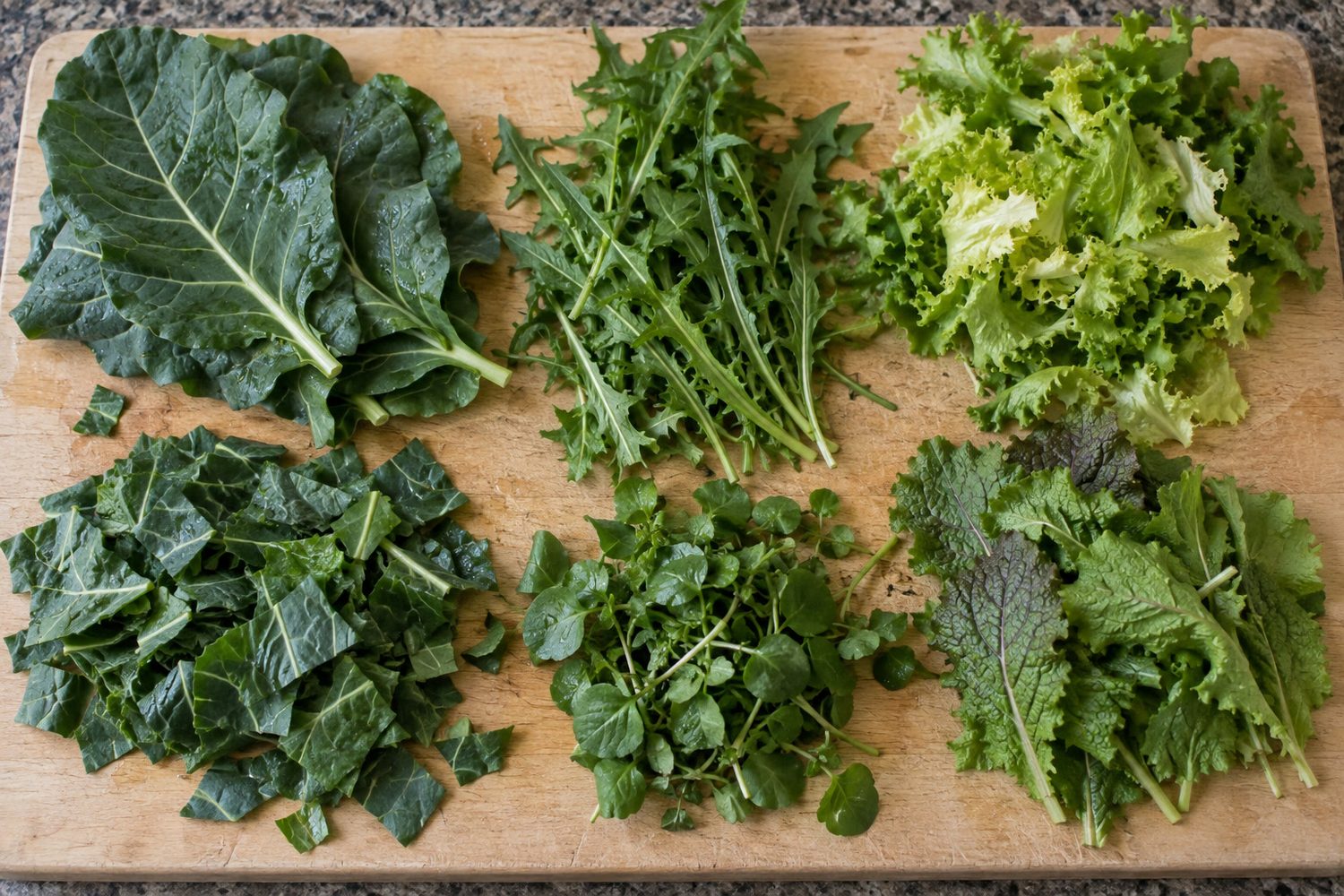
Keepers do report dragons picking radish microgreens out of a mixed salad first. One Reddit keeper wrote in 2019 that their dragon always went for them (Reddit post), with no amount or health outcome given. That tells you dragons like the taste, not what the food does over time.
The short answer for your next salad
UC Davis places radishes and sprouts among low-nutrition foods to feed sparingly as occasional treats, and that is the only veterinary line that names radish for bearded dragons. The nutrient numbers for radish microgreens come from single plant samples, not feeding trials, and there is no published amount or schedule. If your vet agrees to include them, keep them occasional, cut clean shoots from untreated seed, wash them, and watch your dragon's appetite, stool and energy afterward.
How much, how often, and at what age
The sourced structure is about the salad, not about microgreens:
- Adults. NC State's veterinary handout specifies 50 percent dark leafy greens, 20 percent chopped vegetables, 25 percent animal matter and no more than 5 percent fruit, as shares of the food offered. Microgreens would sit inside that first 50 percent, as one component of it.
- Juveniles under four months. Roughly 70 percent insects to 30 percent plant matter. Greens matter far less at this age than insects and calcium do.
- Hatchlings. Offer finely chopped greens, expect very little interest, feed insects two or three times a day.
- Frequency. VCA says adults may eat every 24 to 72 hours; NC State says daily or every other day. Neither converts that into grams.
There is no published gram or teaspoon portion of microgreens per unit of body weight for this species. Which brings us to the two claims worth naming.
Two numbers you will find, and why neither holds
The Hepper page is explicitly vet reviewed and gives a specific allowance: one to two teaspoons, once or twice weekly. It is the most useful-looking number in the category. Its own cited sources contain no P. vitticeps microgreen dose study, so the teaspoon figure is a field claim wearing a vet review. It may well be sensible. It is not evidence, and a reader deserves to know which one they are getting.
Island Microgreens sells a reptile microgreen seed subscription and its product page claims a precise calcium ratio and a role in preventing metabolic bone disease. No feed analysis and no trial is supplied. That is a commercial claim about the exact disease that kills these animals, so treat the ratio on the packet as marketing until a feed analysis turns up.
What overfeeding actually does
Not poisoning. The realistic failure is that greens displace the insects and calcium a growing dragon needs, or that a monotonous salad heavy in oxalate-rich crops quietly reduces mineral absorption. The consequence shows up over months as poor growth, abnormal stool, or MBD, rather than as a bad afternoon.
On mortality, which keepers usually ask about alongside this: a retrospective necropsy series of 36 bearded dragons found inflammatory disease contributing to about 69 percent of deaths and chronic or degenerative disease to about 47 percent, with causes overlapping. VCA lists yellow fungus disease, atadenovirus, MBD, parasites and respiratory infection among the common conditions. Feeding microgreens is not implicated in any of it. Getting calcium wrong over time is.
The supermarket clamshell
The AeroFarms Micro Rainbow Mix sold in some Costco stores is usually described as bok choy, cabbage, arugula, kale, mustard and kohlrabi. That is several brassicas at once, which is precisely the group carrying the goitrogen caution, and the retail listing did not expose a readable ingredient panel. Read the physical clamshell, do not assume two "rainbow" mixes contain the same thing, and do not treat a mix as a single known food because it has one name.
What nobody has established
- Calcium-to-phosphorus ratios for most of these crops at microgreen stage. This is the big one: it is the number that decides everything and for most crops it does not exist.
- Whether oxalate and glucosinolate concentrations at microgreen stage resemble the mature plant for most crops.
- Any allium ruling for reptiles, in either direction.
- A portion size for any microgreen, at any life stage, from any veterinary source.
Nothing here replaces a reptile veterinarian, and a dragon with suspected MBD, kidney disease or an abnormal calcium result needs one rather than a diet change.
Frequently asked questions
These cover the questions that come up once a keeper has a tray or a bag in hand.
Are broccoli sprouts the same thing as broccoli microgreens?
No. A sprout is a germinated seed often eaten with the seed and root attached, while a microgreen is the stems and leaves cut after true leaves form. Plant researchers have compared glucosinolate profiles across broccoli seeds, sprouts, microgreens, and baby leaves (Agronomy, 2021), but no bearded dragon source names broccoli sprouts specifically.
Does broccoli block calcium absorption in bearded dragons?
Neither VCA nor UC Davis describes broccoli that way. VCA's calcium absorption caution is about oxalates in mature Swiss chard, spinach, and beet greens, and UC Davis's broccoli caution is about goitrogens, which act on iodine uptake and the thyroid. A broccoli-specific calcium-binding effect in bearded dragons hasn't been published.
Is broccoli on the ASPCA plant list for reptiles?
The ASPCA hasn't given a verdict either way. Its reptile and amphibian hazards page names fireflies, not broccoli, and advises researching new food sources, while its plant database rates plants only for dogs, cats, and horses. A food that doesn't appear on a list hasn't been cleared for dragons; it simply hasn't been rated.
Does a juvenile dragon change the answer?
VCA says young dragons lean more insectivorous and have a higher calcium need, and UC Davis recommends calcium supplementation three times a week for juveniles versus weekly for adults. Neither source gives an age or size rule for broccoli microgreens, so the general juvenile calcium advice is the part that applies.
Is the calcium ratio in my tray the same as the study lot?
Not necessarily. The 4.04 to 1 figure came from one 2025 broccoli microgreen lot, and published microgreen values vary with growing system, harvest timing, and whether they're reported by fresh or dry weight.
Are radish sprouts the same as radish microgreens?
No. Sprouts are harvested earlier and eaten with the seed and seed leaves attached, while microgreens are cut above the growing medium once the seed leaves have opened. UC Davis mentions sprouts as a low-nutrition occasional treat but does not name a species or address microgreens.
Does black radish give a better calcium ratio than other radishes?
One 2025 black radish microgreen sample came out near 3 to 1, but that is a single cultivar grown under one set of conditions. Treat the figure as one data point, not a rule for choosing seed.
Can I compare the glucosinolate numbers with the calcium numbers?
Not directly. The calcium figures are per 100 g fresh weight, which includes the water in the shoots, while the glucosinolate figures are per gram of dry weight. Without moisture data for the same sample, the two cannot be put on one scale.
What would it take to get a real answer?
A veterinary-supervised feeding study in bearded dragons, using a named radish cultivar, known seed treatment and harvest day, and both juvenile and adult groups with proper UVB and calcium care. It would need to track intake, body weight, stool, blood calcium and phosphorus, thyroid measures and bone density against a group fed recommended mature greens. No such study has been published.
The four verdicts on this page, and what each one is telling you
Hover or tap a card to highlight it.
Safe
A veterinary, extension or ASPCA source says so for this species. No crop on this page reaches it.
Caution
Safe in a stated quantity, or except in a named circumstance, with the limit given.
Unsafe
Such a source says avoid, and the mechanism is known. Nothing here qualifies, including the alliums, because the reptile evidence does not exist in either direction.
Not established
Nobody credible has looked. That covers all fourteen crops in the table above, and it is different from both safe and unsafe.
The terms on this page, in plain words
Tap a term to see what it means.
Metabolic bone disease (MBD). The preventable, diet-driven condition that deforms and weakens a dragon's skeleton when it cannot get enough usable calcium. The thing this whole page is arranged around.
Sources
- Merck Veterinary Manual, nutrition in reptiles - the 1:1 minimum and 2:1 preferred calcium to phosphorus ratio.
- VCA, bearded dragon feeding - the oxalate and goitrogen cautions, the recommended mature greens, and adult feeding frequency.
- VCA, bearded dragon diseases - metabolic bone disease and the common conditions.
- NC State Veterinary Hospital - the 50/20/25/5 adult diet split.
- UC Davis School of Veterinary Medicine - the goitrogen and oxalate flags that disagree with VCA on broccoli and kale.
- Unusual Pet Vets care sheet - the 70/30 juvenile split and hatchling feeding.
- ASPCA, garlic - N-propyl disulfide, named for dogs, cats and horses and not for reptiles.
- Crouch et al., 2021, retrospective necropsy series - causes of death across 36 bearded dragons.
- Hepper - the vet-reviewed page whose teaspoon allowance this page disputes.
- Island Microgreens - the reptile seed subscription making an unsupported calcium and MBD claim.
- AeroFarms - the retail mix sold at Costco.
- VCA
- UConn Extension
- USDA ARS, 2017
- Balik et al., 2025
- USDA FoodData Central
- Foods, 2022
- 2024 study
- Penn State Extension
- EPA
- FDA
- VCA Urgent Care
- ASPCA
- Agronomy, 2021
- Hanlon & Barnes, 2011
- Balik et al., 2025
- radish leaf review, 2025
- calcium and phosphorus handout
- radish microgreen glucosinolate study
- PetMD
- NPIC treated seed guidance
- FDA seed guidance update
- VCA Bearded Dragon Diseases
- Spartan Animal Hospital handout
- Reddit post
Keep reading
Animals and microgreens
Can Tortoises and Turtles Eat Microgreens?
A sulcata and a box turtle cannot share an answer: one is a fiber-fermenting grazer, the other is half carnivore. And a microgreen is close to the opposite of what a grazing tortoise is built for.
Read Can Tortoises and Turtles Eat Microgreens?Animals and microgreens
Can You Gut-Load Feeder Insects With Microgreens?
You can feed them to insects. You cannot deliver calcium that way, and calcium is the entire reason gut-loading exists. A cricket needs a 13-fold ratio change, and the best published gut-load managed three to four.
Read Can You Gut-Load Feeder Insects With Microgreens?Animals and microgreens
Can Alpacas and Llamas Eat Microgreens?
It would take 50 to 90 trays to supply one alpaca's dry matter for a single day, and up to 250 for a llama. That settles the feed question, and leaves identity and suddenness as the only real risks.
Read Can Alpacas and Llamas Eat Microgreens?Animals and microgreens
Can Cats Eat Microgreens?
Some yes, four unsafe. Parsley is ASPCA-listed toxic to cats and the alliums have a published feline dose, while greens are enrichment for a cat rather than nutrition.
Read Can Cats Eat Microgreens?