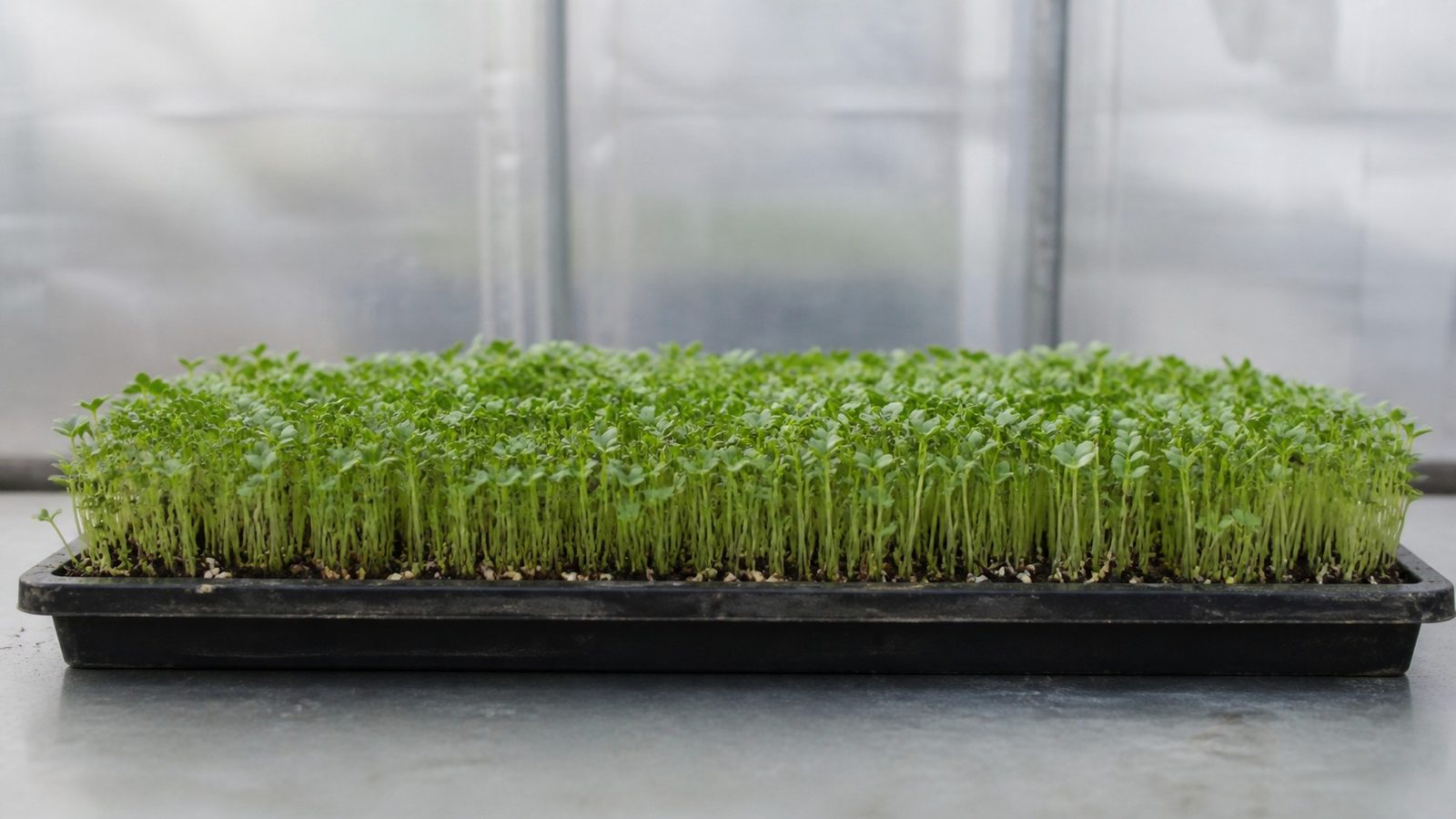
At a glance
Mucilage. Wet chia gels within seconds and the gel locks every seed exactly where it landed, so an uneven sow cannot be corrected and a wet surface becomes an airless layer you cannot rake apart.
- Botanical name
- Salvia hispanica
- Also sold as
- Chia Micro-Greens, White Chia Sprouting Seed, Black Chia Microgreens Seed
- Family
- mint
- Difficulty
- Moderate
- Days to harvest
- 6 to 12 days
- Harvest window
- No published figure
- Seed per 1020 tray
- 26.3 to 28.35 g
- Soak
- None
- Blackout
- 2 to 4 days
- Germination temperature
- No published figure
- Yield per 1020 tray
- No published figure
- Regrows after cutting
- No published figure
- Mold risk
- High
- Hull shedding
- some
- Shelf life
- 3 to 5 days
- Eaten as
- raw
- Seed cost per tray
- $0.78
1 oz at $12.48/lb, True Leaf organic white chia, listed 2026-08-08. Cheap seed by the pound, and a high rate per tray, so the tray cost lands higher than the price suggests. Seed only, excludes medium, tray, labor, light and loss.
Any field name above ranks every variety by it. No published figure means we researched it and nobody has established one, which is different from not yet researched. Every figure here is sourced at the bottom of the page. Compare every variety side by side.
Chia microgreens are a small, bitter, minty garnish that grows in about a week, and it is worth knowing that before you sow, because most people arrive at this crop wanting something else.
Chia seed is famous for omega-3 fat and fiber, and it earns that: the mature seed is roughly 30 to 33 percent fat. The microgreen is a seedling that has spent most of that fat germinating. The one composition study on chia microgreen material reports about 6.9 percent fat in a dried powder, a different material on a different basis, and there is no USDA record for the fresh microgreen at all. If you want what chia seed is known for, eat the seed. If you want a small bitter minty garnish, grow the tray. They are not substitutes and nothing published suggests otherwise.
What the tray does offer is a genuinely unusual crop: a mint-family seed that gels on contact with water, anchors itself, needs no weight at all, and will grow on a cotton pad on a plate.
What growers are saying right now
Sampled from public posts and videos, 9 July to 8 August 2026. Every line links what it is quoting. How often something is repeated is not evidence that it is true, so every line also says what the sources actually establish.
Chia microgreens are packed with calcium, protein and antioxidants
Circulating A grower's tray post at 86 likes, in a month where chia content overall drew more than 10 million views
Not established for the fresh microgreen. There is no USDA record for it, and the only composition numbers that exist are for a DRIED POWDER used as a noodle ingredient, which reported 34.7 percent protein on a dried basis. Dried powder and a fresh cut tray are not the same food. What is actually measured
Chia seeds: omega-3 fats, fiber, more calcium than people expect
Circulating The standard pitch, which this account states carefully, adding that chia is not a cure or treatment
All about the SEED, and this is the single most important thing to understand before growing the tray. The mature seed is roughly 30 to 33 percent fat. The one study on microgreen material puts it near 6.9 percent in dried powder. Growing the microgreen does not deliver what the seed is famous for. Why the microgreen is a different food
I used to avoid chia because it made me feel so bloated, until I started soaking it first
Circulating The most engaged chia item of the window at 115,209 views and 2,692 likes, describing a weekly batch of pre-soaked seed
About eating the seed, not the tray, and worth separating cleanly. A cut microgreen is a seedling, not a spoonful of gelling seed, so the digestive question that drives this conversation does not carry over to it.
Grab a plate, some cotton pads and a few chia seeds, and by day 7 you are cutting microgreens for breakfast
Circulating A grower walking through the method, plate and cotton pads and nothing else
This one is real, and chia is one of the few crops where it works. The mucilage glues the seed to the pad and holds it there, which is exactly the job a medium and a weight do for everything else. Why chia needs no weight
Soaking chia in water and soaking it in milk give completely different benefits
Circulating 170,144 views and 4,298 likes
Nothing opened for this page speaks to it, and nothing here should. It is a claim about a soaked seed drink rather than about a microgreen, so nothing on this page can confirm or deny it.
What it is, and how to tell you grew it right
Chia microgreens are seedlings of Salvia hispanica, a mint-family plant, cut roughly a week after sowing. White and black chia are color forms of the same species and one supplier states plainly that the difference is not meaningful beyond appearance.
A correct tray is a dense, low, even green carpet: slender pale to light green stems topped by pairs of very small oval to rounded cotyledons. It should read fine-textured and flat rather than tall or leafy. On black-seeded lots you will see small dark hulls sitting among the green at the medium line, which is normal and cosmetic rather than a fault.
Nobody publishes an average harvest height for chia, so do not expect a ruler figure. Judge it on evenness and on catching it before the true leaves push through.
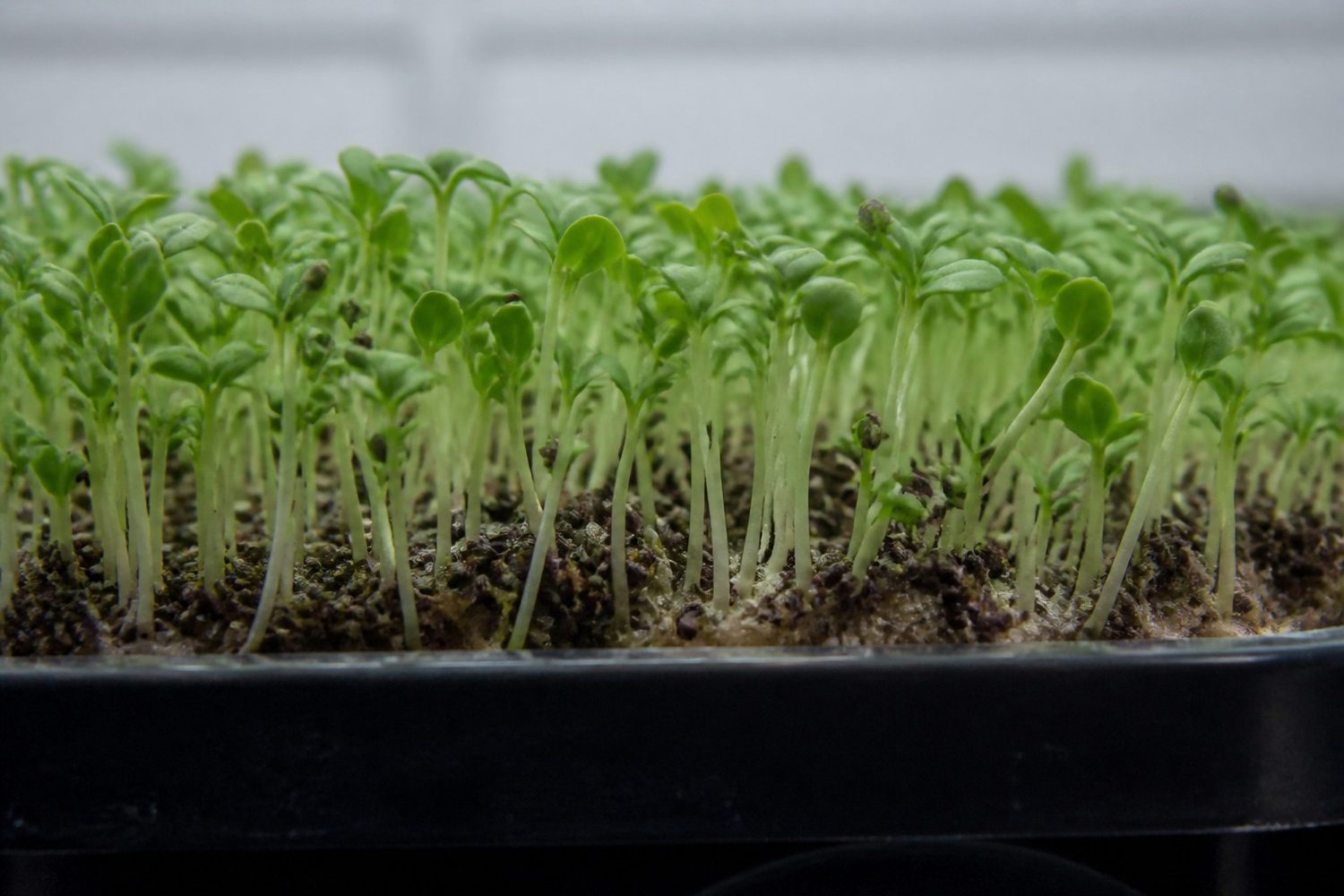
The confusion is with flax or cress at a glance, and both are also mucilaginous, which makes the gel useless as a tell. What separates them is leaf shape: chia has paired small broad cotyledons, while flax's are noticeably narrower and more linear. No validated side-by-side key exists, so check the bag if it matters.
What it tastes like, and what to do with it
Minty and herbal with a real bitter, almost spicy edge. This is not a neutral green and nobody should sell it as one. The bitterness is the defining characteristic, it is a mint-family flavor, and it gets stronger if you cut late.
That makes it an accent, in small amounts, on something with fat or sweetness to soften it. Avocado toast, cream cheese and crackers, a cold soup, or blended into a fruit smoothie where the bitterness disappears into the mix. The two growers demonstrating the plate method both landed on the same uses, eggs and avocado toast and bowls, which is about right.
It is the wrong crop as a salad base and the wrong crop next to another bitter or sharp green, where the bitterness stacks and the soft low-volume texture contributes nothing. And it has a real dissenting audience: anyone expecting the mild neutral green that "microgreens" implies will find this one aggressive. That is a flavor judgment from the crop guidance rather than a tasting panel, but it is consistent across sources.
Growing it: only what differs from the standard method
Everything general about trays, medium, light and watering is on the standard tray method for growing microgreens. Chia's deltas all come from one property, and it is worth understanding rather than memorizing.
Mucilage is the whole crop. Chia seed coats gel within seconds of getting wet. That gel does three things: it glues the seed to whatever it is touching, it fixes the seed's position permanently, and it holds water at the surface. Every instruction below follows from that.
Sow dry. Do not soak, ever, and this is stronger than the usual "no soak" note. On most crops a soak is unnecessary. On chia it is actively harmful, because hydrated seed becomes a single gelled mass that cannot be spread evenly at all. There is one controlled experiment that did soak chia and reported 96 to 98 percent germination, with its best result from water started at 70 to 80C and left to cool for 12 hours. That is a seed-preparation study in a small basket, not permission to soak a 1020, and treating it as tray practice would ruin the tray.
Level and fully moisten the medium FIRST, then spread dry seed in one even layer, then mist finely. The order matters more here than anywhere else on this site. Once the gel sets, the distribution you have is the distribution you keep, and there is no raking it out. Then do not move the tray.
Use no weight at all. Chia is the rare crop where the correct amount of weight is zero. The gel is the crop's own anchoring mechanism, so pressure adds nothing and actively compacts the surface into an air-poor layer. Two to four days of blackout with germination at two to three days, cover off when shoots are visibly pushing up.
Less free water than a brassica tray, not more. Mist rather than pour, and bottom water once it has rooted, because a forceful top stream washes gelled seed and medium onto the crop. Nobody publishes a chia irrigation volume, light level or airflow rate, so the direction is established and the numbers are not.
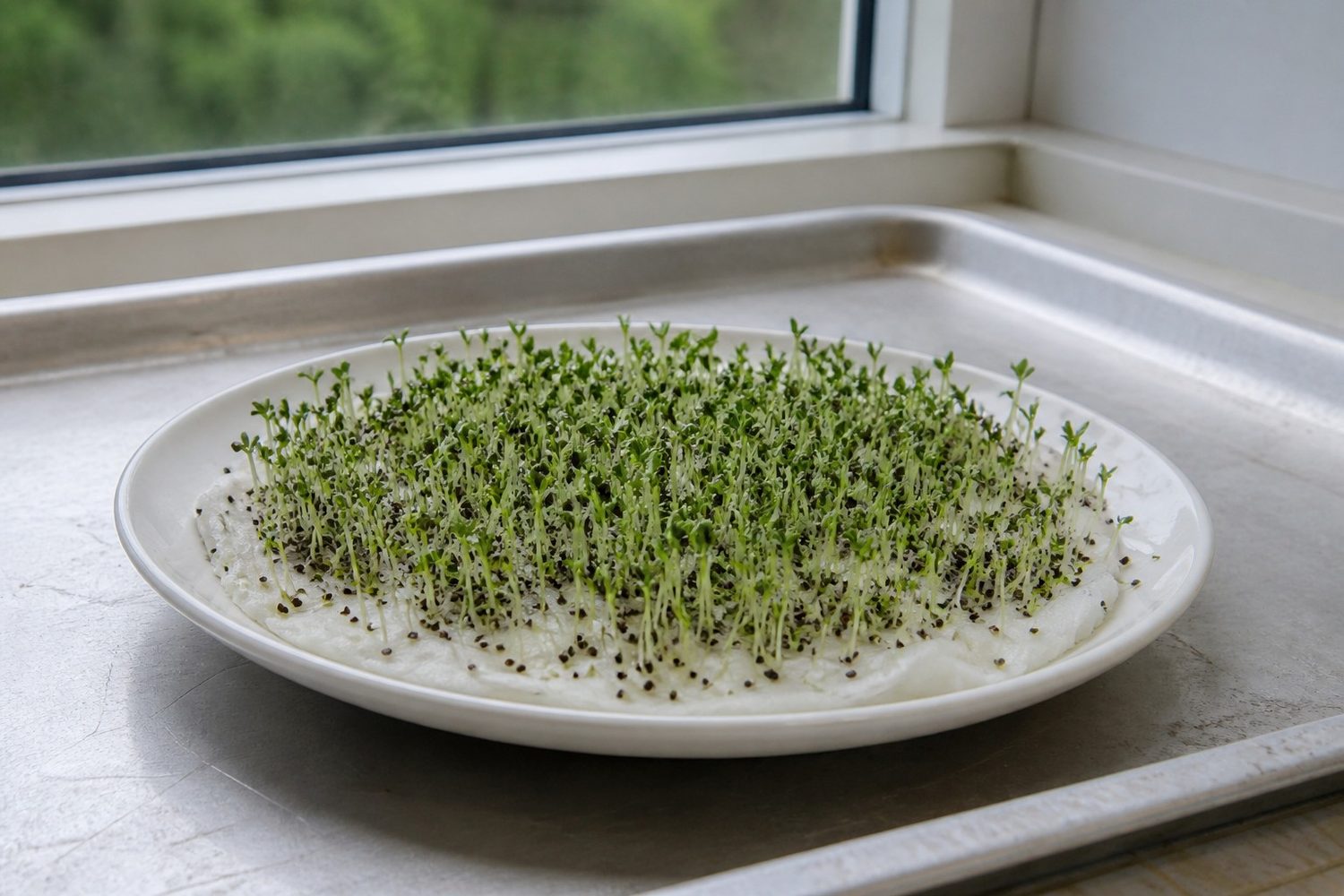
And the plate method is legitimate, for a kitchen. Cotton pads on a plate, soaked, dry seed scattered on top, cutting in about a week. It works precisely because of the mucilage: the gel does the job that medium and weight do for every other crop. It will not scale and it is not how you would run a bench, but if somebody wants a week of chia microgreens on a windowsill, that is a real method rather than a gimmick.
A chia tray, day by day
- 1
Day 0, moisten then sow dry
Level and fully wet the medium first. Scatter about 26 to 28 g of dry seed in one even layer. Mist finely. Then leave it alone: the gel sets and the layout is final.
- 2
Days 1 to 3, covered, no weight
Germination is fast, 2 to 3 days. The cover is for darkness and humidity only. Adding weight here compacts a surface that is already holding water.
- 3
Days 2 to 4, uncover
Off when shoots are visibly lifting. Do not run a fixed weighted-stack count on this crop, because there is no weight to remove.
- 4
Days 4 onward, light and restraint
Bottom water or mist. The failure from here is a wet, close-packed gel layer with no air moving through it.
- 5
Days 6 to 12, cut
Sources give 6 to 10, 8 to 12 and 10 to 12 days, and a controlled experiment peaked at day 6. Cut at cotyledons. Past about day 13 one guide calls it overripe, and the bitterness is the thing that changes.
What goes wrong with chia specifically
Five failures, and the first three are all mucilage.
At sowing, clumps and blank patches. Uneven dry distribution, or a coarse water stream that moves seed before it sets. The early sign is piles, and the window to fix it closes in seconds once the gel forms. After that, redistribution is not possible.
At germination, a stagnant wet layer. Too much moisture, seed buried too deep, or any weight applied. The sign is little emergence under a surface that stays glossy wet. Soft seedlings or a rotten smell means the tray is finished.
At the seedling stage, damping-off and mold. An overcrowded, wet, poorly ventilated gel layer is close to an ideal culture. Watch for base rot, spreading fuzzy growth, collapse, or a sour smell. Isolate a small early patch; discard a spreading one. The mold risk on this crop is structural rather than measured: the gel keeps a wet surface around every seed, a trait chia shares with other mucilaginous seed such as flax, basil and cress.
In light, stretching and weak stems. Not enough light or airflow, showing as a pale leaning canopy. Recoverable if you correct it before cutting, at some cost to quality.
At the end, bitterness. Cut late and the crop coarsens and the bitter note sharpens. The visible warning is true leaves developing beyond the first hint. It is still edible if sound; it is no longer the delicate accent you grew it for.
Gel, root hairs, or mold? Chia has all three
Hover or tap a card to highlight it.
The gel
Clear to translucent, sitting on and around the seed itself, present from the first hour. This is mucilage, it is supposed to be there, and it is what new chia growers throw trays out over.
Root hairs
Fine, white, localized on individual roots, and they collapse and nearly vanish when you mist them, reappearing as things dry.
Mold
Spreads between plants as an aerial web across seed, stems and medium, persists after misting, and usually arrives with a sour or rotten smell and soft collapsing stems.
The order to check
Is it clear and on the seed? Gel. Does it vanish when misted? Root hairs. Does it bridge between plants and smell wrong? Discard the tray.
Where it stops
A grower's diagnostic, not an identification. Only a lab names an organism, so on a food crop let doubt resolve toward discarding.
Nutrition, and what is actually established
Read this part before you plant, because the gap between what people believe about chia and what anybody has measured is unusually wide.
There is no USDA record for chia microgreens. FoodData Central was searched on 2026-08-08 and no entry was found, so there is no identifier, no nutrient panel, and no calorie, omega-3, calcium or iron figure that can honestly be published for the fresh microgreen.
What exists is two studies, neither of which is a food label. A 2019 controlled experiment measured germination, height and fresh weight per 100 microgreens under different soaking, medium, density and harvest treatments. A 2025 food-science paper analyzed dried chia microgreen POWDER as an ingredient in wheat noodles, reporting 34.7 percent protein, 13.63 milligrams gallic acid equivalents per gram of total phenolics, and useful levels of calcium, phosphorus, zinc and iron.
And here is the number that matters. That same 2025 study reports roughly 6.9 percent fat for its dried chia microgreen powder. Mature chia seed is around 30 to 33 percent fat, which is where its omega-3 reputation comes from. Those are different materials measured on different bases and the comparison is not exact, but the direction is unambiguous and it is the opposite of what most people assume: germinating the seed does not concentrate its fat, it consumes it.
So, plainly, for anybody deciding what to do:
- If you want chia's omega-3 fat and fiber, eat the seed. That is what has actually been measured and that is what the reputation belongs to.
- If you want a bitter minty green garnish, grow the microgreen, and enjoy it for that.
- Do not grow the tray as a way of getting the seed's benefits in leaf form. Nothing published supports that, and the one relevant measurement points the other way.
- What is genuinely unknown is the fresh microgreen's composition, because nobody has published it. Anyone giving you an omega-3 figure per 100 g of fresh chia microgreens is quoting the seed, the dried powder, or nothing at all.
Which seed to buy
There are no cultivars to choose between. Suppliers sell white chia and black chia, and one states directly that the difference is color rather than nutrition or flavor. No named cultivar with documented differences in stem length, tenderness, days or yield exists anywhere, so buy on price, freshness and labeling.
Chia microgreens seed on Amazon works for a home grower, with one caveat specific to this crop. Checked on 2026-08-08, that search returns real sprouting and microgreen listings, and it also returns a great deal of grocery chia sold for pudding and smoothies. Food chia is not necessarily bad seed, but it carries no germination test and no sprouting-use labeling, and a bag that has sat damp is already partway into its mucilage problem before you open it. Look for the words sprouting or microgreens on the pack.
Specify Salvia hispanica, seed intended for edible sprouting or microgreen use, untreated, with a current germination test and lot date if you can get them. Refuse treated field seed or seed whose treatment status is undisclosed, because this is cut and eaten within a fortnight.
A bad lot here shows as damaged or defective seed, uneven and delayed emergence, or blank patches, and sometimes it arrives already damp and clumped, which is a bad sign you can see before sowing. The trap is that you cannot fix a thin chia stand by oversowing next time without raising the mold risk, so a weak lot costs you the tray rather than just some seed.
Is it worth growing?
For a home grower who wants something distinctive and quick, yes. For a market grower selling by weight, no, and the reason is not the plant.
It is genuinely fast, genuinely unusual, and the plate method makes it about the lowest-barrier crop there is: no medium, no weight, no equipment, a week. If you want to grow something on a windowsill and eat it, chia is a good answer.
It is a poor commercial crop because there is no verified yield per tray at all. Not a weak yield, not a contested yield, none. You cannot price a crop you cannot weigh in advance, and the 3 to 5 day shelf life, among the shortest of any microgreen and beaten only by garden cress at 2 to 3 days, means you are selling into a very narrow window even when it works. Add a bitter flavor that genuinely divides people and you have a crop to trial in a small way before committing bench to it.
Its tray-slot rivals are cress, flax and basil, the other small aromatic and mucilaginous crops. Any of them wins when the buyer wants a neutral base, a predictable cut yield, or a more forgiving watering routine. Chia wins when its specific bitter minty accent is a deliberate menu choice, or when the point is a fast fresh thing on a kitchen counter.
A note on the numbers above
Hover or tap a row to highlight it.
| Figure | Value | Source | What kind of number it is |
|---|---|---|---|
| Days to harvest | 6 to 10 | True Leaf | Supplier range, no temperature or harvest stage |
| Days to harvest | 8 to 12 | True Leaf wholesale | Supplier range, no temperature or harvest stage |
| Days to harvest | 10 to 12 | Cool Beans and Sprouts | Harvest when the shoots fall over |
| Days to harvest | Peak at day 6 | 2019 controlled experiment | Measured, in a 20x27 cm basket on coir, sand and rice husk |
| Seed per 1020 | 1 oz (28.35 g) | True Leaf wholesale | Supplier rate for a nominal 10x20 |
| Seed per 1020 | 26.3 g | Scaled from 204 g/m2 | The 2019 experiment's best density, converted |
| Yield per 1020 | No figure | Nobody | Chia is not in the 29-variety trial and nobody has weighed a tray |
| Yield, nearest measurement | 1.83 g per 100 microgreens | 2019 experiment, day 7 at 204 g/m2 | Real, and not convertible without an emerged-plant count |
| Soak | None, and soaking is harmful | Crop guidance | The seed gels into a mass that cannot be spread |
| Soak, contrary result | 96 to 98 percent germination | 2019 experiment | Seed prep in a basket, best at 70 to 80C cooling 12 h. NOT tray practice |
| Weight | None | Crop guidance | A genuine zero. The mucilage does the anchoring |
| Germination temperature | No figure | Nobody | No chia-specific range or boundary has been established |
| Shelf life | 3 to 5 days at 4 to 6C | Crop grow card | Sealed, damp towel off the leaves, do not wash until serving |
| Harvest window | No figure | Nobody | The guidance calls cut chia capricious and says cut before use |
| Seed price | $12.48/lb | True Leaf, listed 2026-08-08 | A real current price |
| Protein, dried powder | 34.7 percent | 2025 food-science paper | DRIED POWDER as a noodle ingredient, not fresh microgreens |
| Fat, dried powder | About 6.9 percent | Same paper | Against roughly 30 to 33 percent in mature chia SEED |
| Nutrition, USDA | No record | USDA FoodData Central | Searched 2026-08-08 |
Four fields say "no published figure," and germination temperature is the surprising one. Most crops here inherit a temperature band from a supplier's general microgreen boilerplate. Chia's suppliers do not publish one at all, and no experiment establishes a range or what happens outside it. So, you are setting the room by feel on this one, which is a fair summary of how thinly the crop is documented despite being one of the most talked-about seeds in the world.
Chia cannot complete the comparison table below, because nobody has weighed a tray.
Hover or tap a row to highlight it.
| Crop | Seed per 1020 | Yield | Days | Cost per tray | Oz per $1 | Oz per tray-day |
|---|---|---|---|---|---|---|
| Basil | 5 to 6.5 g | 5.5 to 7.5 oz | 12 to 26 | $0.83 | 7.8 | 0.34 |
| Thyme | 31 g, area-converted | 3.3 oz, area-converted | 20 to 35 | no price to multiply | cannot be calculated | 0.15 at 21.3 days |
| Chia | 26.3 to 28.35 g | No published figure | 6 to 12 | $0.78 | cannot be calculated | cannot be calculated |
| Mint | No published figure | No published figure | 10 to 18 | no rate to price | cannot be calculated | cannot be calculated |
| Oregano | No published figure | No published figure | 16 to 25 | no rate to price | cannot be calculated | cannot be calculated |
A blank means nobody has published that figure, so the cell is left empty rather than filled with an estimate. How the numbers work
All 62 crops, sortable, on the microgreen comparison.
Chia has the most complete inputs of any crop that cannot finish this table: a real seed rate agreed by two methods, a real day range, a real price. What it does not have is a single weighed tray, and one weighed tray is all it would take. On current evidence chia would probably land near the bottom, since a 6 to 12 day crop of small soft seedlings is not a heavy one, but "probably" is not a number and this directory does not publish those.
Seed price per pound continues to predict nothing. Chia is $12.48 a pound, the cheapest seed on the site by a distance, and at 28 g a tray it costs $0.78 a tray, about the same as broccoli at $0.79 a tray from seed at $27.60 a pound, more than twice chia's price. That now holds across fourteen crops: what decides cost per tray is the rate, never the price on the bag.
Terms on this page
Tap a term to see what it means.
Mucilage. The gel a chia seed forms within seconds of getting wet. It anchors the seed, fixes its position permanently, and holds water at the surface. Everything unusual about growing chia follows from it.
Sources
- True Leaf Market, organic white chia sprouting seed - Salvia hispanica, 6 to 10 days, the statement that white and black chia differ in color rather than nutrition or culinary use, and the $12.48/lb price behind the seed cost, listed 2026-08-08.
- True Leaf Market wholesale, organic chia seeds - 8 to 12 days, 1 oz per nominal 10x20 tray, mucilage on wetting, 2 to 4 days blackout with germination at 2 to 3 days, and the damp but not soggy instruction.
- SeedsNow, black chia for microgreens - black chia sold for sprouts and microgreens, and the product photography showing retained dark hulls among the green shoots.
- Sproutpeople, chia micro-greens - dry surface sowing with fine misting, and hull shedding used as the cue for moving to light.
- Cool Beans and Sprouts, chia seeds for sprouting and microgreens - 10 to 12 days, harvest when the shoots fall over.
- UA Organic, chia microgreens grow card - the mucilage handling problem and why an uneven sow cannot be corrected, the minty-herbal bitter and spicy flavor and its sharpening with age, 3 to 5 days at 4 to 6C sealed with a damp towel off the leaves, do not wash until serving, cut chia described as capricious, day 13 and beyond called overripe, and the raw garnish and smoothie uses.
- Junpatiw and Sangpituk, 2019, chia microgreen production experiment (PDF) - densities from 56 to 204 g/m2 with the highest fresh weight at 204, harvests at 5 to 9 days with the peak at day 6, 1.83 g fresh weight per 100 microgreens, soaking treatments giving 96 to 98 percent germination with the best at 70 to 80C cooling for 12 hours, and the warning that excessive density reduces air circulation and favors fungal disease.
- Food and Bioprocess Technology, 2025, chia microgreen powder in wheat noodles - dried chia microgreen powder at 34.7 percent protein, about 6.9 percent fat, 13.63 mg gallic acid equivalents per gram of total phenolics, and calcium, phosphorus, zinc and iron levels.
- Johnny's microgreens yield trial results (PDF) - the 29-variety chart that contains no chia line.
- Johnny's yield trial, method and discussion - harvest at first true leaf, and the warning that yields vary with procedure, system, conditions, harvest stage and seed lot.
- UC IPM, damping-off - Pythium beginning at root tips, Rhizoctonia and Pythium favored by moisture and temperature combinations.
- Virginia Tech Extension SPES-756 (PDF) - general damping-off and mildew risk in moist microgreen systems.
- SDSU Extension, growing microgreens at home - bottom watering practice and seed treatment cautions for a crop that is cut and eaten.
- USDA FoodData Central - searched for "chia microgreens" on 2026-08-08, no microgreen record located.
Keep reading
The variety directory
Mint microgreens
Mint must not be blacked out, and its seed costs $1,394.50 a pound. The one published seed rate would put 154,000 seeds in a 1020 tray, ten times the densest sowing anyone has measured.
Read Mint microgreensThe variety directory
Oregano microgreens
Concentrated resinous oregano as a fresh garnish, on a sixteen to twenty-five day tray. The seed is expensive and no sowing rate is published, so weigh a test patch before you scale.
Read Oregano microgreensThe variety directory
Basil microgreens
Basil is the slow one: 19 to 25.5 days to first true leaf against a brassica's twelve, on 6.5 g of seed, and the purple cultivars cost you another week. Three cultivars, three sets of measured numbers.
Read Basil microgreensThe variety directory
Dill microgreens
Two suppliers disagree by ten days on when to cut it, and an indoor grower with no stake in the argument settles it. Plus why dill's yield figure should be read alongside chervil's.
Read Dill microgreens