At a glance
Germination is fast and the crop is otherwise undemanding, but the seed coat turns to gel the moment it is wet, so the single decision that makes or breaks the tray is refusing to soak it and keeping surface water off.
- Botanical name
- Linum usitatissimum
- Also sold as
- Flax micro-greens, Brown and/or golden flax, Flaxseed, Linseed
- Family
- flax
- Difficulty
- Moderate
- Days to harvest
- 5 to 14 days
- Harvest window
- No published figure
- Soak
- None
- Blackout
- 3 to 5 days
- Germination temperature
- 61 to 77 °F
- Yield per 1020 tray
- 5 to 7 oz
- Regrows after cutting
- No published figure
- Mold risk
- High
- Hull shedding
- some
- Shelf life
- 7 to 9 days
- Eaten as
- raw
- Seed cost per tray
- $0.67
35 g (1.23 oz) at $8.68/lb, Sproutpeople certified-organic flax micro-greens seed, listed 2026-08-08. Seed only, excludes medium, tray, labor, light and loss.
Any field name above ranks every variety by it. No published figure means we researched it and nobody has established one, which is different from not yet researched. Every figure here is sourced at the bottom of the page. Compare every variety side by side.
Flax is one of two mucilaginous seeds you are likely to grow, chia being the other, and the two share the same trap: almost everything written about them is about the seed, and the seed is not what you are growing.
On flax, somebody ran the comparison directly. Puccinelli and colleagues grew flax as both sprouts and microgreens under controlled light and measured both, and the answer is genuinely two-sided: the microgreens came out higher in chlorophyll, carotenoids, phenols and antioxidant capacity, and lower in dry matter. More pigment and more antioxidant per gram, less substance per gram.
That is about as direct an answer as the question gets, and it is not a ranking. Whether the microgreen beats the seed depends entirely on which compound you were asking about.
What growers are saying right now
Sampled from public posts and videos, 10 July to 9 August 2026. Every line links what it is quoting. How often something is repeated is not evidence that it is true, so every line also says what the sources actually establish.
Flaxseed is the richest plant source of omega-3, with lignans that gently modulate estrogen, and 14 days of it changes your hormones, gut and skin
Circulating Said here in a daily-habit video, and this framing is essentially the entire flax conversation online
Every word of it is about the mature SEED, and this page is about a seedling cut eight days after sowing. Chia is the worked example of why that distinction is not pedantry: chia seed runs about 30 to 33 percent fat and the one measurement on chia microgreen material puts it near 6.9 percent, because germination spends the seed's oil rather than concentrating it. No source establishes the omega-3, protein or lignan content of flax microgreens, and the supplier claims of 20 to 25 percent protein and seed-level omega-3 have no measured flax-microgreen dataset behind them. If you want the seed's omega-3, eat the seed. What is actually established
Flax is a beautiful plant, and it is where linen comes from
Circulating A seed grower's field video at 3,991 views and 342 likes, on brown-seeded flax standing in flower
Correct, and worth knowing before you buy seed, because Linum usitatissimum is grown for three different products by three different industries: fiber for linen, oil for linseed, and food. That is why the seed shelf is stocked mostly by people who never intend it to germinate. Which seed to buy
Search for a flax tray and you will not find one
Circulating A month across four platforms turns up no grow-along, no harvest shot and no failure post for this crop, and the third-ranked result is a ten-year-old video about hemp seeds
Expect to work without a community on this one. Flax has a large audience for its seed and effectively none for its microgreen, the same way fennel and endive do.
What it is, and how to tell you grew it right
Flax microgreens are seedlings of Linum usitatissimum, cultivated flax, in the Linaceae family. That family matters mostly for what it rules out: flax is not a brassica, and it does not get a brassica's peppery character by association. What it has instead is mucilage.
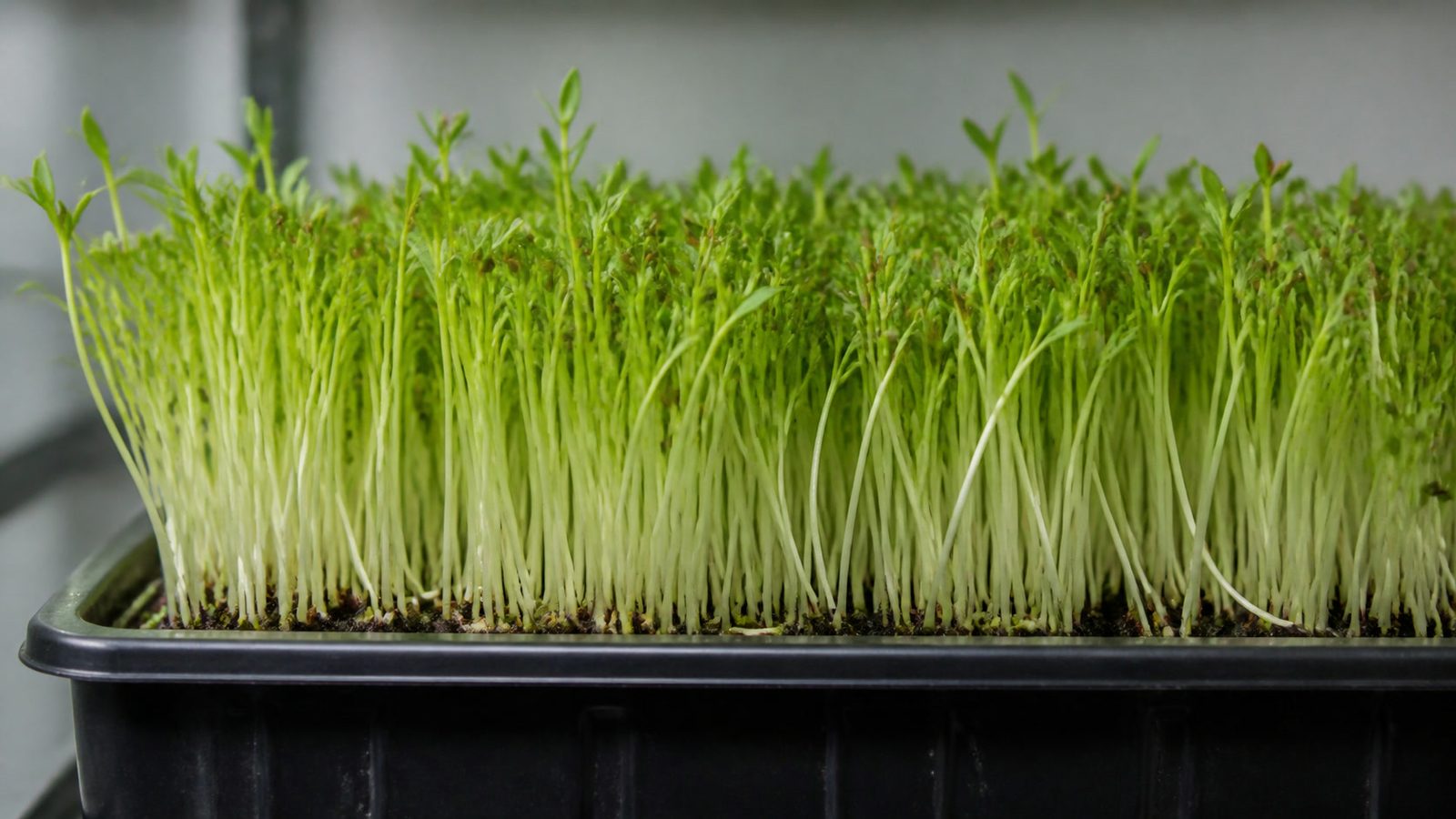
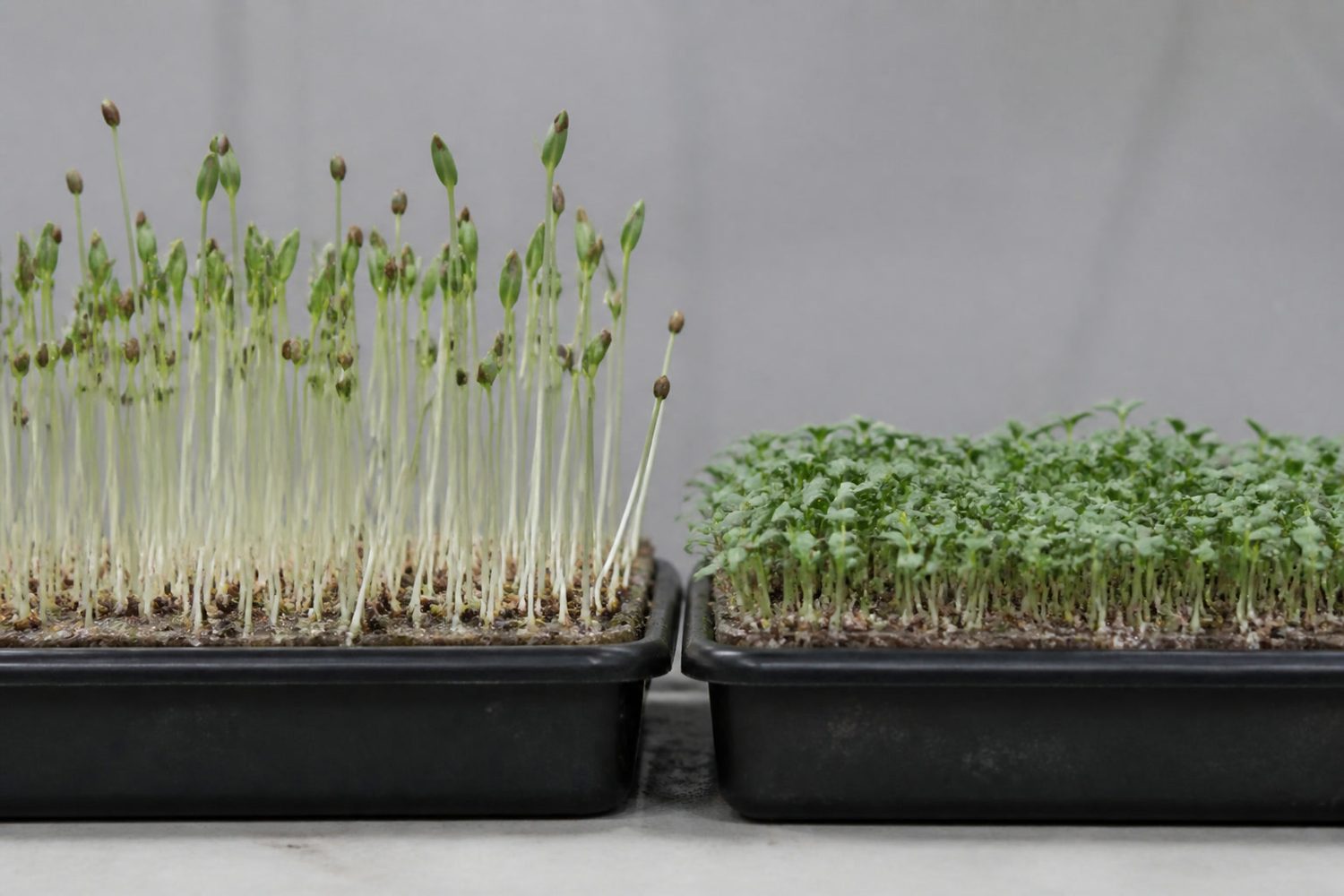
A correct tray is a dense, upright-to-lanky stand of thin pale white to light green stems carrying paired narrow-oval green cotyledons, cut at 1 to 3 inches with the leaves open. It stands noticeably taller and more delicate than a squat brassica tray. At the medium line the mucilage holds brown seed debris in place, and some cotyledons will still be wearing their seed coats.
Those are the "helmets", and they are worth expecting. The seed coat stays clamped on the leaf, which is edible and unattractive, and one flax guide reports that a humid covered finish before uncovering helps them release. Nobody has measured how many stay on.
What it is confused with in a tray is chia, the other mucilaginous crop. Do not identify either one from the slime, because both gel. The tell is the seed itself: flax seed is flat, elongate and brown or golden, and the standing flax crop goes tall and lanky in a way chia does not.
What it tastes like, and what to do with it
Light, tender and close to neutral. There is no pepper in it and no bitterness worth naming, and the supplier's own description is "light and tender", which is a fair summary rather than an evasive one. As the stems get taller the crop gets lankier rather than stronger.
Its selling point is texture, not flavor, which is unusual enough to be the whole recommendation. Flax is soft and faintly slick, so it adds volume and body without adding taste: folded into a green smoothie, soaked into a cabbage and carrot slaw, laid under a yogurt dressing, piled onto avocado toast. Add it at the end of anything hot, because heat is reported to turn it slightly bitter.
It is the wrong crop for a crisp canapé and the wrong crop where a garnish is supposed to announce itself. And it is a poor snack on its own: one grower source says so directly, and the reason is that a mild soft green eaten alone has nothing to offer. If you dislike slippery textures you will dislike this at any age or density, and no growing decision changes that.
Growing it: only what differs from the standard method
Everything general about trays, medium, light and watering is on the standard tray method for growing microgreens. Flax has four deltas and they all come from the mucilage.
Do not soak it. This is not a preference. Two independent sources say plainly not to soak flax, which puts it in a very small group here: on most crops a soak is optional or helpful, and on this one it is the documented way to ruin the tray. Wet flax seed turns gelatinous, bridges into glossy islands, and cannot be spread evenly afterward. Dry seed stays separable.
Surface sow on a carefully leveled bed, with no medium over the top. Flat sticky seeds set where they first get wet, so an uneven bed becomes a permanently uneven stand. Level it more carefully than you would for a crop you can nudge later, because you cannot nudge this one.
Cover for three to five days, and add no weight. This is the second unusual instruction, because most crops do want a weighted cover; the flax method in the one grower note that gives figures uses none, because the cover is for darkness and humidity while the roots anchor, and extra weight can lift a sticky crop off the medium when you take the cover away. Uncover when the sprouts are rooted and the leaves start showing.
Then bottom water only, and only as the medium dries. Top water binds seedlings together on this crop specifically. Bottom watering intervals vary from once every two days to several times daily depending on substrate and stage, so this is a crop you watch rather than schedule.
Hold it at 61 to 77°F and avoid heat. A germination-model study on two cultivars put the optimum for time-to-germination around 71.7°F, and the practical guidance is to avoid hot conditions, which on a wet mucilaginous mat is also the mold advice.
A flax tray, day by day
- 1
Day 0, sow dry
35 g surface-sown on a carefully leveled bed, no medium over the top, no soak. Wetting the seed before it is on the tray is the mistake to avoid.
- 2
Days 0 to 3, covered
Darkness and humidity while the roots anchor. NO added weight, which is unusual here and is because a sticky crop lifts with the cover.
- 3
Days 3 to 5, uncover
When sprouts are rooted and leaves begin to show. A humid finish just before uncovering helps the seed coats release rather than riding up as helmets.
- 4
Days 5 onward, light
Bottom water only, as the medium dries. Top water binds this crop into a mat.
- 5
Days 5 to 14, cut
Leaves open, 1 to 3 inches, cut close to the medium. Past that it goes taller and lankier rather than better.
- 6
At harvest, pack dry
Cutting or packing wet sticky greens is the last failure and the easiest to avoid.
What goes wrong with flax specifically
At sowing: gelled, clumped seed. From soaking, or from a bed that was already too wet. The sign is seed merging into glossy islands instead of an even single layer. Recoverable only before germination, by redistributing carefully or starting over. There is no later fix.
Under the cover: a lifting mat, or patchy emergence. From added weight or an uneven moisture bed. Seedlings and root mat stick to the cover and come up with it. Recoverable if the roots are anchored: lift the cover gently, get light on it, correct the bottom moisture. Not recoverable where the stems tore.
In light: a wet collapsing patch. Pythium and Rhizoctonia, the general damping-off complex, on a crop that gives them an unusually good start. The sign is localized water-soaked, pinched or collapsing stems rather than a dry upright stand. Discard rather than salvage.
And the mist test is unreliable here, for a crop-specific reason. The category's standard check for root hairs against mold does not transfer cleanly, because flax mucilage itself can look webby. Do not diagnose from white fuzz alone on this crop. Look for whether growth bridges across seed coats, medium and adjacent stems, and whether it comes with collapse or an off smell. If in doubt, isolate the tray rather than washing it and selling it.
Mucilage or mold? Why the usual test fails on flax
Hover or tap a card to highlight it.
The standard test
On most crops, mist it: root hairs collapse and nearly vanish, mold does not care. That test is on the broccoli page and it works there.
Why it fails here
Flax mucilage is itself webby and wet, so a flax tray can look like the mold picture while being perfectly healthy. Whiteness and webbiness are not evidence on this crop.
What to look at instead
Whether the growth BRIDGES. Root hairs and mucilage stay at the root and the seed. Growth that spans from seed coat to medium to a neighboring stem is the disease pattern.
The two symptoms that decide it
Collapse and smell. Water-soaked pinched stems, or an off odor, mean discard. A tidy upright stand that happens to be slimy does not.
When in doubt
Isolate the tray. Do not wash a suspect tray and sell it, because washing a sticky green also shortens its life.
At harvest: clumping and fast spoilage. From cutting or packing wet. The sign is wet bundles and condensation inside the container. Let the crop's surface dry before packing, and rinse at serving rather than before storage, because washing a sticky green shortens its life rather than extending it.
Late: taller and lankier. Visible before you cut, as stems elongate past the 1 to 3 inch cue. Nobody has run a controlled comparison of late-cut flax for texture or bitterness.
Nutrition, and what is actually established
There is no USDA record for flax microgreens. FoodData Central returns mature flax seeds, FDC ID 2707588, which is a different food and not a substitute.
What has been measured is a direct comparison, and it is the reason this crop is interesting. Puccinelli and colleagues grew flax indoors as both sprouts and microgreens under red, blue, green and combined light. Against the sprouts, the microgreens came out 62.6 percent higher in chlorophyll, 24.4 percent higher in carotenoids, 37.8 percent higher in phenols, 25.1 percent higher in antioxidant capacity, and 30.7 percent LOWER in dry matter. Under 100 percent blue light they reported flavonoids at 2.48 mg CAE/g fresh weight, total phenols at 3.76 mg GAE/g, chlorogenic acid at 1.10 mg/g and antioxidant capacity at 8.06 µmol TEAC/g.
Read the direction of those numbers rather than their size. Growing the seed on into a microgreen builds pigments and phenolics, which are made in the light, and dilutes everything else with water. That is what "lower dry matter" means: a gram of microgreen is more water and less substance than a gram of sprout, which is in turn more water and less substance than a gram of seed.
Four crops now have this measured, and they agree with each other. Chia: germination spends the seed's fat rather than concentrating it. Celery: a 20-genotype study found several minerals higher in the mature leaf than in the microgreen. Fennel: the seedling carried 81 to 98 percent more monoterpenes than the mature plant. Flax measures both halves in one experiment. The category's founding claim, that microgreens concentrate nutrition, is not true or false; it is incomplete. It holds for the compounds a young leaf makes in light and fails for the ones stored in a seed or accumulated over a season.
What is not supported for flax microgreens specifically: any figure for omega-3 or ALA, the 20 to 25 percent protein claim, "all essential amino acids", or named vitamins and minerals in label quantities. Those appear on a supplier page with no measured flax-microgreen dataset behind them, and mature seed values cannot be quietly moved across.
Which seed to buy
There is no cultivar decision. What is actually sold is brown or golden flax, and no supplier attaches any difference in stem length, color, tenderness, days or yield to the seed-coat color. Buy on lot quality and choose the color only if the look matters to you.
Specify untreated seed sold for sprouting or microgreens, with a lot and preferably a current germination statement. Refuse seed treated with fungicide or insecticide and refuse seed sold only for field planting, because a fiber or oilseed lot is not an input for a crop eaten raw.
And the shelf is unusually good on this crop. Flax seed on Amazon checked on 2026-08-09 returns 256 results with 17 flax listings on the first page, and 8 of them are sold for microgreens or sprouting, including a proper size ladder from Country Creek at 4, 8 and 16 oz. Three ordinary grocery flaxseed products, from Anthony's, Bob's Red Mill and Medley Hills Farm, go further and print "sproutable" on the label, which is the food trade voluntarily telling you the seed is still viable.
Compare that with fennel, whose identical-shaped search returned zero microgreen listings, and fenugreek, which returned nineteen. The pattern holds: a crop with a sprouting tradition has a trustworthy seed supply, and a crop without one does not, however large its food market is. Flax and fenugreek are classic sprouting seeds. Fennel is not. That is a better question to ask about an unfamiliar crop than how popular the species is.
Three traps remain on this particular shelf, and all three are visible in the listing title:
- Milled or ground flaxseed will never germinate. One of the first-page results is ground flax for smoothies. It is a good product and it is not seed.
- "Lewis Blue Flax" is a different species. One listing sells it for planting, and Linum lewisii is a perennial North American wildflower, not the annual Linum usitatissimum grown for food and fiber. It is sold as a garden flower, it is not a microgreen crop, and the one note on eating it says to cook it first, which a microgreen is not.
- Cat grass mixes contain flax but are not flax. Two first-page results blend it with wheatgrass and barley.
Is it worth growing?
Yes, for a specific job: soft volume. Flax is cheap at 67 cents a tray, quick, and returns a reasonable 5 to 7 ounces, and it does something almost nothing else does, which is add body and bulk to a smoothie, a slaw or a dressing without adding flavor. If that is the job, very little competes with it.
It is not a first tray. Dry sowing, no weight and moisture discipline are three decisions a beginner will get wrong at least once, and the mucilage makes each mistake unrecoverable rather than merely costly. And it is not a crop to sell by appearance: helmets on the leaves and a lanky stand are normal for it.
Its real competition is chia, for the same mucilaginous soft-texture slot, and neither has a strong case over the other on measured grounds. Against sunflower, pea or radish it is not competing at all: those are crunch and flavor crops and flax is neither.
A market grower should trial it beside a reliable crop before committing rack space. The only per-tray figure that exists is one grower's average, and this crop has no benchmark in the trade's yield trial to check it against.
A note on the numbers above
Hover or tap a row to highlight it.
| Figure | Value | Source | What kind of number it is |
|---|---|---|---|
| Seed per 1020 | 35 g | Vitality Farms crop notes | One grower's rate, at a 9 to 12 day crop, no soak |
| Yield per 1020 | 5 to 7 oz | Vitality Farms crop notes | That grower's stated average. Medium and cut stage unstated |
| Yield per 1020 | No trial figure | Johnny's | Flax is absent from the 29-variety trial |
| Days to harvest | 5 to 6 | University of Saskatchewan | Published, no temperature or leaf stage |
| Days to harvest | 5 to 14 | Sproutpeople | From dry seed, cut at open leaves and 1 to 3 inches |
| Soak | Do not soak | Two independent sources | A prohibition, not a zero-by-default |
| Blackout | 3 to 5 days, NO weight | Vitality Farms crop notes | The no-weight part is crop-specific |
| Germination temperature | 61 to 77°F | Green Harvest | Practical range, with heat to be avoided |
| Germination optimum | About 71.7 to 71.8°F | Kurt, 2012 | Modeled optimum for time to germination, two cultivars |
| Shelf life | 7 to 9 days at 39 to 43°F | Grower page | Cut and packed dry. Not a controlled study |
| Microgreen vs sprout | +62.6% chlorophyll, +24.4% carotenoids, +37.8% phenols, +25.1% antioxidant, -30.7% dry matter | Puccinelli et al., 2022 | Measured, controlled light, the best evidence on this crop |
| Seed price | $8.68/lb | Sproutpeople, 2026-08-08 | Certified organic, sold for microgreens |
| Harvest window | No published figure | Nobody | Nobody measures how long a ready flax tray holds |
| USDA record | None for the microgreen | FoodData Central | Mature flax seed is FDC 2707588 and is a different food |
The yield and the seed rate come from the same single document. Both the 35 g and the 5 to 7 oz are one grower's production notes, and internally consistent is not the same as corroborated. A single grower sheet can supply matching figures for two different crops without either having been weighed, which happens more than you would think. Weigh your own trays.
The tray-day figure in the table below uses the 9 to 12 day crop those notes describe, not the 5 to 6 day figure from Saskatchewan, because the yield was measured on the longer crop and pairing a fast harvest with a slow crop's weight would flatter the number. At 6 ounces over about 10.5 days that is roughly 0.57.
Do not soak is the strongest single instruction on this page, and it is the one most likely to be overridden by habit, because soaking large or hard seed is good practice on plenty of other crops. Flax is not one of them, chia is not either, and the reason is the same for both.
Hover or tap a row to highlight it.
| Crop | Seed per 1020 | Yield | Days | Cost per tray | Oz per $1 | Oz per tray-day |
|---|---|---|---|---|---|---|
| Garden cress | 10.5 g | 8.0 oz | 8 to 15 | $0.96 | 8.3 | 0.62 |
| Swiss chard, Bright Lights | 31.5 g | 9.5 oz | 16.5 | $2.10 | 4.5 | 0.58 |
| Flax | 35 g | 5 to 7 oz | 5 to 14 | $0.67 | 9.0 | 0.57 |
| Leek, American Flag | 23 g | 5.64 oz | 10 to 25 | $2.21 | 2.6 | 0.56 at 10 days |
| Fenugreek | 25 to 62 g | 3.9 to 4.3 oz | 6 to 12 | $0.55 to $1.35 | 7.5 | 0.53 |
All 62 crops, sortable, on the microgreen comparison.
Flax is the better of the two mucilaginous crops on paper, and only because chia has no yield at all. Chia sits in the unmeasured group with a seed rate and a price and nothing to divide them into. Flax has one grower's average, which is thin evidence but is evidence. Neither should be planted on the strength of the other's numbers.
Terms on this page
Tap a term to see what it means.
*Linum usitatissimum*. Cultivated flax, the annual crop grown for food, oil and linen fiber. The species on this page.
Sources
- Puccinelli et al., 2022, flax sprouts and microgreens under different light spectra (PDF) - the direct sprout-versus-microgreen comparison: microgreens higher in chlorophyll by 62.6 percent, carotenoids 24.4, phenols 37.8 and antioxidant capacity 25.1, and lower in dry matter by 30.7 percent, plus the blue-light flavonoid, phenol, chlorogenic acid and antioxidant values.
- Sproutpeople, flax micro-greens - the do-not-soak instruction, 5 to 14 days from dry seed, cutting at open leaves and 1 to 3 inches, brown and golden as the only distinction sold, and the $8.68/lb price behind the seed-cost calculation, listed 2026-08-08.
- Vitality Farms micro grow notes (PDF) - the only flax 1020 figures anywhere: 35 g, no soak, stacked 3 to 5 days with no added weight, a 9 to 12 day crop, and a 5 to 7 oz average.
- University of Saskatchewan, microgreens guide (PDF) - 5 to 6 days from sowing to harvest for flax, with no temperature or leaf stage stated.
- Green Harvest, microgreens growing information - the second independent do-not-soak instruction, and the 16 to 25°C practical range with heat to be avoided.
- Kurt, 2012, germination model for flax cultivars - the modeled optimum of about 22.05 to 22.10°C for time to germination in two cultivars.
- UAOrganic, flax microgreens - the helmets and the humid finish that releases them, 7 to 9 days at 4 to 6°C packed dry, washing before storage shortening life, heat turning the crop slightly bitter, and the advice against serving it alone.
- Johnny's microgreens yield trial, method and discussion - the absence of flax from the 29 varieties tested, and the caveat that yields vary with procedure, system, conditions, harvest stage and seed lot.
- UC IPM, damping-off - Pythium and Rhizoctonia as the general complex, and symptoms at or below the medium line.
- Penn State Extension, growing microgreens at home - the baseline tray method the deltas above are measured against.
- Virginia Tech Extension SPES-756 (PDF) - bottom-watering intervals varying from once every two days to several times daily by substrate and stage.
- Kew Plants of the World Online, Linum usitatissimum - the accepted species and its placement in Linaceae.
- USDA NRCS plant guide, blue flax and Lewis flax (PDF) - Linum lewisii as a perennial native distinct from the cultivated annual.
- USDA FoodData Central - no flax microgreen record; mature flax seeds are FDC ID 2707588.
Keep reading
The variety directory
Chive microgreens
One of the few crops where somebody actually ran a density trial, and poor value per dollar of seed. It also competes with a perennial you buy once.
Read Chive microgreensThe variety directory
Dill microgreens
Two suppliers disagree by ten days on when to cut it, and an indoor grower with no stake in the argument settles it. Plus why dill's yield figure should be read alongside chervil's.
Read Dill microgreensThe variety directory
Celery microgreens
Three to four weeks of bench for a seasoning green, with an unusually complete measured nutrient panel behind it: 45.8 mg of vitamin C per 100 g, and four minerals that are higher in the mature leaf.
Read Celery microgreensThe variety directory
Borage microgreens
Borage microgreens taste of cucumber, and a 2025 study found them averaging 130 times the EU maximum for pyrrolizidine alkaloids. Use it as a garnish, not as a salad base or a juice.
Read Borage microgreens