At a glance
Germination is easy, but the seed swells and turns mucilaginous if soaked long or sown into wet medium, and a clumped tray becomes an airless mat that molds rather than a stand you can thin.
- Botanical name
- Trigonella foenum-graecum
- Also sold as
- Fenugreek microgreen seed, Methi, Fenugreek (Organic) Microgreens Seeds, Fenugreek sprouting seed
- Family
- legume
- Difficulty
- Moderate
- Days to harvest
- 6 to 12 days
- Harvest window
- 2 to 3 days
- Seed per 1020 tray
- 25 to 62 g
- Soak
- 0 to 8 hours
- Blackout
- 2 to 3 days
- Germination temperature
- No published figure
- Yield per 1020 tray
- 3.9 to 4.3 oz
- Regrows after cutting
- No published figure
- Mold risk
- Medium
- Hull shedding
- some
- Shelf life
- No published figure
- Eaten as
- raw
- Seed cost per tray
- $0.55
25 g at $9.91/lb, True Leaf Market organic fenugreek microgreen seed at the 5 lb can ($49.55), listed 2026-08-08. At the scaled 62 g upper rate it is $1.35. Seed only, excludes medium, tray, labor, light and loss.
Any field name above ranks every variety by it. No published figure means we researched it and nobody has established one, which is different from not yet researched. Every figure here is sourced at the bottom of the page. Compare every variety side by side.
Fenugreek is methi, the leaf that turns up in dal, thepla and paratha, grown as a tray crop and cut in about a week. It is easy to germinate, cheap to sow at 55 cents, and it has a two to three day window before it stops being pleasantly bitter and starts being unpleasantly bitter.
One warning before you plan a rack around it. There is a published fenugreek yield in circulation that is about eight times too high, and it would make this the best crop you could grow. A second independent study on the same crop puts it back in the ordinary range, and the figure at the top of this page is the corroborated one. The detail is here, and it is worth reading before you price anything.
What growers are saying right now
Sampled from public posts and videos, 10 July to 9 August 2026. Every line links what it is quoting. How often something is repeated is not evidence that it is true, so every line also says what the sources actually establish.
Fenugreek increases lactation, and it changed the flavor of the breast milk to something more like honey
Circulating Said here by a long-standing sprouting author, and it is by far the biggest post about this plant in the window at 99,824 views and 4,171 likes
Both halves have something behind them and neither is about this crop, so here is the honest version. On supply: a network meta-analysis of small trials found fenugreek raised milk volume against placebo, on the order of 11 to 18 mL more per feed, and a 2025 systematic review of mothers of preterm infants rated the evidence very low certainty from two extremely small studies. LactMed places it at risk category L3, moderately safe, and says transfer into milk is not known. On the honey flavor: that is sotolone, the compound that makes fenugreek and maple syrup smell as they do, and it does reach the baby. The part nobody mentions, and the reason this item is here: that same smell has caused newborns to be falsely suspected of maple syrup urine disease, a serious inherited metabolic condition, including a case reported in the New England Journal of Medicine from a mother drinking herbal tea. If you take fenugreek while nursing, tell your pediatrician, so a sweet-smelling baby is not investigated as a metabolic emergency. And all of it concerns the SEED, taken by the gram or in capsules. A garnish of microgreens is a different quantity of a different part of the plant, and nothing establishes that it does any of this, in either direction.
Methi is the herb people keep asking about
Circulating A primer at 4,801 views and 417 likes, opening with the observation that not a video goes by without someone asking what methi is
Worth knowing before you grow a tray of it. Fenugreek's audience already exists and already knows the flavor, which is the opposite of most microgreens. It also means the flavor is not a novelty you can talk somebody into: a customer who cooks Indian food knows exactly what methi should taste like. What it tastes like
Fenugreek for hair growth
Circulating A herbal hair routine at 16,577 views and 744 likes, listing fenugreek alongside chebe, amla and bhringraj
A claim about the seed applied topically, not about the microgreen eaten. It is on this page only because it explains what you will meet when you go shopping: a large share of the fenugreek seed sold online is aimed at cooking, tea or hair, and one listing on the first page of the seed search is titled for hair growth. Which seed to buy
What it is, and how to tell you grew it right
Fenugreek microgreens are seedlings of Trigonella foenum-graecum, a Fabaceae legume, cut above the medium at fully open cotyledons. One species, sold under one name plus its Hindi name, methi. Nothing on the shelf is a distinct microgreen cultivar: what varies is organic status, lot and supplier.
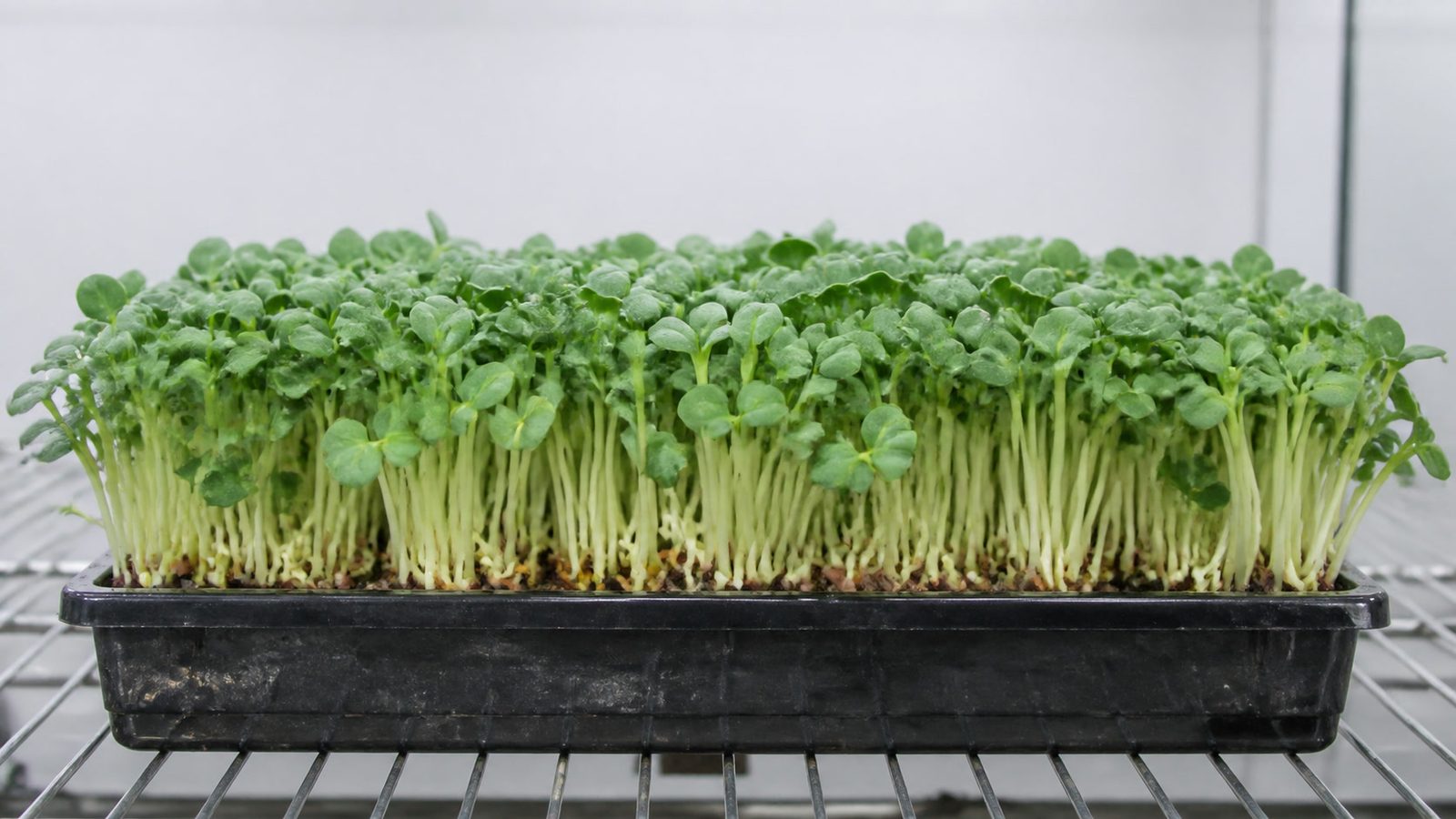
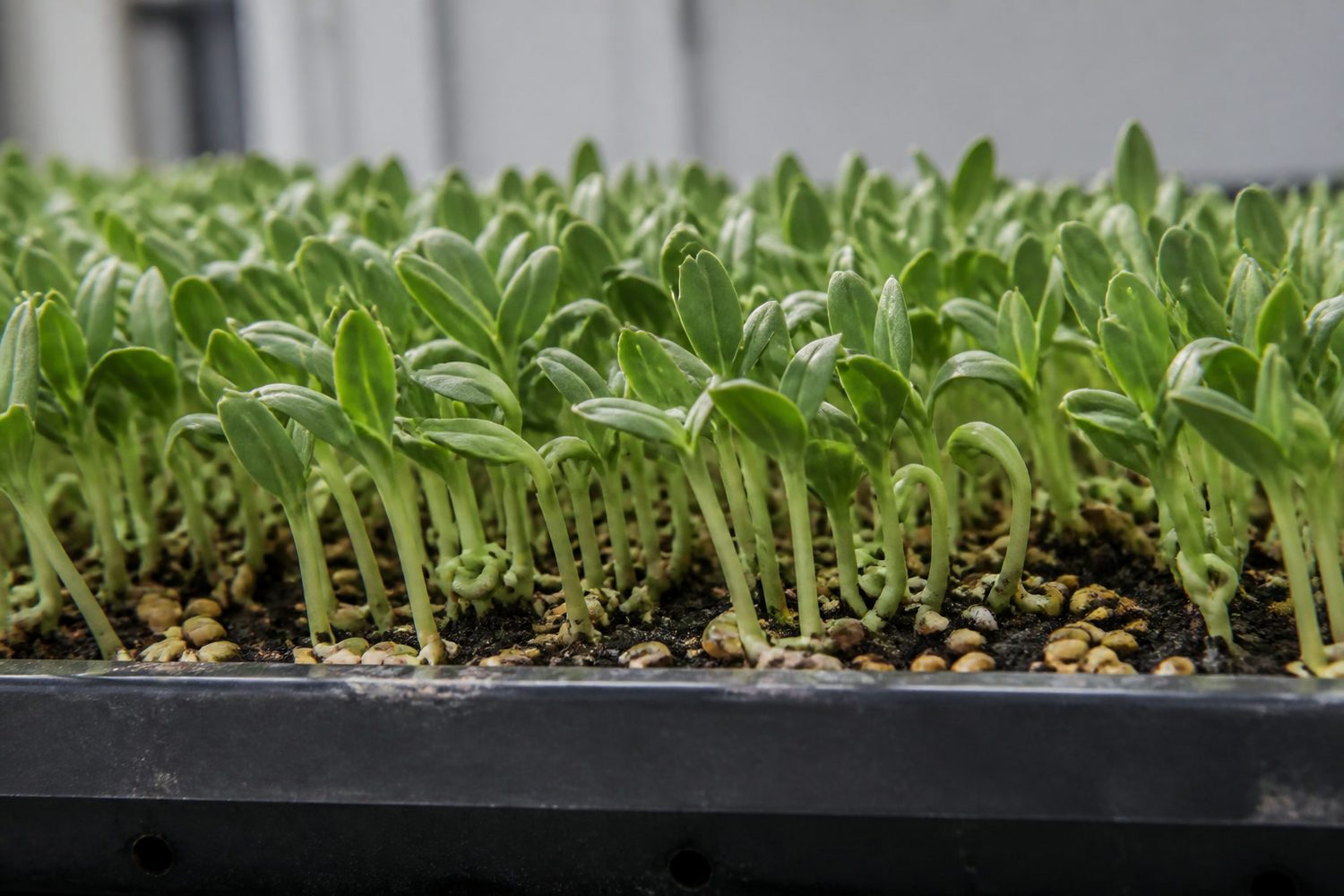
Being a legume changes the tray. The seed is large, angular and hard, and it swells substantially, so it wants a single well-spaced layer rather than the dense broadcast a fine brassica seed forgives. What comes up is stouter than most crops here: comparatively thick pale cream to light green stems, often with a slight curl near the base, carrying thick paired green cotyledons. The canopy reads leafy rather than feathery, the harvest target is 4 to 7 cm, and there is a heavy root mass with tan hulls scattered at the medium line.
That last detail is worth expecting rather than worrying about. Fenugreek's hull is large and tan and a fair number of them ride up with the shoots or sit on the surface. Johnny's sprouting instructions say plainly that hulls can be rinsed or skimmed off and that removing them reduces spoilage in storage, which is the most practical thing published about them. Nobody has measured a retention percentage.
What it might be confused with is another pale-stemmed legume shoot, and the honest position is that no source opened for this page validates a single visual tell against labeled photographs. The candidate is the thick rounded-oval cotyledon pair and the curled stem base against pea's tendrils, and it is offered as a candidate rather than a rule.
What it tastes like, and what to do with it
Concentrated, earthy, bitter methi, with the curry note the seed is known for. It is not a subtle green and it is not a background one: the supplier's own description is that the flavor is powerful and a few go a long way, which is unusually candid product copy.
The flavor moves with the calendar in a way most crops here do not. It is mildest around days 6 and 7, has a stronger fresh-methi bite by days 8 and 9, and is reported noticeably bitter after day 10. That is a genuine harvest decision rather than a curiosity, and it is covered in the failures section below.
Use it where a small amount of assertive methi is the point: scattered into dal, folded through thepla or paratha, in a chutney, or as a finishing green on something rich. The thick leaves carry more body than a delicate garnish, so it holds up better than a fine herb. It is the wrong crop for a mild salad base and the wrong crop for a neutral mixed pack, and putting it in one will be noticed.
Who will not like it: anyone who dislikes bitterness or the curry-like fenugreek aroma. Unlike most flavor objections in this directory, this one has a known audience on the other side. People who cook South Asian food will recognize it immediately and know whether they want it.
Growing it: only what differs from the standard method
Everything general about trays, medium, light and watering is on the standard tray method for growing microgreens. Fenugreek's deltas all come from one property: the seed swells and goes slimy.
Sow dry, or soak briefly and watch it. This is the crop's defining decision and the sources genuinely disagree. One guide permits dry sowing or two to four hours in room-temperature water to advance germination by half a day to a day, and warns that longer makes methi slimy and impossible to distribute. Another recommends six to eight hours to soften the seed coat. Nobody has run a comparison. Dry is the lower-risk default, a short watched soak is defensible, and an overnight soak is the single most reported way to ruin a fenugreek tray.
Sow lighter than you think, and in one layer. The measured rate is 25 g per 1020 footprint. A supplier's rate scales to 52 to 62 g, which is a place to start a density test rather than a standard. Every crop-specific source opened warns that crowding is what loses this crop, so start at the bottom. Level the medium, distribute in a single layer, and do not bury it.
Two to three days covered, then off at the signal. One source specifies three days, another says check at 48 hours. The cover's job here is even seed-to-medium contact and stopping a large swelling seed from lifting or clumping, not forcing a stretch. Take it off when shoots are 2 to 3 cm and pushing the lid. Held longer, fenugreek goes pale and leggy quickly.
Then bottom water sparingly. Keeping water off a crowded seed layer is the whole game. There is no fenugreek-specific light recipe, irrigation volume or fan rate anywhere; the general extension targets are 60 to 70°F and 50 to 70 percent humidity, and they are general.
A fenugreek tray, day by day
- 1
Day 0, sow
25 g in a single layer on leveled medium. Dry, or after a short watched soak of two to four hours. Do not soak overnight.
- 2
Days 0 to 2, covered
The cover is for contact, not for stretch. Check at 48 hours rather than waiting out a fixed schedule.
- 3
Day 2 or 3, uncover
When shoots are 2 to 3 cm and pushing the lid. This crop goes pale and leggy faster than most if you leave it.
- 4
Days 3 to 6, light
Bottom water sparingly. Water sitting in a crowded seed layer is what turns into the mat.
- 5
Days 6 to 8, the good cut
Fully open cotyledons at 4 to 7 cm, mildest flavor. From here you have two to three days before it turns.
- 6
Day 10 onward, bitter
Still edible, no longer what was ordered. Nothing about the tray looks wrong.
What goes wrong with fenugreek specifically
First, at sowing: clumped seed. Glossy, stuck-together seed instead of an even layer, from a long soak or a medium that was already too wet. This is recoverable only in the seconds before you walk away, by redistributing it. It is not recoverable by adding water, which is the instinct.
Then: uneven emergence and a lifting mat. Bare gaps, plus seedlings pushing up a compact crust rather than an even canopy. Partly recoverable by correcting the moisture and taking the cover off at the lid-push signal instead of on a schedule.
Then: damping-off and root rot. Collapse, brown or water-soaked tissue at or below the medium line, or seedlings simply missing. Pythium commonly begins at the root tips and Rhizoctonia rots stems at the line. On a food crop with spreading disease the answer is discard and sanitize. The fenugreek-specific trigger, crowding plus wetness, is grower consensus rather than a measured comparison, but every source that discusses this crop names the same cause.
And there is no fenugreek root-hair test. No opened source gives a photograph-validated way to tell fenugreek root hairs from mold. The cautious version is whether the white growth is confined evenly to intact roots and barely changes after watering, against fuzzy growth spreading across seed, stems and medium with collapse or an off smell. Do not judge safety from whiteness alone, and treat collapse or rot at the medium line as the decisive symptom rather than color.
Last, and least visible: harvesting late. Past day 10 the crop is reported noticeably bitter. Nothing rots, nothing collapses, the tray looks fine, and the product is wrong.
Fenugreek is one of three microgreens whose harvest window is a flavor clock rather than a weight one, alongside radish, which gets hotter, and endive, which gets more bitter. All three run about one to three days and all three are sold on taste. Three grower assertions from unrelated sources is not proof of a rule, but the pattern is worth planning around: on a crop whose selling point is flavor, the window is short, and nothing in the tray's appearance tells you it has closed.
The methi clock, and what each day costs
Hover or tap a card to highlight it.
Days 6 to 7
Mildest. Fully open cotyledons at 4 to 7 cm. This is the cut if you are selling to somebody who has not asked for a strong one.
Days 8 to 9
Stronger fresh methi. Legitimate and preferred by some buyers. Sell it as what it is.
Day 10 and after
Noticeably bitter. Still safe, still edible, no longer the product. The tray gives you no visual warning.
How to check
Taste a stem before you cut, every time. On this crop your mouth is the harvest test, not the look of the true leaves.
How confident to be
This is grower guidance, not a holding trial. Nobody has measured texture, yield or nutrient change by late-harvest day.
Nutrition, and what is actually established
There is no USDA FoodData Central record for fenugreek microgreens, and the mature leaf and the seed entries are not substitutes for one.
What exists is thin and condition-specific. The measured study behind this page's other figures reports, for its cocopeat treatment, about 85.65 percent germination, 9.8 days to one true leaf, roughly 93 percent moisture, about 0.4 to 0.5 percent ash, and 655.86 mg/kg fresh weight nitrate. Those are numbers for that system on that medium, not a nutrition panel.
The nitrate figure is the one worth pausing on, because it is the sort of number that gets quoted without context in either direction. It is a measurement of leafy tissue grown a particular way, and leafy greens generally carry nitrate that varies with light, nitrogen supply and harvest time. It is not a warning and it is not a selling point; it is one number from one treatment, and there is nothing to compare it against for this crop.
What is not supported is the marketing you will actually meet: that fenugreek microgreens concentrate the seed's blood-sugar effects, that they are a leading plant iron source, or that they deliver a therapeutic dose of 4-hydroxyisoleucine. The supplier making the blood-sugar case ties its own mechanism to fenugreek seed, not to a measured microgreen serving. The lactation evidence at the top of this page is likewise seed evidence. A tray of microgreens is a garnish, and no study has measured what eating it does. If you want the seed's effects, the research is about the seed, and it belongs in a conversation with a clinician rather than on a plate of garnish.
Which seed to buy
There is no cultivar decision here. What is sold is a standard open-pollinated lot, an organic microgreen or sprouting lot, and a non-GMO microgreen lot, all the same species. Organic is traceability, not germination.
What to specify: seed sold explicitly for microgreens, sprouting or food use, with the species named and untreated status stated. Refuse anything coated or treated with dyes, fungicides or insecticides, because the shoot is the food and treatment residues can be in it. And run a 50 to 100 seed germination test before committing a rack, because the documented lot trap on this crop is spice seed that may have been heat treated or irradiated for preservation, which can germinate poorly or not at all.
And the good news, which is genuinely surprising after fennel. Fenugreek seed on Amazon checked on 2026-08-09 returns 848 results with 40 fenugreek listings on the first page, and 19 of those 40 are sold for microgreens or sprouting: Sow Right's fenugreek microgreen seed, Outsidepride's fenugreek and microgreens packs, Country Creek's sprouting seed at 4, 8 and 16 oz, heirloom methi sold explicitly for microgreens, and several sprouting mixes that include it. The other 21 are culinary methi for cooking, tea and hair care. Control on the same page: 20 microgreen listings for other crops.
That is a genuinely usable shelf, and the contrast with fennel one page over is the useful part. Both crops are the same shape of problem: a plant whose seed is a mass-market spice, sold overwhelmingly to people who want to eat the seed rather than sow it. Fennel's search returned zero listings for microgreens. Fenugreek's returned nineteen.
The difference is sprouting. Fenugreek is a classic sprouting seed with a long tradition behind it, so a food-use, germination-tested supply chain already exists and the microgreen trade inherited it. Fennel has no sprouting tradition, so it has no such chain, however large its spice market is. If you are buying seed for an unfamiliar crop, that is the thing to check first: not whether the species is popular, but whether anyone has been sprouting it.
The spice-trade caution still applies at the edges. Several listings here advertise "non-irradiated" as a feature, which tells you what the default is in that category, and a methi jar sold for tadka is not a planting lot no matter how organic it is.
Is it worth growing?
Yes, for the person who wants methi, and it is one of the more sensible propositions in this directory: 55 cents of seed, about four ounces in eight days, no soak required, and a flavor with an audience that already knows it by name.
The caveats are real and short. The window is two to three days. Crowding and wet medium lose the tray, and the seed's own behavior tempts you into both. And there is no benchmark from the trade's 29-variety trial to plan against, so your own weighed trays are the only numbers you should price from.
Grow something else if you want a mild green, a neutral mix component, or a forgiving first crop. Its competition is pea shoots when the buyer wants a thick substantial legume green with a familiar sweetness, and the brassicas when they want an assertive garnish with a trial behind it. Fenugreek wins in one situation and wins it decisively: when the dish actually wants methi.
The yield figure to ignore
Hover or tap a row to highlight it.
| Figure | Value | Source | What kind of number it is |
|---|---|---|---|
| Fresh yield | 863.65 to 951.80 g/m2 | Gadhave et al., 2025 | Measured under shade net, media and seed-treatment trial |
| Yield per 1020 | 3.9 to 4.3 oz | Area conversion of the above | 951.80 g/m2 x 0.1290 m2 = 123 g. What this page publishes |
| Fresh yield | 7,358 g/m2 | Khan et al., 2026, as cited | Not published here. About 8x the corroborated figure. See below |
| Days to harvest | 7.80 average | Gadhave et al., 2025 | Measured, best treatment |
| Days to harvest | 6 to 12 | True Leaf Market | Product page, no temperature or stage |
| Days to harvest | 7 to 10 | SAGreens | After a 6 to 8 hour soak and 3 dark days, at open cotyledons |
| Seedling height | 7.46 cm | Gadhave et al., 2025 | Measured, best treatment |
| Seed per 1020 | 25 g | Khan et al., as cited | The rate reported for the best-yielding treatment |
| Seed per 1020 | 52 to 62 g | SAGreens, area-scaled | From 25 to 30 g per 25x25 cm. A starting point, not a standard |
| Harvest window | About 2 to 3 days | Grower guide | Days 6 to 8 mild, 8 to 9 stronger, bitter past 10 |
| Germination | 85.65 percent | Khan et al., as cited | Cocopeat treatment |
| Nitrate | 655.86 mg/kg FW | Khan et al., as cited | One treatment, one system |
| Germination temperature | No published figure | Nobody | The 60 to 70°F band is general, not fenugreek's |
| Shelf life | No published figure | Nobody | General guidance only, and washing shortens it |
| Seed price | $9.91/lb at 5 lb | True Leaf Market, 2026-08-08 | $49.55 for the can |
| USDA record | None found | FoodData Central | No fenugreek microgreen entry |
If you find a fenugreek yield of 33.5 ounces a tray, do not plan against it. That figure is in circulation and it is almost certainly a units error.
It comes from a 2026 study reporting a measured fresh yield of 7,358 g per square meter at 25 g of seed in cocopeat. Converted onto a 1020's 0.1290 square meters that is about 949 g, or 33.5 ounces.
Look at what that would mean before you believe it. It is nearly twice sunflower's 18.77 oz, the heaviest tray anybody has measured, from a quarter to a sixth of sunflower's seed. Against 55 cents of seed it would return about 61 ounces per dollar, three times arugula's 20.8, which is the best figure published for any crop. At roughly eight days it would be 3.4 ounces per tray-day against sunflower's 1.79. A crop nobody in the trade talks about would be first in every column by a factor of two to three, at 93 percent moisture, in eight days.
A second study settles it. Gadhave and colleagues, in a 2025 media and seed-treatment trial on the same crop, report fresh yield of 863.65 to 951.80 g per square meter, at an average 7.80 days to harvest and 7.46 cm seedling height. That is about one eighth of the first figure and converts to 3.9 to 4.3 ounces a tray, which lands between red cabbage and bull's blood beet rather than at the top of anything. An ordinary result for a legume shoot.
Note the coincidence that gives the error away. 951.80 g is almost exactly the 949 g the first figure produced per tray. One study's per-square-meter result and the other's per-tray conversion land on the same number, which is what a units mistake looks like from the outside.
The 2026 paper could not be opened to check what it actually prints, because the host did not respond, so the figure above is what the abstract is cited as saying rather than a page anybody has read. That is another reason not to build on it.
What would settle it is somebody weighing a 1020 of fenugreek sown at 25 g and reporting the grams. That is an afternoon's work, and it would resolve a question the published record currently cannot.
Hover or tap a row to highlight it.
| Crop | Seed per 1020 | Yield | Days | Cost per tray | Oz per $1 | Oz per tray-day |
|---|---|---|---|---|---|---|
| Pea shoots | 150 g | 8 oz | 8 to 14 | $2.39 | 3.3 | 0.73 |
| Lentil | 19.1 to 28.7 g, area-converted | 6.1 to 8.4 oz, area-converted | 8 to 12 | $0.37 to $0.56 | 15.5 | 0.73 |
| Fenugreek | 25 to 62 g | 3.9 to 4.3 oz | 6 to 12 | $0.55 to $1.35 | 7.5 | 0.53 |
| Clover, Red | 20 g | 3 to 5 oz | 10 | $0.96 | 4.2 | 0.40 |
| Alfalfa | not a tray crop | not a tray crop | 4 to 6 | not a tray crop | not applicable | not applicable |
A blank means nobody has published that figure, so the cell is left empty rather than filled with an estimate.
All 62 crops, sortable, on the microgreen comparison.
The remaining figures on this page, and what they rest on. The seed rate, germination percentage and nitrate come from the 2026 paper this page declines to use for yield, which is a deliberate and uncomfortable position: a source can be wrong or misreported on one figure and ordinary on others, and pretending otherwise in either direction would be the easy move. Those three are flagged as "as cited" in the table above and none of them carries a claim on its own. The days, height and yield come from the study that could be opened and read. The price is a current listing. The harvest window and the flavor timing are grower guidance and say so.
Terms on this page
Tap a term to see what it means.
Methi. The Hindi name for fenugreek, and the name most of its customers use. Both the seed and the leaf are sold under it.
Sources
- Gadhave et al., 2025, media and pre-sowing seed treatments on fenugreek microgreens under shade net - the corroborated yield: 863.65 to 951.80 g/m2 fresh, an average 7.80 days to harvest and 7.46 cm seedling height, across three media and four pre-sowing treatments. This is the study behind the figures published at the top of this page.
- Khan et al., 2026, fenugreek microgreens on five growing media - the source of the 25 g seed rate, 85.65 percent germination, 9.8 days to one true leaf and 655.86 mg/kg nitrate, and of the 7,358 g/m2 yield figure this page does not publish. The host did not respond when opened on 2026-08-09, so its printed figures could not be checked directly.
- True Leaf Market, organic fenugreek microgreens seed - 6 to 12 days, the powerful-flavor and a-few-go-a-long-way description, and the $49.55 per 5 lb can behind the seed-cost calculation, listed 2026-08-08.
- SAGreens, fenugreek microgreen seeds - 7 to 10 days after a 6 to 8 hour soak and 3 dark days, harvest at fully open cotyledons and 4 to 7 cm, and the 25 to 30 g per 25x25 cm rate scaled in the table above.
- BageechaBox, fenugreek methi microgreens growing guide - the grower guidance behind the short watched soak, the 2 to 3 cm lid-push signal, the crowding-to-mold failure chain, the day 6 to 8 mild and day 10 bitter flavor window, and the spice-lot warning.
- Johnny's sprouting instructions (PDF) - hulls may be rinsed or skimmed off, and removing them reduces spoilage in storage.
- Johnny's microgreens yield trial, method and discussion - the caveat that one system's yields do not transfer, and the absence of fenugreek from the 29 varieties tested.
- Penn State Extension, growing microgreens at home - the baseline method, and the warning that washing shortens the life of delicate microgreen tissue.
- SDSU Extension, growing microgreens at home - about a week refrigerated in general, and the caution that seed treatments can be present in the shoots.
- Virginia Tech Extension SPES-756 (PDF) - the general 60 to 70°F and 50 to 70 percent humidity microgreen targets, used as context rather than as a fenugreek figure.
- UC IPM, damping-off - Pythium and Rhizoctonia solani, root-tip onset and rot at or below the medium line.
- Khan et al., 2018, effectiveness of fenugreek as a galactagogue: a network meta-analysis - the small-trial evidence that fenugreek raised milk volume against placebo.
- Herbal galactagogues for mothers of preterm babies, systematic review, 2025 - very low certainty evidence from two extremely small studies, no conclusions drawable in that population.
- LactMed, fenugreek - transfer into milk unknown, untoward effects rarely reported, lactation risk category L3.
- False diagnosis of maple syrup urine disease owing to ingestion of herbal tea, New England Journal of Medicine - the reported case behind the advice to tell your pediatrician.
- Sotolon - the compound shared by fenugreek, maple syrup and the urine of maple syrup urine disease patients.
- USDA FoodData Central - no fenugreek microgreen record.
Keep reading
The variety directory
Alfalfa
Alfalfa grows in a jar in four to six days, rinsed twice a day and eaten whole, root and all. The care goes into the food safety rather than the growing.
Read AlfalfaThe variety directory
Chickpea shoots
One of the very few crops with real regrowth data behind it: a measured second cut at 96 percent of the first, if you cut above a node instead of at the medium line.
Read Chickpea shootsThe variety directory
Mung bean shoots
The crop where the sprout and microgreen line stops being a technicality: mung is the bean sprout of commerce, and the two products sit under different food-safety law. 200 to 215 g a tray, and no measured yield anywhere.
Read Mung bean shootsThe variety directory
Pea shoots
Pea shoots are the easiest microgreen to start and one of the easiest to lose. Sourced figures for seed rate, days, yield and cost, plus the wet-seed failure that actually kills trays.
Read Pea shoots