Garden cress microgreens
Cal HewittPublished Checked
- brassica
- beginner
- measured yield
- garnish
- no soak
- mold prone
At a glance
Germinates in one to three days and reaches a cut inside two weeks with no soak and no weight, but the seed gels the moment it is wet, so overwatering a dense covered tray is the one thing that reliably ruins it.
- Botanical name
- Lepidium sativum
- Also sold as
- Cress, Cressida Organic Microgreen Seed, Curled garden cress, Peppergrass, Curly cress, Shahi (Iranian cress), Halim / aliv
- Family
- brassica
- Difficulty
- Beginner
- Days to harvest
- 8 to 15 days
- Harvest window
- No published figure
- Seed per 1020 tray
- 10.5 g
- Soak
- None
- Blackout
- 3 to 5 days
- Germination temperature
- 60 to 72 °F
- Regrows after cutting
- No published figure
- Mold risk
- High
- Hull shedding
- Not applicable
- Shelf life
- 2 to 3 days
- Eaten as
- raw
- Seed cost per tray
- $0.96
10.5 g at $41.40/lb, Johnny's organic Cressida microgreen seed at 1 lb, listed 2026-08-08. Bulk tiers change this. Seed only, excludes medium, tray, labor, light and loss.
Any field name above ranks every variety by it. No published figure means we researched it and nobody has established one, which is different from not yet researched. Every figure here is sourced at the bottom of the page. Compare every variety side by side.
"Do not sow too thick" is the advice on every crop, and almost nowhere does it come with a number. On garden cress it does. Dubey and colleagues sowed cress at densities from 6 to 14 seeds per square centimeter and measured both what came off the tray and what was living on it. Fresh biomass peaked at 12 seeds per square centimeter. Total aerobic bacteria did not peak at all: they climbed from 7.04 to 7.94 log units per gram as density went from 6 to 14, which is roughly eight times the bacterial load, and the fungi rose too.
Read those two results together, because separately each is half a sentence. There is a density that gives you the most crop, and pushing past it buys you no extra weight and a visibly dirtier product. So, you can put a figure on what over-sowing costs you here, rather than being told it is unwise: past the optimum you buy no extra weight and a measurably dirtier product.
What growers are saying right now
Sampled from public posts and videos, 10 July to 9 August 2026. Every line links what it is quoting. How often something is repeated is not evidence that it is true, so every line also says what the sources actually establish.
Sow them thick, do not worry about overcrowding
Circulating The instruction in this 77,473-view reel at 971 likes, on growing microgreens in takeaway tubs, which says to empty whole packets into each container
This is the one claim on this page worth taking seriously, and cress is the crop that can answer it. In the density study above, going from 6 to 14 seeds per square centimeter raised total aerobic bacteria about eightfold and did not raise yield past 12. So, the advice is not merely untidy, it has a measured cost, and the cost lands on a crop eaten raw and uncooked. What to do instead: sow to a single even layer, keep the cover to three to five days, and bottom water. The trade's own trial rate for a 1020 is 10.5 g. What the density study found
Broccoli and bok choy and lettuce microgreens do not have all that much flavor
Circulating Said here at 46,757 views, in a beginner's crop-picking video, as the reason to try something else first
A fair complaint, and it is the strongest argument for this crop. Garden cress is as fast and as forgiving as the mild brassicas and it tastes of something, which is a rarer combination than it should be. It is the beginner crop for people who found their first tray boring. Is it worth growing
Nothing, in the specific sense
Circulating A 30-day sweep for garden cress returned generic beginner microgreen content, a 4.7-million-view fast-vegetable video that mentions microgreens in passing, and on Hacker News a self-watering garden gadget and a banana plant fruiting in Essex
The word "garden" pulls the search sideways and there is no cress conversation underneath it to hold the results down. Like fennel, endive and flax, cress has a real published record and no online community. Expect to work from the studies rather than from a grow-along, and do not read the quiet as a sign the crop is simple.
What it is, and how to tell you grew it right
Garden cress is Lepidium sativum, a fine-seeded brassica, and the name is the problem. At least three unrelated plants are sold as "cress": garden cress, watercress (Nasturtium officinale) and upland cress (Barbarea verna). Johnny's own growing information groups all three on one page while the Cressida product itself is L. sativum. A bag labeled only "cress" has not told you what you bought.
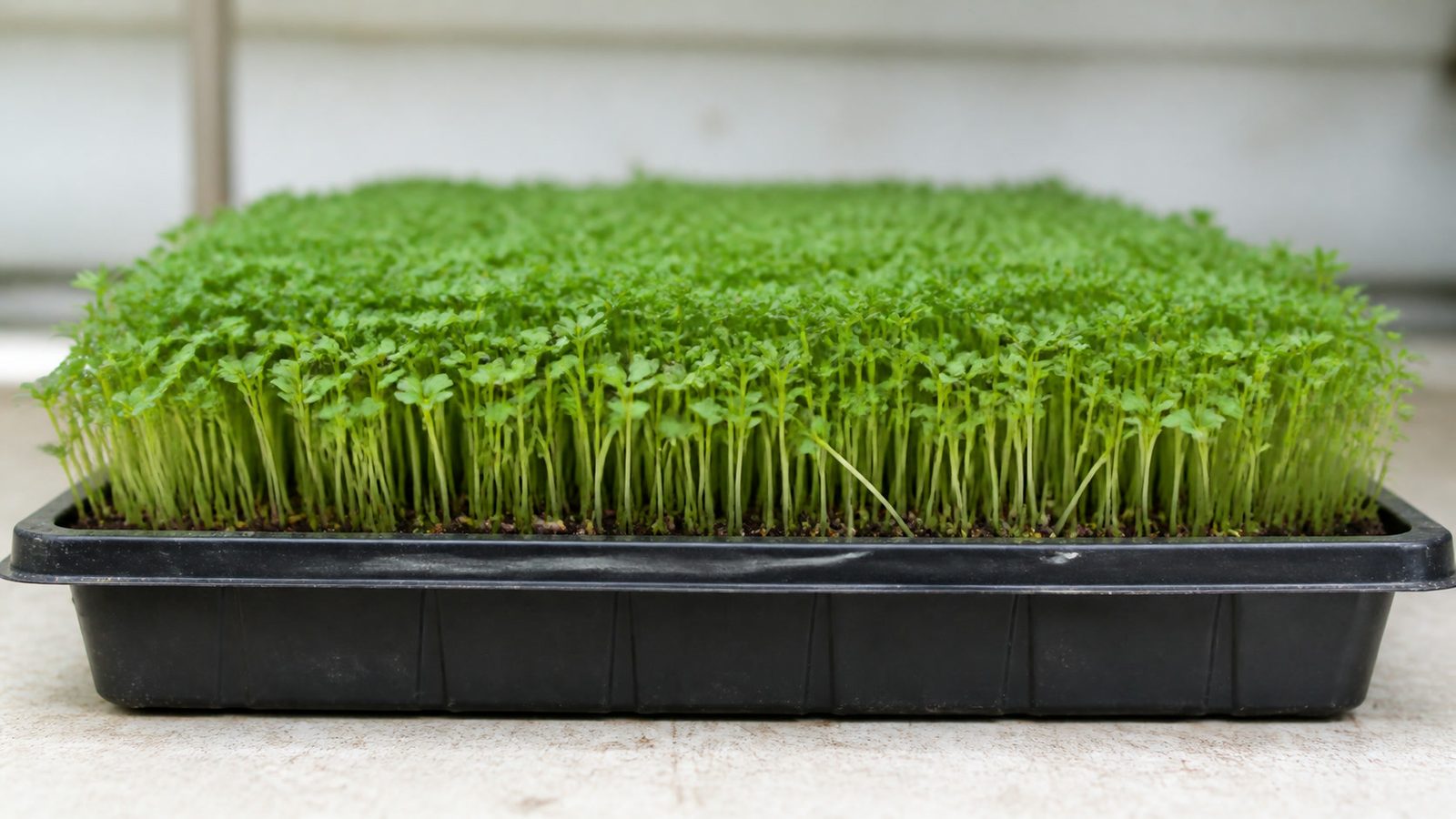
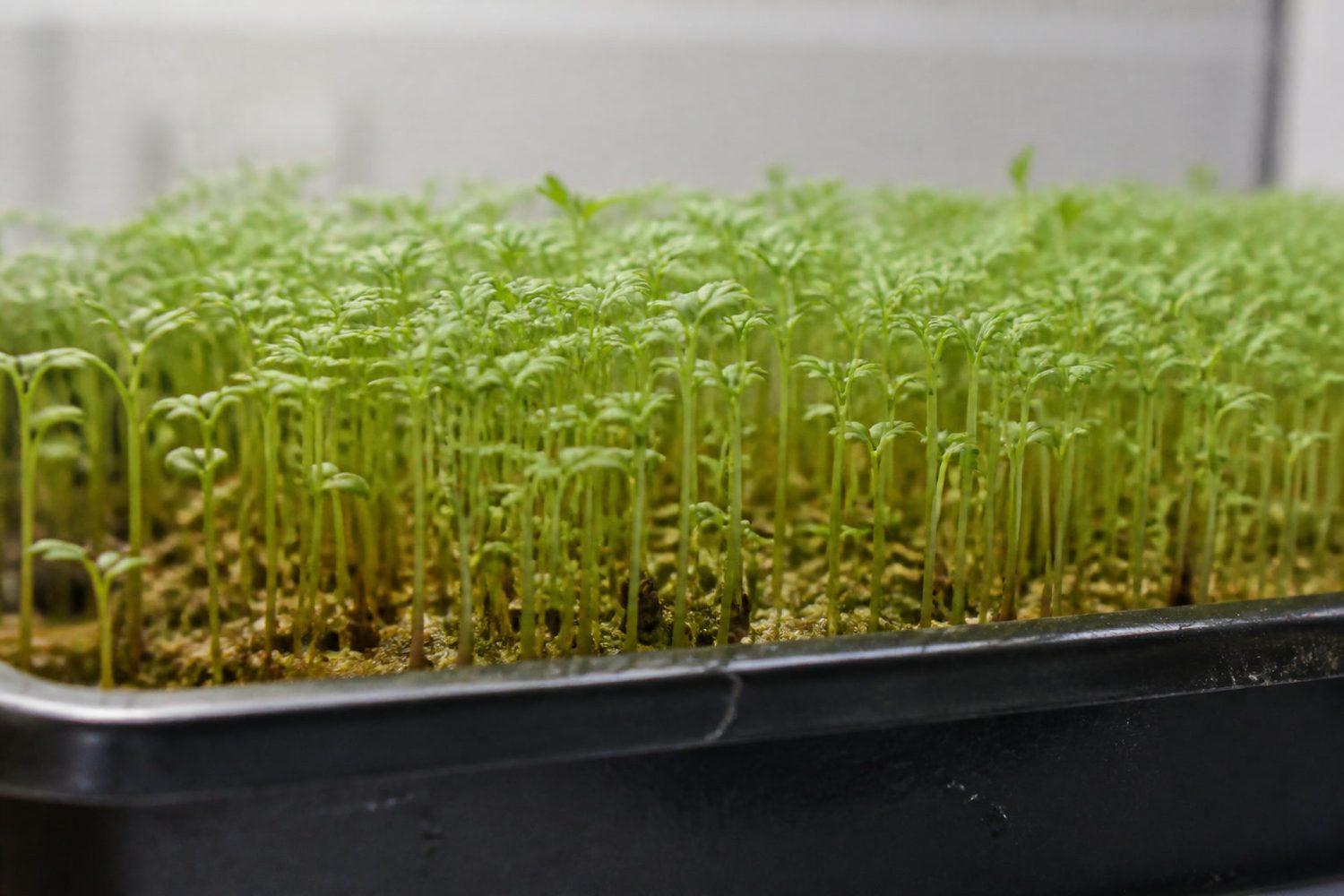
A correct tray at the cotyledon cut is a dense, level carpet of fine pale green stems carrying small, bright green, rounded cotyledons. The stems are slender rather than radish-thick, and an evenly spread sowing gives a tight uniform canopy with the medium hidden except at the cut edges. Fine white root hairs at the medium surface are normal.
Held to first true leaf, around day 13, the identifying feature arrives: Cressida's fancy three-lobed leaf. That is also the reliable way to tell garden cress from watercress, which has rounded leaflets on a branching shoot. At cotyledon stage the two are not reliably separable by eye, so do not try.
No source establishes an average stem height at a stated stage for this crop.
What it tastes like, and what to do with it
Mustardy on the tongue, then a warm pepper heat that climbs into the nose the way horseradish does and lingers there. Johnny's sells Cressida for an extra-spicy bite; the Shahi supplier says the peppery aftertaste stays in the nose. It is tender and juicy rather than tough, and the cotyledon cut is described as the sharpest and most tender.
This is a condiment, not a salad base. Use it in small volumes where a dish needs a high note: over a soft-boiled egg, through a sandwich or a wrap, on steak tartare, on a cream cheese blini, scattered across a plain salad. Its fine stems and small leaves cannot carry a bowl and its heat should not have to.
Who will not like it: anyone who dislikes mustard, watercress, radish heat or a horseradish finish. That is a real constituency, and this is not a crop to talk them round with. Sell it as an accent and let the heat be the reason somebody buys it.
Growing it: only what differs from the standard method
Everything general about trays, medium, light and watering is on the standard tray method for growing microgreens. Cress has four deltas and three of them come from the gel.
Do not soak it. Cress seed forms a mucilaginous coat the instant it meets water, so a soak produces a sticky mass that cannot be distributed. The supplier's answer for soak time is "none". Cress is one of only three mucilaginous microgreens, with chia and flax, and the only brassica among them, which matters because brassica habits otherwise transfer well and this one does not.
Broadcast dry in a single thin layer on a leveled, pre-moistened bed, and do not bury it. Mist once to start the gel. A fine seed at an inconsistent depth gives uneven emergence, and on this crop the bare patches then tempt you into the mistake below.
Cover three to five days, no weight. Nothing supports adding weight to this crop. The cover is for humidity and even germination, and it comes off when most seed has germinated and the pale shoots are lifting it, which is a signal rather than a date.
Then bottom water, and stop top spraying entirely. This is the delta that matters most. The mucilage already holds water at the surface, so top watering a covered cress tray compounds the one condition the crop cannot handle.
Hold it at 60 to 72°F. It is a cool-season crop, emergence runs one to three days in that band, and the heat-mat advice that suits warm-season microgreens does not apply.
A garden cress tray, day by day
- 1
Day 0, sow dry
10.5 g broadcast in one thin even layer on leveled, pre-moistened medium. No soak, no burying. One light mist to start the gel.
- 2
Days 1 to 3, germination
Fast. Cover on for humidity, with NO weight. Do not top spray under the cover, which is the single most consequential mistake on this crop.
- 3
Days 3 to 5, uncover
When most seed has germinated and the shoots are pushing the cover up. Bottom water from here and keep air moving.
- 4
Days 8 to 12, the cotyledon cut
Sharpest and most tender. This is the cut for a garnish sold on heat.
- 5
Day 13, first true leaf
The three-lobed leaf appears and the tray is a little heavier. This is where the trial's 8.0 oz was measured.
- 6
After cutting
Get it cold fast, at 39 to 41°F, and do not wash it before storing.
How thick to sow, and what it costs you
On almost every crop the answer to "how thick?" is somebody's opinion. On garden cress it has been measured.
Hover or tap a row to highlight it.
| Seed density | Fresh biomass | Total aerobic bacteria | What it means |
|---|---|---|---|
| 6 seeds/cm2 | Lower | 7.04 ± 0.09 log10 CFU/g | The cleanest tray tested, and not the heaviest |
| 12 seeds/cm2 | Highest of those tested | between the two ends | The yield optimum |
| 14 seeds/cm2 | No higher than 12 | 7.94 ± 0.17 log10 CFU/g | About EIGHT TIMES the bacteria of the 6 rate, for no extra crop |
Three things follow, and they are the practical content of this page.
Past the yield optimum you are only buying microbes. Biomass peaked at 12 seeds per square centimeter and did not improve at 14. Bacterial load kept climbing. There is no version of "sow it thicker" that is a trade-off above that point; it is a straight loss.
A log unit is not a small number. Going from 7.04 to 7.94 log10 CFU per gram is roughly an eightfold increase in total aerobic bacteria, and the study reports fungi rising as well. Total aerobic bacteria is a general hygiene indicator rather than a count of anything dangerous, so this is not a finding that dense cress makes people ill. It is a finding that a denser tray ships a measurably less clean product, on a crop that is eaten raw and never cooked.
The trade's own rate is already conservative. Johnny's trial figure is 10.5 g per 1020, corroborated by a second supplier at 10 g, and its own guidance is to go lower still if you intend to hold the tray to a larger true-leaf crop, because a thinner stand has better airflow and depletes water and fertility more slowly. Nothing in the measured record argues for going up.
One caveat worth stating. The study also covered rocket and pea, at their own densities, so its method is not cress-specific, but its cress numbers are. It is a single study, in one system, and the densities it tested stop at 14. Nobody has run the same experiment on the brassicas most people actually grow.
What goes wrong with garden cress specifically
Days 0 to 3, clumped or patchy emergence. From soaked or unevenly wetted seed, an uneven bed, or seed at inconsistent depth. The sign is bare patches beside seed clumps on a glossy gelled surface. Redistribute only before the radicles emerge; after that, starting again is cleaner than pulling a dense mat apart.
Through the blackout, seed rot and damping-off. From a saturated medium, a cover left on too long, crowding and poor airflow. Pythium and Rhizoctonia are the usual organisms and wet conditions are what they want. Seedlings pinch and collapse at or below the medium line. An early wet spot can be dried out by uncovering and correcting the watering; a tray with spreading collapse is a discard and a sanitize.
After emergence, mold in a wet canopy. The difference from the point above is location. Root hairs stay anchored at the roots and at the medium surface; mold migrates up the stems, spreads in expanding patches, and usually arrives with collapse or a persistently wet surface. That location test is the one to use.
And do not use the mist-and-see-if-it-vanishes test as your food-safety decision on this crop. It is a useful first look on broccoli. Here, extension guidance puts the emphasis on location, spread and seedling health instead, and cress is densely sown enough that root hairs get mistaken for mold constantly. If it is genuinely ambiguous, discard it rather than harvest it.
Late: the crop changes stage rather than spoiling. Past the cotyledon cut you are growing a first-true-leaf crop, which is slightly heavier and slightly less tender. Nobody has measured when cress becomes tough or stringy after that.
Nutrition, and what is actually established
There is no USDA record for garden cress microgreens, checked 2026-08-08. Mature cress values are not a substitute.
The claim you will meet is a mature-cress claim wearing a microgreen label. A supplier page prints roughly 516 percent of the daily value for vitamin K, 83 percent for vitamin C and 43 percent for vitamin A per 100 g, next to its microgreen listing, with no microgreen assay and no FDC identifier behind it. Those are mature-raw-cress-shaped figures. Nothing opened for this page measured any of them in a cress microgreen, and the broader immune, anti-inflammatory, antidiabetic and antihypertensive language has no cress-microgreen clinical evidence at all.
What has been measured is narrower and more interesting. Keutgen and colleagues grew garden cress microgreens under controlled conditions across mineral-nutrition treatments and measured chlorophyll, carotenoids, phenols, flavonoids, anthocyanins, antioxidant capacity, nitrate, stem length and consumer sensory response. As mineral concentration fell, carotenoids and nitrate went down and anthocyanins went up, and tasters generally preferred the highest mineral treatment.
That is a result about how you feed the crop, not a label panel, and it lines up with what flax showed from a different angle: composition moves with growing conditions, so a single per-100-g number for a microgreen is close to meaningless without the conditions attached.
Which seed to buy
Four forms are actually sold and none has been compared against another for tray yield: Cressida or Curled Cressida, Johnny's open-pollinated selection with the fancy three-lobed leaf and the trial figures on this page; Broad Leaved, an oval-leaved cultivar; Curled Garden Cress, dark green and curly from the seed-leaf stage; and Shahi, an Iranian type with long tender serrated spoon-shaped leaves and a stronger peppery finish. Choose on look and on which supplier will tell you about the lot.
Specify garden cress, Lepidium sativum, for edible microgreen or sprout production, untreated, with lot identity and a germination figure. Refuse treated field seed: dyes, fungicides and insecticides can be present in the young shoots that are eaten. And do not accept a bag labeled only "cress", because that word covers three different plants.
Seed counts vary enough between suppliers that you cannot infer one lot from another: Johnny's lists about 155,900 seeds per pound for Cressida while another supplier lists 12,000 per ounce, and one Shahi lot was published at 70 percent germination. Ask for the number rather than assuming it.
And this is the best-supplied crop in the directory. Garden cress seed on Amazon checked on 2026-08-09 returns 171 results with 43 cress listings on the first page, 36 of them garden cress, most explicitly for microgreens or sprouting, with a real size ladder from 2 oz through 4, 8 and 16 oz to 2 lb, several 1 lb bags between $15.99 and $21.77, and at least one listing naming Lepidium sativum in the title.
There is a pattern in that worth knowing before you shop. Fennel returned zero microgreen listings, fenugreek nineteen, flax eight, garden cress thirty-six. The predictor is not how popular the species is, it is whether anyone sprouts it, and cress is the archetypal sprouting seed, the one generations of schoolchildren grew on wet cotton wool.
Two traps remain, and both are visible in the title:
- Seven of the 43 cress listings are a different plant. Five watercress and two upland cress, sold on the same search under the same word. That is roughly one in six.
- Halim and aliv seed is the same species sold to be eaten, not sown. Several listings offer Lepidium sativum as a supplement for soaking in milk or water, marketed on iron and calcium. It is the fennel and fenugreek pattern again: a food-seed market for the identical plant, with no germination test and no planting lot behind it.
Is it worth growing?
Yes, and it is one of the few microgreens that is genuinely good for a beginner and genuinely interesting to a chef at the same time.
For a first tray it is hard to beat: germination in one to three days, a cut inside two weeks, no soak, no weight, about a dollar of seed, and a measured 8 ounces to plan against rather than an estimate. And unlike the mild brassicas that most beginners start with, it tastes of something, which is the complaint the beginner video in the pulse block above was making.
The honest limits are two. It spoils fast, so treat it as a cut-to-order crop rather than something you hold. And it is a condiment, so a market grower selling by weight into a mild-salad market should grow something else.
Its competition is not really another tray. It is watercress, which most buyers think they are asking for when they say cress, and which is a different species with different and harder requirements. Garden cress wins whenever the actual need is a fast, dense, spicy tray in eight to thirteen days, which is most of the time.
A note on the numbers above
Hover or tap a row to highlight it.
| Figure | Value | Source | What kind of number it is |
|---|---|---|---|
| Seed per 1020 | 10.5 g | Johnny's 2017 trial, Cressida | Measured, at first true leaf, about 3 flats per oz |
| Seed per 1020 | 10 g per 25x50 cm | Deliseeds | Independent supplier figure, close corroboration |
| Optimum density | 12 seeds/cm2 | Dubey et al., 2026 | Measured peak fresh biomass, cress |
| Bacteria at 6 seeds/cm2 | 7.04 ± 0.09 log10 CFU/g | Dubey et al., 2026 | Measured |
| Bacteria at 14 seeds/cm2 | 7.94 ± 0.17 log10 CFU/g | Dubey et al., 2026 | Measured. About 8x the load, for no extra yield |
| Yield per 1020 | 8.0 oz | Johnny's 2017 trial, Cressida | Measured, at first true leaf, from 10.5 g |
| Yield per 1020 | 7.9 to 9.9 oz | Deliseeds | Unreplicated, at an EARLIER cotyledon cut |
| Days to harvest | 13 average | Johnny's 2017 trial | Measured, to first true leaf |
| Days to harvest | 10 to 15 | Johnny's product page | Published range, no stage stated |
| Days to harvest | 8 to 12 | Deliseeds | At cotyledon stage, 64 to 72°F |
| Shelf life | 2 to 3 days | Deliseeds | Practical home advice, loosely wrapped and refrigerated |
| Shelf life | Through 15 days at 4°C | 2026 packaging study | ACTIVE MODIFIED-ATMOSPHERE polypropylene, not a home bag |
| Seeds per lb | About 155,900 | Johnny's, Cressida | Which is why hull shedding is not applicable here |
| Seed price | $41.40/lb | Johnny's, listed 2026-08-08 | Organic Cressida at 1 lb |
| Harvest window | No published figure | Nobody | How long a READY tray holds is unmeasured |
| USDA record | None for the microgreen | FoodData Central | Mature cress values are a different food |
The shelf life is two numbers that are both true and are not about the same thing. A supplier tells a home grower to use it within two to three days, loosely wrapped and cold. A 2026 study kept cress in good condition through 15 days by sealing it in active modified-atmosphere polypropylene at 4°C, and reported that 12°C storage was clearly worse. The spec block carries the two to three days because that is what a person with a clamshell and a fridge should plan on. The 15 days is real and it is a packaging result, not a shelf-life property of the crop.
This is one of the minority of microgreens with a genuinely measured yield, from the same 29-variety trial that anchors broccoli, kale, radish, mustard, cilantro, cabbage and bull's blood beet. Johnny's seeded each variety at least three times by weight in greenhouse flats and cut everything at first true leaf, and warns in its own discussion that one system's yields are unlikely to transfer perfectly to another's. Weigh your own trays before pricing.
Hull shedding is genuinely not applicable on this crop, rather than merely unmeasured. At about 155,900 seeds per pound the seed is far too fine for hulls to be a handling step, and the crop's seed problem is the gel instead. Most crops in this directory that report no hull issue report it as unestablished, because nobody measured. Cress is one of the few where the answer is that the question does not apply.
Hover or tap a row to highlight it.
| Crop | Seed per 1020 | Yield | Days | Cost per tray | Oz per $1 | Oz per tray-day |
|---|---|---|---|---|---|---|
| Cabbage, Red | 10.5 g | 8.5 oz | 13.5 | $1.27 | 6.7 | 0.63 |
| Tatsoi | 7.5 g | 8.5 oz | 13.5 | $0.93 | 9.1 | 0.63 |
| Garden cress | 10.5 g | 8.0 oz | 8 to 15 | $0.96 | 8.3 | 0.62 |
| Watercress | No published figure | No published figure | 7 to 25 | no rate to price | cannot be calculated | cannot be calculated |
| Turnip, Purple Top White Globe | 10 g | No published figure | 7 to 12 | $0.31 | cannot be calculated | cannot be calculated |
A blank means nobody has published that figure, so the cell is left empty rather than filled with an estimate. How the numbers work
All 62 crops, sortable, on the microgreen comparison.
Garden cress and Red cabbage sow at the identical 10.5 g and finish one hundredth of a point apart, at 0.62 and 0.63 ounces per tray-day. They are the same size of proposition on a bench and completely different products on a plate, which is a reminder that this table ranks bench economics and nothing else. Nobody chooses between cress and cabbage on a decimal.
Terms on this page
Tap a term to see what it means.
*Lepidium sativum*. Garden cress, the species on this page. Also sold as curly cress, peppergrass, halim and aliv.
Sources
- Johnny's Selected Seeds, microgreens yield trial results (PDF) - Cressida at 10.5 g per 1020, 8.0 oz yield and a 13-day mean to first true leaf, with the rounding and variation caveats.
- Johnny's microgreens yield trial, method and discussion - at least three seedings per variety by weight, the first-true-leaf harvest standard, and the warning that one system's yields do not transfer.
- Johnny's Cress, Cressida organic microgreen seed - Lepidium sativum, 10 to 15 days, the three-lobed leaf, the extra-spicy positioning, about 155,900 seeds per pound, the advice to seed lower for a later harvest, and the $41.40 per lb price behind the seed-cost calculation, listed 2026-08-08.
- Dubey et al., 2026, optimizing seed density in microgreens, Plants - cress tested from 6 to 14 seeds per cm2, peak fresh biomass at 12, and total aerobic bacteria rising from 7.04 ± 0.09 to 7.94 ± 0.17 log10 CFU/g across that range, with fungi also increasing. The measured basis for this page's density section.
- Keutgen et al., 2021, garden cress microgreens under mineral nutrition treatments, Agronomy - carotenoids and nitrate falling and anthocyanins rising as mineral concentration fell, sensory quality generally best at the highest treatment, and the growing conditions behind those results.
- Deliseeds, cress microgreens seeds - the no-soak instruction, 3 to 5 blackout days with no weight, 18 to 22°C, 8 to 12 days at cotyledon stage and about day 13 at first true leaf, the 10 g per 25x50 cm rate, overwatering named as the main enemy, and the 2 to 3 day practical storage advice.
- NE Seed, curled garden cress - the dark green curly form, 7 to 10 days at 60 to 70°F, and 12,000 seeds per ounce.
- Truelove Seeds, Shahi Iranian cress - the long tender serrated leaf form, the stronger peppery aftertaste, and a published 70 percent germination lot.
- University of Arkansas, cress guide (PDF) - garden cress, upland cress and watercress as separate species, and the Curled Cressida against Broad Leaved description.
- LSU AgCenter, growing microgreens - the location test for root hairs against mold, the note that they are commonly confused in densely sown trays, and washing only immediately before use.
- UC IPM, damping-off - Pythium and Rhizoctonia, and damp conditions as the setting.
- Virginia Tech Extension SPES-756 (PDF) - uncovering when most seedlings have germinated, typically 2 to 5 days, and bottom irrigation as a normal 1020 method.
- SDSU Extension, growing microgreens at home - the warning that seed treatment dyes, fungicides and insecticides can be present in the shoots that are eaten.
- Garden cress storage under modified-atmosphere packaging, 2026 - active modified-atmosphere polypropylene at 4°C retaining moisture and slowing chlorophyll, vitamin C, phenolic and microbial deterioration through 15 days, against 12°C storage.
- USDA FoodData Central - searched 2026-08-08, no garden cress microgreen record.
Keep reading
The variety directory
Arugula microgreens
Arugula is a seasoning green rather than a salad base: 10 g of seed makes 10 oz in 14 days, it is genuinely peppery, and its 10-day shelf life comes from a controlled storage study rather than an estimate.
Read Arugula microgreensThe variety directory
Broccoli microgreens
Broccoli takes 13 g of seed per 1020 tray and gives 11.5 oz at first true leaf, both from Johnny's trial. No soak, fast even germination, and the root-hair-or-mold test you will need in the first week.
Read Broccoli microgreensThe variety directory
Cabbage, red microgreens
Red cabbage is measured at 10.5 g per 1020 tray returning 8.5 oz, the lowest of the four mild brassicas measured in one trial. What it sells on is the purple veining, which no broccoli tray can give you.
Read Cabbage, red microgreensThe variety directory
Collard microgreens
The crop where more light did not buy more weight: collard was the documented exception in a controlled DLI study. Its mold risk is left blank because nobody has measured it.
Read Collard microgreens