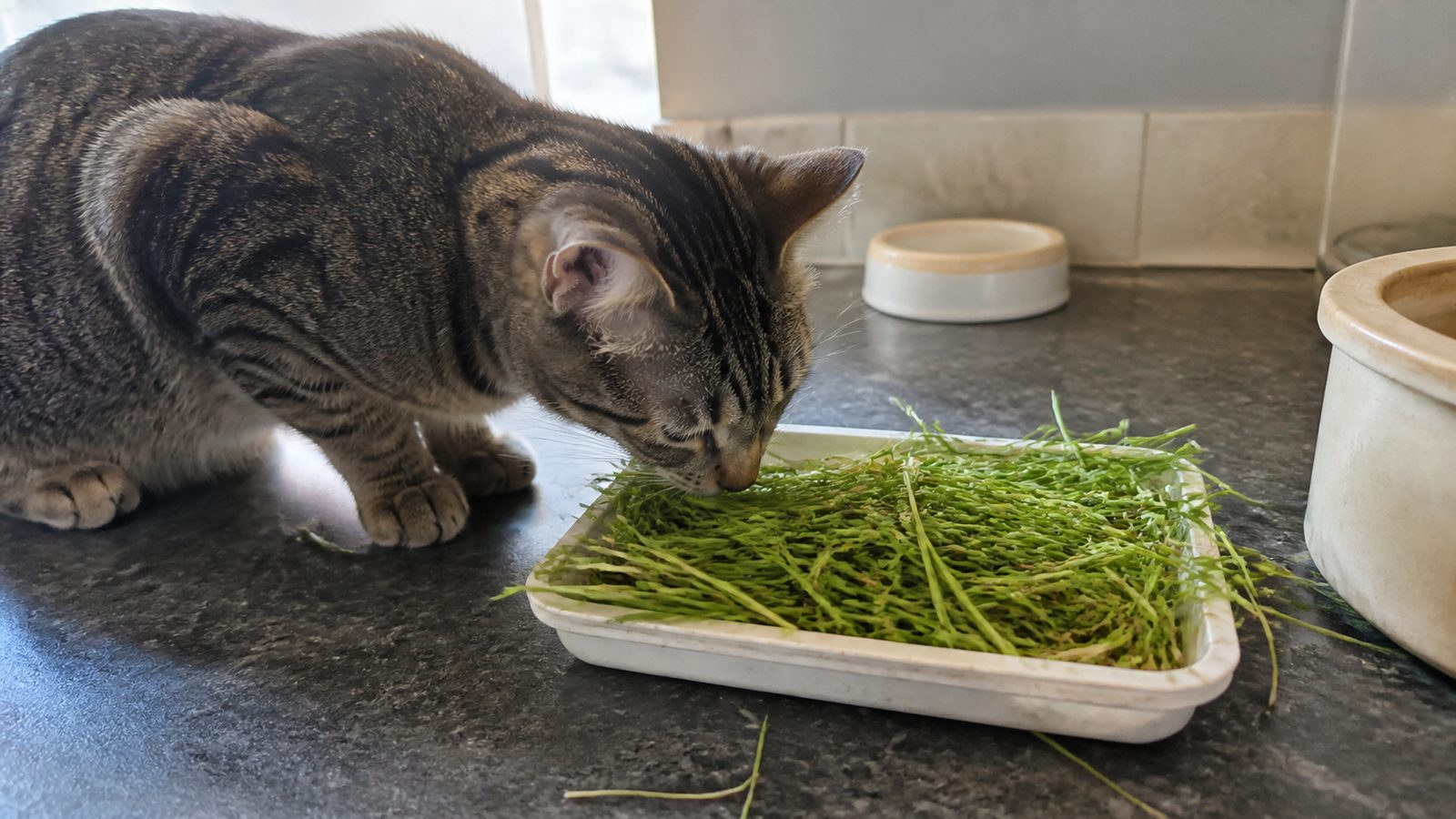
Some of them, in small amounts, as a treat. Four crops are not safe for a cat, and parsley is the one most guides leave out.
Cats have a real toxicology literature, so the answers below range from unsafe with a published dose through to genuinely non-toxic rather than collapsing into a single shrug.
Do not feed these
The alliums: onion, chives, leek and garlic. Their sulfur-containing oxidants damage feline red blood cells, producing Heinz bodies, methemoglobinemia and hemolytic anemia. Cats are the most susceptible of the common companion species, and Merck reports toxicity after less than a teaspoon of cooked onion, or 5 g per kg of body weight of raw onion. That is a small quantity for a four-kilo animal. Nobody has published a dose for allium material at microgreen stage, and the absence of that number is not a reason to find out.
Parsley. ASPCA lists Petroselinum crispum as toxic to cats, on furanocoumarins, causing photosensitization and dermatitis after large amounts. Parsley is worth dwelling on, because it is an ordinary culinary microgreen that nobody thinks twice about.
And one that is not a microgreen at all but belongs on any page a worried cat owner lands on: true lilies and daylilies cause acute kidney injury in cats. The toxic principle is still unknown, which means there is no safe part and no safe amount. If you keep cut flowers and a cat, that matters more than anything else on this page.
Parsley is the one most guides leave out
A widely shared vet-approved guide to this question gets the important half right: it names the alliums as harmful and it acknowledges that cats are obligate carnivores. It then recommends wheatgrass, alfalfa and broccoli sprouts as safe, cites no feline microgreen study or named veterinary source for any of those, and does not mention parsley.
ASPCA specifically lists parsley as toxic to cats. If you are working from a safe-foods list that does not mention it, that is the gap to close before you cut a tray.
Why a cat is not a rabbit or a chicken
A cat is an obligate carnivore, and that is not a slogan. Cats cannot convert plant beta-carotene into vitamin A and they require taurine, which plants do not supply. So, the honest framing for greens is enrichment, not nutrition: something to chew, not something that feeds them.
Which sets the ceiling. Cornell puts treats at no more than 10 to 15 percent of daily caloric intake; VCA is more conservative at 10 percent for grass specifically. Note the unit: calories, not tray size and not a percentage of body weight. No veterinary source sets a separate allowance for microgreens.
The crop table
Hover or tap a row to highlight it.
| Crop | Verdict | What stands behind it |
|---|---|---|
| Chives | Unsafe | Allium oxidants, feline hemolytic anemia. No safe dose at any stage |
| Leek | Unsafe | Same genus-level toxicology |
| Onion | Unsafe | Effects reported at 5 g/kg raw, or under a teaspoon cooked |
| Parsley | Unsafe | ASPCA-listed. Furanocoumarins, photosensitization and dermatitis |
| Basil | Safe | ASPCA lists mature basil non-toxic. A toxicity listing, not a reason to feed it |
| Cilantro | Safe | ASPCA lists mature cilantro non-toxic. Microgreen stage unstudied |
| Wheatgrass | Caution | VCA names wheat among cat-grass crops, inside the 10 percent ceiling |
| Barley grass | Caution | Same cat-grass guidance, no separate microgreen dose |
| Alfalfa | Caution | VCA includes it in cat grass. Not established as a food |
| Swiss chard | Caution | ASPCA lists the mature plant non-toxic but flags oxalic acid in large leaves |
| Radish | Not established | No feline source for the plant or the microgreen |
| Broccoli | Not established | A human-food reputation is not a feline verdict |
| Kale | Not established | No feline microgreen source |
| Pea shoots | Not established | No feline source for cut shoots |
Four different states in one table, and two things worth reading off it. "Safe" here means ASPCA lists the mature plant as non-toxic, which is a statement about poisoning and not a recommendation: basil is not cat food, it just will not hurt them. And four crops are genuinely unstudied, including broccoli and radish, which you will see recommended anyway.
Cat grass is the thing you already own
The pet aisle got there first. Cat grass is cereal grass, usually wheat, oat or barley, grown in substrate to a blade a few inches tall and nibbled above the medium. That is the same plant and very nearly the same process as growing wheatgrass or barley grass as a microgreen.
So, if you already keep a pot of cat grass, you are already doing this, and VCA's ten percent ceiling is the guidance that applies. What does not transfer in either direction is sprouted seed: FDA's sprout guidance covers whole seed germinated warm and wet, which is a different product with a different safety profile. Livestock fodder data does not transfer either.
What nobody has established
- Whether allium toxicity at microgreen stage differs from the bulb. The mechanism is genus-level and established; the stage-specific dose is not, and this is the one gap where nobody should be curious.
- Any feline feeding study of any microgreen, at any stage. Every "safe" above is a mature-plant toxicity listing rather than a trial.
- Whether cats get anything at all from greens beyond something to chew.
- Whether a cat can be harmed by drinking from a microgreen tray, which is a real question people ask and which no source addresses.
If your cat has eaten allium or parsley material, that is a call to a veterinarian or to a pet poison line, not a wait-and-see.
The four verdicts on this page, and what each one is telling you
Hover or tap a card to highlight it.
Safe
ASPCA lists the mature plant non-toxic to cats. Basil and cilantro. It means it will not poison them, not that it feeds them.
Caution
Allowed within a stated limit, such as the cat-grass crops inside VCA's ten percent ceiling.
Unsafe
A veterinary or ASPCA source says avoid, with a mechanism. Four crops in the table above, and one of them is parsley.
Not established
Nobody credible has looked. Four crops, including broccoli and radish.
The terms on this page, in plain words
Tap a term to see what it means.
Obligate carnivore. An animal whose body requires nutrients that only come from animal tissue. A cat cannot convert plant beta-carotene into vitamin A, and plants do not supply taurine.
Sources
- Merck Veterinary Manual, Allium toxicosis - the feline mechanism, and the doses: 5 g/kg raw onion, under a teaspoon cooked.
- ASPCA, parsley - listed toxic to cats, furanocoumarins.
- ASPCA, basil and cilantro - listed non-toxic.
- ASPCA, beets - non-toxic with an oxalic acid note.
- ASPCA on feline toxins - lilies and acute kidney injury.
- Merck, nutritional requirements of small animals - beta-carotene conversion and taurine.
- Cornell Feline Health Center - treats at 10 to 15 percent of calories.
- VCA, grass treats for cats - the cat-grass crops and the 10 percent ceiling.
- FDA, seeds used for sprouting - why sprout guidance does not transfer.
- Dial A Vet - the vet-approved page that omits parsley.
Keep reading
Animals and microgreens
Can Dogs Eat Microgreens?
Five groups of these crops are unsafe for dogs with sources, including buckwheat and parsley, which almost nobody names. The sunflower clearance people cite is a different species.
Read Can Dogs Eat Microgreens?Animals and microgreens
Can Guinea Pigs Eat Microgreens?
The one pet where microgreens have a real nutritional case, and it still does not hold. Merck needs 10 mg of vitamin C per kg per day; USDA measured 20.4 to 147 mg per 100 g across 25 microgreens.
Read Can Guinea Pigs Eat Microgreens?Animals and microgreens
Can Hamsters Eat Microgreens?
A teaspoon a day for a dwarf and a teaspoon or two for hamsters generally, inside a 10 percent ceiling. Plus the hoarding problem nobody warns you about, which is the real risk with wet food.
Read Can Hamsters Eat Microgreens?Animals and microgreens
Can Parrots and Pet Birds Eat Microgreens?
Yes, as part of the fresh food. But the hazard on your worktop is avocado, where 8.7 g of mashed fruit killed a budgerigar within 48 hours, and no microgreen has an avian dose at all.
Read Can Parrots and Pet Birds Eat Microgreens?