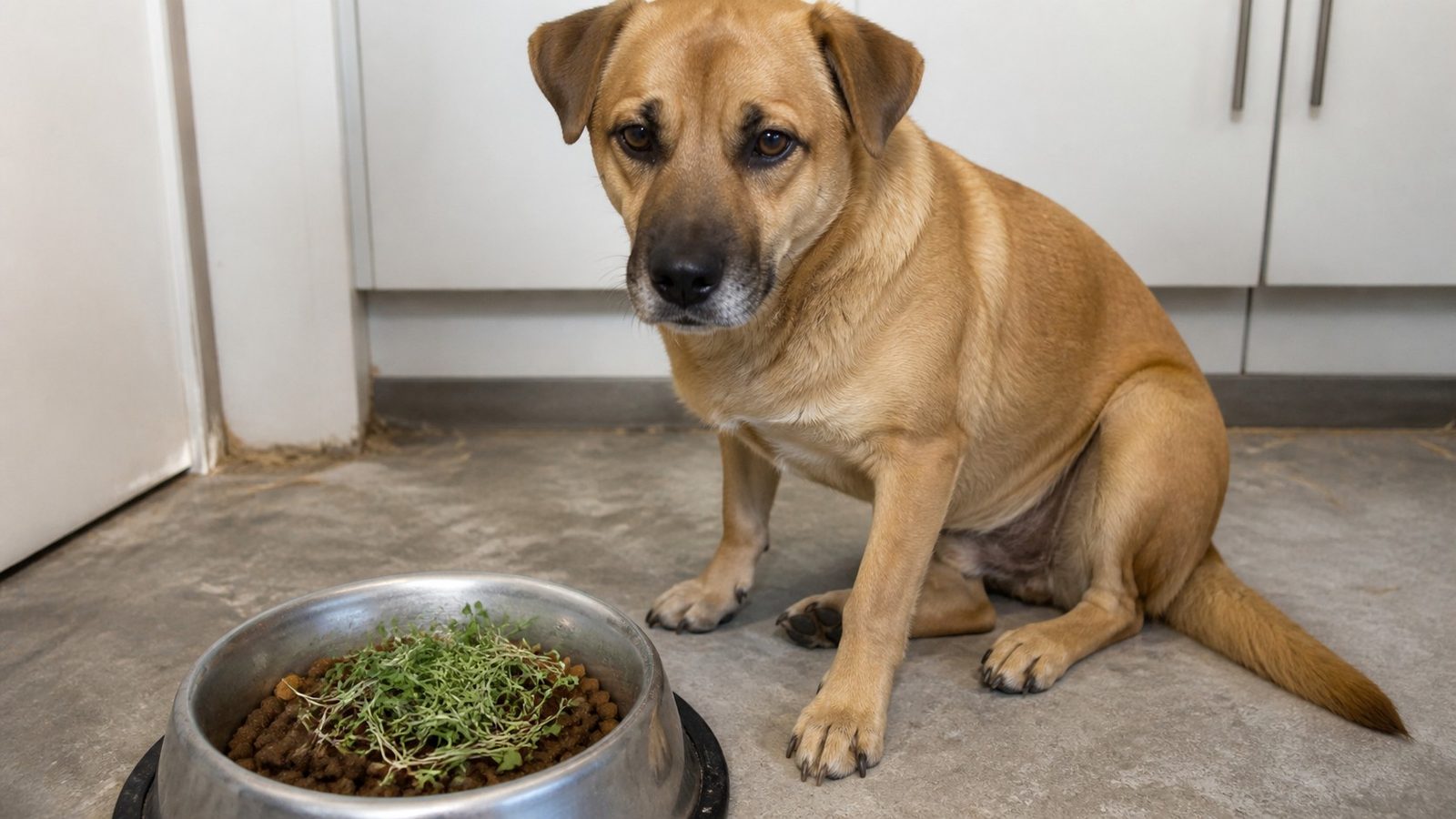
Most of them, in small amounts. Five groups of crops are not safe for a dog, and two of the five are ones almost nobody names: buckwheat and parsley.
What a plant listing does and does not tell you
The ASPCA's toxic and non-toxic plant list for dogs is the most useful single reference for this, because it names the plant, its scientific name and, where there is one, the toxic principle and the signs it causes. Every entry describes the plant, though, not a microgreen, and none of them gives a feeding amount. A "non-toxic" listing means the plant is not expected to poison a dog. It does not tell you how much of a tray a dog can eat, or how often.
That matters most for the crops in the middle of the table below. Treat a non-toxic listing as permission to offer a small, occasional amount inside the treat share, not as a serving size. Treat a toxic listing as a reason to keep the tray where the dog cannot reach it.
The five to keep away from a dog
The alliums: onion, chives, leek and garlic. Sulfur oxidants cause canine red-cell injury. Merck reports signs in dogs at 15 to 30 g of raw onion per kg of body weight, which is a lot more than the feline threshold but is still a real number on a real curve. No dose exists for allium material at microgreen stage.
Buckwheat. This one surprises people. **ASPCA lists Fagopyrum species as toxic to dogs**, naming fagopyrin, causing photosensitization, sunburn and dermatitis. It is a whole-plant listing with no canine dose, and no dog has been fed buckwheat microgreens in a study, so the stage limitation stands. But the basis is real and traceable.
Parsley. ASPCA lists it toxic to dogs as well as cats, on furanocoumarins, again photosensitization and dermatitis after large amounts.
Buckwheat and parsley are the two worth remembering, because they are ordinary culinary microgreens that nobody treats as hazardous.
Crops with a toxic listing: keep these away from the dog
These five groups are the ones to keep off the shelf the dog can reach, and out of any mix you grow for the house.
The onion family
Onion, garlic, chives and leek all appear on the ASPCA list as toxic to dogs (onion, garlic, chives, leek). These turn up in some spicy or savory microgreen mixes, so read the seed list on any blend before you grow it in a house with a dog.
The Merck Veterinary Manual explains why: onion-family plants contain sulfur-containing oxidants that damage red blood cells, and raw, cooked or concentrated forms are all toxic. Merck reports clinical signs in dogs after 15 to 30 g/kg of raw onion, and puts garlic at three to five times more toxic than onion. That onion figure is a dose that has caused illness in mature onion, not a safe amount and not a microgreen amount, so do not use it to judge a nibble. VCA adds that onion, garlic, chives and leeks are poisonous raw, cooked, dried, powdered and in liquid form.
Buckwheat
The ASPCA lists buckwheat (Fagopyrum spp.) as toxic to dogs. The toxic principle is fagopyrin, and the signs are photosensitization, which means the skin becomes unusually sensitive to sunlight and can burn or develop dermatitis. No canine dose is given for buckwheat sprouts or microgreens, so keep a buckwheat tray out of reach rather than guessing at a safe nibble.
One thing to check on the packet: the ASPCA lists wild buckwheat, a different genus sometimes called sulfur flower, as non-toxic. That entry does not cover the cultivated buckwheat sold for microgreens.
Parsley
The ASPCA lists parsley (Petroselinum crispum) as toxic to dogs. The toxic principle is furanocoumarins, and the listed sign is photosensitization, with the ASPCA's own qualifier that "large amounts are needed to cause this effect." It gives no dose.
UC Davis Veterinary Medicine takes a different view in a landscaping article, where parsley appears among plants "safe to have around pets and livestock." The practical reading is simple: a dog that grabs a few stems is unlikely to have a problem by the ASPCA's own note, but parsley carries a toxic listing from a poison-control service, so keep the tray out of reach and do not add it to the bowl.
Watercress and sorrel
Both are grown as microgreens and both carry ASPCA toxic listings. Watercress (Nasturtium officinale) contains gastrointestinal irritants and can cause mild vomiting and diarrhea. Sorrel (Rumex scutatus) contains soluble oxalates, and the ASPCA says small exposures cause GI upset. Each listing covers that plant only; it does not carry over to other crops in the same family, such as the rest of the mustard family alongside watercress.
Crops listed non-toxic as plants
The ASPCA lists basil (Ocimum basilicum) and cilantro (Coriandrum sativum) as non-toxic to dogs. UC Davis also includes basil among plants safe to have around pets.
Beets (Beta vulgaris) are listed as non-toxic, and Swiss chard is one of the common names on the same entry, so the listing covers both. The ASPCA adds that "large mature leaves contain oxalic acid." A microgreen is not a large mature leaf, but if your dog has a history of kidney or bladder stones, the AKC's kale page names beet greens and Swiss chard among foods high in calcium oxalate that stone-prone dogs should avoid. Ask your vet before offering either to that dog.
For amaranth, the non-toxic listing is for cocks comb, Amaranthus hypochondriacus, and that one species only. Amaranth seed is sold under several species, so check that your packet names A. hypochondriacus before treating the listing as yours.
Sunflower, where the clearance you will see is for a different species
You will see "sunflower is ASPCA non-toxic" used to green-light sunflower microgreens for dogs.
**The ASPCA plant database entry is for Helianthus angustifolius, swamp sunflower.** The crop in a microgreen tray is Helianthus annuus. A non-toxic listing for one species in a genus is not a clearance for another, and it is certainly not a clearance for a different growth stage of another. Sunflower is not established for dogs as a microgreen. It is not flagged as dangerous either; it is simply not answered, and the citation people pass around does not answer it.
Sunflower
Sunflower shoots are one of the most common trays, and the listing is less tidy than it looks. The ASPCA's plant database entry is for swamp sunflower, Helianthus angustifolius, not the usual crop sunflower, Helianthus annuus. A separate ASPCA garden article from May 2, 2024 lists "Sunflower (Helianthus spp.)" among plants non-toxic to dogs and cats, which covers the genus as a whole. No ASPCA page names H. annuus or addresses the seedling stage.
In practice, that makes sunflower a crop to treat like the other non-toxic listings: a few shoots as an occasional extra inside the treat share, not a regular heap. Keep the hulls and the root mat out of it, since dogs do not need the growing medium or seed coats that come with a pulled clump.
The crop table
Hover or tap a row to highlight it.
| Crop | Verdict | What the evidence supports |
|---|---|---|
| Chives | Unsafe | Allium sulfur oxidants, canine red-cell injury. No safe dose at any stage |
| Leek | Unsafe | Same allium mechanism |
| Onion | Unsafe | Signs at 15 to 30 g raw onion per kg body weight |
| Garlic | Unsafe | Same ASPCA listing as the other alliums: N-propyl disulfide; vomiting, Heinz body anemia, blood in urine, weakness, high heart rate, panting. Merck puts garlic at three to five times more toxic than onion |
| Buckwheat | Unsafe | ASPCA, fagopyrin, photosensitization and dermatitis. No canine dose |
| Parsley | Unsafe | ASPCA, furanocoumarins, photosensitization after large amounts |
| Watercress | Unsafe | ASPCA, gastrointestinal irritants, mild vomiting and diarrhea |
| Sorrel | Unsafe | ASPCA, soluble oxalates. Small exposures cause GI upset |
| Basil | Safe | ASPCA non-toxic plant listing, no toxic principle. A listing, not a serving size |
| Cilantro | Safe | ASPCA non-toxic plant listing, no toxic principle |
| Beet and Swiss chard | Safe | ASPCA non-toxic, with "large mature leaves contain oxalic acid." Ask your vet first if your dog forms stones |
| Amaranth | Safe | ASPCA non-toxic for Amaranthus hypochondriacus only. Check your seed packet names this species |
| Broccoli | Caution | Mature broccoli: isothiocyanate GI irritation, considered safe under 10 percent of daily intake, potentially toxic above 25. Not a microgreen dose |
| Kale | Caution | Mature kale: calcium oxalate and isothiocyanates. Advised against as a regular treat, and relevant to stone-prone dogs |
| Sunflower | Not established | The ASPCA database listing is a different species. See above |
| Radish | Not established | Do not substitute ASPCA's wild-radish horse listing for the cultivated crop |
| Mustard | Not established | Species-ambiguous, and the dog verdict cannot be inferred from horse listings |
| Arugula | Not established | No canine source |
| Carrot | Not established | No canine microgreen source |
| Pea shoots | Not established | No canine source. Do not confuse garden pea with sweet pea, which is a different genus |
| Wheatgrass | Not established | A retail "pet grass" claim is not evidence |
| Alfalfa | Not established | No canine source |
The two CAUTION rows are the only ones with a real percentage attached, and they are about mature plants: broccoli under ten percent of daily intake considered safe, above twenty-five potentially toxic. Take that as the shape of the risk rather than as a microgreen allowance, because the isothiocyanate content of a broccoli seedling has not been measured against the adult head.
Crops the ASPCA list does not include
Broccoli, kale, radish, cabbage, mustard, arugula, pea shoots, wheatgrass, alfalfa, clover, spinach and chia have no entry on the ASPCA dog list. That is not a toxic finding and it is not a clearance either. It means you are working without a listing, so start with one crop at a time, keep the amount small, and watch your dog for a day afterward.
Two of these have extra detail from the AKC, a kennel club rather than a veterinary text. On broccoli, the AKC quotes its chief veterinarian, Dr. Jerry Klein, that broccoli is "considered safe in dogs if the total amount ingested is less than 10% of their daily intake; more than 25% is considered toxic." That quote is about mature broccoli, and the page does not say whether daily intake means calories or weight. He also says the florets contain isothiocyanates that can cause "mild-to-potentially-severe gastric irritation in some dogs." On kale, the AKC says it contains calcium oxalate and isothiocyanate, "could be safe in small quantities" and "should not be a regular treat." The same page lists spinach among the high-oxalate foods for stone-prone dogs.
How much
There is no established microgreen quantity for a dog. The broccoli figure above is the closest any crop-specific figure comes, and it is a mature-vegetable rule for one crop.
A dog does not need these. A complete diet is complete. Greens here are a topper, an enrichment, a way to use a tray that is about to bolt. That sets the sensible quantity better than any percentage would.
How much is sensible: the 10% treat share
There is no published microgreen serving for dogs in grams or pinches, so work from the calorie rule veterinary sources give for every extra your dog eats. UC Davis, VCA and WSAVA all put treats and additional foods at under about 10% of daily calories, with the rest coming from a complete and balanced diet. The 10% is for all extras combined, so greens share it with biscuits, chews and table scraps. UC Davis gives the simple version: a dog eating 100 calories a day should get no more than 10 calories from treats and other foods.
WSAVA's owner sheet (v2, 2024) sets out the ceiling by body weight for an average healthy adult dog in ideal condition:
Hover or tap a row to highlight it.
| Dog's weight | Maximum treat calories per day |
|---|---|
| 2 kg | 14 kcal |
| 10 kg | 47 kcal |
| 20 kg | 79 kcal |
| 30 kg | 108 kcal |
| 45 kg | 146 kcal |
Microgreens are low in calories, so the limit here is rarely the greens themselves; it is everything else already in that allowance. Keep the amount small and occasional anyway, because the calorie rule does not cover how a dog's stomach handles a new food. Dial A Vet, a vet-reviewed site, suggests starting with about a teaspoon and offering microgreens occasionally rather than daily. WSAVA's advice is to talk to your dog's veterinary team about a suitable quantity and type of treat, and that goes double for a dog on a prescription diet or with a medical condition.
What nobody has established
- Any canine feeding study of any microgreen, at any stage.
- Whether isothiocyanate content in broccoli or kale at microgreen stage resembles the mature plant, which is what the two caution rows on this page rest on.
- Whether fagopyrin in buckwheat is present at microgreen stage at all, which is the difference between a real warning and an inherited one.
- Any allium dose at microgreen stage, in any species.
If a dog has eaten allium material, that is a call to a veterinarian rather than a wait, and the 15 to 30 g per kg figure is a threshold for signs and not a safe allowance below it.
If your dog has eaten something from the tray
Start by working out which crop it was and roughly how much is missing. Take a photo of the tray or keep a stem, because UC Davis advises bringing plant material to the vet if poisoning is suspected.
If the crop is buckwheat, parsley in any real quantity, or anything from the onion family, call your veterinarian or ASPCA Poison Control as soon as possible, even if your dog seems fine. Onion-family damage can take days to show. Merck notes that red blood cell changes begin within 24 hours and that the breakdown of red blood cells typically happens 3 to 5 days after exposure.
For onion, garlic, chives or leek, VCA lists weakness, elevated heart rate, faster and harder breathing, pale gums and red-colored urine as signs, and says to call a veterinarian or Pet Poison Helpline right away. Merck adds lethargy, loss of appetite, exercise intolerance, jaundice and collapse. For buckwheat and parsley, the ASPCA sign is photosensitization, which shows as sunburn-like reddening or dermatitis on the skin. For watercress and sorrel, the ASPCA lists vomiting, diarrhea and stomach upset.
Growing medium, tray water, seed hulls and moldy greens are a separate question with no measured risk figure, so treat them all as off limits: keep the dog away from them, and throw out any tray with visible mold rather than letting the dog finish it.
FAQ
Are sunflower microgreens safe for dogs? An ASPCA garden article from May 2, 2024 lists sunflower (Helianthus spp.) as non-toxic to dogs and cats. It names no species and does not address seedlings, and the ASPCA's database entry covers swamp sunflower rather than crop sunflower. Offer a few shoots occasionally, inside the 10% treat share, without the hulls.
Can dogs eat pea shoots? The ASPCA dog list has no entry for garden pea, so there is no listing to lean on either way. If you want to try them, offer a small amount of that one crop on its own and watch your dog for the next day. Ask your vet first if your dog has a medical condition or a special diet.
My dog ate a microgreen mix. What should I check? Read the seed list on the mix packet for onion, garlic, chives, leek, buckwheat, parsley, watercress or sorrel. If any of those are in it, call your vet or ASPCA Poison Control as soon as possible. If none are, stop offering the mix and call your vet if vomiting, diarrhea or weakness appears.
Is wild buckwheat the same as buckwheat microgreens? No. The ASPCA lists wild buckwheat, a plant in a different genus, as non-toxic, and cultivated buckwheat (Fagopyrum spp.) as toxic because of fagopyrin. Buckwheat sold for microgreens is the cultivated kind.
Keeping the shelf dog-safe
The simplest setup is to grow the toxic-listed crops, if you grow them at all, on a shelf the dog cannot reach, and keep the bowl extras to basil, cilantro, beet, chard, the listed amaranth or a few sunflower shoots, all inside the treat share. If you also keep a cat, the cat guide covers its own list, and growing microgreens for animals covers tray setup for a house with pets.
The four verdicts on this page, and what each one is telling you
Hover or tap a card to highlight it.
Safe
A veterinary or ASPCA source clears it for dogs. Basil, cilantro, beet and chard, and one amaranth species reach it as plants, and the sunflower database listing people cite is a different species.
Caution
Allowed within a stated limit. Broccoli and kale, both on mature-plant guidance rather than on a microgreen dose.
Unsafe
A source says avoid, with a mechanism. Five groups: the alliums, buckwheat, parsley, watercress and sorrel.
Not established
Nobody credible has looked. Eight crops, and it is different from both safe and unsafe.
The terms on this page, in plain words
Tap a term to see what it means.
Heinz bodies. Clumps of damaged hemoglobin inside red blood cells, the signature of allium poisoning across species.
Sources
- Merck Veterinary Manual, Allium toxicosis - the canine mechanism and the 15 to 30 g/kg figure.
- VCA, onion, garlic, chive and leek toxicity in dogs - the same group, treated clinically.
- ASPCA, buckwheat - Fagopyrum, fagopyrin, toxic to dogs.
- ASPCA, parsley - furanocoumarins, toxic to dogs.
- ASPCA, sunflower - the non-toxic listing, which is H. angustifolius.
- AKC, Dr. Jerry Klein on kale - calcium oxalate and isothiocyanates, and the advice against regular treats.
- toxic and non-toxic plant list for dogs
- onion
- garlic
- chives
- leek
- wild buckwheat
- landscaping article
- Watercress
- Sorrel
- basil
- cilantro
- Beets
- cocks comb
- garden article
- broccoli
- UC Davis
- VCA
- WSAVA
Keep reading
Animals and microgreens
Can Cats Eat Microgreens?
Some yes, four unsafe. Parsley is ASPCA-listed toxic to cats and the alliums have a published feline dose, while greens are enrichment for a cat rather than nutrition.
Read Can Cats Eat Microgreens?Animals and microgreens
Can Guinea Pigs Eat Microgreens?
The one pet where microgreens have a real nutritional case, and it still does not hold. Merck needs 10 mg of vitamin C per kg per day; USDA measured 20.4 to 147 mg per 100 g across 25 microgreens.
Read Can Guinea Pigs Eat Microgreens?Animals and microgreens
Can Hamsters Eat Microgreens?
A teaspoon a day for a dwarf and a teaspoon or two for hamsters generally, inside a 10 percent ceiling. Plus the hoarding problem nobody warns you about, which is the real risk with wet food.
Read Can Hamsters Eat Microgreens?Animals and microgreens
Can Parrots and Pet Birds Eat Microgreens?
Yes, as part of the fresh food. But the hazard on your worktop is avocado, where 8.7 g of mashed fruit killed a budgerigar within 48 hours, and no microgreen has an avian dose at all.
Read Can Parrots and Pet Birds Eat Microgreens?