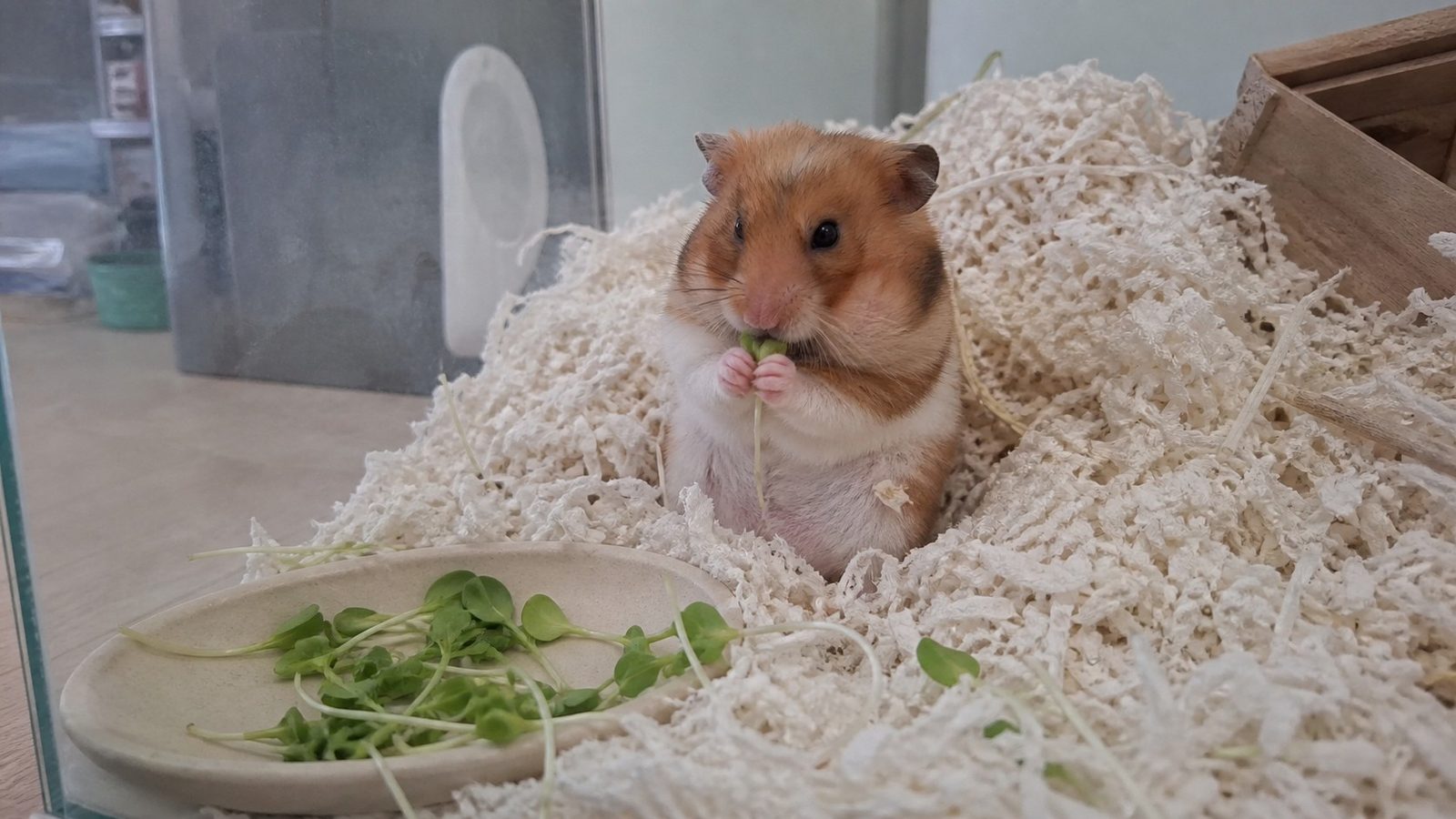
Yes, in very small amounts. One teaspoon of fresh vegetables a day for a dwarf hamster, inside a ceiling of ten percent of the total diet for every treat and vegetable combined.
For hamsters in general, Syrians included, PDSA says a teaspoon or two of fruit, vegetables and herbs a day. Do not get a Syrian amount by scaling the dwarf figure up.
People ask about this crop by crop: radish, mustard greens, collard greens, basil, wheatgrass, kale, pea shoots. The answer is the same for every one of them.
The numbers, and the unit they are in
PetMD's veterinarian-reviewed dwarf hamster care sheet gives one teaspoon of fresh vegetables per day, and puts grains, vegetables, fruit, hay and treats together at no more than ten percent of the daily diet. Merck applies the same ten percent to hamsters generally. The other ninety percent is the balanced pelleted or lab-block diet, and that is the part that actually feeds the animal.
Two cautions about that teaspoon, because it is the number everyone will take away.
It is for a dwarf, and it is not per kilogram. UC Davis puts adult dwarfs at 28 to 57 g and Syrians at 87 to 130 g. The source never states the body weight its teaspoon assumes, so multiplying it by the size difference invents a dose that nobody published. For a Syrian, use PDSA's general figure for all hamsters, a teaspoon or two a day of fruit, vegetables and herbs together, rather than a scaled-up dwarf dose.
It is a household measure, not a dose-response result. Nobody has run a hamster trial on microgreens, so this is the general fresh-vegetable allowance being applied to a food nobody tested.
The thing nobody warns you about: they will hoard it
This is the species-specific risk and it is not toxicity.
Hamsters transport and store food in cheek pouches that extend back toward the shoulder blades, and they cache what they do not eat. A clinical review notes pouch impaction and eversion, most often linked to dental disease. But the practical hazard with a wet food is simpler than that: a hamster will take fresh greens away and bury them, and buried wet greens spoil.
So, the instruction that matters is not about quantity at all. Offer a small amount, and go and find what did not get eaten. Remove leftovers and any cached wet material from the bedding the same day. No source has shown that wet or fibrous microgreens cause pouch impaction at any stated amount, and no crop compound is implicated, so do not let anyone sell you a fear about the pouches themselves. The spoilage is the real thing.
On the related worry: fresh greens add water, and abrupt diet changes and too much fresh food can upset a hamster's gut. Wet tail dehydrates an animal this small very quickly. No water-content threshold has ever been established, which is exactly why the teaspoon ceiling is worth respecting instead of improvised.
Every crop asked about, and the same answer fourteen times
Hover or tap a row to highlight it.
| Crop | Verdict | What the evidence supports |
|---|---|---|
| Radish | Not established | No credible hamster source for the microgreen or the mature plant |
| Mustard | Not established | Penn State identifies brassica microgreens as glucosinolate-containing. That is composition, not hamster safety |
| Collard | Not established | No credible hamster source at any stage |
| Basil | Not established | No credible hamster source at any stage |
| Wheatgrass | Not established | No credible hamster source treats it separately |
| Broccoli | Not established | UC Davis says hamsters may enjoy MATURE broccoli. No microgreen study, no dose |
| Kale | Not established | Community reports exist. They are not safety evidence |
| Pea shoots | Not established | No credible hamster source |
| Alfalfa | Not established | No credible hamster source |
| Clover | Not established | No credible hamster source |
| Arugula | Not established | No credible hamster source |
| Cilantro | Not established | No credible hamster source |
| Spinach | Not established | UC Davis and PetMD list MATURE spinach for hamsters. Neither tests the microgreen or establishes oxalate exposure |
| Swiss chard | Not established | No credible hamster source at any stage |
Fourteen rows and one verdict. Three of them have a mature-vegetable mention behind them, which is the closest anything comes, and a mention of adult broccoli in a care sheet is not a study of broccoli microgreens.
None of this says these crops are dangerous. It says the specificity of the question, "can hamsters eat radish", has no matching specificity in the evidence, whatever a confident crop list tells you.
One claim to put down
You will see it said that dwarf hamsters need different rules because they are diabetes-prone. The metabolic concern is real in the general literature. **What does not exist is any hamster microgreen sugar figure, or any crop-level distinction between a Syrian and a Phodopus dwarf**, so nobody can tell you which of these crops a dwarf should avoid. Turning a general metabolic worry into a specific feeding rule is inventing guidance, and the actual difference that matters between the two is body size and therefore portion.
What nobody has established
- Any hamster feeding study of any microgreen, at any stage.
- A fresh-green quantity for a Syrian, which is the more common pet of the two.
- The water content or amount at which fresh greens upset a hamster's gut.
- Whether wet or fibrous material poses any pouch risk distinct from other foods.
- Whether the dwarf teaspoon should scale with body weight at all.
Introduce one new food at a time so that if something disagrees with the animal you know what it was, and take an individual amount from an exotics veterinarian rather than from a care sheet written for a different species of hamster.
Offering greens to a hamster, in order
Hover or tap a card to highlight it.
Start with less than you think
One teaspoon a day is the documented ceiling for a dwarf. For hamsters generally, PDSA says a teaspoon or two a day, so start at a teaspoon rather than scaling up.
One new food at a time
If something disagrees with the animal you need to know what it was. Introduce a second only once the first has been fine for several days.
Go back and look
A hamster will pouch what it does not eat and bury it. This is the step everyone skips.
Remove the cache the same day
Buried wet greens spoil in the bedding. This, not toxicity, is the realistic hazard with fresh food.
Stop for wet or loose droppings
Wet tail dehydrates an animal of 30 to 130 grams very fast. Stop the new food and call an exotics vet.
The terms on this page, in plain words
Tap a term to see what it means.
Cheek pouch. The expandable pocket a hamster carries food in, running back toward the shoulder blades. Used for transport and hoarding rather than chewing.
Sources
- PDSA, your hamster's diet - a teaspoon or two of fruit, vegetables and herbs a day, for hamsters generally.
- PetMD, dwarf hamster care sheet - the one teaspoon of fresh vegetables a day, and the ten percent combined ceiling.
- Merck Veterinary Manual, providing a home for a hamster - the same ten percent limit for hamsters generally.
- UC Davis School of Veterinary Medicine, hamster care - adult body weights, 87 to 130 g Syrian against 28 to 57 g dwarf, and mature vegetables hamsters may enjoy.
- Merck Veterinary Manual, hamsters - impacted pouches in routine examination.
- Royal Veterinary College clinical review - pouch anatomy, impaction and eversion, and the dental link.
- PetMD, wet tail in hamsters - how fast dehydration moves in an animal this size.
- PetMD, how to care for your hamster - introducing one food at a time.
Keep reading
Animals and microgreens
Can Cats Eat Microgreens?
Some yes, four unsafe. Parsley is ASPCA-listed toxic to cats and the alliums have a published feline dose, while greens are enrichment for a cat rather than nutrition.
Read Can Cats Eat Microgreens?Animals and microgreens
Can Dogs Eat Microgreens?
Five groups of these crops are unsafe for dogs with sources, including buckwheat and parsley, which almost nobody names. The sunflower clearance people cite is a different species.
Read Can Dogs Eat Microgreens?Animals and microgreens
Can Guinea Pigs Eat Microgreens?
The one pet where microgreens have a real nutritional case, and it still does not hold. Merck needs 10 mg of vitamin C per kg per day; USDA measured 20.4 to 147 mg per 100 g across 25 microgreens.
Read Can Guinea Pigs Eat Microgreens?Animals and microgreens
Can Parrots and Pet Birds Eat Microgreens?
Yes, as part of the fresh food. But the hazard on your worktop is avocado, where 8.7 g of mashed fruit killed a budgerigar within 48 hours, and no microgreen has an avian dose at all.
Read Can Parrots and Pet Birds Eat Microgreens?