Can Parrots and Pet Birds Eat Microgreens?
Cal HewittPublished Checked
- parrots
- birds
- pets
- animal feeding
- safety
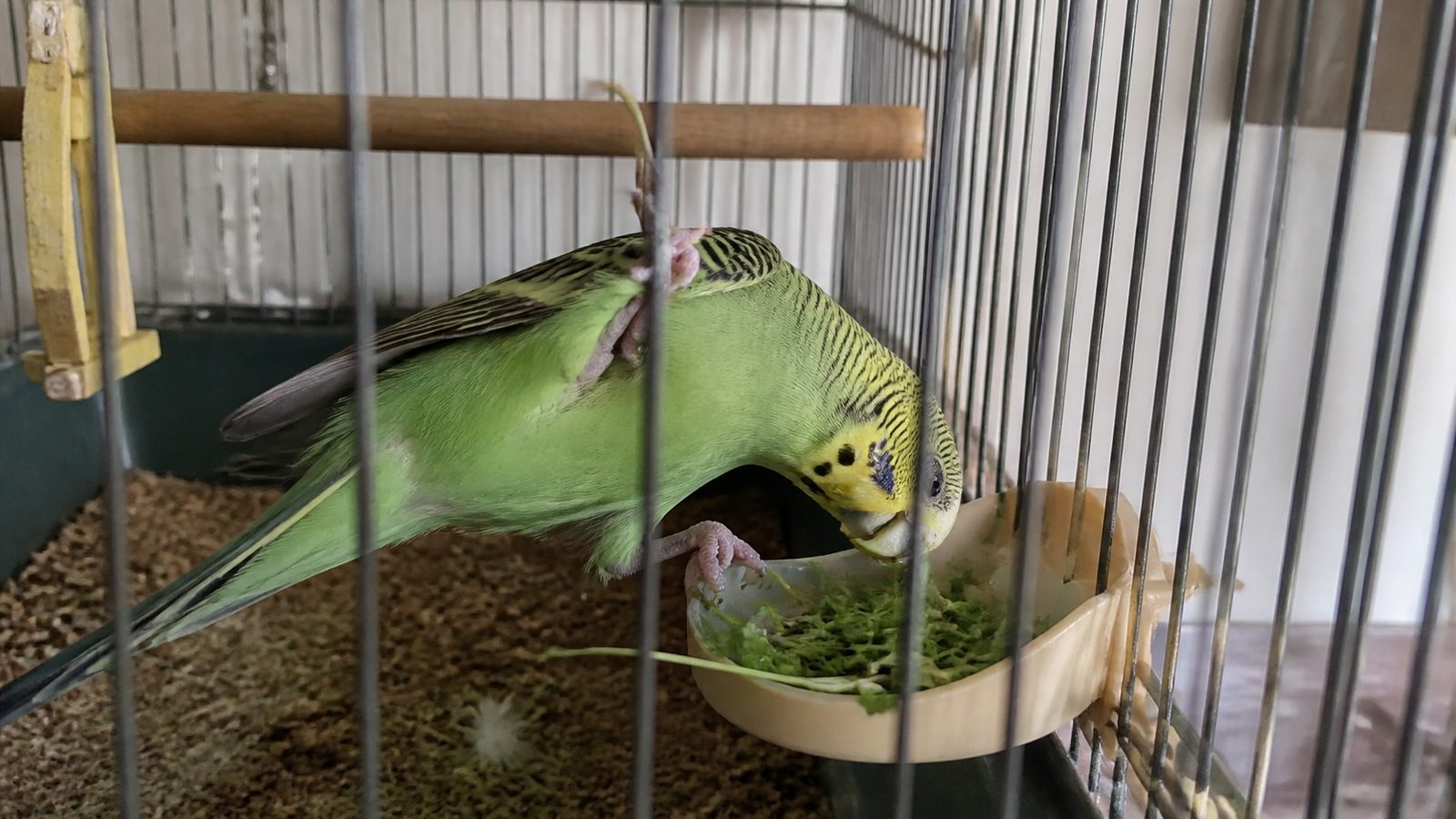
Yes, within the fresh food part of the diet. And if you already sprout seed for your birds, which is long-standing practice in aviculture, you are doing something adjacent and doing it right.
But before any of that, the thing that actually kills pet birds in a kitchen is not on the crop list below.
Avocado first, because it has a real avian dose
Avocado is not a microgreen, and it is still the thing to deal with first. If you are working out which greens are safe for a parrot, the genuine hazard is probably already on your worktop.
Persin is the toxic principle and it causes myocardial necrosis, damage to the heart muscle. Merck lists budgerigars and cockatiels among susceptible species and gives numbers of a precision that is rare in this subject: 1 g of avocado fruit caused agitation and feather pulling in budgerigars, and 8.7 g of mashed fruit caused death within 48 hours. The leaves are the most toxic part of the plant.
That is direct avian evidence rather than an extrapolation from another animal, and 8.7 g is a teaspoon or two. Keep avocado, guacamole and avocado plants away from birds entirely.
The real clinical problem is the seed diet
This is the context every greens question for birds sits inside.
The documented disease in pet birds is the all-seed diet: deficient in calcium, vitamin A and amino acids, excessive in fat, and associated with obesity, liver and kidney disease, bone problems, respiratory illness and reproductive trouble. Sunflower seed is a particular offender precisely because birds like it and it is fatty and calcium-poor.
Fresh vegetables and fruit are recommended alongside a formulated pellet diet, as part of correcting that. So, the honest role for a microgreen is variety and enrichment inside the fresh food fraction. No source establishes that a microgreen counts as a nutritionally equivalent serving of anything, and it is not a treatment for a seed-fed bird. Pellets are.
Note the trap that follows: sunflower seed is a known problem and sunflower microgreens are a completely different material. Neither the concern nor a clearance transfers between them.
The crop table
Three crops reach CAUTION, and all three rest on mature-plant guidance rather than on anything measured at microgreen stage.
Hover or tap a row to highlight it.
| Crop | Verdict | What stands behind it |
|---|---|---|
| Broccoli | Caution | Merck says pet birds may be offered smaller amounts of broccoli leaves and florets. Mature plant, no dose |
| Cilantro | Caution | UF lists cooked coriander leaves among vegetables for parrots. No raw microgreen evidence |
| Spinach | Caution | Merck includes it among smaller amounts of vitamin-A-rich produce. No oxalate limit given |
| Sunflower | Not established | The sources address fatty, calcium-poor sunflower SEED. That is not the shoot |
| Wheatgrass | Not established | FDA treats wheatgrass sprouts as a human-food sprout commodity. Not bird-safety evidence |
| Kale | Not established | No qualifying psittacine evidence |
| Radish | Not established | No psittacine evidence. Pungency is not a toxicological verdict |
| Mustard | Not established | No qualifying psittacine evidence |
| Pea shoots | Not established | No qualifying psittacine evidence |
| Basil | Not established | No qualifying psittacine evidence |
| Arugula | Not established | No qualifying psittacine evidence |
| Alfalfa | Not established | Human sprout safety concern is not parrot safety evidence |
| Barley grass | Not established | No qualifying psittacine grass evidence |
| Clover | Not established | Do not confuse Trifolium with crown vetch, which is a different and toxic plant |
Sprouting, which you may already be doing
Parrot keepers sprout seed deliberately, and there is real avicultural practice behind it. So, it is worth being precise about where that stops.
A sprout is the whole germinated seed, root and shoot, eaten entire. A microgreen is the shoot cut above the medium, with the seed left behind. FDA's sprout guidance is about the first thing and is human food-safety regulation rather than bird-safety evidence, and it does not certify the second. If you sprout for your birds already, growing on to microgreen stage is a change of product, not a continuation, and nobody has studied the new one.
Where a microgreen sits in a pet bird's diet
Hover or tap a card to highlight it.
The base
A formulated pellet diet. This is what corrects the deficiencies an all-seed diet causes.
The fresh fraction
Vegetables and fruit alongside the pellets. A microgreen can be part of this, as variety.
What it is not
A nutritionally equivalent serving of anything, and not a treatment for a seed-fed bird.
The hazard to remove
Avocado. 1 g caused signs and 8.7 g killed a budgerigar within 48 hours. Leaves are worst.
The distinction to hold
Sunflower SEED is the known dietary problem. Sunflower shoots are different material with no evidence either way.
The terms on this page, in plain words
Tap a term to see what it means.
Psittacine. Of the parrot family. Used where evidence applies to parrots specifically rather than to birds generally.
What nobody has established
- Any avian feeding study of any microgreen, at any stage.
- Whether the oxalate content of spinach matters to a bird, which Merck's caution does not address.
- Whether sunflower shoots carry any of what makes sunflower seed a problem, in either direction.
- Whether sprouting practice transfers to microgreens for this audience, which is the question keepers here are actually closest to answering for themselves.
An avocado exposure is an emergency. Everything else on this page is a conversation with an avian vet rather than a wait.
Sources
- Merck Veterinary Manual, avocado toxicosis - persin, myocardial necrosis, and the budgerigar doses of 1 g and 8.7 g.
- ASPCA, common toxins for birds - avocado among the named avian hazards.
- Merck Veterinary Manual, nutritional disorders of pet birds - the all-seed diet, and the smaller amounts of broccoli and vitamin-A-rich produce.
- University of Florida veterinary hospital, caring for your pet bird - pellets plus fresh food, and cooked coriander leaves among the vegetables.
- FDA, sprout safety guidance - what a sprout is regulated as, and why it is not bird-safety evidence.
Keep reading
Animals and microgreens
Can Cats Eat Microgreens?
Some yes, four unsafe. Parsley is ASPCA-listed toxic to cats and the alliums have a published feline dose, while greens are enrichment for a cat rather than nutrition.
Read Can Cats Eat Microgreens?Animals and microgreens
Can Dogs Eat Microgreens?
Five groups of these crops are unsafe for dogs with sources, including buckwheat and parsley, which almost nobody names. The sunflower clearance people cite is a different species.
Read Can Dogs Eat Microgreens?Animals and microgreens
Can Guinea Pigs Eat Microgreens?
The one pet where microgreens have a real nutritional case, and it still does not hold. Merck needs 10 mg of vitamin C per kg per day; USDA measured 20.4 to 147 mg per 100 g across 25 microgreens.
Read Can Guinea Pigs Eat Microgreens?Animals and microgreens
Can Hamsters Eat Microgreens?
A teaspoon a day for a dwarf and a teaspoon or two for hamsters generally, inside a 10 percent ceiling. Plus the hoarding problem nobody warns you about, which is the real risk with wet food.
Read Can Hamsters Eat Microgreens?