At a glance
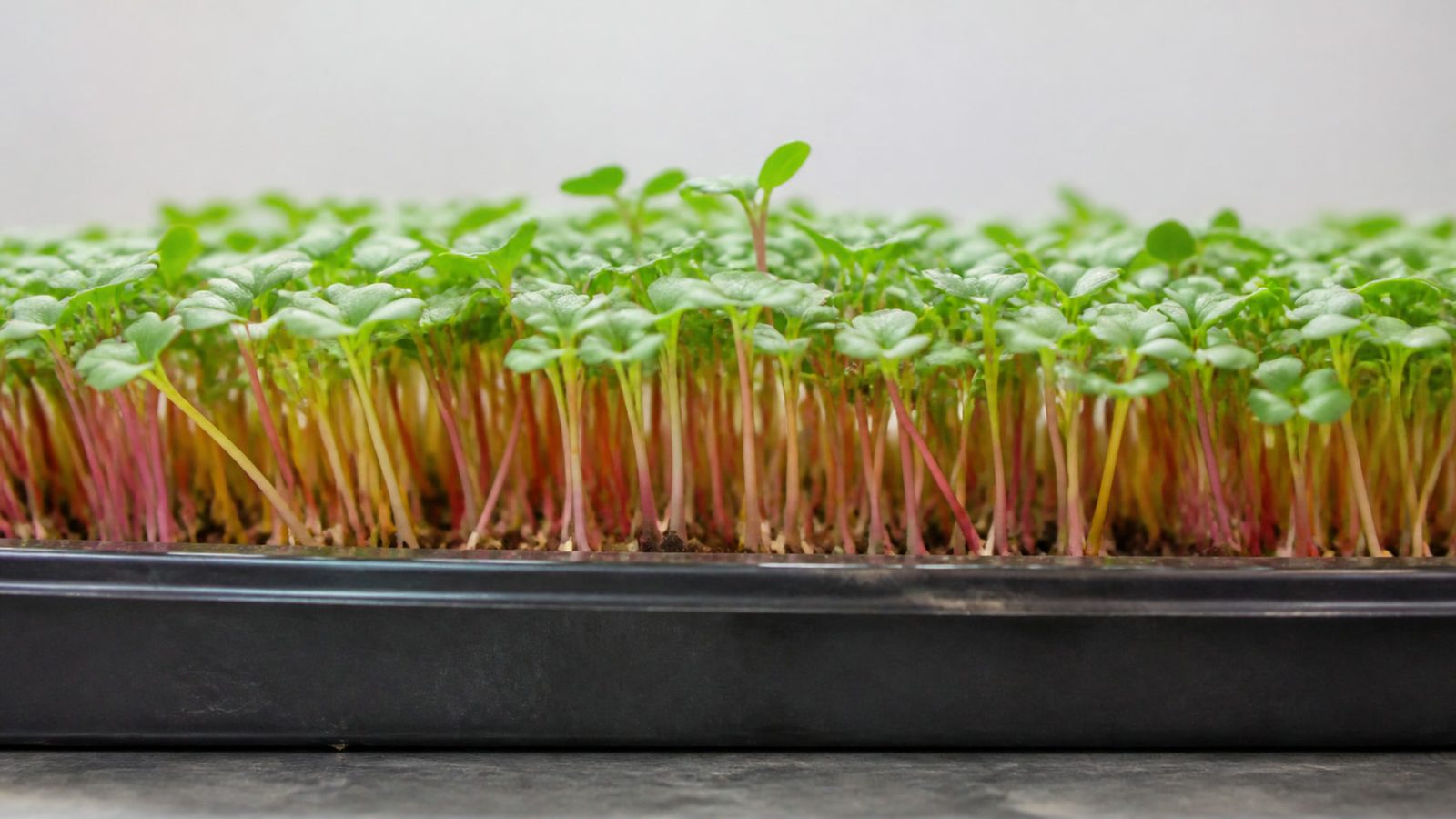
The seed is a large corky multigerm cluster, so one apparent seed can throw several seedlings and an uneven tray gives you gaps, clumps, stuck hulls and leaders outrunning laggards. Nothing here is delicate; it just does not behave like fine brassica seed.
- Botanical name
- Beta vulgaris subsp. cicla
- Also sold as
- Swiss Chard, Rainbow Mixture, Bright Lights, Pink Lipstick, Barese Dark Green Smooth Leaf, Canary, Eldorado
- Family
- chenopod
- Difficulty
- Moderate
- Days to harvest
- 16 to 19 days
- Harvest window
- No published figure
- Seed per 1020 tray
- 31.5 g
- Soak
- None
- Blackout
- No published figure
- Germination temperature
- No published figure
- Yield per 1020 tray
- 9.5 oz
- Regrows after cutting
- No published figure
- Mold risk
- High
- Hull shedding
- heavy
- Shelf life
- No published figure
- Eaten as
- raw
- Seed cost per tray
- $2.10
31.5 g at $30.30/lb, True Leaf Market Bright Lights swiss chard seed, listed 2026-08-08, at the Johnny's trial rate. 31.5 g is 1.11 oz at $1.89 an ounce. More than twice the $0.99 of Bull's Blood beet, which is the same species measured in the same trial at the same stage on 23 g. Seed only, excludes medium, tray, labor, light and loss.
Any field name above ranks every variety by it. No published figure means we researched it and nobody has established one, which is different from not yet researched. Every figure here is sourced at the bottom of the page. Compare every variety side by side.
Swiss chard is a color crop. The leaves are mild and spinach-like with no pepper in them at all, and what you are actually selling is thin stems in pink, gold, orange, red and white. Expect 9.5 ounces from 31.5 grams of seed in 16.5 days.
Before you commit a tray to it, there is one comparison worth making, because chard and Bull's Blood beet are the same species, Beta vulgaris, and one trial grew both in the same greenhouse, cut them at the same stage, and finished them on the same day. Comparisons that clean are rare.
Hover or tap a row to highlight it.
| Bright Lights chard | Bull's Blood beet | |
|---|---|---|
| Seed per 1020 | 31.5 g | 23 g |
| Yield | 9.5 oz | 7.5 oz |
| Days to first true leaf | 16.5 | 16.5 |
| Seed cost per tray | $2.10 | $0.99 |
| Oz per dollar of seed | 4.5 | 7.6 |
| Oz per tray-day | 0.58 | 0.45 |
Chard takes 37 percent more seed and returns 27 percent more weight, in the same time. It wins the tray slot on rate and loses the economics badly, because its seed costs more than twice as much per tray.
Neither is a mistake. They are different answers to different questions, and this is the rare case where you can see both answers measured rather than argued.
What growers are saying right now
Sampled from public posts and videos, 10 July to 9 August 2026. Every line links what it is quoting. How often something is repeated is not evidence that it is true, so every line also says what the sources actually establish.
Day 13 of our Swiss chard grow, and it is harvest day
Circulating A commercial grower's day-by-day run at 117,134 views and 301 comments
This disagrees with the trial and the disagreement is the useful part. Johnny's measured first true leaf at 16.5 days; this grower cuts at 13. Both can be right, because they are almost certainly cutting at different stages, and it is a reminder that a days-to-harvest figure means nothing without the stage attached. Whenever you take a day count from somebody, ask what they were cutting at. What the numbers show
FloraGro versus MaxiGro for swiss chard microgreens, a nutrient showdown
Circulating An A/B test on this crop at 27,064 views
Worth flagging because somebody actually ran a controlled comparison on chard, and because of the grower's own caveat inside it: these products are formulated for people growing full adult crops, not microgreens. That caution generalizes past this crop and past this page.
The taxonomic name is cicla, and it means beet-like. The beet develops a root, the chard will not have nearly as much of one
Circulating A garden how-to at 72,577 views and 2,494 likes
Correct, and it is the plain-language version of why the comparison at the top of this page works. Chard and Bull's Blood beet are the same species pulled in two directions by breeding, and at microgreen stage the difference in the tray is a difference of degree.
Rainbow swiss chard, which is just a beautiful crop
Circulating A microgreen farm's grow-along at 10,501 views
The market in one sentence. Nobody in this sweep grows chard for its flavor, and the crop's own suppliers describe it as mild. The stems are the product. Is it worth growing
What it is, and how to tell you grew it right
Swiss chard microgreens are seedlings of Beta vulgaris subsp. cicla, the leafy form of the same species as garden beet. **Beet, Bull's Blood beet and chard are all Beta vulgaris**, pulled in different directions by breeding, which is why they behave so similarly in a tray.
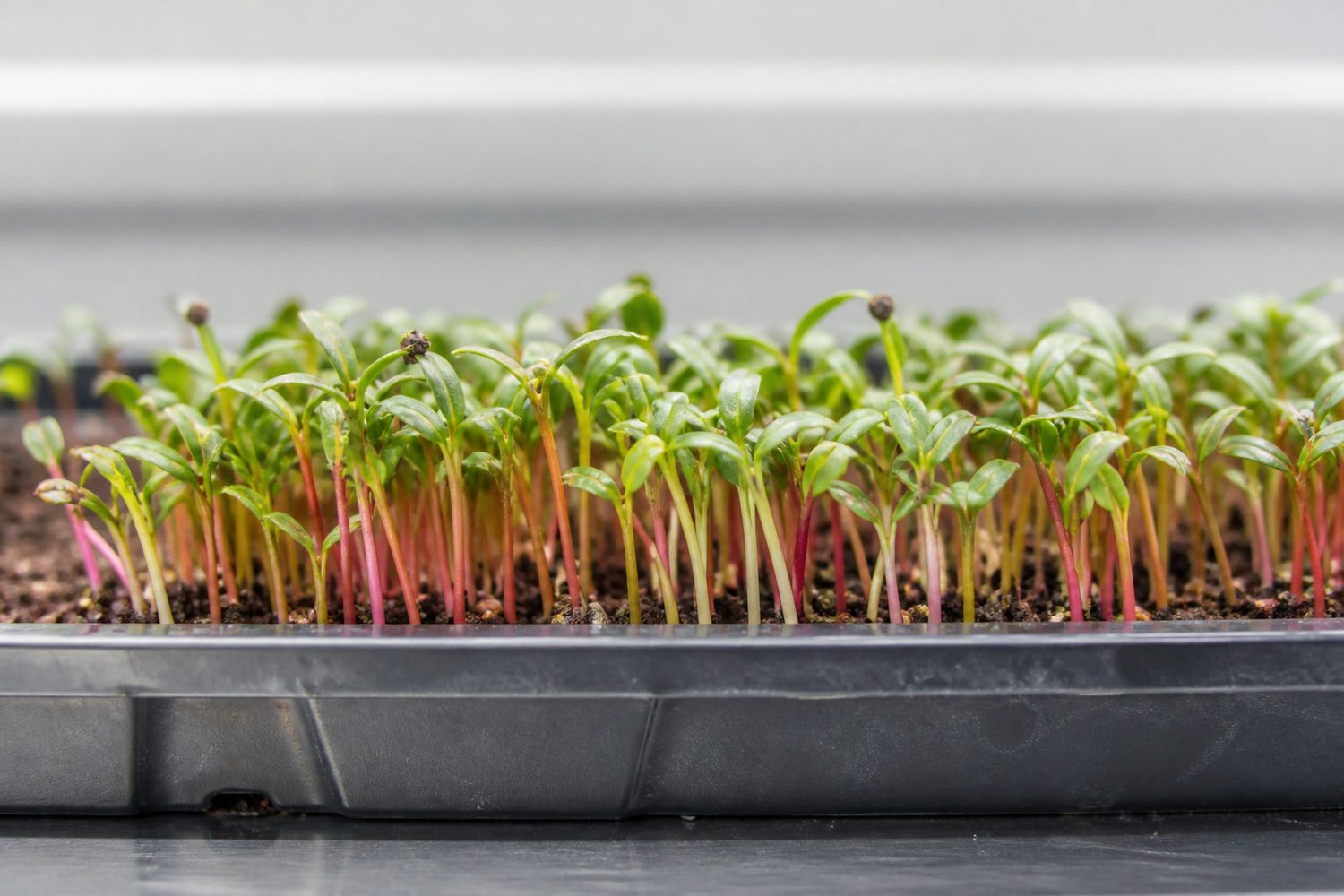
"Swiss chard" is a color decision, not one product. Bright Lights and Rainbow Mixture are deliberate mixtures giving pink, gold, orange, purple, red and white stems. Pink Lipstick is a pink-stem selection, Canary is yellow-stemmed, Eldorado has orange to bright-yellow petioles, and Barese is plain green with a slight spinach taste. Buy the outcome you want on the plate, because they are genuinely different seed lots.
A correct tray is a dense but individually legible stand: green cotyledons and first true leaves above thin colored stems, with the medium mostly hidden except at the cut line. On a mixture, expect a spread of stem colors rather than a uniform sheet.
The confusion is with Bull's Blood, for the good reason that they are the same species with colored stems. The tray-level tell is that a Bright Lights tray is deliberately multi-colored while Bull's Blood is one selection bred for deep red and purple. The production tell is stronger and it is in the table above: they are not interchangeable tray recipes.
What it tastes like, and what to do with it
Mild and spinach-like, lightly earthy and faintly sweet. There is no pepper and no brassica bite. Barese is described by its supplier as having a slight spinach taste and Bright Lights as milder than mature chard.
The color is the product, not the flavor. That makes it a salad green with visual value rather than a condiment: composed salads, open sandwiches, avocado toast, grain bowls, egg dishes, or a finish on a creamy soup where the stems read across the surface.
It is the wrong choice when a dish needs a peppery hit, and a mixture is the wrong choice when a buyer needs one predictable color. Nobody has published whether chard turns bitter with age.
Growing it: only what differs from the standard method
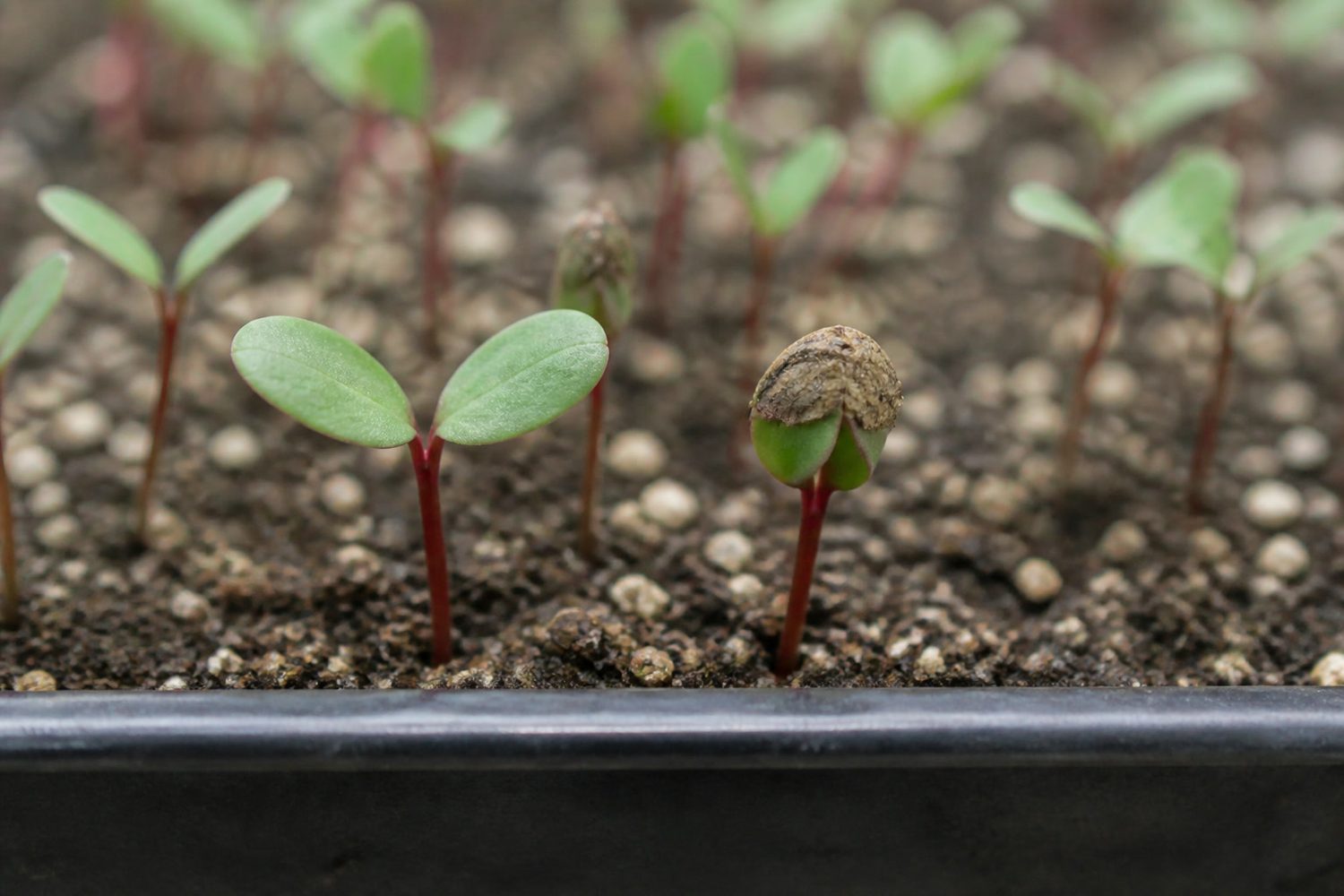
Everything different about chard comes from one fact: the seed is a large, corky, irregular multigerm cluster. One apparent seed can throw several seedlings.
Level the medium and spread the seed evenly. This matters more here than on fine seed, because an uneven surface under a lumpy seed gives you clumps beside gaps, and a multigerm stand already emerges over a spread of days.
Press for contact and cover only lightly. Do not bury it. The seed is heavy enough to be displaced by hard overhead watering, so bottom-water once established.
Use a cover or nested tray as a tool, not as a schedule. Its jobs are seed-to-medium contact, moisture, and mechanically helping the hulls come off. Take it off when most shoots are pushing it up, which is a signal rather than a day count. Nobody publishes a chard blackout duration, and following one would mean ignoring what the tray is telling you anyway.
Then watch the airflow rather than the light. Chard is seeded heavy by weight and grown longer than a brassica, so the canopy sits wetter. No source gives a chard-specific light level, fan speed or water volume, and none is invented here.
Do not raise the rate to speed it up. Crowding makes both of this crop's real problems worse.
What goes wrong with swiss chard specifically
Stuck hulls are the signature failure and they cost you pack-out, not just looks. A brown hull pinned to a small first leaf is conspicuous, and on a tray-wide scale it is the difference between a saleable pack and a rework. The cause is a dry seed coat and poor early contact. Do not try to hand-pick a whole tray; you will damage more seedlings than you rescue. Fix it at sowing next time.
Uneven emergence, which is partly normal. Multigerm seed genuinely emerges over a spread, so an irregular-looking tray is not automatic evidence of a bad lot. Empty patches beside dense clumps point at uneven contact or moisture instead.
Then the trap that follows from it: waiting for the laggards. True leaves keep advancing on the leaders while the small plants stay trapped underneath. Johnny's warns that each day materially changes size and yield. Harvest the usable stand rather than chasing uniformity that is not coming.
Damping-off, on general pathology: water-soaked pinched stems at the medium line and collapsing patches, from the Pythium and Rhizoctonia complex under wet conditions. Root hairs are fine white symmetric fuzz on firm white roots and do not constrict a stem; cottony growth spreading across stems and medium, with collapse, is disease.
Nutrition, and one study that is not a label
USDA FoodData Central returned zero results for Swiss chard microgreens across Foundation, SR Legacy, FNDDS, Experimental and Branded categories, searched 8 August 2026. There is no FDC entry, and the mature chard entry is not a substitute.
One peer-reviewed study did measure the microgreen. Saleh and colleagues in 2022 grew Swiss chard alongside kale, arugula and pak choi under six formulated growing media and measured germination, growth and yield plus chlorophylls, carotenoids, sugars, protein, phenolics, flavonoids, ascorbate and antioxidant-enzyme activity.
Its central result is the reason it cannot become a nutrition label: the numbers moved with the medium. Mushroom-compost treatments improved many of the measured traits. That is a finding about growing conditions, not a fixed composition for the crop.
So, the claims to reject are specific ones. "All the health benefits of full-grown Swiss chard are found in microgreen form" is unsupported. Any exact vitamin or mineral figure lifted from mature chard is unsupported. And "40 times more nutritious" has nothing behind it at all.
Which seed to buy
Buy by the visual outcome, because that is the only axis with real differences behind it.
Bright Lights or Rainbow Mixture for mixed gold, pink, orange, purple, red and white stems. Bright Lights is the one with trial numbers: 31.5 g, 9.5 oz, 16.5 days. Pink Lipstick for pink, Canary for yellow stems with dark savoyed leaves, Eldorado for orange to bright-yellow petioles at 16 to 19 days, and Barese for a plain green tray with a slight spinach taste.
Claims about relative tenderness, stem length or yield between these selections are not verified, so choose on color and treat any performance claim as marketing.
Specify seed sold for edible microgreen production, the named cultivar, a lot number, a germination test date, and untreated status. Refuse dyed, fungicide-treated or insecticide-treated field seed: those treatments can be present in the shoot you eat.
Judge a lot by usable uniform canopy, not by counting seeds. On a multigerm crop the seed count tells you less than usual.
And buy it by the pound, because on this crop the packet aisle is genuinely absurd. Swiss chard microgreen seed on Amazon returned 44 chard listings out of 60 tiles on 9 August 2026, and the top result was a 210 milligram organic Rainbow Mix packet at $1.78. That is $8.48 a gram, or $3,844 a pound, several times the dearest seed anybody sells by the pound, and at the trial's 31.5 g rate it works out to roughly $267 of seed for one tray. The rest of the packets are the same shape at $4.29 to $6.48 for a hundred or two hundred seeds.
The only tray-scale option on that page was a 1 lb bag at $43.54, which is $3.02 a tray against the $2.10 above.
This trap is not a chard problem, it is a rate problem, and chard is where it shows worst. A garden packet costs a sorrel grower a few dollars because sorrel uses 3.5 grams. It costs a chard grower the price of a light fixture, because chard uses thirty-one and a half.
Is it worth growing?
Grow it if your buyer pays for color. That is a real and reasonably reliable market, and 9.5 oz a tray is a respectable benchmark for a 16-day crop.
Its competitor is not broccoli, it is its own sibling. Against Bull's Blood beet, chard gives you more weight per tray-day and a multi-color mix; Bull's Blood gives you nearly twice the weight per dollar of seed and a single confident deep red. If your buyer wants "red microgreens", Bull's Blood is both cheaper and more on-brief. If they want the rainbow, only chard does it.
Against a fast brassica, chard loses on speed, seed economy and hull-free pack-out, and wins on nothing except appearance. That is a fair trade if appearance is what is being bought.
For a one-tray home grower it is enjoyable and slightly fussy. Expect a slower first run and some hulls.
A note on the numbers above
Hover or tap a row to highlight it.
| Figure | Value | Source | What kind of number it is |
|---|---|---|---|
| Seed per 1020 | 31.5 g (1.11 oz) | Johnny's 29-variety trial, Bright Lights | Measured, first-true-leaf harvest |
| Yield per 1020 | 9.5 oz | The same trial | Measured, averaged over at least three seedings |
| Days to harvest | 16.5 | The same trial | Measured to first true leaf, temperature unstated |
| Days to harvest | 16 to 19 | Sakata, Eldorado | Stated for an indoor microgreen, stage unstated |
| Days to harvest | 8 to 12 | A Rainbow Mixture listing | A seller claim with no conditions. Excluded from this page's range |
| Seed price | $30.30 per pound | True Leaf, Bright Lights, listed 2026-08-08 | A price on a day, $1.89 an ounce |
| Seed cost per tray | $2.10 | Calculated | 1.11 oz at $1.89 |
| Sibling: Bull's Blood beet | 23 g, 7.5 oz, 16.5 days | The same Johnny's trial | The same species, measured the same way. The comparison at the top of this page |
| Blackout | No figure exists | Every source opened | The cover comes off on a signal, not a day count |
| Germination temperature | No figure exists | Every source opened | Nobody pairs a chard temperature with an outcome |
| Harvest window | No figure exists | Every source opened | Nobody has run a daily harvest panel |
| Composition | Measured, and medium-dependent | Saleh et al. 2022 | A real study whose numbers move with the growing medium |
| Fresh-weight panel | No FDC record | USDA FoodData Central, searched 8 August 2026 | Zero results across all five categories |
The sibling comparison is worth trusting, and here is precisely why. Same trial, same greenhouse, same season, same harvest stage, same 16.5 days. Most cross-crop figures you will meet come from two publishers using different methods; these two do not. Chard needs 37 percent more seed (31.5 g against 23 g) and returns 27 percent more weight (9.5 oz against 7.5 oz), which means the extra seed does not fully pay for itself in weight, and the seed price makes it worse: $2.10 against $0.99 a tray.
The two derived numbers land on opposite sides. Per dollar of seed, Bull's Blood wins clearly, 7.6 ounces against 4.5. Per tray-day, chard wins, 0.58 against 0.45, because it puts more weight through the same slot in the same time. Which one matters depends entirely on whether your constraint is seed budget or bench space.
Chard is well measured on what comes out and unmeasured on how you get there. Its rate, yield and days are all pinned down by a trial, while nobody publishes a blackout duration, a germination temperature or a harvest window for it. So, trust the output figures and run the process by signal: cover off when the shoots push it, cut when the usable stand is at first true leaf, and note your own dates as you go. Sesame is the opposite case, well studied in the lab and unmeasured on the bench.
Hover or tap a row to highlight it.
| Crop | Seed per 1020 | Yield | Days | Cost per tray | Oz per $1 | Oz per tray-day |
|---|---|---|---|---|---|---|
| Swiss chard, Bright Lights | 31.5 g | 9.5 oz | 16.5 | $2.10 | 4.5 | 0.58 |
| Beet, Bull's Blood | 23 g | 7.5 oz | 16.5 | $0.99 | 7.6 | 0.45 |
| Amaranth | 7.5 g | 6.5 oz | 11 to 18 | $1.10 | 5.9 | 0.45 |
| Spinach, Winter Giant | 60 g | 7.2 oz | 18.0 | $2.52 | 2.9 | 0.40 |
| Celosia | 8 g | 3.4 oz, one tray | 13 | $1.06 | 3.2 | 0.26 |
All 62 crops, sortable, on the microgreen comparison.
Terms on this page
Tap a term to see what it means.
*Beta vulgaris*. The species holding garden beet, Bull's Blood beet and swiss chard. Three crops, one species, and they behave alike in a tray.
Sources
- Johnny's microgreen yield trial summary and the trial tech sheet - Bright Lights at 31.5 g, 9.5 oz and 16.5 days, Bull's Blood beet at 23 g, 7.5 oz and 16.5 days, both at first true leaf, plus the warnings about heat reducing uniformity and about yields not transferring between systems.
- Bright Lights swiss chard seed, True Leaf Market - the mixture description, milder-than-mature claim, and the $30.30 per pound price listed 8 August 2026.
- Rainbow Mixture, Pink Lipstick, Barese and Canary - the color selections, the Barese spinach-taste description, and the 8-to-12-day claim this page excludes.
- Eldorado, Sakata - 16 to 19 days to indoor microgreen, and the mature-crop disease list this page declines to treat as a tray problem.
- Saleh, R. et al., 2022, growing media effects on swiss chard, kale, arugula and pak choi microgreens, Plants - open access PDF. Measured composition that moved with the medium.
- USDA FoodData Central - searched 8 August 2026, zero results across all five data types.
- Damping-off, UC IPM - the pathogens and the rot-at-the-medium-line sign.
- Growing microgreens at home, SDSU Extension - pressing rather than burying seed, bottom soaking to avoid washing seed aside, the general storage guidance, and the untreated-seed warning.
- Microgreens production, Virginia Cooperative Extension - large-seed handling, irrigation varying by stage and substrate, and the serving uses.
Keep reading
The variety directory
Quinoa microgreens
A delicate tray of thin burgundy stems and small open cotyledons, very mild, holding at its best for three to five days. No published seed rate or yield for a 1020, so plan a trial rather than an order.
Read Quinoa microgreensThe variety directory
Spinach microgreens
A genuinely difficult crop with the thinnest numbers behind it: nobody has ever measured a 1020 tray of spinach. About $2.52 of seed for 7 to 9 oz over 16 to 20 days.
Read Spinach microgreensThe variety directory
Tatsoi microgreens
A fast, mild, forgiving brassica: 7.5 g of seed, 8.5 oz, 13.5 days, at 93 cents a tray. It turns seed into leaf better than mizuna or pak choi and takes longer to do it.
Read Tatsoi microgreensThe variety directory
Turnip microgreens
Easy, fast and cheap at about 31 cents of seed a tray, and almost entirely unmeasured: nobody has weighed a turnip tray. No soak, 7 to 12 days, cut at spread cotyledons.
Read Turnip microgreens