At a glance
A fast, mild, small-seeded brassica with a measured 13.5-day cycle and nothing unusual in the method. The only real way to lose it is to sow it thick and keep it wet, which is the standard brassica failure.
- Botanical name
- Brassica rapa subsp. narinosa
- Also sold as
- Tatsoi, Tatsoi Organic Microgreen Seed, Asian Spinach
- Family
- brassica
- Difficulty
- Beginner
- Days to harvest
- 8 to 15 days
- Harvest window
- No published figure
- Seed per 1020 tray
- 7.5 g
- Soak
- None
- Blackout
- 2 to 5 days
- Germination temperature
- 65 to 75 °F
- Yield per 1020 tray
- 8.5 oz
- Regrows after cutting
- No published figure
- Mold risk
- Medium
- Hull shedding
- some
- Shelf life
- No published figure
- Eaten as
- raw
- Seed cost per tray
- $0.93
7.5 g at $56.25/lb, Johnny's Tatsoi Organic microgreen seed, listed 2026-08-08. The lightest-sown of the three Brassica rapa crops measured in the same trial: tatsoi 7.5 g, mizuna 9.5 g, pak choi Rosie 10.5 g. Seed only, excludes medium, tray, labor, light and loss.
Any field name above ranks every variety by it. No published figure means we researched it and nobody has established one, which is different from not yet researched. Every figure here is sourced at the bottom of the page. Compare every variety side by side.
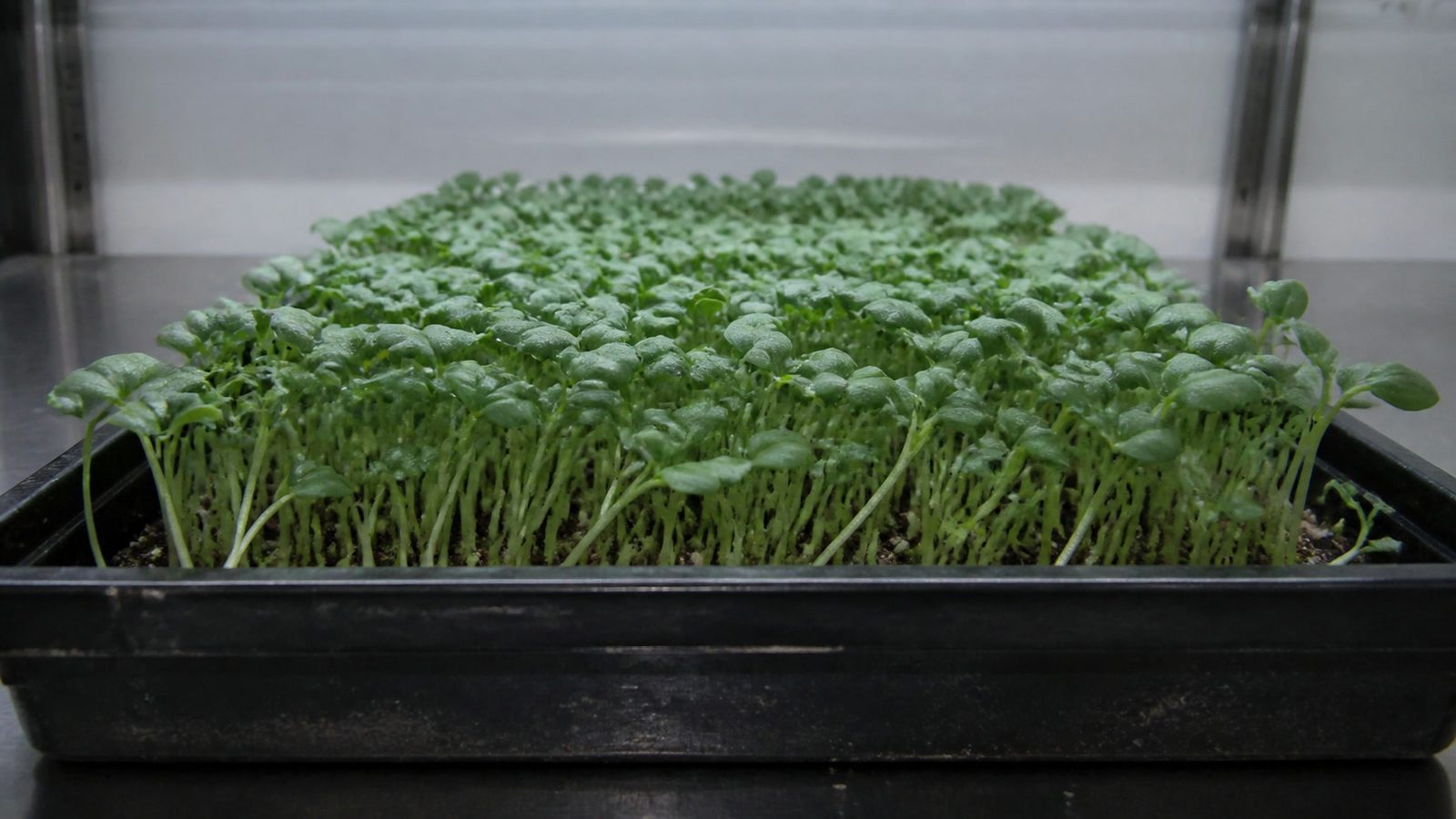
Tatsoi is about as easy as a tray gets: a fast, mild, small-seeded brassica with dark green spoon-shaped leaves, sown dry at 7.5 grams and cut at 8.5 ounces in 13.5 days. There is no heat in it and nothing unusual in the method. The only real way to lose it is to sow it thick and keep it wet.
What it does better than its close relatives is turn seed into leaf, which matters if seed cost is your constraint. Tatsoi, mizuna and pak choi are three subspecies of one species, Brassica rapa, and unusually, one trial grew all three in the same greenhouse and cut them at the same stage, so these figures can be set side by side without the usual caveats.
Hover or tap a row to highlight it.
| Tatsoi | Mizuna | Pak choi, Rosie | |
|---|---|---|---|
| Seed per 1020 | 7.5 g | 9.5 g | 10.5 g |
| Yield | 8.5 oz | 10 oz | 11 oz |
| Days to first true leaf | 13.5 | 12 | 13 |
| Ounces of leaf per gram of seed | 1.13 | 1.05 | 1.05 |
| Oz per tray-day | 0.63 | 0.83 | 0.85 |
Tatsoi is the lightest sown, and it converts seed into leaf better than either sibling: 1.13 ounces per gram against 1.05 for both of the others. It is also the slowest earner of the three per tray-day, at 0.63 against 0.83 and 0.85.
So, the same species, grown the same way, gives you a seed-efficiency answer and a bench-space answer that point in opposite directions. Which one is right depends on what is scarce.
What growers are saying right now
Sampled from public posts and videos, 10 July to 9 August 2026. Every line links what it is quoting. How often something is repeated is not evidence that it is true, so every line also says what the sources actually establish.
Nobody is talking about tatsoi
Circulating There is plenty of general microgreen chatter, in r/microgreens and on TikTok, and none of it is about this crop
Which is unusual, because the measured record is good. Johnny's 29-variety trial weighed tatsoi alongside two of its own siblings at the same stage, so the rate, the yield and the days are all pinned down. A crop can be well measured and undiscussed at the same time, and this is one. You will get better numbers here than opinions. What the numbers show
What it is, and how to tell you grew it right
Tatsoi microgreens are seedlings of Brassica rapa subsp. narinosa. It is also sold as Asian spinach, which is a market name for the same crop rather than a different plant.
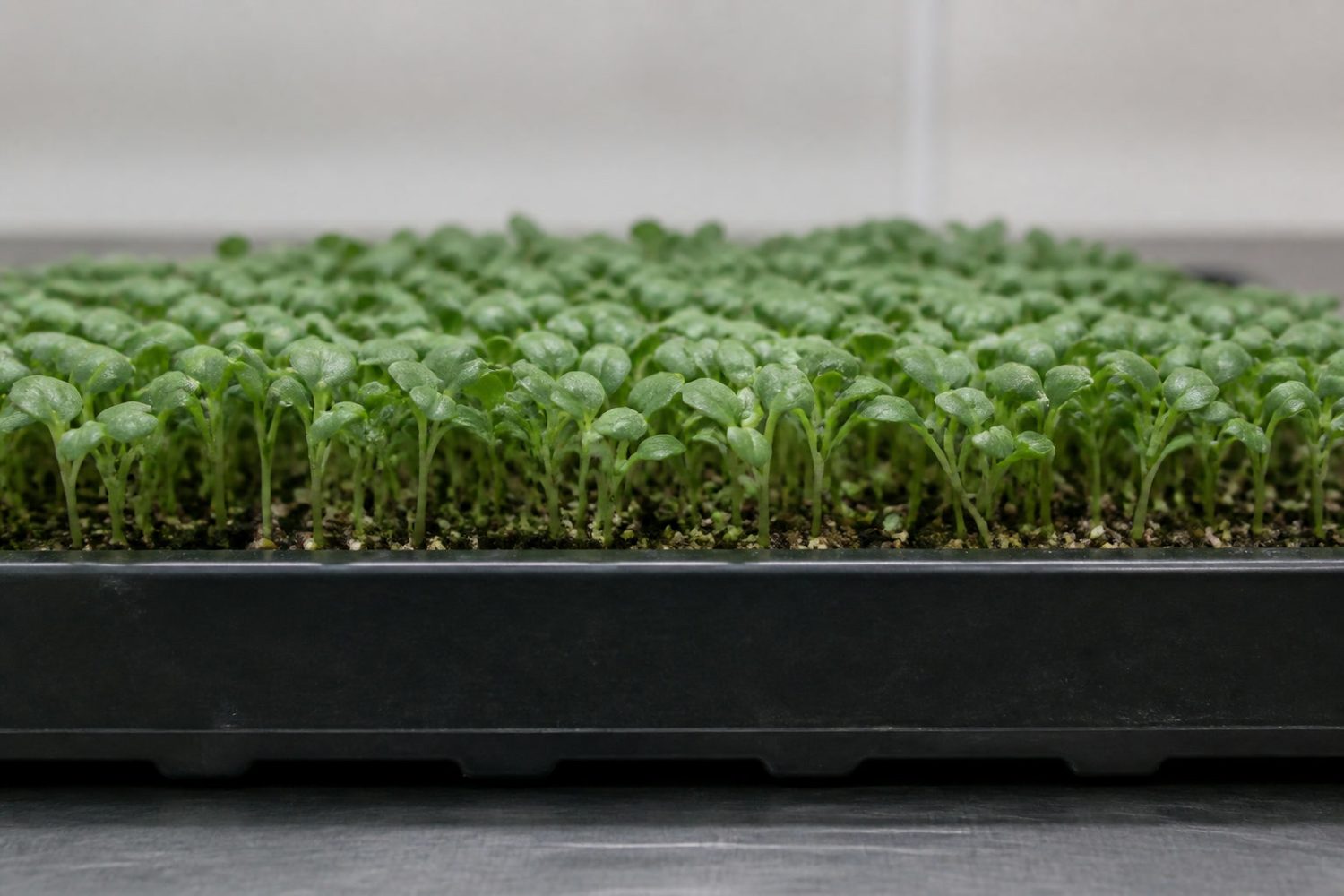
A correct tray is an even, dense, fine-stemmed green stand with dark-green spoon-shaped leaves at first true leaf. Stem color and thickness are not documented anywhere reliable, so do not judge a lot by whether the stems came up pale or tinted.
Do not trust the supplier's identification tell, because it only half works. Tatsoi's own product page offers the dark-green spoon-shaped leaf as the way to know it. That works against mizuna, which develops conspicuously divided and fringed true leaves. It does not work against komatsuna, whose true leaf is described in exactly the same words: broad, spoon-shaped or oval.
So, the honest version is a two-step. At cotyledon stage, tatsoi, komatsuna, pak choi, mizuna and generic mustard are not distinguishable at all. At first true leaf you can separate the frilly one from the spoon-shaped ones. Within the spoon-shaped group, the seed label is still the identification, and anyone claiming otherwise has not put the two trays side by side.
What it tastes like, and what to do with it
Mild and lightly sweet with a subtle nutty edge. There is no arugula pepper and no mustard heat, and that is the point of the crop.
It gives you enough tender leaf volume to be more than a garnish, so it works as a salad base, in sandwiches and wraps, on tacos, scattered on pizza after baking, or stirred into noodle soup at the moment of serving.
It is the wrong choice when a dish needs a deliberate hit of heat, and the wrong texture when something crunchy is wanted; the leaf is soft.
A 2026 foodomics paper describes microgreen-stage aroma in this crop group as green, cucumber, melon and nutty, with a different profile at baby-leaf stage. Nobody has measured how tatsoi's flavor changes past the harvest window.
Growing it: only what differs from the standard method
Honestly, almost nothing differs, and that is why this is a beginner crop.
No soak. Small brassica seed, dry-sown. A soak adds surface water and clumping for no documented benefit.
Sow light: 7.5 grams. That is the trial figure and it is below what the same trial used for mizuna, kale and cabbage. A second supplier's arithmetic lands at 8.5 g. Start at 7.5 and only move up after a local run shows an even stand without crowding.
Level the medium first. On small seed this matters more than it sounds: hollows collect both water and seed, which makes exactly the dense wet pocket that fails first.
Cover to majority germination, then take it off. The two-to-five-day figure is the general extension range rather than a tatsoi instruction, and no source publishes a weight for this crop. The cover is for darkness and humidity, not for stretching the stems.
Then airflow, and restraint with water. 65 to 75F ambient, bottom-water once established. Above 75F germination can be inhibited and disease pressure rises.
What goes wrong with tatsoi specifically
There is one real failure and it is self-inflicted: too much seed plus too much water. A crowded saturated canopy is the condition damping-off wants, and on a dense small-seeded brassica it arrives fast. The early sign is thinning with pinched, rotting stems at the medium line and yellowing patches. Pythium often starts at root tips; it and Rhizoctonia are the usual agents. Affected seedlings do not recover and affected trays should not be sold.
Root hairs are the thing people mistake for it. Fine white fuzz on the roots at the medium surface is normal; mist it and it collapses into the wet root. Mold persists and spreads as a web across seed coats, medium, stems or leaves, and comes with declining seedlings.
Uneven emergence shows as bare zones beside seed piles, and it comes from uneven broadcast or a dry patch rather than from the crop. Re-sow immediately or accept an uneven cut.
Overrunning it puts true leaves well past the first set with an understory that never catches up. It stays edible. It stops matching the 8.5 oz specification, which is quoted at first true leaf and nowhere else.
Nutrition, and two studies that are not a nutrition label
USDA FoodData Central has no tatsoi microgreen record, checked for both "tatsoi" and "tatsoi microgreens". Mature tatsoi, bok choy and generic brassica values are not substitutes.
Two peer-reviewed studies measured tatsoi microgreens, and both were biofortification experiments. One harvested tatsoi at 14 days at second true leaf and measured iodine at 101.30 mg/kg dry weight in the untreated control, rising to 137 and 200.73 mg/kg with 4 and 8 micromolar potassium iodide in the nutrient solution. Another compared 0, 8 and 16 micromolar selenium in soilless tatsoi and reported that 16 micromolar raised total phenols by 95 percent and yield by 18 percent against its own control.
Those are treatment results. The dosed figures describe tatsoi grown in an iodine or selenium solution, not tatsoi you would buy, and neither study is a serving-size panel.
So, the claims to reject are the usual ones: fixed servings of vitamins A, C or K, "packed with" a named mineral, a fixed antioxidant ranking, and anything of the "fifty times more nutritious" shape. None of it has a source.
Which seed to buy
One documented microgreen product, Johnny's Tatsoi OG: open-pollinated, certified organic, dark-green spoon-shaped leaves, and the only tatsoi with a rate, a yield and a harvest stage attached to it. Another supplier sells the same crop as Asian Spinach without publishing microgreen data.
No source substantiates a red-stemmed, faster or higher-yielding tatsoi cultivar, so if you see one advertised, ask for the trial.
Specify seed sold as microgreen or food seed, with a lot number, a germination test and untreated or organic status. Refuse pesticide-treated field seed, because you are eating the seedling and some seed coats persist to the cut.
And on this crop, check the marketplace, because it reverses the pattern. Tatsoi microgreen seed on Amazon returned 32 tatsoi listings out of 60 tiles on 9 August 2026, and one of them, a 1 lb bulk bag at $22.20, is $0.37 a tray against Johnny's $0.93. The marketplace is about 40 percent of the seed house here.
That is worth checking every time, because it usually runs the other way: on shiso the marketplace is 1.5 to 2.7 times the seed house, on sorrel about 1.5, on swiss chard about 1.4. "Buy from the seed house" is not a rule, it is a habit that happens to be right most of the time. Find the per-pound number and do the multiplication yourself.
Two shapes to avoid on that page. One listing sells 3,000 seeds at "7.5+ grams" for $5.29, which is almost exactly one tray at the trial rate and fourteen times the bulk price per gram. And several listings file this crop as "Tatsoi Mustard" or, in one case, "Pak Choi Rosette Tatsoi", which is the same within-species naming muddle the identification section above is about.
A bad lot looks like low or patchy emergence after an even 7.5 g weighed sowing at the right moisture and temperature. On a crop this cheap that is a small loss, which is one of the quiet arguments for it: at 93 cents a tray, or 37, a failed run costs less than most.
Is it worth growing?
Yes, for most people, and the reason is that it is hard to get badly wrong.
It suits a beginner who wants a fast forgiving green, a market grower selling a mild dark-green brassica, and a home grower who wants salad rather than heat. At 93 cents of seed a tray it is cheap to run, and 9.1 ounces per dollar of seed is a good return even though 8.5 ounces is only a moderate yield.
Its competition is its own siblings and the choice is real. Against mizuna you are choosing a spoon leaf over a frilly one and giving up a good deal of tray-day rate. Against pak choi you are giving up rate again for a lighter, cheaper sowing. Against arugula or a hot mustard you are choosing to have no heat at all.
One caution before you plan around the yield. Penn State measured 4.05 ounces a tray for tatsoi over a two-week cycle at 10 to 15 g, which is less than half Johnny's 8.5 ounces. Two measured sources, one crop, a factor of two apart. Run your own tray before you promise anyone a number.
A note on the numbers above
Hover or tap a row to highlight it.
| Figure | Value | Source | What kind of number it is |
|---|---|---|---|
| Seed per 1020 | 7.5 g (0.265 oz) | Johnny's 29-variety trial | Measured, first-true-leaf harvest |
| Seed per 1020 | 8.5 g | A second supplier, calculated from "1.5 oz sows about 5 trays" | Arithmetic, tray size and stage unstated |
| Seed per 1020 | 10 to 15 g | Penn State | A different system, over a two-week cycle |
| Yield per 1020 | 8.5 oz | Johnny's trial | Measured at first true leaf, averaged over at least three seedings |
| Yield per 1020 | 114.8 g (4.05 oz) | Penn State, 14 to 28 greenhouse cycles | Measured, stage unstated, and less than half the above |
| Days to harvest | 13.5 | Johnny's trial | Measured to first true leaf |
| Days to harvest | 10 to 15 | Johnny's product page | Stated flat, temperature unstated |
| Days to harvest | 8 | A second supplier | Stated flat, no tray method or stage |
| Seed price | $56.25 per pound | Johnny's, listed 2026-08-08 | A price on a day |
| Seed cost per tray | $0.93 | Calculated | 7.5 g of a 453.592 g pound |
| Seed count | about 215,100 per pound | Johnny's | Small brassica seed, not a hull job |
| Iodine, untreated control | 101.30 mg/kg dry weight | An iodine biofortification study | A control value from a treatment experiment, at second true leaf |
| Harvest window | No figure exists | Every source opened | Nobody has run a staggered harvest |
| Fresh-weight panel | No FDC record | USDA FoodData Central | Checked for both "tatsoi" and "tatsoi microgreens" |
The three-way sibling comparison is the part worth trusting, and it is unusually clean. Same trial, same greenhouse, same season, same first-true-leaf harvest, three subspecies of Brassica rapa. The seed rates run 7.5, 9.5 and 10.5 grams and the yields run 8.5, 10 and 11 ounces, which is close to monotonic: more seed, more leaf. What separates them is the ratio. Tatsoi returns 1.13 ounces of leaf per gram of seed against 1.05 for both mizuna and pak choi, so the lightest sowing is also the most efficient one.
The tray-day figure reverses it. Tatsoi's 0.63 sits below mizuna's 0.83 and pak choi's 0.85, because it takes the longest of the three and yields the least. If seed is your constraint, tatsoi wins. If bench space is, it loses to both.
On cost the comparison stops being fair, and it is worth saying why rather than quoting it. Tatsoi's tray is $0.93 and mizuna's is $0.39, but those come from different suppliers at different pack sizes, so the gap is a shopping difference rather than a crop difference. The rate and yield figures are the ones that came out of one trial; the prices did not.
And the yield itself has a serious second opinion. Penn State measured 4.05 oz a tray against Johnny's 8.5. Both are real measurements from real greenhouses over multiple cycles, and they differ by a factor of two. Penn State sowed heavier (10 to 15 g against 7.5) and ran a fixed two-week cycle without stating a leaf stage, which is very likely the whole explanation: the stage you cut at moves the number more than the crop does. Take Johnny's 8.5 oz as the working figure, because its rate and stage are both stated, and keep Penn State's 4.05 in mind as the reminder that averaging two different measurements would give you a number describing neither.
Hover or tap a row to highlight it.
| Crop | Seed per 1020 | Yield | Days | Cost per tray | Oz per $1 | Oz per tray-day |
|---|---|---|---|---|---|---|
| Kohlrabi, Purple Vienna | 9.5 g | 11 oz | 10 to 16 | $0.89 | 12.4 | 0.69 |
| Cabbage, Red | 10.5 g | 8.5 oz | 13.5 | $1.27 | 6.7 | 0.63 |
| Tatsoi | 7.5 g | 8.5 oz | 13.5 | $0.93 | 9.1 | 0.63 |
| Garden cress | 10.5 g | 8.0 oz | 8 to 15 | $0.96 | 8.3 | 0.62 |
| Watercress | No published figure | No published figure | 7 to 25 | no rate to price | cannot be calculated | cannot be calculated |
A blank means nobody has published that figure, so the cell is left empty rather than filled with an estimate. How the numbers work
All 62 crops, sortable, on the microgreen comparison.
Terms on this page
Tap a term to see what it means.
*Brassica rapa*. The species behind tatsoi, komatsuna, mizuna, pak choi and broccoli raab. Five familiar tray crops, one species, and none of them separable at cotyledon stage.
Sources
- Tatsoi organic microgreen seed, Johnny's - the species, the dark-green spoon-shaped leaf description, 10 to 15 days, about 215,100 seeds a pound, the temperature guidance, the damping-off warning, and the $56.25 per pound price listed 8 August 2026.
- Johnny's microgreen yield trial summary and the trial tech sheet - tatsoi at 7.5 g, 8.5 oz and 13.5 days, mizuna at 9.5 g, 10 oz and 12 days, pak choi Rosie at 10.5 g, 11 oz and 13 days, all at first true leaf, plus the caveat that yields do not transfer perfectly between systems.
- Growing microgreens, Penn State Extension - 114.8 g per tray from 14 to 28 greenhouse cycles at 10 to 15 g over two weeks, the second measured yield that disagrees with the first.
- Asian Spinach (Tatsoi), Fruition Seeds and its microgreens guide - the market name, the 8-day claim, the 10-to-15-day general figure, and the germination-at-temperature record.
- Iodine biofortification of tatsoi and other microgreens - study record. Control iodine of 101.30 mg/kg dry weight at second true leaf, rising with dose.
- Selenium biofortification of soilless tatsoi - study record. 16 micromolar selenium raised total phenols 95 percent and yield 18 percent against its control.
- Microgreen and baby-leaf foodomics, 2026 - the green, cucumber, melon and nutty aroma notes at microgreen stage.
- USDA FoodData Central - checked for tatsoi and tatsoi microgreens, no record.
- Damping-off, UC IPM - the pathogens and the rot-at-the-medium-line sign.
- Microgreens production, Virginia Cooperative Extension - the general 2-to-5-day cover range and the 41F dark storage recommendation, neither used as a tatsoi figure.
- Microgreens, LSU AgCenter - the practical root-hair versus mold test.
Keep reading
The variety directory
Turnip microgreens
Easy, fast and cheap at about 31 cents of seed a tray, and almost entirely unmeasured: nobody has weighed a turnip tray. No soak, 7 to 12 days, cut at spread cotyledons.
Read Turnip microgreensThe variety directory
Arugula microgreens
Arugula is a seasoning green rather than a salad base: 10 g of seed makes 10 oz in 14 days, it is genuinely peppery, and its 10-day shelf life comes from a controlled storage study rather than an estimate.
Read Arugula microgreensThe variety directory
Broccoli microgreens
Broccoli takes 13 g of seed per 1020 tray and gives 11.5 oz at first true leaf, both from Johnny's trial. No soak, fast even germination, and the root-hair-or-mold test you will need in the first week.
Read Broccoli microgreensThe variety directory
Broccoli raab microgreens
Rapini as a tray crop: bitter on purpose, 49 cents of seed a tray, and one of the few crops where the microgreen is genuinely easier than the vegetable.
Read Broccoli raab microgreens