At a glance
Not because it needs anything exotic, but because it germinates over five to ten days and holds a tray for three to four weeks, so the long nothing-is-happening phase invites re-sowing, overwatering and a blackout the crop does not want.
- Botanical name
- Rumex sanguineus
- Also sold as
- Sorrel, Red Veined, Red Veined Sorrel, Bloody dock, Red-veined dock, Spinach dock
- Family
- dock
- Difficulty
- Difficult
- Days to harvest
- 17 to 30 days
- Harvest window
- No published figure
- Seed per 1020 tray
- 3.5 g
- Soak
- None
- Blackout
- None
- Germination temperature
- 60 to 75 °F
- Yield per 1020 tray
- 6.5 oz
- Regrows after cutting
- No published figure
- Mold risk
- Medium
- Hull shedding
- No published figure
- Shelf life
- No published figure
- Eaten as
- raw
- Seed cost per tray
- $2.71
3.5 g at $351.35/lb, Johnny's Red Veined organic sorrel microgreen seed, listed 2026-08-08. That is among the dearest microgreen seed sold by the pound, behind mint at $1,394.50 and ahead of watercress at $296.25, oregano at $242.36 and shiso at $155.50, and it still costs only $2.71 a tray because 3.5 g is about the lightest rate anybody weighs out. At the 1 oz pack size ($35.40, or $566.40/lb) the same tray is $4.37. Seed only, excludes medium, tray, labor, light and loss.
Any field name above ranks every variety by it. No published figure means we researched it and nobody has established one, which is different from not yet researched. Every figure here is sourced at the bottom of the page. Compare every variety side by side.
Sorrel is an acid rather than a green. It tastes of lemon zest, it is strong enough to use one leaf at a time, and what you are selling is a small bright green leaf crossed by red to purple veins on a fine crimson stem.
It takes 24 days to get there and returns about 6.5 ounces, roughly twice broccoli's time for a bit over half its weight. The seed price is startling, $351.35 a pound, and the tray still costs only $2.71, because sorrel goes on at 3.5 grams, about the lightest rate anybody weighs out. That is worth remembering whenever you are pricing seed: the number on the bag tells you almost nothing until you multiply it by grams per tray. Mint and oregano are dearer still per pound and nobody can even cost their trays, because neither has a published rate.
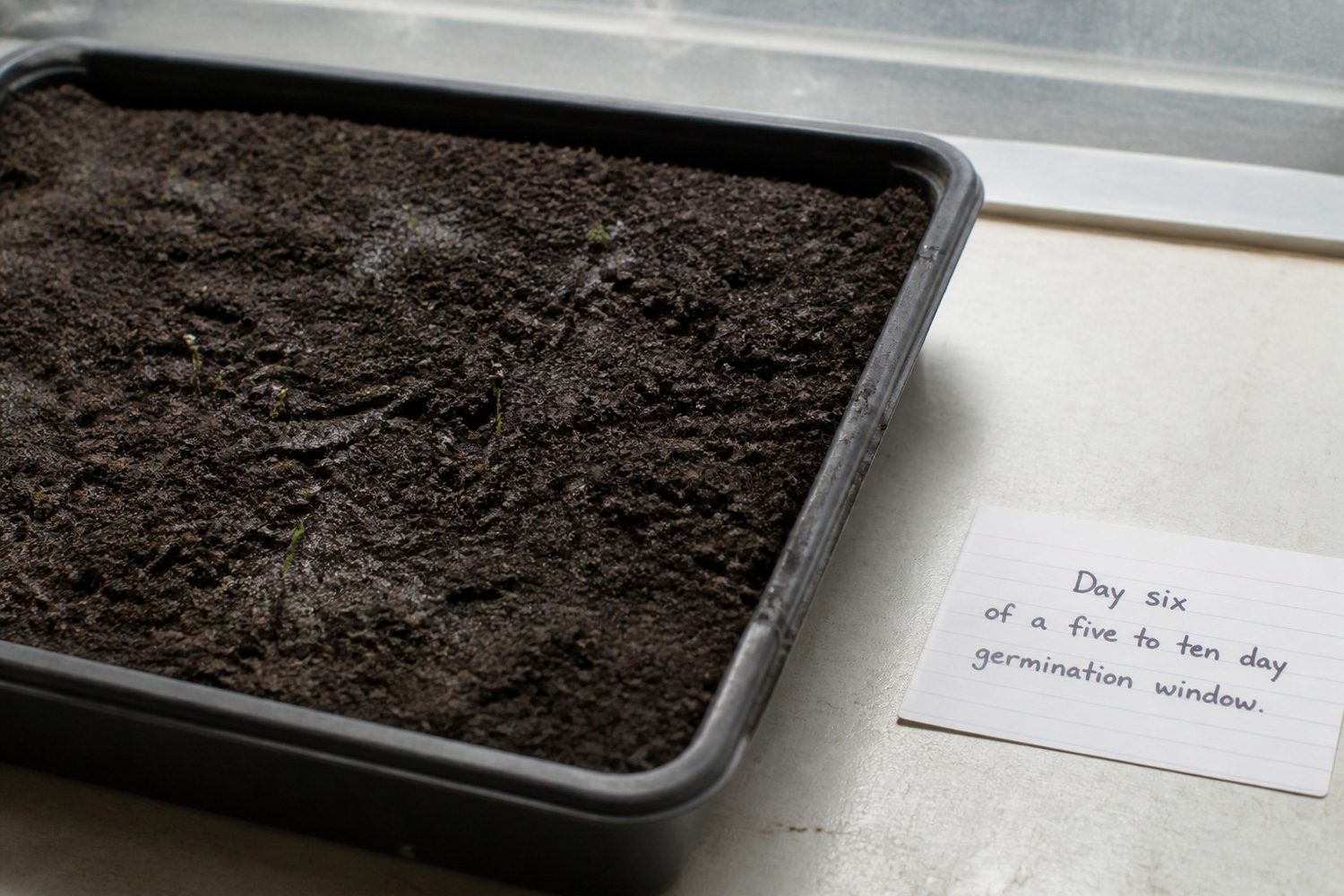
It takes no blackout and no soak, and germination alone runs five to ten days. The most common way to lose this crop is deciding on day four that it has failed.
What growers are saying right now
Sampled from public posts and videos, 10 July to 9 August 2026. Every line links what it is quoting. How often something is repeated is not evidence that it is true, so every line also says what the sources actually establish.
Nobody has posted about sorrel in years
Circulating Not one current item, and every ranked result runs from 2018 to 2022
The unusual thing here is that the old material is genuinely good: real microgreen how-tos with 781,000 YouTube views between them. So, the knowledge exists and the conversation has stopped, which means the 2018 videos are still the best watching you will find on this crop. Do not read their age as a reason to discount them.
Growing red veined sorrel a certain size for a microgreens customer, quite a challenge for me
Circulating A market grower's account at 14,408 views and 107 comments, from 2018
The best independent corroboration of the difficulty rating on this page. A chef asked him for leaves a coin's width across, he calls it hard, and he says he does not grow it regularly for that reason. Two details match the published guidance from a completely different direction: he got germination going with soil around 18 to 20C, and he notes you are not sowing it like a conventional microgreen because you are growing them bigger, which is the same instruction as Johnny's advice to sow less for larger leaves. How to grow it
A sort of sour lemon zest flavor, and as it grows bigger it just gets better and better
Circulating A grower walking a tray from microgreen to mature at 4,492 views
The flavor half matches every source here. The second half contradicts them, and the disagreement is worth flagging rather than smoothing: Wisconsin Extension describes the species as lemony-tart young and tough and bitter with age, and Johnny's sells the crop specifically at the "very small leaves" stage. One grower's palate against a stated extension direction is not a finding either way, and nobody has measured it, which is the gap this page keeps returning to. What the numbers show
I couldn't believe how good this tasted
Circulating A microgreen farm's how-to at 16,273 views, from 2021
Worth recording because enthusiasm this specific is rare on a crop this slow, and because it points at the real market. Sorrel is not grown for the grower. It is grown because somebody tasted it once and wanted it on a plate. Is it worth growing
What it is, and how to tell you grew it right
Read the botanical name on the packet before anything else. The chef-facing crop is Rumex sanguineus, red-veined sorrel, and every microgreen supplier opened here sells that species. **Common sorrel, Rumex acetosa, is a different plant** also sold as "sorrel". The trade names pile up further: bloody dock, red-veined dock, wood dock, spinach dock, narrow-leaved dock. They are all names for the red-veined species, but "sorrel" alone on a label promises nothing.
It is in the Polygonaceae, the buckwheat family, alongside buckwheat, which it resembles in no way at all in a tray.
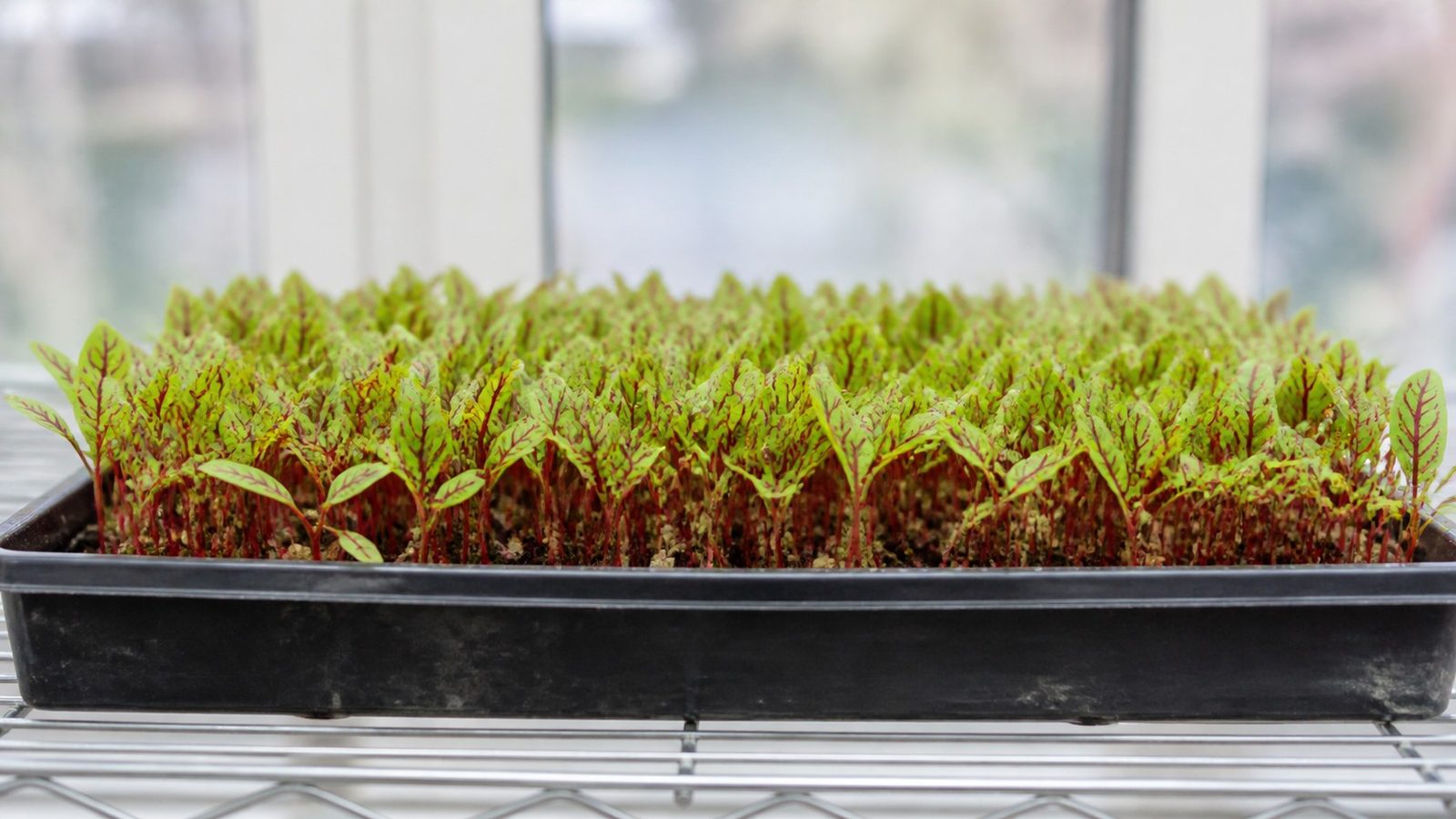
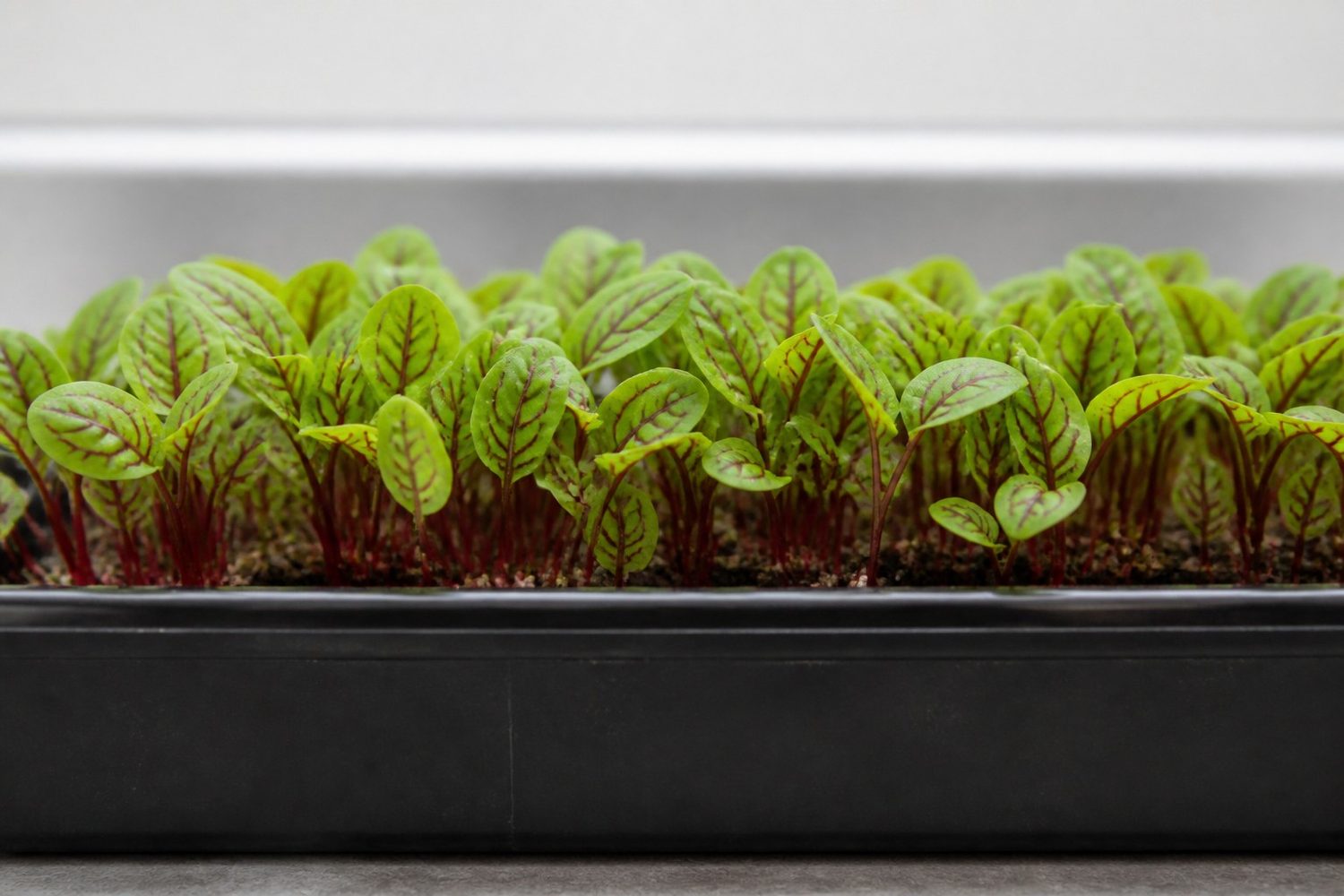
The product is the leaf, not the stem. A correct tray is small, bright green leaves crossed by conspicuous red to purple veins, on fine crimson stems. Do not expect a red leaf: green blade with red venation is the crop. That veining is also the identification tell, because plain green sorrel and green dock look the same at a glance and lack it.
Johnny's trial cut at first true leaf, at 24 days. Its 3.5 g rate is stated for "very small leaves", and the same page tells you to sow less if you intend to grow them bigger, which is the opposite of the instinct.
What it tastes like, and what to do with it
Bright, sharp, lemon-tangy. This is an acid rather than a flavor: sorrel does on a plate what a squeeze of lemon does, and it is strong enough to be used by the leaf.
That makes it a seafood garnish, a canape topper, a composed-salad accent, a dessert garnish (its supplier names that use specifically), and a contrast element in an otherwise mild blend. It is the wrong crop for bulk, crunch or a neutral base.
Anyone who dislikes sour will dislike it, and that is not a matter of getting the growing right.
There is a second reason not to eat it by the handful, and it gets its own section below.
Oxalic acid, and why there is no dose to give you
Sorrel is sour because of oxalic acid, and the extension sources that describe the species are explicit about it: Wisconsin Extension says the plant contains oxalic acid and should not be eaten in large quantities, and N.C. Extension notes possible stomach upset and that large intake can bind nutrients.
Those are statements about the plant, not measurements of a microgreen serving, and one does not convert into the other.
Here is the pointed part. A 2020 peer-reviewed study did measure oxalate in microgreens, alongside protein, fiber, minerals, ascorbic acid, alpha-tocopherol and beta-carotene, across ten culinary crops: spinach, carrot, mustard, radish, roselle, onion, fenugreek, sunflower, French basil and fennel. Sorrel is not one of the ten. The one study that measured the thing sorrel is defined by skipped the crop where it matters most.
So, the honest position is a direction without a dose. Sorrel is a high-oxalate plant used as a garnish in small amounts, which is how the trade sells it and how the flavor pushes you to use it anyway. Anyone told to limit oxalate should treat it as a high-oxalate food and not as "a microgreen, therefore a vegetable serving". Nobody has published the milligrams.
Growing it: only what differs from the standard method
Four departures, and three of them are things you do not do.
No soak. The published sorrel guide lists pre-soak: no. No source gives a duration or temperature, so there is no short-versus-long soak question to answer.
No blackout, and no weight. The guide lists blackout "Nil", and grower reports independently converge on a humidity dome and nothing on top. This is a different thing from what lettuce, mint and purslane do, and the difference is worth keeping straight: those three must not be blacked out because their seed is light-responsive and darkness suppresses germination. Nothing says sorrel's seed needs light. It simply is not a blackout crop in any protocol anyone has published.
Sow 3 to 3.5 grams and no more. At about 1,150 seeds a gram that is still roughly four thousand seeds in the tray, so a rate that looks absurdly sparse on the scale is not sparse in the medium. Broadcast, press for contact, cover lightly or dome, and bottom-water so the medium does not splash onto very small plants.
Then wait longer than feels right. Germination alone is published at five to ten days, and harvest at 24 to 30. The single most reported mistake on this crop is deciding at day four that the tray has failed.
What goes wrong with sorrel specifically
Almost everything that goes wrong is a reaction to the slowness.
Mistaking the germination window for failure. Five to ten days is normal here. Growers re-sow, add water, add a weight, or add a blackout, and each of those makes it worse. Recoverable until the ten-day window is genuinely past and the seed has clearly decayed.
Damping-off around emergence, on general pathology rather than a sorrel study: seedlings rot at or below the medium line, or never appear. Pythium typically starts at root tips and is favored by cool wet conditions; Rhizoctonia can appear warmer and drier. Individual seedlings do not recover. The tray sometimes does, if losses are limited and you fix moisture and airflow.
The usable field test, again general rather than sorrel-specific: white fuzz confined to otherwise healthy root tips at the medium is root hairs, and is not a reason to bin a tray. Spreading growth, decay, or seedlings collapsing at the soil line is disease.
Late-crop pests on a long tray. One grower report describes yellowish aphids and a white leaf coating, and the species is listed outdoors with slugs, rust and powdery mildew. A three-to-four week tray simply gives pests more time than a nine-day brassica does. This is observation, not a crop-specific indoor diagnosis.
Cutting late. Leaves get larger and coarser and the delicate red-veined garnish stops being one. The mature plant goes tough and bitter with age, which supports the direction, and nobody has published the day it happens in a tray.
Nutrition: nothing, and an unusually specific nothing
USDA FoodData Central returned no entry for red-veined sorrel microgreens, searched across all data types on 8 August 2026. No FDC ID, no nutrient values.
**No peer-reviewed nutrient-composition paper for Rumex sanguineus microgreens was found either.** The supplier claim that this crop supplies vitamins A, B complex, D and E plus a long mineral list appears on a product page with no analysis behind it, and it should not be turned into numeric nutrition copy.
The gap is sharpened by the oxalate study above: composition work on culinary microgreens exists, it measures exactly the compound this crop is known for, and it leaves this crop out. So, if a customer asks what is in it, the honest answer is that nobody has looked.
Which seed to buy
One market type: **Red Veined sorrel, Rumex sanguineus**. Johnny's version is organic and open-pollinated at 26 to 30 days; Hoss sells it untreated at 17 to 28 days. No supplier page establishes named cultivars that differ reliably in stem length, tenderness, yield or color.
Specify the botanical name, untreated status, and lot and germination information for production quantities. Refuse seed treated for ornamental or field use, since the harvest is eaten raw.
Pack size matters more here than on most crops. Johnny's listed the pound at $351.35 and a single ounce at $35.40, which is $566.40 a pound. On the 3.5 g rate that is the difference between $2.71 and $4.37 a tray for the same seed. On a crop this slow, buying the small pack twice is the expensive habit.
The marketplace is where the species trap actually bites. Red veined sorrel seed on Amazon returned 24 sorrel listings out of 58 tiles on 9 August 2026, and page one held three different plants under the one word: Rumex sanguineus, plain garden sorrel sold as a "large leaf cool weather perennial" which is R. acetosa, and something listed as "Indian sorrel", a different genus again. The $4.49 to $6.95 packets of 100 to 200 seeds are garden packets and nowhere near the roughly four thousand seeds a tray takes.
On price it runs about 1.5 times the seed house, the same shape as shiso: Mountain Valley's 1 oz at $32.28 is $516.48 a pound and $3.99 a tray, and Hoss's 8 g "Red Panda" at $9.99 is $566.50 a pound and $4.37 a tray, against Johnny's $2.71. That Red Panda is a named cultivar no source opened here describes, so this page says nothing about how it grows.
One inconsistency to know about before you calculate anything. Mountain Valley states about 15,000 seeds an ounce, which is roughly 529 a gram. The published growing guide says about 1,150 a gram. Those are a factor of two apart, from two suppliers of the same crop, so weigh your seed rather than counting it.
And test the lot before committing a tray slot. A bad lot on a nine-day brassica costs you nine days. Here it costs three to four weeks, and you will not be sure it was the seed until most of that has gone.
Is it worth growing?
Grow it if you are selling a premium visual garnish and can charge for acid and color in small portions. That is a real market and this crop serves it well.
Do not grow it for weight or for speed. Johnny's own trial makes the trade-off concrete in one line: red-veined sorrel at 24 days and 6.5 oz against broccoli at 12.5 days and 11.5 oz from the same 1020, both cut at first true leaf. That is roughly twice the time for a bit over half the weight.
For a one-tray home grower it is justified only if you actually want lemon-tart red-veined leaves. If what you want is forgiving daily salad, grow almost anything else.
A note on the numbers above
Hover or tap a row to highlight it.
| Figure | Value | Source | What kind of number it is |
|---|---|---|---|
| Seed per 1020 | 3.5 g (0.123 oz) | Johnny's 29-variety trial | Measured, at a first-true-leaf harvest |
| Seed per 10x20 | 3 g | A published growing guide | A second recommendation, close to the first |
| Yield per 1020 | 6.5 oz | Johnny's trial | Measured, averaged over at least three seedings |
| Yield per 10x20 | 180 g (6.35 oz) | The same growing guide | A guide expectation at up to 30 days |
| Days to harvest | 24 | Johnny's trial | Measured to first true leaf, greenhouse, August to October |
| Days to harvest | 26 to 30 | Johnny's product page | Stated flat, harvest stage unspecified |
| Days to harvest | 17 to 28 | A second supplier | Stated flat, with 5 to 10 days for germination alone |
| Seed price | $351.35 per pound | Johnny's, listed 2026-08-08 | A price on a day. The same page listed 1 oz at $35.40 |
| Seed cost per tray | $2.71 | Calculated | 3.5 g at $0.7746 a gram |
| Soak | None | A published growing guide | Stated as "No", not merely absent |
| Blackout | Nil | The same guide | Stated as "Nil", and growers agree |
| Seed count | about 1,150 per gram | A seed guide | Why 3.5 g is still roughly 4,000 seeds |
| Oxalic acid | Present, "not in large quantities" | Wisconsin Extension | A species-level caution, with no microgreen dose |
| Oxalate in microgreens | Measured in 10 crops, none of them sorrel | Ghoora et al. 2020 | The absence that matters most on this page |
| Harvest window | No figure exists | Every source opened | Nobody has measured how long the tray holds |
| Fresh-weight panel | No FDC record | USDA FoodData Central, searched 8 August 2026 | An absence, confirmed rather than assumed |
Dear seed, ordinary tray, and that pair is the whole economic point. At $351.35 a pound sorrel sits behind only mint's $1,394.50 and ahead of watercress's $296.25, oregano's $242.36 and shiso's $155.50. At 3.5 g it still makes a $2.71 tray. That 3.5 grams is about as light as any weighed rate gets; the only lighter figure anywhere, celery's 1.1 to 4.4 g, was calculated rather than weighed.
What it returns for that is thin. 6.5 oz over 24 days works out at 2.40 oz per dollar of seed and 0.27 oz per tray-day, both low. Sorrel is not sold by the ounce, and the economics only work if the price per gram to your buyer is a garnish price.
Nobody has measured how long a ready sorrel tray holds. The mechanism is documented clearly enough: the species is lemony-tart young and tough and bitter with age, and the tray product is explicitly the "very small leaves" stage. What is missing is the number of days between those two. That is true of most herbs sold by the leaf rather than by weight. So, cut one tray at first true leaf and leave the next a few days longer, taste both, and write down where yours turns.
Hover or tap a row to highlight it.
| Crop | Seed per 1020 | Yield | Days | Cost per tray | Oz per $1 | Oz per tray-day |
|---|---|---|---|---|---|---|
| Sorrel, Red Veined | 3.5 g | 6.5 oz | 24 | $2.71 | 2.40 | 0.27 |
| Buckwheat | 91.4 g | No published figure | 6 to 12 | $2.04 | cannot be calculated | cannot be calculated |
A blank means nobody has published that figure, so the cell is left empty rather than filled with an estimate. How the numbers work
All 62 crops, sortable, on the microgreen comparison.
Terms on this page
Tap a term to see what it means.
*Rumex sanguineus*. Red-veined sorrel, the crop here. Not Rumex acetosa, common sorrel, which is also sold under the word "sorrel".
Sources
- Red Veined sorrel organic microgreen seed, Johnny's - the 3.5 g rate, 26 to 30 days, the bright lemon description, the temperature guidance, and the $351.35 per pound and $35.40 per ounce prices listed 8 August 2026.
- Johnny's microgreen yield trial summary and the trial tech sheet - 3.5 g, 6.5 oz and 24 days to first true leaf, the broccoli comparison, and the trial's caveat that yields do not transfer perfectly between systems.
- Red veined sorrel microgreens, Hoss - 17 to 28 days, 5 to 10 days germination, untreated seed, and the unsupported nutrient claim this page declines to repeat.
- Sorrel red veined microgreens seeds, True Leaf Market - the spinach dock and narrow-leaved dock trade names.
- Microgreen growing guide, Seedmart Australia - 3 g per 10x20, no pre-soak, nil blackout, 180 g at up to 30 days, and about 1,150 seeds a gram.
- Rumex sanguineus, N.C. Extension - species identity and the note on stomach upset and nutrient binding with large intake.
- Bloody dock, Wisconsin Extension - the oxalic acid caution, the lemony-tart-young to tough-and-bitter-old direction, and the outdoor pest list.
- Ghoora, Babu and Srividya, 2020, "Nutrient composition, oxalate content and nutritional ranking of ten culinary microgreens", Journal of Food Composition and Analysis, DOI 10.1016/j.jfca.2020.103495 - measured oxalate in ten crops, none of which is sorrel.
- USDA FoodData Central - searched 8 August 2026, no record.
- Damping-off, UC IPM - the pathology and the root-hairs-versus-disease test.
- Microgreens production, Virginia Cooperative Extension and Growing microgreens at home, SDSU Extension - general controlled-environment risks and general storage guidance, neither used as a sorrel figure.
- Grower reports on r/microgreens describing growing issues and the no-weight approach and germination trouble.
Keep reading
The variety directory
Celery microgreens
Three to four weeks of bench for a seasoning green, with an unusually complete measured nutrient panel behind it: 45.8 mg of vitamin C per 100 g, and four minerals that are higher in the mature leaf.
Read Celery microgreensThe variety directory
Mint microgreens
Mint must not be blacked out, and its seed costs $1,394.50 a pound. The one published seed rate would put 154,000 seeds in a 1020 tray, ten times the densest sowing anyone has measured.
Read Mint microgreensThe variety directory
Oregano microgreens
Concentrated resinous oregano as a fresh garnish, on a sixteen to twenty-five day tray. The seed is expensive and no sowing rate is published, so weigh a test patch before you scale.
Read Oregano microgreensThe variety directory
Carrot microgreens
Carrot is one of the cheapest trays of seed you can sow at 44 to 66 cents, and one of the poorest uses of a bench: about 2 oz after 20 days, a twelfth of radish's daily turnover.
Read Carrot microgreens