Buckwheat microgreens
Cal HewittPublished Updated Checked
- large seed
- shoot
- long keeping
- knotweed
- moderate
- needs soaking
- raw or cooked
At a glance
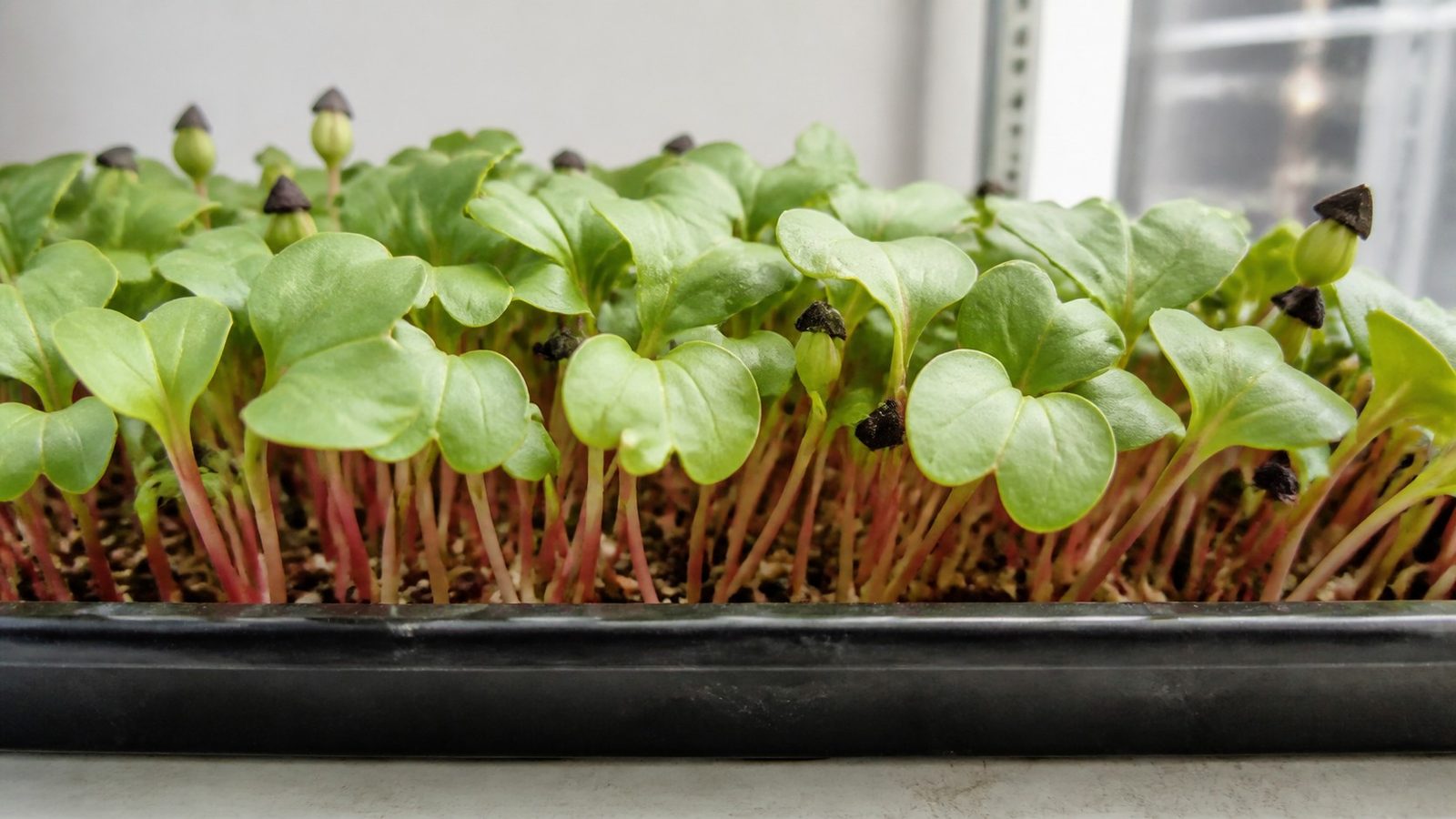
Germinates fast and forgives little else: the large intact hull has to sit against the medium, and the moisture that hull holds is what turns into base rot when a tray is sown too densely or watered too freely.
- Botanical name
- Fagopyrum esculentum
- Also sold as
- Buckwheat shoot seed, Buckwheat microgreens, Unhulled buckwheat
- Family
- knotweed
- Difficulty
- Moderate
- Days to harvest
- 6 to 12 days
- Harvest window
- No published figure
- Seed per 1020 tray
- 91.4 g
- Soak
- 12 to 24 hours
- Blackout
- 3 to 4 days
- Germination temperature
- No published figure
- Yield per 1020 tray
- No published figure
- Regrows after cutting
- No published figure
- Mold risk
- Medium
- Hull shedding
- heavy
- Shelf life
- 21 days
- Eaten as
- raw or cooked
- Seed cost per tray
- $2.04
91.4 g at $10.10/lb, Johnny's organic buckwheat shoot seed, listed 2026-08-08. The gram figure is scaled from a published density rather than measured. Seed only, excludes medium, tray, labor, light and loss.
Any field name above ranks every variety by it. No published figure means we researched it and nobody has established one, which is different from not yet researched. Every figure here is sourced at the bottom of the page. Compare every variety side by side.
Buckwheat keeps longer than any other microgreen anyone has measured, and nobody knows what a tray yields. A USDA-ARS postharvest study held it at acceptable quality for 21 days refrigerated, half as long again as the next best measured crop and more than double the supplier estimates around it. It is also absent from the only per-tray trial in the category, so nobody can tell you what a 1020 makes. It is also the one crop here where the commonest buying mistake means nothing comes up at all, because hulled buckwheat is a different product from the seed you need.
What growers are saying right now
Sampled from public posts and videos, 9 July to 8 August 2026. Every line links what it is quoting. How often something is repeated is not evidence that it is true, so every line also says what the sources actually establish.
Buckwheat is a cereal grain
Circulating Said in the opening seconds of True Leaf Market's own how-to, which is the most substantial buckwheat microgreen video in the window
It is not, and the correction is useful rather than pedantic. Buckwheat is Fagopyrum esculentum in the Polygonaceae, the knotweed family, not a grass and not a cereal. That is exactly why it grows as a broad-leaved shoot rather than as a blade like wheatgrass, and why it behaves like a large-seeded shoot crop in the tray. What it is
It has to have the shell on it
Circulating Put exactly that way by a grower who then names what the hulled version is called: groats, the thing you cook
Correct, and it is the most expensive mistake available on this crop. Hulled buckwheat will not germinate, so the wrong bag produces nothing at all rather than a poor tray. The published research protocol uses shell-intact seed. Buy it unhulled and check the bag says so. Which seed to buy
Soak it about four hours
Circulating What that same how-to does on camera
The crop-specific supplier instruction is 12 to 24 hours, and the USDA-ARS study soaked 12 hours in slightly acidified water. Nobody has published a controlled comparison, so four hours cannot be called wrong, only unsupported by anything opened here. What is established is the direction: drain thoroughly, because free water around a large hull is this crop's main enemy.
Buckwheat is a great summer cover crop
Circulating A first-year cover-crop bed, grown for pollinators rather than for eating, which is most of what buckwheat seed is sold for
Same species, different seed, and the distinction matters because cover-crop seed is not sold for food use and may be treated. Extension guidance is explicit that seed treatments can be present in the young shoots. If it is going in your mouth in ten days, buy seed sold for food or shoot use.
What it is, and how to tell you grew it right
Buckwheat microgreens are common buckwheat, Fagopyrum esculentum, in the Polygonaceae. Tartary buckwheat, F. tataricum, is also sold for microgreens and is a genuinely different species rather than another name for the same thing.
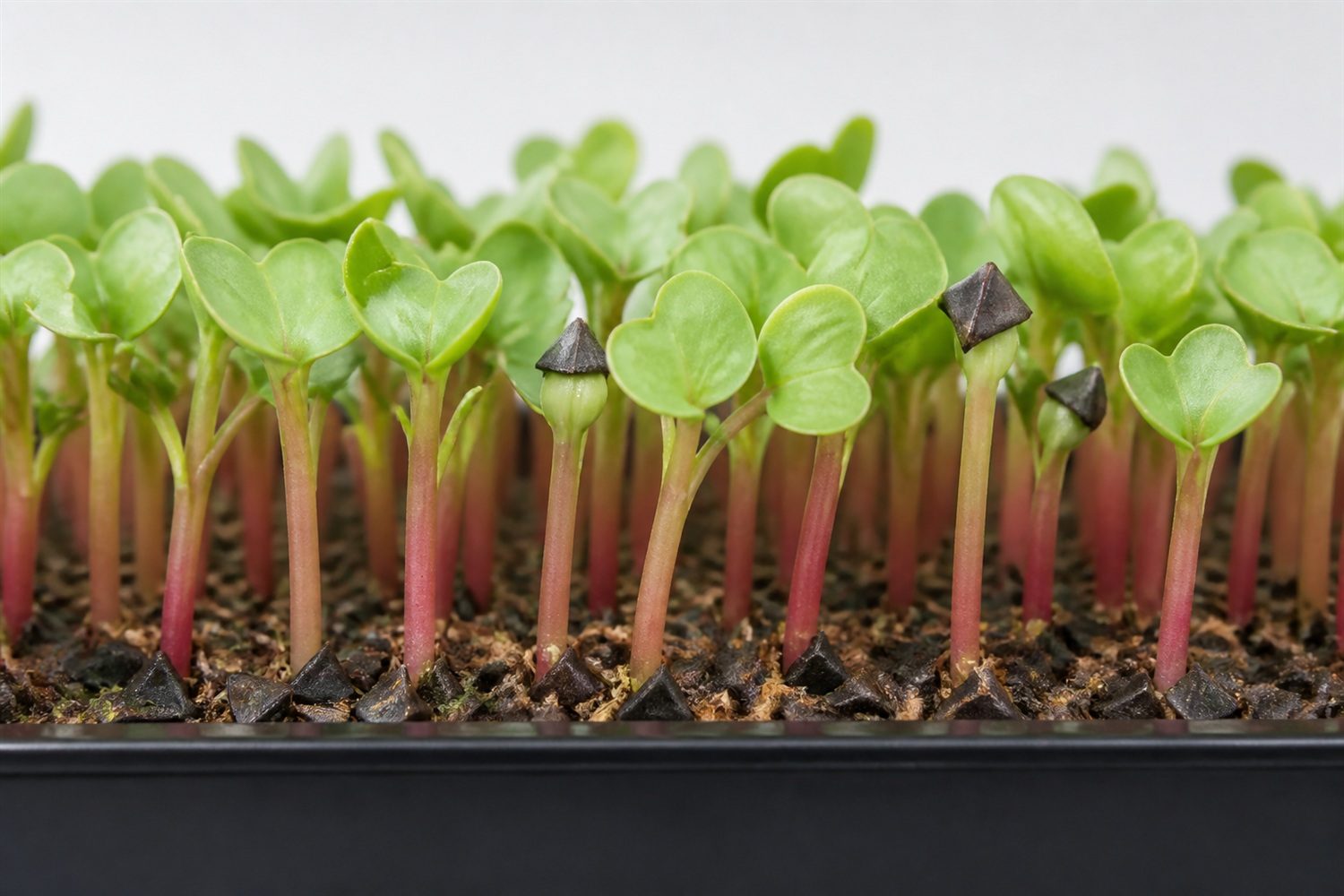
A correct tray is unmistakable and unlike anything else here: broad, pale-green, heart-shaped cotyledons on thick, juicy, translucent pink to red stems. Not white stems, not fine ones. The stand looks relatively open because the leaves are large, and there will be dark triangular hulls at the medium line with a few still clinging to shoots. Johnny's harvest target is three to four inches; the other published guide cuts earlier at about two inches with the first true leaves showing.
The confusion is with other large-seeded shoots, sunflower especially, at a distance. The tell is the stem: buckwheat's is vivid pink to red and translucent under a broad heart-shaped leaf, while sunflower's is thicker, greener, and carries elongated seed leaves in opposite pairs.
What it tastes like, and what to do with it
Mild and lettuce-like, juicy and crisp, with a tangy, faintly citrus edge that keeps it from reading as plain. That combination is unusual, because most microgreens are either neutral or assertive: buckwheat gives you volume and texture with a little brightness rather than heat.
So, it works where a substantial, mild leaf earns its place: layered through sandwiches and wraps, folded into a salad or a grain bowl, or used as a garnish that is doing real work rather than decorating. Johnny's says explicitly that the shoots can be eaten raw or cooked, which only a few microgreens can claim, pea being the other one.
It is the wrong choice for a small peppery finish, and it is the wrong choice in a dense mixed tray, where broad leaves dominate and a stray hull ends up in somebody's pack. People wanting a radish or mustard bite will find it too mild; people who dislike a citrus tang will notice it.
The practical deal-breaker for a buyer is usually not flavor at all. It is a hard hull in the box.
Growing it: only what differs from the standard method
The general method is on the standard tray method. Buckwheat's differences all follow from one fact: the seed is large and it arrives wearing a hard shell.
Soak it, 12 to 24 hours. The crop-specific supplier instruction is that range; the USDA-ARS study used 12 hours in slightly acidified water at pH 5.5 to 6.0. No source states a water temperature, so use room-temperature water and treat a precise figure from anywhere else as unsourced. Drain thoroughly before sowing.
Sow heavy by weight and light by eye. The published density is 16 g per 35 square inches, which scales to roughly 91 grams on a nominal 1020: seven times a broccoli tray, and about as heavy as a microgreen rate gets. Spread the soaked seed as a single even layer with the seeds not stacked, because a clump of hull-on seed is not a denser canopy, it is an airless wet pocket.
Press it in and keep it there. The whole seed has to be in contact with the medium or the root pushes the hull upward instead of driving down. A grower card calls for four and a half to six and a half pounds of pressing weight for three to four days, and while that is grower guidance rather than a trial, the reasoning is sound and matches what goes wrong without it. Level the medium first.
Three to four days covered, then off. Take the cover and weight off when most of the tray has germinated and it is visibly lifting, which is the general rule for any crop and lands at three to four days here. Then bottom-water: splashing broad leaves and hulls is the opposite of what this crop wants.
Air movement is not optional. The grow card calls it mandatory and reports base rot when trays are over-wet. That is the single most useful sentence anyone has written about this crop.
A tray of buckwheat, day by day
- 1
Day minus 1, soak
12 to 24 hours in clean water, then drained thoroughly. Hulled groats will do nothing at this step or any other.
- 2
Day 0, sow and press
About 91 g of soaked seed on leveled medium in a single even layer, pressed firmly for contact. Cover with 4.5 to 6.5 lb.
- 3
Days 1 to 4, covered
Dark and weighted so roots drive down rather than lifting the hulls. Off when the majority has germinated and the tray lifts the cover.
- 4
Then, light and airflow
Bottom water only. The stems color up pink and the leaves green. Air movement through the canopy is the thing that keeps base rot away.
- 5
Days 6 to 12, cut
Two inches with first true leaves showing, or three to four inches for a bigger shoot. Screen or brush the dry hulls off; do not wash and then store.
What goes wrong with buckwheat specifically
Four failures, in the order they arrive, and two of them are about the hull.
Uneven germination. Dry, unswollen seed or roots wandering across the surface instead of into it. Usually poor hydration or poor contact. Correctable early if the moisture and pressure are fixed before anything rots, but a tray with big gaps will never be a uniform pack.
Hull lift and surface rooting, which is buckwheat's own failure. Seeds rise with their roots exposed, because a large seed that was not pressed into a level medium pushes itself up instead of anchoring. Caught immediately, better contact can still save it. This is what the weight is for.
Base rot and damping-off in the covered phase. Excess moisture plus crowded hulls plus poor airflow. The tell is a sour smell, a soft dark area at the medium line, or seedlings collapsing. Pythium and Rhizoctonia are the usual organisms and damp is what favors them. A localized patch can be cut out; a spreading or slimy tray is not food and should go.
Hull contamination at harvest. Husks mostly release as the leaves open, but the ones that do not are hard and unpleasant and no customer forgives them. Remove them from otherwise sound greens by screening or brushing while the crop is dry.
Root hairs or mold: the standard test with one crop-specific note. Root hairs are bright white, fine, straight, uniform, attached close to individual roots and seeds, and they collapse after a light mist. Mold is grayish or dull, web-like or patchy, may show dark specks, spreads across medium, stems and seeds, and survives the mist. On buckwheat, look hard at the hull and medium line specifically, because that is where both the roots and the trouble appear.
Storing it: the longest measured shelf life of any microgreen
Most microgreens have only a supplier's estimate for shelf life. Five have a controlled study behind them, and buckwheat's returns the longest number of the five, which is the single most useful fact here if you sell the crop.
A USDA-ARS-led postharvest experiment kept buckwheat microgreens at acceptable quality for 21 days at 5°C, which is 41°F, in packaging with high enough oxygen transmission, the best film tested being 16.6 pmol/(m²·s·Pa). That is a research upper bound rather than a promise for a loosely packed clamshell, but it is a real number from a real trial and it is roughly double the published figures for the crops around it.
Two findings from the same study are worth acting on:
Temperature does the work. Storage at 15 to 20°C gave higher bacterial counts after 10 days; storage at 1°C produced signs consistent with chilling injury late on. Cold, but not that cold.
Do not wash before storing. Water, 50 mg/L chlorine and 100 mg/L chlorine washes all reduced microbes initially, and all rebounded between days 7 and 21, and the washed product showed more water-soaked stems by day 7. Store it dry and unwashed and wash immediately before use. That is counterintuitive enough that most people do the opposite.
Nutrition, and what is actually established
USDA FoodData Central was checked on 2026-08-08 and holds no entry for buckwheat microgreens. It does hold buckwheat grain, and those values must not be moved onto a microgreen: different product, different stage.
The crop-specific research that exists is a 2010 study growing common and Tartary buckwheat microgreens hydroponically for 10 days to first true leaf after a 24-hour soak, across three common-buckwheat accessions. It measured antioxidant activity, flavonoids including rutin, quercetin and kaempferol, phenolic acids, carotenoids and α-tocopherol. Its findings were that the microgreens had higher antioxidant activity, carotenoids and α-tocopherol than the seed, and that Tartary buckwheat microgreens carried higher flavonoid content than common buckwheat.
That is compositional analysis, not a health outcome and not a serving figure. The claims to leave alone are a defined high-protein or high-iron profile, and any fixed rutin amount per serving, because the study's own result is that it varies by species and genotype.
Which seed to buy
Unhulled, and this is the one decision on the page that can waste the whole tray. Hulled buckwheat, sold as groats, is a food ingredient and will not germinate. The published protocol uses shell-intact seed, and the bag should say unhulled or shoot or microgreen seed rather than groats.
Seed sold for shoots or sprouting, not cover crop. Buckwheat is widely sold as a summer cover crop, and that is the same species with a different purpose. Cover-crop and field seed can be treated, and extension guidance says plainly that treatments can be present in the shoots you eat. This is not a theoretical risk on this crop: a search for buckwheat microgreen seed returns cover-crop bags on the first screen.
Specify common buckwheat, F. esculentum, sold for food, shoot or microgreen use, untreated, with lot and germination information for a commercial purchase. Organic is a useful attribute and it is not a substitute for either of those.
A bad lot shows as low, slow or uneven emergence, dead hulls staying wet and soft, and gaps or clumps instead of an even canopy. On a large-seed crop that cannot be corrected into a uniform pack, so run a small germination test before committing to bulk.
Unhulled buckwheat microgreen seed on Amazon is the convenient route for a home tray, but read the bag before you order, because those search results do return hulled groats and cover-crop seed alongside the right thing.
Is it worth growing?
Yes, for a home grower who wants a fast, mild, substantial salad and sandwich green, and for a market grower who can sell pink stems and is willing to handle hulls. The color is a genuine selling point, the flavor is broadly liked, and it keeps longer than anything else here.
The caution here is about a number you will not find. There is no verified per-tray yield for this crop, because it is absent from the only public trial and no second study fills the gap. If you sell by predictable ounces, that is a real problem, and the answer is to measure your own: grams sown, usable cut weight, tray dimensions, temperature, light and harvest stage. Do that once and you will know more than any published source.
Against sunflower, the other large-seeded shoot, it comes down to leaf and flavor: sunflower gives a nuttier, crunchier shoot, buckwheat a broader, juicier, tangier one with pink stems. Against a small-seeded brassica like broccoli, buckwheat trades a published yield figure and a light hull burden for volume, color and the longest measured shelf life going.
Terms on this page
Tap a term to see what it means.
Groats. Hulled buckwheat, the ingredient you cook. It will not germinate, and buying it by mistake is the one error on this page that produces nothing at all.
Sources
- Johnny's Selected Seeds, buckwheat organic shoot seed - Fagopyrum esculentum, 7 to 12 days, 3 to 4 inch harvest, heart-shaped leaves and pinkish stems, raw or cooked, and the price checked 2026-08-08.
- Johnny's microgreens yield trial results (PDF) - the 29-variety scope that does not include buckwheat, which is why there is no measured tray yield here.
- Johnny's trial method and discussion - the harvest standard and the caveat that yield varies with system, conditions, stage and lot.
- Sow Right Seeds, buckwheat microgreens - 6 to 12 days, the 12 to 24 hour soak, 3 to 4 day blackout, 16 g per 35 square inches, and the tangy citrus description.
- Sow Right Seeds, how to grow buckwheat microgreens - the harvest stage, covering practice and culinary uses.
- Kou et al., 2013, postharvest quality of buckwheat microgreens - 21 days at 5°C, the packaging film results, the wash-treatment rebound and water-soaked stems, shell-intact seed, the 12-hour acidified soak and 25°C dark germination.
- Janovská, Štočková and Stehno, 2010, buckwheat microgreen composition - antioxidant activity, flavonoids, carotenoids and α-tocopherol against seed, and common against Tartary.
- Virginia Tech Extension SPES-756 (PDF) - determining density by species rather than a universal rate, uncovering at majority germination, bottom watering, and the general production range.
- SDSU Extension, growing microgreens at home - watering from below, and why treated seed is unacceptable on a crop eaten as shoots.
- UC IPM, damping-off - Pythium and Rhizoctonia, and rot at or below the medium line.
- UAOrganic buckwheat grow card - the pressing weight, mandatory air movement, and base rot under over-watering.
- USDA FoodData Central - checked 2026-08-08, no buckwheat microgreen record.
Keep reading
The variety directory
Chickpea shoots
One of the very few crops with real regrowth data behind it: a measured second cut at 96 percent of the first, if you cut above a node instead of at the medium line.
Read Chickpea shootsThe variety directory
Sunflower microgreens
The heaviest tray you can grow, at about 18.8 oz, and the only one that needs a soak, a weight and daily hull-brushing. Published seed rates run from 48 g to 250 g a tray, more than five times apart.
Read Sunflower microgreensThe variety directory
Lentil microgreens
The cheapest legume tray by a wide margin, because its seed is a grocery commodity: about 47 cents and 7 oz a tray, against pea shoots at $2.39 for eight.
Read Lentil microgreensThe variety directory
Pea shoots
Pea shoots are the easiest microgreen to start and one of the easiest to lose. Sourced figures for seed rate, days, yield and cost, plus the wet-seed failure that actually kills trays.
Read Pea shoots