At a glance
Germination alone takes six to seven days and the crop takes three to five weeks, so every moisture and temperature error has far longer to become an uneven stand, and the tray is occupied the whole time.
- Botanical name
- Petroselinum crispum
- Also sold as
- Parsley microgreen seed, Dark Green Italian Flat-leaf, Plain or Single, Forest Green, Italian Flat Leaf
- Family
- umbellifer
- Difficulty
- Difficult
- Days to harvest
- 21 to 35 days
- Harvest window
- No published figure
- Seed per 1020 tray
- 15 to 20 g
- Soak
- None
- Blackout
- 4 to 5 days
- Germination temperature
- 60 to 75 °F
- Yield per 1020 tray
- 6.25 oz
- Regrows after cutting
- No published figure
- Mold risk
- High
- Hull shedding
- some
- Shelf life
- No published figure
- Eaten as
- raw
- Seed cost per tray
- $0.50
15 g at $14.99/lb, True Leaf Market Dark Green Italian Flat-leaf parsley microgreen seed at the 1 lb size, listed 2026-08-09. $0.66 at the 20 g end. The ladder runs 1 oz $4.25, 4 oz $6.54, 1 lb $14.99, 5 lb $45.69, 25 lb $170.99, so the same tray is $0.23 at 25 lb. Cheap seed on a very expensive bench: three to five weeks of shelf is the real cost of this crop. Seed only, excludes medium, tray, labor, light and loss.
Any field name above ranks every variety by it. No published figure means we researched it and nobody has established one, which is different from not yet researched. Every figure here is sourced at the bottom of the page. Compare every variety side by side.
Parsley is the long game. Six to seven days before anything shows above the medium at all, then three to five weeks in total for about 6.25 ounces. Very little else asks for that much bench. The real cost of this crop is not the seed, which runs about fifty cents a tray, it is five weeks of shelf you cannot use for anything else.
What you get for it is a small, tender, three-lobed parsley leaf with none of the bitterness of the mature herb. If that is what the plate wants, one tray earns its place. If you are trying to make a bench pay, almost anything else turns over faster.
And it behaves like the rest of its family. The umbellifers, carrot, celery, chervil, cilantro, dill and fennel, are all slow and all light, and parsley lands exactly where they do, at 0.30 ounces per tray-day, level with cilantro. So, if you are choosing an Apiaceae, choose it for a flavor no brassica can give you, and price it as a garnish.
What growers are saying right now
Sampled from public posts and videos, 10 July to 9 August 2026. Every line links what it is quoting. How often something is repeated is not evidence that it is true, so every line also says what the sources actually establish.
Parsley and cilantro implicated in an outbreak
Circulating A tabloid health headline that reached Hacker News on 28 July, naming cyclosporiasis cases in North Carolina and Michigan
The outbreak is real and the produce named is wrong. CDC counted this 2026 Cyclospora outbreak at 6,358 illnesses across 15 states on 5 August and closed it on 11 September at 12,883 illnesses across 21 states, 570 hospitalizations and 2 deaths, and the vehicle identified is iceberg lettuce from central Mexico, recalled by Taylor Farms on 17 July. Parsley is a plausible suspect because fresh herbs genuinely have that history, which is why FDA runs a surveillance program specifically on cilantro, basil and parsley. It is not this outbreak. What that means for a tray
You have to be patient, because for a while it will seem like nothing is happening
Circulating Said about a hydroponic parsley grow at 253 views
That is the most useful thing anyone says about this crop. Published germination is six to seven days and the crop runs three to five weeks. The characteristic failure on parsley is not disease, it is a grower deciding at day three that the tray has failed and watering the empty medium harder. Growing it
Fifty-two bunches of parsley per tower in one square meter
Circulating An aeroponic grower's post at 436 views
Worth reading as the competition rather than as technique. Parsley is a cheap, abundant, year-round supermarket herb produced at exactly that kind of density, and a three-to-five week tray of microgreen parsley is not competing with it on volume or price. It competes on being a small tender lobed leaf, which is a garnish argument. Is it worth growing
Parsley is the little herb that works hard, and here is when to plant it
Circulating A garden clip at 152 views, one of four parsley items in the window and all four about the mature plant
Nobody is discussing parsley as a tray crop, the way nobody discusses onion or oregano either. The published record is thin in the same way: no trial entry, no direct 1020 measurement, no shelf-life study, no harvest window. Expect to keep your own numbers on this one.
What it is, and how to tell you grew it right
Parsley microgreens are seedlings of Petroselinum crispum, in the Apiaceae. Flat-leaf, curly and root parsley are cultivated forms of one species, not different crops. **Japanese parsley, Cryptotaenia japonica, is a different plant and is not a substitute.**
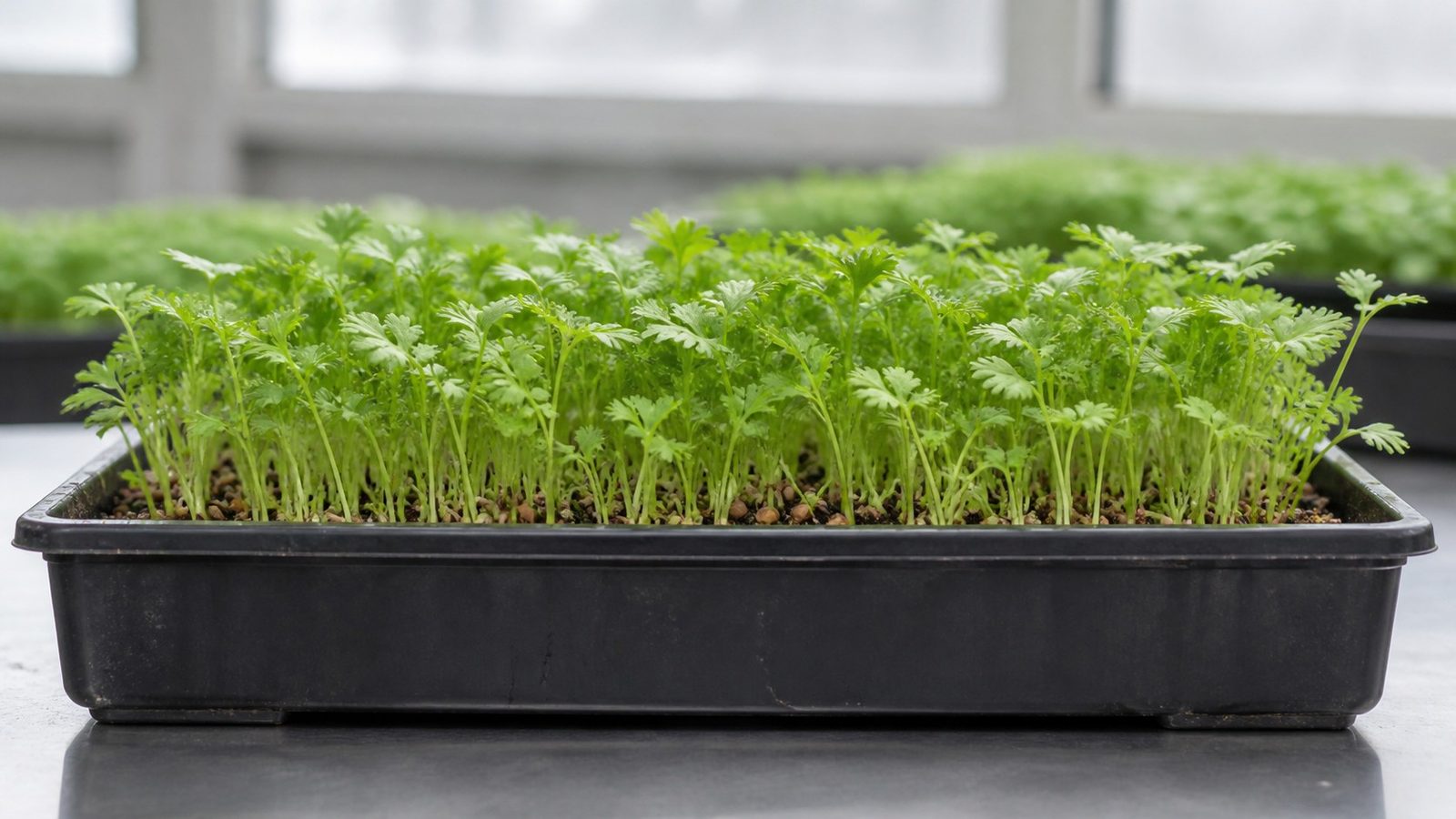
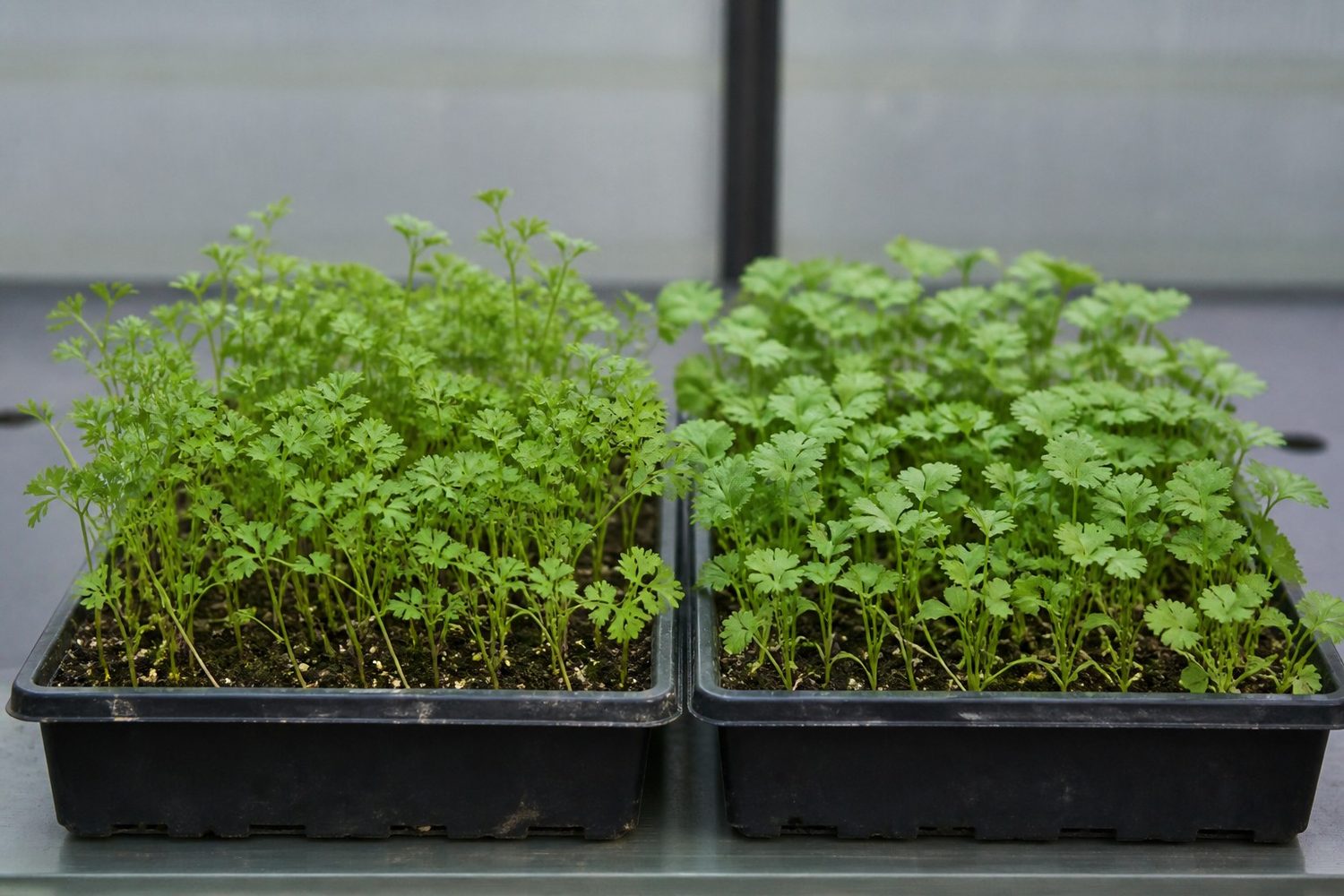
A correct flat-leaf tray at harvest is a fairly short, dense, mid-green carpet: thin pale to mid-green stems carrying small serrated, three-lobed leaves that look like miniature parsley rather than the paired ovals of a brassica. Expect unevenness if germination straggled, and expect brown hulls near the medium and on some leaf bases. Harvested height is not published for this crop.
What it is confused with is cilantro, and the tell is the emerging true leaf: parsley's is more pointed, sharply serrated and compact, cilantro's is rounder, scalloped and more finely divided. That is a morphology inference rather than a measured key, because no side-by-side comparison of the two at tray stage has been published.
What it tastes like, and what to do with it
Mild, clean and recognizably parsley, subtler than the mature herb, with a crisp young texture. The bitterness people associate with parsley, which is documented in second-year mature plants, is not part of this crop and should not be projected onto it.
Use it where a small amount of fresh parsley and a clean green leaf earn their place: finishing roasted vegetables, grilled fish, eggs, soup, pasta, grain bowls, a tabbouleh-style salad, a sandwich. It is the wrong tray for a bulk salad base and wrong for a hot pan, where a small mild leaf disappears.
The people who will not like it are the people who already find parsley grassy, metallic or soapy. No preference study exists for the microgreen, so that is carried over from the herb rather than measured here.
Growing it: only what differs from the standard method
Everything general is on the standard tray method for growing microgreens. Parsley's deltas are almost all about time.
Expect six to seven days to germinate and plan for three to five weeks. That is the crop. A brassica is up in one to three days and cut in twelve; parsley is a different kind of commitment and treating it like a fast tray is the documented way to ruin it.
Four to five days covered. That is the published parsley-specific blackout, and it runs longer than most crops need. No weight is validated for parsley; the general method uses 2 to 5 lb during the first half of the dark period only, for seed contact rather than stem stretching, removed once roots are visibly into the medium.
Sow 15 to 20 g, evenly, on a level surface, and press rather than bury. Cover lightly, no deeper than twice the seed's diameter. Clusters compete badly through a germination window this long, so an even broadcast matters more here than on a crop that races.
Soaking is optional and untested on a tray. The one microgreen source says no presoak. A university extension allows a warm soak of up to 24 hours to speed parsley's otherwise two-to-five-week garden germination, but that is mature-crop guidance and nobody has tested it on a microgreen tray. If you try it, treat it as a lot-management experiment rather than a step.
Bottom water once the canopy forms, and keep the air moving the whole time. Three to five weeks under cover and canopy is a long exposure for a damp surface, which is why this crop's mold risk is rated high despite nothing about it being especially delicate.
Feed it if the medium will not. Johnny's notes that slow species can exhaust a low-fertility medium, and at three to five weeks parsley is the crop most likely to.
Hold 75°F at the medium until germination, then drop to 60°F. Johnny's calls 65 to 75°F ambient generally favorable and warns that above 75°F germination can be inhibited and disease pressure rises. No parsley-specific lower limit is published.
What goes wrong with parsley specifically
Day three, and the tray looks empty. This is the failure, and it is a decision rather than a disease. Published germination is six to seven days. Growers uncover early, conclude the seed was bad, and water the bare medium harder, which sets up everything below.
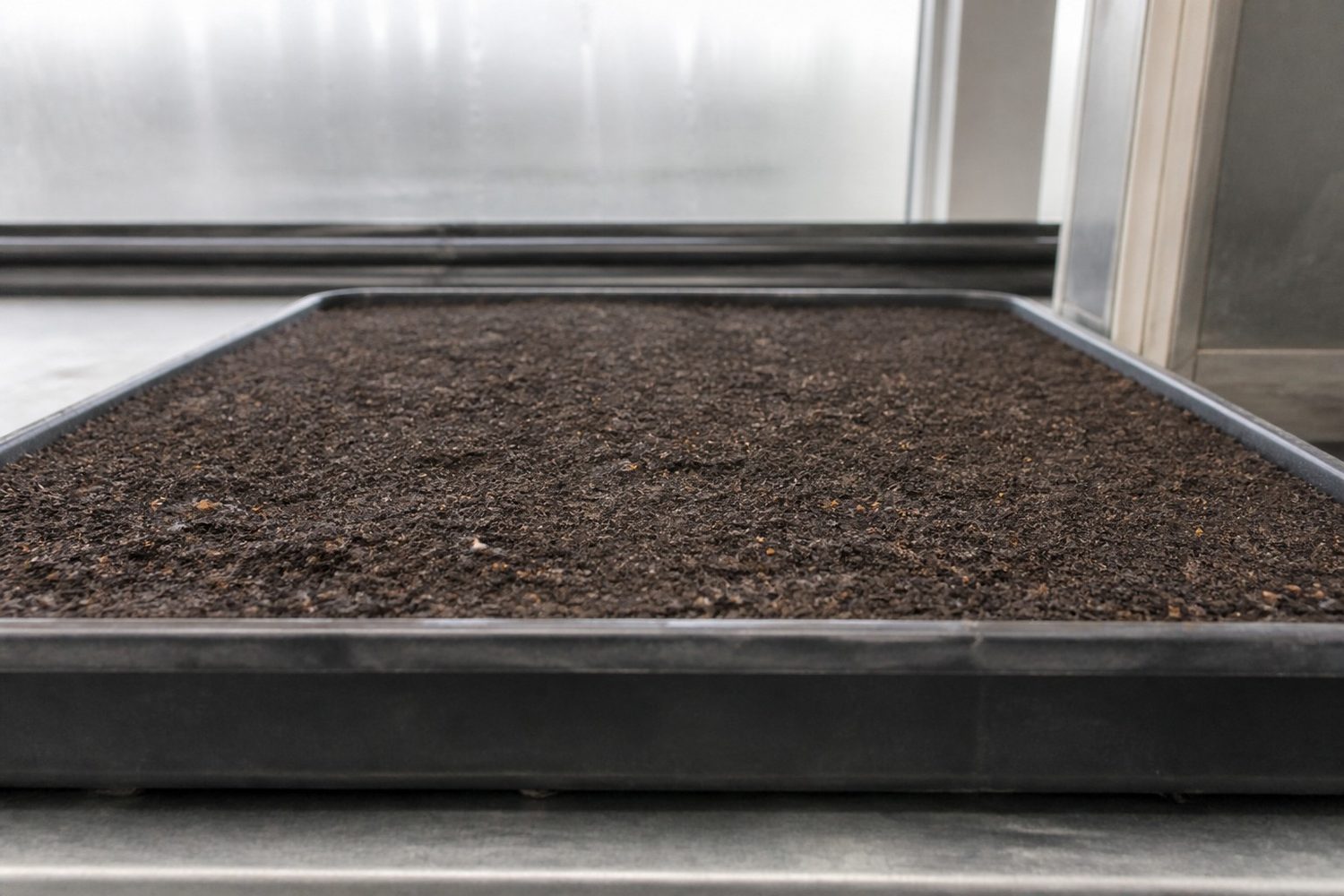
Pre-emergence rot and permanent gaps, from weak or old seed in a saturated cool medium. What you see is absence rather than delay. The gaps do not fill.
Damping-off at emergence, water-soaked pinching at or below the medium line, Pythium often starting at the root tips. Isolate a small patch and fix the water; collapsed seedlings do not come back.
On root hair against mold, the usual location test applies: root hairs form a uniform fine white halo confined to the roots at the medium surface and do not bridge between stems, and they become far less conspicuous when the root zone is moistened. Anything spreading above the medium and continuing to spread is mold. That test has not been validated on parsley specifically, so treat continued spread as the decisive signal rather than the initial appearance.
A staggered stand after uncovering, from dense sowing, a weak lot, or too little light. Mixed heights and persistent hulls. Harvestable only if the healthy sections are uniform enough to cut together. Where the light is the suspect, uneven coverage across the tray matters more than the fixture's rating, which the grow lights review covers in detail.
Hulls, and this crop keeps them. Parsley seed is not dust, the crop is lightly covered, and brown hulls stay in young stands. There is no published retention rate. Not harvesting immediately at emergence gives the first true leaves time to shed some; the rest is hand work on a premium tray.
Nutrition, safety, and what is actually measured
One controlled study measured this crop, and its answer is the interesting kind. El-Nakhel and colleagues compared P. crispum cv. Comune 2 as microgreens at 21 days against baby greens at 36 days, three replicates, controlled chamber. The microgreens carried 1.8 times the lutein and 2.8 times the beta-carotene of the baby greens, and less ascorbic acid, fewer total polyphenols and lower hydrophilic antioxidant activity.
Both directions, in one experiment, on one crop, which is the opposite of a clean win either way. "Microgreens are more nutritious" is not a property of the plant, it is a property of the compound you asked about. The same split turns up on lettuce, celery, chia, fennel, flax, lentil and mizuna. So, if a customer asks whether the tray beats the mature herb, the answer is that it depends which nutrient they care about, and on parsley you can name both halves.
There is no USDA FoodData Central record for parsley microgreens, so the supplier claims about vitamins A, C and K have no analytical basis for this crop, and the study above actively contradicts the vitamin C version.
The same study measured nitrate at 3,362 mg per kg fresh weight. For scale, the EU caps fresh spinach at 2,500 to 3,000 mg/kg and there is no microgreen limit anywhere. The mizuna entry works through what that means in full; the short version is that those caps are written for vegetables eaten by the 100 grams, a garnish is 10 to 20, and the sensible conclusion is not to treat leafy microgreens as a bowl-sized salad base.
On the outbreak in the pulse block above, the distinction that matters is where contamination happens. Cyclospora on fresh herbs is a documented, recurring problem, serious enough that FDA samples cilantro, basil and parsley specifically for it. FDA's herb sampling report names the openings for contamination: irrigation water splashing up from soil, unsanitary wash water, harvest equipment and hand harvesting. An indoor tray grown from clean seed in fresh medium is not that supply chain. That is not the same as saying a tray is safe from Cyclospora, because nobody has tested one, and seed-borne pathogens are a real category on other crops. Buy seed intended for food use, keep your water and surfaces clean, and do not read a field outbreak as a verdict on your bench.
Which seed to buy
Five named products exist and the real split is flat-leaf against curly. Italian and Dark Green Italian flat-leaf give broad serrated leaves and the stronger culinary flavor in mature descriptions; Forest Green is curly and compact; "Plain or Single" is a trade description rather than a cultivar. No comparative microgreen trial exists between any of them, so a claim that one is faster or taller in a tray would be invented.
Ask for the germination test date, and mean it on this crop. Parsley germination in garden culture is documented to range from two to five weeks depending on freshness, and a stale lot in a tray does not look like a stale lot: it looks like a staggered, half-empty tray that you will blame on your watering. Specify untreated seed for edible microgreens, a cultivar, a lot number and a test date, and run a counted germination test before committing multiple trays. The cost of a bad lot on parsley is not the seed, it is three to five weeks of a shelf.
Seed is cheap and the ladder is steep. True Leaf lists 1 oz $4.25, 4 oz $6.54, 1 lb $14.99, 5 lb $45.69 and 25 lb $170.99. At the pound that is a 50-cent tray; at 25 lb it is 23 cents. Either way the seed is a rounding error against the bench time, which is the honest way to think about the economics of this crop.
Parsley microgreen seed on Amazon is the convenient route for a first tray, and on this crop the seed house is both cheaper and more likely to state a cultivar and a germination date. Buy wherever you like and spend the attention on the lot test instead, because nothing you save on a 50-cent tray matters next to losing five weeks of shelf to a stale one.
Is it worth growing?
For a cook who wants fresh parsley in leaf form, yes, one tray. For a bench you need to make pay, no, and it is worth being direct about why.
Parsley occupies a tray for three to five weeks and returns about 6.25 ounces. That is 0.30 ounces per tray-day, level with cilantro and near the bottom of anything you could put in the same space. Its seed is cheap, so it scores respectably on value per dollar at 9.5 to 12.5 ounces per dollar, and that number will mislead you here: seed cost is not what parsley consumes. Shelf time is, and no price column captures that.
The family pattern is consistent enough to plan around. Carrot at 0.10, fennel at 0.04, dill at 0.23, cilantro at 0.30, parsley at 0.30, chervil at 0.38, celery with no measured yield at all. Not one measured umbellifer exceeds 0.38, and the reason is the same each time: they are slow, and most of them are sown heavy for a light crop. Choose an Apiaceae for a flavor no brassica provides, which is a perfectly good reason, as long as it is priced as a garnish.
Against its own family, parsley wins when the dish wants parsley and nothing else will do. Cilantro wins on a stronger and more distinctive note, dill and fennel win on anise, and any brassica wins outright on speed and weight.
A note on the numbers above
Hover or tap a row to highlight it.
| Figure | Value | Source | What kind of number it is |
|---|---|---|---|
| Seed per 1020 | 15 to 20 g | Grower crop table | Not a trial. 25 g elsewhere for an unstated tray size |
| Fresh yield | 1.37 kg/m² at 21 days | El-Nakhel et al. 2021 | Measured, cv. Comune 2, 50,000 seeds/m², n=3 |
| Yield per 1020 | 6.25 oz | Area conversion of the above | 0.129 m². No direct 1020 measurement exists |
| Days to harvest | 26 to 30 | Johnny's | Its own microgreen product, no temperature |
| Days to harvest | 28 to 35 | New Zealand supplier | No temperature |
| Days to harvest | 21 | El-Nakhel et al. 2021 | Measured, after nine dark days at 24°C |
| Germination | 6 to 7 days | Grower crop table | And 2 to 5 WEEKS in garden culture by freshness |
| Blackout | 4 to 5 days | Grower crop table | No parsley-specific weight validated |
| Dry matter | 7.4 percent | El-Nakhel et al. 2021 | Measured |
| Nitrate | 3,362 mg/kg fresh | El-Nakhel et al. 2021 | Measured. Above the EU cap for fresh spinach |
| Carotenoids | 1.8x lutein, 2.8x beta-carotene vs baby green | El-Nakhel et al. 2021 | Measured, and the microgreen wins |
| Ascorbic acid, polyphenols | Lower than the baby green | El-Nakhel et al. 2021 | Measured, and the microgreen loses |
| Seed price | $14.99/lb | True Leaf, checked 2026-08-09 | Ladder from $4.25 an ounce to $170.99 for 25 lb |
| Shelf life | No published figure | Nobody | No parsley-specific storage trial |
| Harvest window | No published figure | Nobody | Nobody has established it |
The yield is a conversion rather than a tray measurement, so check it against your own scale. The study measured 1.37 kg per square meter; a 1020 is 0.129 m², so 177 grams, or 6.25 oz. Parsley is absent from the 29-variety trial, so there is no direct 1020 measurement to compare it with. On pak choi, where that check was possible, the same arithmetic landed within 4 to 13 percent of two independently measured trays. That is one crop rather than a validation, so weigh your first parsley tray and use that number afterwards.
The rate and the yield do not come from the same tray. The 15 to 20 g comes from a grower table; the study sowed 50,000 seeds per square meter, which works out nearer 12 g per 1020. So, the ounces-per-dollar figure pairs one source's rate with another source's yield, as fennel's does too. Treat it as an estimate, not as a benchmark, which is what you get on pak choi or broccoli, where one trial supplied both halves.
Parsley ties cilantro at 0.30 ounces per tray-day, and its whole family lands in that band. Carrot 0.10, fennel 0.04, dill 0.23, cilantro 0.30, parsley 0.30, chervil 0.38, celery with no measurable yield. The best of them, chervil at 0.38, is less than half broccoli's 0.92 and about a fifth of sunflower's 1.79. That is enough crops to plan on: if a crop is an umbellifer, expect a slow tray and a light cut, and price it accordingly. It is not the only slow family, basil sits at 0.34, but it is the most consistent one.
Value per dollar flatters this crop, so do not buy on it. At 9.5 to 12.5 ounces per dollar parsley looks respectable, better than chives or borage, because the seed is $14.99 a pound and the rate is light. What that column cannot see is five weeks of shelf, during which a broccoli tray would have turned over twice and returned 23 ounces. On a crop this slow, the tray-day column is the one to read.
Nobody has measured how long a ready parsley tray holds. Cut it, note the date, and leave the next one a few days longer to find your own limit.
Hover or tap a row to highlight it.
| Crop | Seed per 1020 | Yield | Days | Cost per tray | Oz per $1 | Oz per tray-day |
|---|---|---|---|---|---|---|
| Chervil | 18.9 to 20 g | 3 to 5 oz | 9 to 12 | $1.00 | 4.0 | 0.38 |
| Cilantro | 26 g | 6 oz | 20.0 | $1.10 | 5.4 | 0.30 |
| Parsley, Italian flat-leaf | 15 to 20 g | 6.25 oz, area-converted | 21 to 35 | $0.50 to $0.66 | 9.5 to 12.5 | 0.30 at 21 days |
| Dill | 10 g | 3 to 5 oz | 15 to 20 | $0.52 | 7.7 | 0.23 |
| Carrot | 6.2 to 9.4 g | 2.0 oz | 20.0 | $0.44 to $0.66 | 3.0 to 4.5 | 0.10 |
All 62 crops, sortable, on the microgreen comparison.
Read that table by family and the umbellifers cluster at the bottom of it. Fennel 0.04, carrot 0.10, dill 0.23, cilantro 0.30, parsley 0.30, chervil 0.38, and celery with no measured yield at all. Seven crops, one family, and the best of them still turns a bench more slowly than an average brassica.
Terms on this page
Tap a term to see what it means.
*Petroselinum crispum*. Parsley. Flat-leaf, curly and root parsley are all this species. Japanese parsley is a different plant.
Sources
- El-Nakhel et al., 2021, mineral and antioxidant attributes of Petroselinum crispum at different stages (PDF) - the one controlled study: cv. Comune 2, microgreens at 21 days against baby greens at 36, n=3, nine dark days at 24°C then 24/18°C, 1.37 kg/m² fresh, 7.4 percent dry matter, 3,362 mg/kg nitrate, 1.8x lutein and 2.8x beta-carotene over the baby green and less ascorbic acid, polyphenols and hydrophilic antioxidant activity.
- True Leaf Market, Dark Green Italian flat-leaf parsley microgreen seed - the price ladder verified 2026-08-09 at 1 oz $4.25, 4 oz $6.54, 1 lb $14.99, 5 lb $45.69 and 25 lb $170.99.
- Johnny's parsley microgreen seed - 26 to 30 days, 75°F until germination then 60°F, 65 to 75°F ambient favorable, the above-75°F warning, 1/8 to 1/4 inch spacing with a light cover, and the note that slow species may need fertility the medium lacks.
- Johnny's microgreens yield trial results (PDF) - parsley is absent from the 29 varieties, which is why there is no direct 1020 measurement.
- Bootstrap Farmer microgreen crop table - 15 to 20 g per 1020, no presoak, 6 to 7 days germination and 4 to 5 days blackout.
- Kings Seeds, Italian flat-leaf parsley microgreen - about 28 to 35 days, 25 g for a propagation tray of unstated size, cover no deeper than twice the seed diameter, and the mid-green stems with serrated three-lobed leaves.
- University of Minnesota Extension, growing parsley - garden germination from two to five weeks depending on seed freshness, the warm soak of up to 24 hours as mature-crop guidance, and second-year bitterness.
- FDA, investigation of a 15-state Cyclospora outbreak linked to iceberg lettuce, July 2026 - the 2026 outbreak the headline misattributed: iceberg lettuce from central Mexico, recalled by Taylor Farms on 17 July.
- CDC, Cyclospora outbreak investigation update, July 2026 - 6,358 illnesses across 15 states on 5 August 2026, and the final count on 11 September 2026 of 12,883 illnesses, 570 hospitalizations and 2 deaths in 21 states.
- FDA, microbiological surveillance sampling of fresh herbs: cilantro, basil and parsley - why fresh herbs are a plausible suspect at all, and that the documented risk is a field-production one.
- Virginia Tech Extension SPES-756 (PDF) - the parsley lighting protocol cited as a study rather than a minimum, and the general production environment.
- Utah State Extension, grow your own microgreens - the general 2 to 5 lb contact weight during the first half of the dark period.
- UC IPM, damping-off - Pythium and Rhizoctonia, root-tip onset, and rot at or below the medium line.
- USDA FoodData Central - searched 2026-08-09, no parsley microgreen record.
Keep reading
The variety directory
Celery microgreens
Three to four weeks of bench for a seasoning green, with an unusually complete measured nutrient panel behind it: 45.8 mg of vitamin C per 100 g, and four minerals that are higher in the mature leaf.
Read Celery microgreensThe variety directory
Mint microgreens
Mint must not be blacked out, and its seed costs $1,394.50 a pound. The one published seed rate would put 154,000 seeds in a 1020 tray, ten times the densest sowing anyone has measured.
Read Mint microgreensThe variety directory
Oregano microgreens
Concentrated resinous oregano as a fresh garnish, on a sixteen to twenty-five day tray. The seed is expensive and no sowing rate is published, so weigh a test patch before you scale.
Read Oregano microgreensThe variety directory
Carrot microgreens
Carrot is one of the cheapest trays of seed you can sow at 44 to 66 cents, and one of the poorest uses of a bench: about 2 oz after 20 days, a twelfth of radish's daily turnover.
Read Carrot microgreens