The Best LED Grow Lights for Microgreens: What to Buy, and the Order to Buy It In
Cal HewittPublished Checked
- grow lights
- equipment
- buying
- lighting
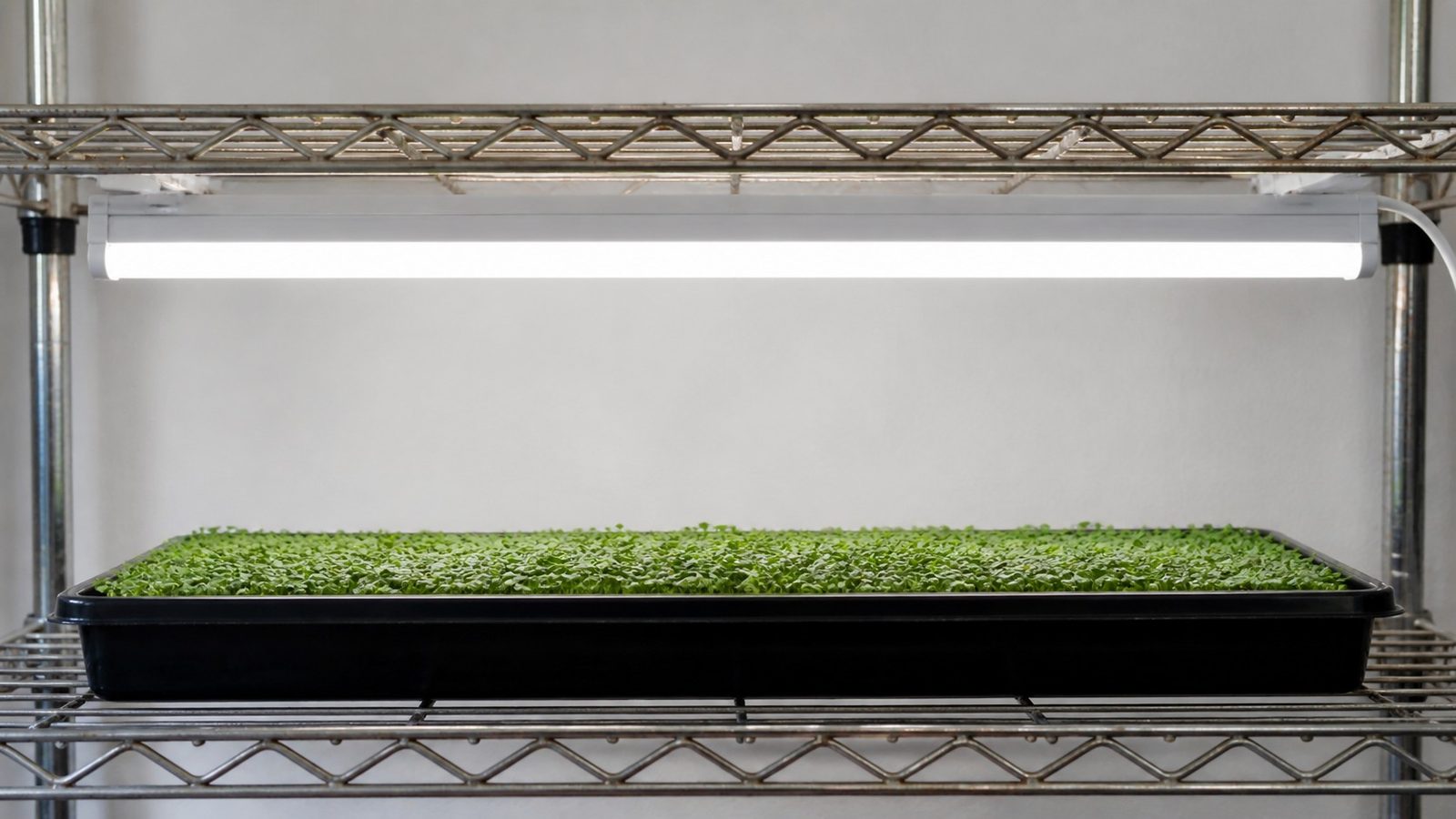
Buy an ordinary white LED strip or shop light, size it to your shelf rather than to a wattage number, put it on a timer, and spend the difference on seed.
Across every fixture named in this category, from the cheap linkable strips growers actually buy to the tunable panels sold as an upgrade, no independent, repeatable light reading taken across a 1020 tray at a stated hanging height could be found for a single one of them. Not for Barrina, not for SunBlaster, not for Active Grow, not for Spider Farmer, not for Vivosun, not for VEVOR. That reading is what decides whether your tray grows evenly.
Without it no review, this one included, can rank these fixtures on light at the tray. So, buy on coverage and a safe listing, then measure your own tray.
The order to buy in
How to spend on lighting, in order
Hover or tap a card to highlight it.
Fix the target first
Decide the daily light total you are aiming at and how your trays sit on the shelf. Virginia Tech's general range for microgreens is 9 to 16 mol per square meter per day. Buying before this step is how people end up with a flowering panel.
Start cheap and safely listed
A white LED strip or shop light arrangement, sized to the shelf, on a timer. This is where most home growers should stop.
Then measure your own tray
Take readings across the whole tray at the height you actually hang it, not just under the middle of the bar. This is the step that replaces the missing published data.
Add bars or change height only to fix what you measured
Fixing a dim corner is a reason to buy another bar. A better spectrum is not.
Move to an integrated rack last
Dimmable, app controlled, tunable hardware earns its price on consistency and labor across many shelves, not on one or two trays.
For step two, the Barrina bars growers name most often are priced in the table further down. For step three, a PAR or PPFD meter is the purchase worth making. Apogee, whose $410 sensor is cited further down, sells a handheld model through the marketplace, and cheaper PPFD and DLI meters and phone app sensors exist. No comparison of their accuracy exists, so none is ranked here, and a meter you are unsure of still tells you more about your own shelf than a wattage does.
Every Amazon link here pays this site a commission. The advice above is to buy the cheapest fixture that covers the tray and spend the difference on a meter, which is the smallest commission in a category where the premium panels pay considerably more. The links sit beside the prices so you can check the figures rather than take them on trust, and where a link reaches a category instead of the exact fixture, the table says so.
The common mistake is buying step five first: a high power full spectrum flowering panel with an app, a fan and spectrum control. One microgreens grower describes Spider Farmer lights in the 4,000 to 5,000 class as overkill for their use. That is one grower's judgment rather than proof, but it points the same way as the extension guidance.
A review worth trusting would give you readings on a grid across a 1020 tray at a stated hanging height, with the lowest, average and highest figures, the meter model it used, and the output measured again after a stated number of operating hours. If the review in front of you has none of that, it has not measured the fixture, whatever else it tells you. The equipment is not exotic either: a full spectrum quantum sensor suitable for canopy readings was listed by its manufacturer at $410.
What is claimed, against what has been measured
The left column is what the seller leads with. The right column is what an independent party has published for that fixture at tray level.
Hover or tap a row to highlight it.
| Fixture | The seller's headline claim | Independently measured at the tray |
|---|---|---|
| Barrina T5/T8 strips | 80 W actual, marketed as "500 W equivalent" | None located |
| SunBlaster 48 inch LED strip, 6400K | Catalog states 50,000 hour life for the LED strip line | None located |
| Active Grow 4 foot T5-HO plug and play lamp | A retrofit lamp for compatible T5-HO ballasts | None located |
| Spider Farmer SF600 | Advertises photon output, efficacy and a coverage area | None located |
| Vivosun AeroLight A100 | 100 W, with a stated coverage area | None located |
| VEVOR four tier lighted stand | 180 W across four tiers | None located |
| GE 24 inch lamp | A retailer article cites "verified 72 PPF" | PPF is total fixture output, not a tray reading, and no test method is given |
Seven fixtures, seven blanks. The GE row is the closest anything comes and it still is not the right measurement: total output from a fixture tells you nothing about how those photons land across a tray, or how much reaches the corners.
The GE row is not linked, because that "72 PPF" figure cannot be tied to a fixture you can buy. GE sells grow lights on the marketplace, including a seeds and greens fixture at $78.04 and a bulb two pack at $19.96 on the same check, but nothing establishes that either is the 24 inch lamp the article attached the figure to. Do not carry the number across to whichever GE listing you find.
One price is worth pulling out of that list. The Spider Farmer SF600 is $63.99 at 72 W for a claimed 2 by 4 foot area, which undercuts every fixture in the price table further down except the Barrina eight pack. So, the assumption that panels are the upgrade and strips are the budget option does not hold on price. It is also the fixture with the owner thread alleging a power supply failure, further down. Weigh both of those, and read a link here as a place to check a price rather than as a recommendation.
Watts are not light. Iowa State Extension states plainly that wattage is not a reliable indication of light intensity. Watts tell you what the fixture costs to run. The Barrina label quoted in a microgreens discussion makes the gap concrete: 80 W actually drawn, sold as "500 W equivalent". Equivalent to what, measured how, is not stated.
The claims that cannot be checked as written are worth naming, because they are most of the category: "X watt equivalent", "full spectrum", "best for microgreens", "covers 2 by 4", "50,000 hour lifespan", and a single light reading taken at the center of the fixture. None of them carries the conditions that would let you compare two products. "Full spectrum" does not state photon quantity or how it is distributed. "Coverage" does not state a target light level or how uneven it is allowed to be at the edges.
You can watch this happen on any shelf-light search. On the same check, a 96 W pair of 4 foot bars was sold as "600 W equivalent" and a 252 W six pack as "1400 W equivalent", both on the same results page, and several listings carried a bare "High PPFD" badge with no number attached to it at all. "High" compared to what, at what height, measured across what area, is not stated anywhere on the listing. That badge is the whole problem in two words: it borrows the authority of the one measurement that matters and supplies none of it.
The two numbers that would actually tell you something
PPFD is the rate at which usable photons arrive at a surface. DLI is the total those photons add up to over a day. If PPFD is the rate of a shower, DLI is how much rain fell.
Iowa State gives the conversion: DLI equals PPFD multiplied by the hours the light is on, multiplied by 0.0036.
For a target, Virginia Cooperative Extension places general microgreen DLI at roughly 9 to 16 mol per square meter per day. That is a crop level target from an extension service, not a product test, and Virginia Tech is explicit that requirements vary by species, by energy preference and by what you are growing for, whether that is yield, color or compactness.
The thing to take from those two facts together: a fixture has to be judged at the tray plane and across the whole tray, not by the number on the box and not by a single reading under the middle of the bar.
What actually fails
The known failure modes are driver or power supply failure, gradual LED output decay, heat, wiring and connector problems, mounting that is missing or unsuitable, and uneven coverage at the tray edges. No credible cross brand time to failure data exists, so treat any claim that one brand lasts longer than another as a guess.
What can be said is which of those are ordinary wear and which are design faults, because the distinction changes whether a replacement fixes anything:
Wear. LED output decays and drivers eventually fail. That is normal, and the rate needs measured life testing that nobody has published.
Design. A driver that cannot be serviced, inadequate heat sinking, low quality connectors, weak strain relief, a cord too short to route safely, or a bar layout that cannot light the tray it is sold for. Telling these apart takes a teardown, temperature readings and a known operating history. It cannot be settled from star ratings or from a lifespan printed on a box.
One owner thread alleges a Spider Farmer SF600 power supply failure, and the manufacturer's reply in that thread discusses warranty conditions and possible parts and shipping charges. One thread is not a failure rate, and it is quoted here as a single documented claim path rather than as evidence about the brand.
The two failures microgreens make worse
Most grow light reviews are written for flowering plants. Two things are worse on a densely sown 1020 tray, and a review written for tall plants will miss both.
Uneven light produces a tilted canopy. One grower reports the outer ends of a tray growing taller and leaning toward a single central shelf fixture. On a crop cut all at once at one height, that is not cosmetic: it is a harvest problem across the whole tray.
Shelf clearance runs out fast. Microgreens change their distance from the light every day, and rack shelves are shallow. Another grower reports pea shoots growing into the bulb. Peas and sunflower are the crops that will find the limit of your shelf first.
Neither report is a product wide measurement. Both identify a use case problem that the general indoor plant literature does not cover.
Warranty is a document, not a promise
Terms vary by SKU and by retailer, so read the actual one. In the SF600 thread above, the brand's reply states three months of coverage for a second hand unit and mentions accessories and shipping charges. There is no reliable owner dataset on claim approval, turnaround, replacement quality, or who pays the freight, for any brand in this category.
A warranty is worth more when the seller states its length, whether it transfers, who pays for labor and shipping, and whether the driver can be replaced on its own.
The products, and what they cost
Prices move. Every figure here is what that listing showed on the check date at the top of this page, and this page is rechecked at least every two months. Treat them as what was on the page that day rather than as the price.
Hover or tap a row to highlight it.
| Product | Seller price | Seen at | On Amazon, same day | Worth knowing |
|---|---|---|---|---|
| SunBlaster 4 foot LED strip, 6400K | $134.95 | Harris Seeds, a retailer | $123.75 | Catalog claims 50,000 hours. The Amazon listing is a 48 inch Prism Lens 48 W, which may be a variant |
| Active Grow 4 foot T5-HO plug and play lamp | $119.00 | Active Grow, the manufacturer | $119.00 | A lamp for an existing T5-HO ballast, not a complete fixture. The only price parity here |
| Vivosun AeroLight A100, 100 W | $119.99 | Vivosun, the manufacturer | $89.49 | The marketplace undercuts the maker by about 25 percent |
| VEVOR four tier lighted stand, 180 W | $159.90 | VEVOR, the seller | category only | The 180 W model was not on page one. A 45 W is $84.90 and a 90 W is $108.90, so wattage varies |
| Barrina 2 foot T5, eight pack | Under $60, owner report | A grower's purchase report | $50.99 to $62.69 | The owner report checks out. Three of the four eight packs are under $60 |
The Barrina row is the cheap end of this table, and it holds up. Four live eight pack listings on the same check ran $50.99, $53.99, $54.89 and $62.69, so the grower report of under $60 is an ordinary price rather than a one-off. Prices in this category move week to week, so check before you order rather than treating any figure here as settled.
Check the marketplace price as well as the maker's. On three of these five the marketplace matches or beats the seller's own price, and on the Vivosun panel it beats it by about 25 percent, so buying direct is not automatically the cheaper route here. The VEVOR row is the weak one and the table says so: the specific 180 W stand was not on page one at all, so that link goes to the category and its price is not comparable.
Almost none of this hardware was designed for microgreens. SunBlaster's rack kit is sold for seed starting, propagation, microgreens and shoots together. Active Grow names microgreens among several applications for a horticultural retrofit lamp. VEVOR's stand is sold for seed starting and houseplants, and Vivosun's AeroLight is a grow tent panel. Barrina strips and ordinary shop lights are borrowed from shelving and general indoor plant use. That explains the recurring mismatch, which is geometry: a panel built for a tent concentrates light on a small footprint, while a narrow strip can leave the ends of a 1020 dim.
The Active Grow row is a lamp, not a fixture. At $119.00 it needs a compatible multi lamp T5-HO ballast you already own, so comparing that number against a $134.95 complete strip is not comparing like with like.
What it costs to be wrong
A bad choice costs the purchase price, the electricity, any replacement hardware, and trays that come out stretched, uneven, heat stressed or underlit. No credible universal figure for a lost tray is published, and it could not be a universal number anyway, because it is specific to your fixture and your utility rate.
The calculation that does work: actual kilowatt hours from a plug in meter, plus the seed, medium and tray labor you lose. Use the meter reading, not the "equivalent" wattage on the box.
The real hazard is not financial. Unlisted or badly routed equipment sitting above trays that get watered every day is an electrical risk. For that specific decision a credible listing does matter: UL 8800 is the horticultural lighting safety standard, covering moisture, wiring and photobiological requirements among others. A UL or ETL style listing supports a safety decision and nothing else. It does not prove light output, uniformity, yield, or the lifespan claim. CE, RoHS, FCC, a bare "ETL listed" with no verifiable model, and "full spectrum" are not performance certifications.
Running cost is watts actually drawn, times hours, divided by 1,000, times your utility rate. Lights are durable equipment rather than a subscription. The recurring costs are the electricity and, on fluorescent fixtures, replacement tubes.
Who should skip this entirely
Skip a dedicated grow light if you are growing occasional trays in a genuinely bright window during the season, if the space cannot safely support an electrical fixture above wet trays, or if your seed, drainage, sanitation, airflow and tray setup are not sorted yet. On a fixed budget, fund those first. The harvesting and washing tools review puts the same order on that category, where the answer is often to buy nothing at all. A basic safe fixture and a timer beat a premium spectrum every time.
University of Maryland Extension says a sunny window can be enough in some cases, while noting that microgreens generally do best under fluorescent or LED lighting, typically 6 to 12 inches above the foliage for around 16 hours. A grow light is not a prerequisite for every home crop.
You will read the opposite. One popular guide claims flatly that ordinary room bulbs cannot do the job, and that is too broad as written: what decides it is the light reaching the canopy and the distance it travels, not the label on the bulb. A bright room bulb several feet away genuinely is not equivalent to measured canopy light, but that is about distance and intensity.
Buy the light if you have no dependable bright window, if you are producing year round, or if you are running racks where repeatable timing matters. At one or two trays a simple white strip and a timer is the sensible scale. At multiple rack levels, uniformity, electrical load, mounting and cooling stop being preferences and become procurement requirements.
What the rest of the field says, and who is selling
Worth knowing who is talking when you read a recommendation.
Bootstrap Farmer sells growing supplies, and its lighting guide is a seller's guide. That does not make its advice wrong, and it does mean the advice should be attributed. On The Grow publishes setup guidance based on its own testing, at 6 to 12 inches and 16 to 17 hours. RootedUrban and LawnGearLab publish selection advice and product rankings.
What none of them provides, this page included, is a comparative driver failure rate, an output decay test, or a light reading at the edge of a tray. They agree that LEDs are efficient, that a daylight or white spectrum is suitable, that 6 to 12 inches is a workable starting range, and that a timer helps. Those are reasonable and they are not measurements.
Microgreens do not need special lighting, whatever a full spectrum, high wattage fixture is sold on. They need an adequate and evenly distributed number of photons at the canopy, and a sensible daily total. Neither premium spectrum branding nor input watts demonstrates either. Extension guidance permits fluorescent or LED fixtures and allows that sunlight can sometimes be enough.
What is still genuinely unknown
These are the gaps a cheap fixture and a meter work around, rather than questions anybody has answered:
- The best daily light total by crop and by goal, whether that is yield, color, compactness or energy cost.
- Whether a single central bar is acceptable, or whether edge uniformity requires two.
- The best photoperiod for a short cycle crop.
- Whether far red or blue manipulation is worth anything over a cycle this short.
- For every fixture in the table above: the readings across a 1020 tray at a stated height.
Sellers and grower publishers disagree here mainly because their fixture geometries and their definitions of success are not held constant.
The terms on this page, in plain words
Tap a term to see what it means.
PAR. Plant usable light, meaning the wavelengths a plant can photosynthesize with.
Sources
Every price below was seen on the check date at the top of this page, and the prices on this page are rechecked at least every two months.
- Iowa State University Extension, supplemental light for indoor plants - wattage is not a reliable indication of light intensity, the DLI conversion, why total output divided by area is not the same as a canopy reading, and the heat risk of moving a fixture closer.
- Virginia Cooperative Extension, microgreens production - the general 9 to 16 mol per square meter per day range, and the statement that requirements vary by species and production goal.
- University of Maryland Extension, growing microgreens and baby greens indoors - 6 to 12 inches above the foliage, 16 hours, fluorescent or LED, and that a sunny window may suffice in some cases.
- UL, horticultural lighting services - UL 8800 as the horticultural lighting safety standard.
- Apogee Instruments, SQ-500 full spectrum quantum sensor - listed at $410 by the manufacturer.
- Harris Seeds, SunBlaster 4 foot LED strip 6400K - $134.95.
- Active Grow, T5-HO plug and play 4 foot LED lamp - $119.00, and the microgreens application claim.
- Vivosun, AeroLight catalog - the A100 at $119.99, and the 100 W to 850 W line.
- VEVOR, four tier 180 W plant stand - $159.90.
- Johnny's Selected Seeds tools brochure - the SunBlaster rack system positioned for seed starting, propagation, microgreens and shoots, with the 10,000 hour fluorescent and 50,000 hour LED catalog claims.
- A microgreens lighting question thread - the Barrina T5 two foot eight pack configuration, and the 80 W actual against "500 W equivalent" label.
- A Barrina against Spider Farmer discussion - outer ends growing taller toward a single shelf fixture, and one bar against two.
- A light recommendation thread - the eight pack under $60 owner report, a roughly 8 inch setup, and a wiring safety concern.
- A rack height question - uncertainty about tray clearance on a rack.
- A light distance question - pea shoots growing into the bulb, and the report that a 4,000 to 5,000 class panel was overkill.
- A Spider Farmer SF600 power supply complaint - one alleged power supply failure and the manufacturer's stated warranty path, including three months on a second hand unit.
- Bootstrap Farmer, what lights do I need to grow microgreens - lighting and spectrum advice, published by a company that sells growing supplies.
- On The Grow, microgreen lighting guide - 6 to 12 inches and 16 to 17 hours, based on the publisher's own testing.
- RootedUrban, best grow lights for microgreens - selection advice, and the categorical claim that ordinary room bulbs cannot do the job.
- LawnGearLab, best grow lights for microgreens - a product ranking, and the "verified 72 PPF" claim for a GE 24 inch lamp with no test method given.
Keep reading
The test bench
Microgreens Shelving and Racks: Tiers Are Not Growing Levels
A 48 by 24 by 72 inch adjustable wire rack from $89.99 is the whole answer for most growers. Adding tiers to the same frame trades away the light distance extension guidance asks for, by the sellers' own clearance numbers.
Read Microgreens Shelving and Racks: Tiers Are Not Growing LevelsThe test bench
Timers for Microgreens: The Same $8 Timer Pays Back in Two Months or Four Years
What a timer saves you depends entirely on the wattage of the thing it switches, and the three guides that recommend one never mention load. That same missing number is also the safety number.
Read Timers for Microgreens: The Same $8 Timer Pays Back in Two Months or Four YearsGrowing guides
Why do my microgreens taste bitter? Usually because that crop is supposed to
Roughly three quarters of microgreen crops are described as sharp, peppery or bitter in their own tasting notes, so check the crop before you look for a fault. Plus why turning the lights down is a guess.
Read Why do my microgreens taste bitter? Usually because that crop is supposed toThe test bench
AeroGarden and Countertop Pod Gardens for Microgreens: Is It Worth It?
Pod count is holes for separated mature plants, not dense tray area. A $30 tray kit gives you more sowing surface for microgreens than a $250 pod garden.
Read AeroGarden and Countertop Pod Gardens for Microgreens: Is It Worth It?