Microgreens Shelving and Racks: Tiers Are Not Growing Levels
Cal HewittPublished Checked
- shelving
- racks
- equipment
- buying
- lighting
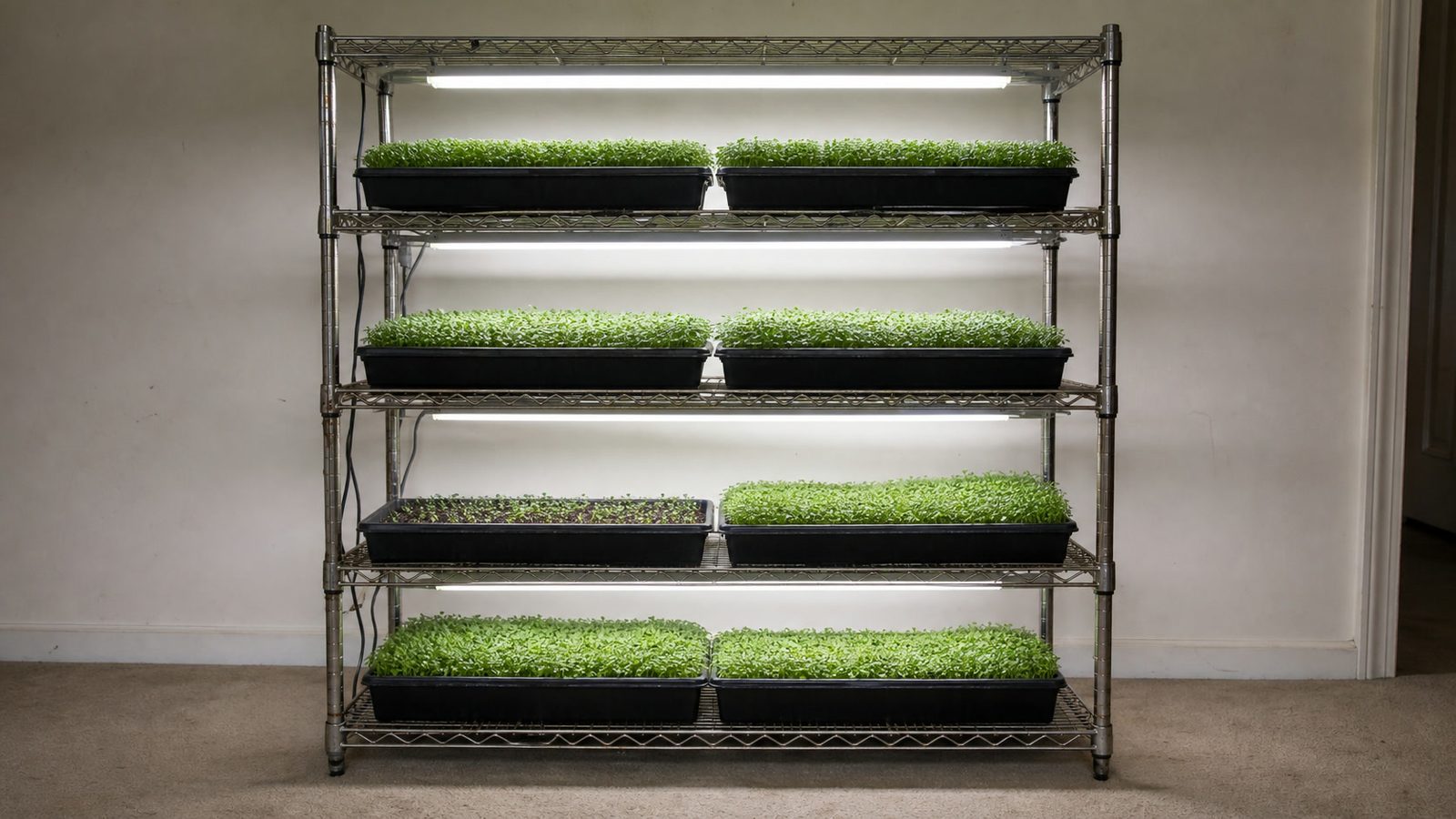
Buy one 48 by 24 by 72 inch adjustable wire shelving unit and configure it around your tray, dome and light stack. That format is the whole answer for the overwhelming majority of growers, and it starts at $89.99.
Ignore the tier count in the product title. It counts horizontal surfaces. What you need is the number of levels where a tray, its crop, a light fixture, a sensible light gap and the hand that waters it all fit at once. Those two numbers are not the same, and on a 72 inch frame the second one goes down as the first goes up.
Nothing published shows a more expensive rack grows better microgreens. Above a sound adjustable rack, money buys automation, irrigation, assembly support and commercial throughput.
The order to buy in
What to buy, and when to stop
Hover or tap a card to highlight it.
A table or small shelf
For one or two trays. A rack is production infrastructure, not a requirement for growing microgreens, and plenty of good crops are grown on a counter.
One 48 by 24 by 72 inch adjustable wire rack
From $89.99. Configure it around the tray, dome, light and hand stack rather than around the tier count. This is where most growers should stop.
Lights, fans and a timer, added to that rack
The parts that turn shelving into growing space. A cheap wire rack plus decent strip lights is a configuration growers actively recommend to beginners over pricier starter rigs.
Liners and a deliberate drip path
Cheap, and the answer to the one failure mode this format actually has.
A second identical rack
Once one is running a repeatable cycle. Identical beats better, because the tray, light and spacing decisions carry over.
An irrigated or automated rack, last
Only when labor and water handling are a documented bottleneck and the sales exist. Settle tray format, lighting and watering method first, because automation adds plumbing, a pump and maintenance to whatever you have already chosen.
The premature purchase is a turnkey automated rack, and the sellers half say so themselves: one positions a starter kit explicitly for learning and validating demand before its larger systems. That is a staged sales ladder rather than independent evidence, and it happens to point the right way.
Against a fixed first budget, a basic correctly sized rack sits behind trays, light, airflow, sanitation and electrical safety, and ahead of cosmetic upgrades and automation. The frame only creates useful space when the lights, tray support and environment already work.
The arithmetic the tier count hides
A 72 inch frame is a fixed amount of vertical space. Divide it more ways and each way gets less. The sellers publish the numbers that prove it.
Bootstrap Farmer states the clearance from the bottom of its light to the top of its flood tray for each configuration of the same rack: 13.5 inches at three tiers, 8.5 at four, and 6.5 at five.
Now set that against the lighting guidance. University of Maryland Extension puts grow lights 6 to 12 inches above the foliage, which is the figure the grow lights review works from.
Hover or tap a row to highlight it.
| Configuration | Clearance, light to tray top | Room left once you allow a 6 inch light gap |
|---|---|---|
| Three tiers | 13.5 in | 7.5 in of crop height. Comfortable for anything, including pea and sunflower |
| Four tiers | 8.5 in | 2.5 in of crop height. Fine for a brassica, tight for a tall shoot |
| Five tiers | 6.5 in | 0.5 in of crop height. A 2 inch crop sits 4.5 in from the light, below the 6 inch minimum |
At five tiers, a purpose-built microgreen rack cannot meet the extension light-distance guidance for any crop worth harvesting, on the seller's own published clearance. That is not a defect and nobody is lying. It is the trade the fifth tier makes, stated plainly by the manufacturer, and buyers read it as extra capacity.
A DIY build guide reaches the same place from the other direction. On The Grow specifies 9 to 10 inches of shelf spacing for its six-level plan and says outright that it trades away tall crops. Take 9 inches, subtract a 1.25 inch shallow tray, allow the 6 inch minimum light gap, and about 1.75 inches remain for the crop and the fixture together. Pea and sunflower shoots do not grow to 1.75 inches, and growers on racks spaced that way report pea shoots reaching the bulb.
So, decide the crop first and the tier count after. "Buy the tallest rack with the most tiers" is the wrong rule here. Measure the stack, then decide how many levels the frame can honestly carry. An adjustable five-tier rack set up as three generous levels is a better microgreen rack than a six-tier rack you cannot use the top of.
Nominal dimensions are not usable dimensions
Uline states that the posts reduce each shelf dimension by 2¾ inches, so a nominal 48 by 24 inch shelf gives roughly 45¼ by 21¼ inches of usable loading area.
Run the arithmetic on the common claim that a 48 by 24 shelf holds four 1020 trays. Four Bootstrap Farmer Extra Strength 1020 trays, 21.1 by 11.0 inches outside, take 44 inches across, inside 45¼. Their 21.1 inch length sits inside 21¼ with about 0.15 inch to spare. The four-per-shelf claim checks out geometrically, and the depth is the tight dimension.
That spare inch is why shelf depth is the most reported fit problem in this category. Trays are nominally 10 by 20 and their actual outside dimensions vary by manufacturer, which the trays review documents as the reason same-size trays do not always nest. One grower posted a rack with two trays hanging off the sides; the replies stressed full support and a shelf depth comfortably past 24 inches. A shelf that is nominally deep enough and actually is not leaves a saturated tray cantilevered over an edge.
The related complaint is bottom watering on open wire. A grower describes lifting the front of a tray to bottom water and finding it wanted to fall backward, because a wire shelf gives no positive support and the load shifts as the water moves. Two separate threads, so it recurs. It is not a prevalence figure and no survey exists.
What they cost
Prices move. Every figure here is what that listing showed on 2026-08-11, and this page is rechecked at least every two months.
Hover or tap a row to highlight it.
| Option | Price seen | Seen at | Worth knowing |
|---|---|---|---|
| 48x24x72 5 tier, 2500 lb claimed | $89.99 | Amazon | The cheapest full-size adjustable unit found anywhere. Garage shelving, no NSF listing stated |
| 48x24x72 5 tier, 3500 lb claimed | $104.99 | Amazon | Still under Home Depot. Same caveat on NSF |
| 48 in 5 tier sold WITH LINERS | $119.99 | Amazon | The liners are the drip path this page says to plan for rather than fix later |
| AR Shelving Black Label, 5 tier 48x24x72 | $127.99 | Home Depot | Up to 600 lb per shelf claimed |
| HDX, 6 tier 48x24x72 chrome | $229.00 | Home Depot | 850 lb per shelf claimed. No substantive warranty beyond a do-not-overload warning |
| Seville Classics SHE48246B, 5 tier | $229.99 | Lowe's | Casters, NSF certified, and a stated 10 year limited warranty, the best warranty here |
| Uline H-2946-72, 4 shelf | $242.00 | Uline | NSF certified, 800 lb per shelf, and the usable-dimension disclosure above |
| On The Grow six-level DIY build | $450 to $550 | A publisher estimate | Excludes liners. Rack, added shelves, lights, fans and timer for a claimed 24 trays |
| Bootstrap Farmer automated vertical propagation rack | $2,670.99 | Bootstrap Farmer | Flood and drain, pump, aerators and filters. 20 flats at five tiers. 3.5 to 6.8 amps by tier count |
| Urban Greens commercial production rack | Not listed on the page read | Urban Greens | Claims about $1,500 a year in hydroponic operating expenses. A seller figure |
On racks, the marketplace is genuinely the cheaper route. A 48 by 24 by 72 five-tier runs $89.99 to $104.99 on Amazon against $127.99 at Home Depot, so 18 to 30 percent less, and the Seville UltraDurable is $229.99 in both places. That runs the other way from trays, growing medium and storage, where the specialist supplier is the cheaper one. So, price both channels per category rather than assuming either wins.
The caveat on the cheap units: they are sold as garage and storage shelving and do not state an NSF listing. Given that NSF is a food-service sanitation claim rather than anything about holding a crop, that may not cost you much, but it is the difference you are paying for at $229.99.
The gap between $89.99 and $2,670.99 is not a quality gradient. It is the difference between a frame and a plumbed production system. The expensive end buys flood and drain irrigation, a pump and filtration, and a supplier who has already solved the layout. It does not buy a published improvement in the crop, and no independent source compares any of these on yield, quality or loss.
Load ratings are real and they are not comparable. Uline claims 800 lb per shelf and separately caps the whole unit at 1,000 lb once optional casters are fitted. HDX claims 850 lb per shelf. AR Shelving claims up to 600 lb. Those are static, evenly distributed, stationary figures. A microgreen rack is none of those things: the load is wet, it is placed and removed unevenly all day, and it moves. None of these numbers predicts rigidity under that pattern, and no published deflection measurement exists for any of them.
NSF certification means something narrow and real. Uline and the Seville unit are both NSF listed, which concerns material and sanitation suitability in food-service settings. It says nothing about tray capacity, rust lifetime, electrical safety or crop yield. "Commercial grade", "heavy duty" and "perfect for microgreens" say nothing at all.
What goes wrong
Water travels down through open wire. That is the failure mode specific to this format: a spill or an overfilled reservoir on an upper shelf runs onto the crop, the fixture and the connections below. Nothing in a box-storage load rating exposes it, and it is the reason liners and a deliberate drip path belong in the plan rather than in the fixes.
Chrome-plated carbon steel is rust resistant, not rust proof, and Uline says so in those words. A microgreen rack lives in sustained humidity with regular spills, which is the condition that separates those two phrases. No source publishes a corrosion timeline for any of these units in a real grow room.
Casters cost you load. Uline's whole-unit limit drops to 1,000 lb once optional casters are fitted. Whether the mobility is worth that trade is unresolved, and it depends on whether you actually need to move a loaded rack.
The clearance failure is the one that wastes money quietly, because the rack works perfectly as storage. It holds the trays. It just cannot operate as a growing level once the dome goes on during germination, the light is mounted and a forearm has to get in to water. The check is physical: put the intended saturated tray, its dome, the installed light and your hand into each planned level, then run your actual watering routine before you commit to the spacing.
Almost nothing here has a published failure record. No time to failure for shelf sag, caster wear, clip damage or corrosion. No verified case of a shelf sagging within its stated rating. And no owner report of a successful or unsuccessful warranty claim on any of these racks was located, so the Seville 10 year warranty is a document rather than a demonstrated outcome.
Who should skip this entirely
Skip a rack for one or two household trays. A stable waterproof table that safely supports the trays and lights is doing the same job.
Skip it if the room cannot take the heat, humidity or electrical load. A rack multiplies all three, and that is a room problem rather than a shelving problem.
Skip an automated irrigation rack until tray format, lighting and watering method are settled. See the watering systems review for why automating an unmeasured dose is the wrong order of operations.
Skip bare wood. A timber frame built to your own tray dimensions is a legitimate DIY route and it needs a finish, because bare wood and a continually wet grow room do not mix.
Skip fixed shelving. Non-adjustable shelf positions remove the single most useful property in this category, which is the ability to change the spacing once you find out what your crop actually needs.
What is still genuinely unknown
- Usable tray capacity at stated clearance for any named rack. Every capacity figure in this category is a seller or publisher assertion. There is no independent measurement.
- How much any of these shelves deflect under a realistic wet, unevenly distributed tray load, or after repeated loading across a season.
- Whether 9 to 10 inches of spacing is sufficient across varieties. Sources disagree: one build guide favors it for standard microgreens, older owner advice suggests 10 to 12 inches below the lights, and a manufacturer's own tier variants range from 6.5 to 13.5 inches.
- Whether casters repay the reduced mobile load allowance.
- How chrome, powder coat and wire welds hold up in real grow-room humidity over months.
- Whether automation repays its cost at small scale. No independent return-on-investment evidence exists for any rack on this page.
A test that answered these would publish usable shelf dimensions, clearance with the fixtures actually installed, saturated tray mass, deflection curves at even and uneven loads, caster behavior at the declared mobile load, a stated corrosion exposure protocol and duration, and cleaning time, across at least three units per model with raw data and a date. A capacity check on one rack establishes neither durability nor repeatability, so treat a single-unit review as one data point.
The terms on this page, in plain words
Tap a term to see what it means.
1020 tray. The nominal 10 by 20 inch tray the trade uses. Actual outside dimensions vary by maker, which is why shelf depth is the tight dimension.
Sources
Every price above was seen on 2026-08-11, and the prices on this page are rechecked at least every two months.
- Uline, chrome wire shelving unit H-2946-72 - $242.00, four shelves, NSF certified, 800 lb per shelf evenly distributed, the 1,000 lb whole-unit limit with optional casters, the statement that posts reduce each dimension by 2¾ inches leaving about 45¼ by 21¼ inches usable, and that chrome-plated carbon steel is rust resistant rather than rust proof.
- Home Depot, AR Shelving Black Label five tier - $127.99 for a 48 x 24 x 72 inch five-tier wire unit rated up to 600 lb per shelf.
- Home Depot, HDX six tier chrome wire - $229.00, 850 lb per adjustable shelf, and no substantive manufacturer warranty beyond a warning not to overload.
- Lowe's, Seville Classics SHE48246B - $229.99, five tiers with casters, NSF certified and NSF safety listed, and a 10 year limited warranty.
- Bootstrap Farmer, automated vertical propagation rack - $2,670.99, flood and drain with pump, aerators and filters, 12, 16 and 20 flats by tier configuration, the 3.5 to 6.8 amp draw by tier count, the light-to-flood-tray clearances of 13.5, 8.5 and 6.5 inches for three, four and five tiers, the 30 day return policy without a rack-specific warranty on the page, and the disclosure that transport and setup leaks may occur and clamps or drains may need adjusting.
- On The Grow, professional microgreens grow rack build guide - the 48 x 24 x 72 inch NSF wire unit plus shelves, lights, fans and timer, the $450 to $550 estimate excluding liners, the claim of 24 standard 10 x 20 trays across six levels at four per shelf, and the explicit statement that 9 to 10 inch spacing trades away taller crops. A grow-supply seller and publisher.
- Urban Greens, commercial production rack - marketed to commercial microgreen and baby-green operations, the roughly $1,500 a year hydroponic operating expense claim, and the staged starter, automated and commercial product ladder.
- University of Maryland Extension, growing microgreens and baby greens indoors - grow lights 6 to 12 inches above the foliage, which is the figure the clearance arithmetic on this page uses.
- Local Green Stuff, racks for microgreens - open wire letting spills travel vertically onto what is below, and the caution that bare wood and wet grow rooms do not mix. No test evidence published.
- RusticWise, microgreens rack - setup choices and cautions, from an advice publisher rather than a controlled comparison.
- A discussion on upgrading a shelving unit - wire shelving described as troublesome for bottom watering because lifting the front made trays want to fall backward.
- A starter rack discussion - two trays hanging off the shelf sides, advice to use a shelf depth comfortably past 24 inches for four 1020s, and older advice suggesting 10 to 12 inches of clearance below the lights.
- A beginner setup discussion - two commenters endorsing an inexpensive wire rack plus strip lights and calling a more expensive beginner rig overkill.
Keep reading
The test bench
The Best LED Grow Lights for Microgreens: What to Buy, and the Order to Buy It In
Buy an ordinary white LED strip sized to your shelf, put it on a timer, and spend the difference on seed. Then measure your own tray, because no fixture sold for microgreens publishes a reading across one.
Read The Best LED Grow Lights for Microgreens: What to Buy, and the Order to Buy It InThe test bench
Timers for Microgreens: The Same $8 Timer Pays Back in Two Months or Four Years
What a timer saves you depends entirely on the wattage of the thing it switches, and the three guides that recommend one never mention load. That same missing number is also the safety number.
Read Timers for Microgreens: The Same $8 Timer Pays Back in Two Months or Four YearsGrowing guides
Why do my microgreens taste bitter? Usually because that crop is supposed to
Roughly three quarters of microgreen crops are described as sharp, peppery or bitter in their own tasting notes, so check the crop before you look for a fault. Plus why turning the lights down is a guess.
Read Why do my microgreens taste bitter? Usually because that crop is supposed toThe test bench
AeroGarden and Countertop Pod Gardens for Microgreens: Is It Worth It?
Pod count is holes for separated mature plants, not dense tray area. A $30 tray kit gives you more sowing surface for microgreens than a $250 pod garden.
Read AeroGarden and Countertop Pod Gardens for Microgreens: Is It Worth It?