Microgreens Growing Medium: The Mat Often Costs More Than the Seed
Cal HewittPublished Checked
- growing medium
- coco coir
- grow mats
- equipment
- buying
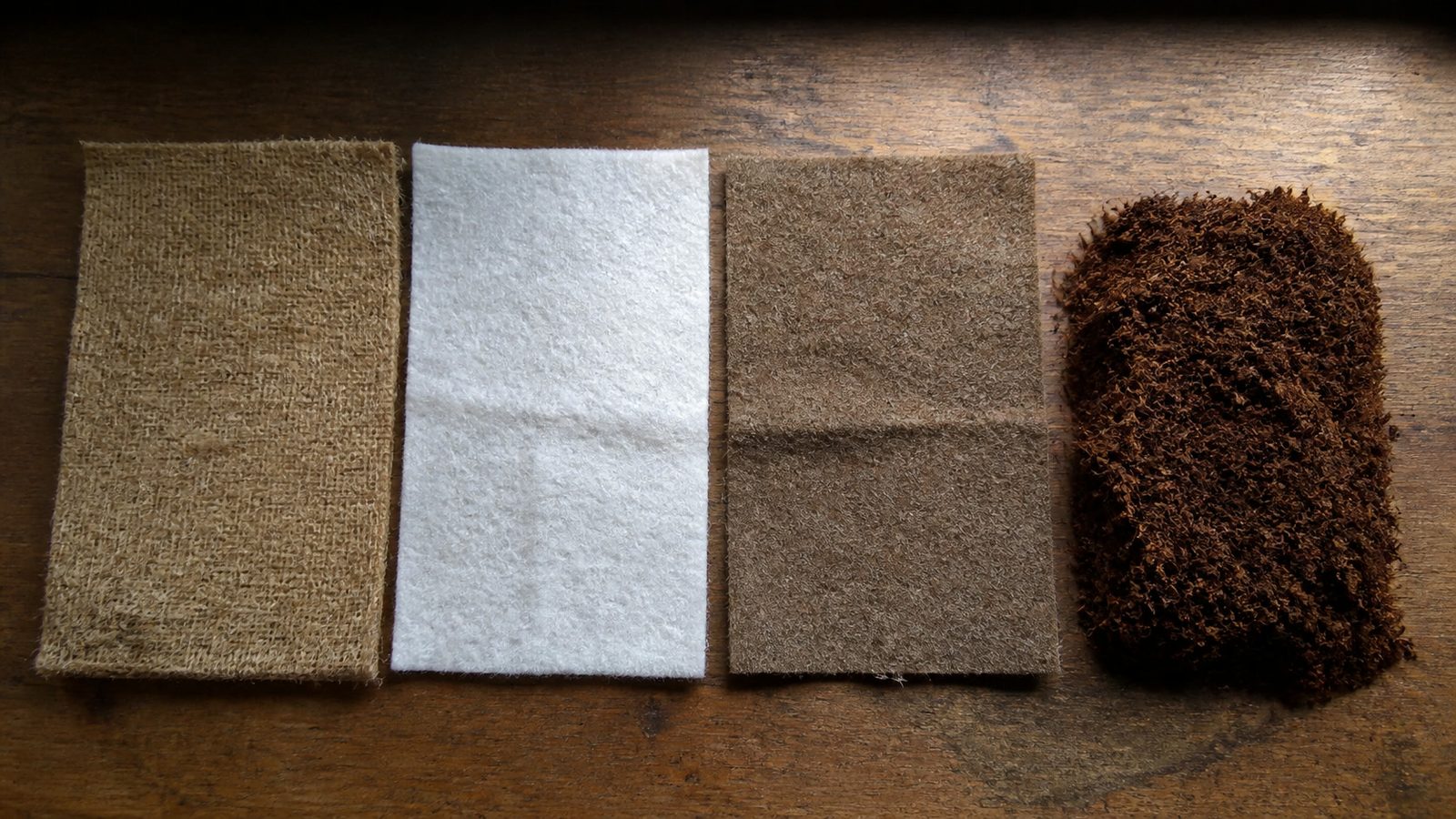
Start with loose coco coir or an ordinary seed-starting mix. It handles large seed better than a pad, and nothing published shows you are giving up yield by using it. It is also the cheapest option here, though by far less than most growers assume: worked out per tray it is about $1.04 to $1.30 against $1.18 for the cheapest mat.
Buy mats when you want a clean cut and a predictable format, not because you expect more crop. A single-use mat in the table below costs $1.18 to $2.90 per 1020 tray, a small pack can run higher, and that is a recurring cost on every single crop you ever grow.
No published source establishes one best microgreen medium. Controlled studies do show that the medium changes the result, and they also show the change depends on the crop and on the nutrient program. There is no retail-brand shootout, and the pages that claim one are usually selling a medium.
The order to buy in
What to buy, and when to stop
Hover or tap a card to highlight it.
One loose medium, used consistently
Coco coir or a plain seed-starting mix, for every crop you already grow. Cheapest per tray but only narrowly, best with large seed, and the baseline everything else has to beat. Buy the big brick: the 10 lb works out about 20 percent below the small 4-pack.
Write down what it actually does
Water added per tray, days to harvest, weight cut, trays lost. Without this you cannot tell whether any upgrade paid for itself, and nobody has published a figure that answers it for you.
One pad type, trialed beside it
On a small-seeded crop where a clean cut matters, such as broccoli or radish. One product, one crop, run against your existing medium.
Bulk packs, only after the trial
The 100-count is less than half the per-tray price of the 10-count, so bulk is where mats become affordable. Buy it once you know which mat, not before.
Stop before the compostable premium
Until you know the standard it is certified to and that your local disposal route actually accepts it.
Do not skip a medium entirely
Unless you are running a hydroponic system that provides real root support and has been validated for the crop.
The premature purchase is a premium branded pad bought before seed density, irrigation and airflow are settled. Those three variables can ruin a crop on any medium, and the published research supports substrate-by-crop testing rather than a universal upgrade ladder.
Against a fixed first budget, medium ranks behind safe seed, trays, light, airflow, sanitation and a way to control irrigation. It is necessary, and it should not displace any of those.
What a mat costs against what the seed costs
Growing medium gets discussed as a minor consumable. Set it against what a tray of seed actually costs and it stops looking minor.
Fifty crops have a costed tray of seed as of 2026-08-11, and the median is $1.08. The cheapest mat on this page is $1.18.
Hover or tap a row to highlight it.
| Crop | Seed per 1020 | Against a $1.18 jute mat | Against a $2.90 hemp mat |
|---|---|---|---|
| Turnip | $0.31 | The mat costs nearly 4x the seed | The mat costs over 9x the seed |
| Arugula | $0.48 | Mat costs more | Mat costs 6x the seed |
| Broccoli raab | $0.49 | Mat costs more | Mat costs 6x the seed |
| Broccoli | $0.79 | Mat costs more | Mat costs nearly 4x the seed |
| The median costed crop | $1.08 | Mat costs more | Mat costs nearly 3x the seed |
| Radish | $2.01 | Seed still costs more | Mat costs more |
| Pea shoots | $2.39 | Seed costs twice the mat | Mat costs more |
For 27 of the 50 costed crops, the cheapest single-use mat costs more than the seed. For 41 of the 50, the dearest one in the table does. On a fast brassica the medium is the largest thing you buy per tray, and it is bought again every cycle forever.
That is not an argument against mats. It is an argument for knowing what they cost, because the category is sold in ten-packs and hundred-packs that hide the per-tray number, and because a yield advantage that would justify the spend has never been published for any named retail product.
What they actually cost per tray
Prices move. Every figure here is what that listing showed on 2026-08-11, and this page is rechecked at least every two months.
Hover or tap a row to highlight it.
| Option | Pack price | Per 1020 tray | Worth knowing |
|---|---|---|---|
| Handy Pantry jute mats, 100 | $118.29 | $1.18 | Joint cheapest mat here, and only at 100 units. $1.25 for the identical pack on Amazon |
| Handy Pantry wood-fiber Micro-Mats, 100 | $58.85 | $1.18 | $0.59 a pad, but these are 10 x 10, so two cover a 1020 |
| Grow-Tech BioStrate 160, 10 | $18.98 | $1.90 | 0.08 inches thick, made for microgreens, labeled fully compostable |
| Handy Pantry Micro-Mats, 10 | $12.44 | $2.48 | The small pack more than doubles the per-tray cost |
| Handy Pantry jute mats, 10 | $24.87 | $2.49 | Same mat as the top row at 2.1x the price |
| Bootstrap Farmer hemp mats, 10 | $28.99 | $2.90 | The dearest per tray in this table. Urban Farmer's pre-cut hemp five-pack was $19.25, $3.85 a mat, on 2026-09-12. 300 GSM, pH neutral, 1,050% water holding claimed |
| Coco coir bricks, 4-pack, 5 lb, stated 9 gallons | $13.49 | About $1.30 | At a 1 inch fill. See the calculation below |
| Coco coir brick, 10 lb, stated 18 to 20 gallons | $22.79 | About $1.04 | At a 1 inch fill. The cheapest medium on this page |
| Bootstrap Farmer coco coir brick, 1/3 cu ft | $11.99 | About $4.00 | The product page says one brick fills three shallow 1020 trays, which is $1.63 a tray from the ten-brick pack at $48.99. A seller's fill, not a measured one |
| True Leaf Minute Soil | From $12.99 | No published figure | A retailer starting price, not a per-tray comparison |
| Bounty paper towel, 12 double rolls | $26.98 | No published figure | $2.25 a roll, and no tray-ready sheet count is published anywhere |
The 10 x 10 Micro-Mat is the trap in this table. At $0.59 a pad it looks like the cheapest thing on the page by a distance. It covers a quarter of the area those other numbers are quoted for, so you need two, and the real figure is $1.18. Read the dimensions before the price.
The other trap is the small pack. The identical jute mat is $1.18 at 100 units and $2.49 at 10. Buying a sample pack is sensible; assuming its price is the category price is not.
Loose coir can finally be priced, and it is closer to a mat than anyone assumes
The seed houses make this impossible and the marketplace does not. A grow-supply retailer's $11.99 coir brick gives a volume, 1/3 cubic foot, and a seller's fill of three shallow 1020 trays, but no weight. Marketplace listings state the expanded volume, which is the missing number: a 4-pack of 5 lb bricks says 9 gallons at $13.49, and a 10 lb brick says 18 to 20 gallons at $22.79. That is $1.50 and about $1.20 a gallon.
A 1020 tray is 200 square inches. Filled one inch deep that is 200 cubic inches, or 0.87 gallons.
Hover or tap a row to highlight it.
| Fill depth | Volume per 1020 | At $1.50 a gallon | At $1.20 a gallon |
|---|---|---|---|
| 0.75 in | 0.65 gal | $0.97 | $0.78 |
| 1 in | 0.87 gal | $1.30 | $1.04 |
| 1.5 in | 1.30 gal | $1.95 | $1.56 |
So, loose coir runs roughly $0.78 to $1.95 a tray, and the honest headline is that it is NOT dramatically cheaper than a mat. At a one inch fill it lands at $1.04 to $1.30, against $1.18 for the cheapest jute. The saving people assume is there mostly is not, and it disappears entirely if you fill deep.
The fill depth is doing all the work. NC State and Colorado State give 0.5 to 1 inch (tray setup and drainage), but nobody has weighed what that fill takes, and that is the real gap, not the price. This table is arithmetic from two published numbers, so treat it as a calculation you can check rather than as a figure anybody measured, and settle it by weighing what your own trays actually take.
What has actually been measured
Three pieces of real research exist. None of them tested a named retail brand against another named retail brand, which is the comparison a buyer actually wants.
The broadest study is generic and it favors coco. Arya and Kutty compared sterile sand, cocopeat, coir mat, tissue paper and newspaper across wheat, ragi, green gram, horse gram, amaranthus and mustard, with five replications. Cocopeat gave the highest yield, and green gram fresh yield ranged from 1.03 to 1.49 kg/m² depending on the medium. Read the limits with the result: the media were generic rather than branded, irrigation ran three or four times daily, and it was not a US 1020 trial.
The study closest to the mats you can buy compared four pad types. Allred's greenhouse work put hemp, jute, Micro-Mats and BioStrate against broccoli, cabbage, kale, mustard and radish, measuring fresh and dry shoot weight and mineral nutrients. It confirms that measured differences exist. It does not publish a cost-per-yield table you could buy from, so the best named product per dollar remains unpublished.
And the most recent controlled work says the answer is conditional. A 2024 controlled-environment study compared peat, coco coir and a cannabis or hemp mat at three nutrient strengths for mustard, radish and pea. Its results are crop-dependent and nutrient-dependent. There is no universal mat win in it.
Read together, those three come to the same place. The medium matters. Which medium wins depends on the crop and on how you feed it. Anyone who tells you hemp beats soil, or soil beats hemp, without naming the crop and the nutrient program is generalizing from one trial they probably ran once.
The 33 gram claim, and why you cannot check it
A seller's guide reports that soil beat every other medium "by at least 33 grams." That page does not state the cultivar, the seed mass, the tray area, the replications, the light, the irrigation or the raw measurements. It is a single unreplicated observation presented as a category ranking, and it cannot be checked by anyone.
It might even be right. That is not the point. A number nobody can verify is not evidence, and this category is full of them.
What the specs tell you, and what they do not
Hover or tap a row to highlight it.
| The claim | Who says it | What it establishes |
|---|---|---|
| 300 GSM, pH neutral, 1,050% water holding by weight | Bootstrap Farmer, hemp | Material properties and likely irrigation behavior. Not a watering interval and not a yield |
| 160 GSM, 0.08 inches thick, sized for 10 x 20 trays | Grow-Tech BioStrate | Fit and handling. The maker's own description |
| "High water holding capacity" | Jute listings | Incomplete without a test method and a comparison medium |
| "Consistent harvests", "clean", "works great" | Across the category | Unfalsifiable. No crop, seed rate, control or measurement |
| "Now fully compostable" | A retailer, on BioStrate | A seller statement. Backyard or industrial is not specified |
| RHP Certified for Horticulture | Listed coir and peat substrates | Real quality assurance for water uptake, air content, pH, EC and nutrients, monitored from raw material to delivery. Says nothing about yield |
| OMRI listed | Some media | Allowed under organic production rules. Not a yield, safety or compostability result |
| ASTM D6400 or BPI certified | Plastic-containing pads | Industrial compostability only. Not backyard breakdown, not performance |
"Compostable" is the claim most worth slowing down on, because it is the one people pay extra for. It means nothing without naming the destination and the standard. A pad certified for industrial composting does not break down in a backyard heap, and if your actual disposal route is a landfill then the premium bought you nothing at all.
"Food-safe" needs the same treatment. A supplier asserting it does not disclose the test, what was screened for, or under what contact conditions. The trays review runs into the same gap on plastics.
What goes wrong
Moisture is the whole category's failure mode, and it cuts both ways. A mat that holds a lot of water is sold as an advantage and experienced as a learning curve. Virginia Tech is direct that substrate choice has to match irrigation, notes hemp holds more water than burlap and therefore needs a lower irrigation rate, and tells growers to test in their own facility with their own crop.
One grower report describes losing about 90 percent of early trays with coir retaining too much water. That is one owner's account rather than a controlled finding, and a waterlogged medium is only one of the things that collapses a tray.
Damping-off is not a medium defect. It is a disease outcome involving moisture, sanitation, airflow, seed and temperature together, and Rhizoctonia can appear in warmer and drier conditions rather than only wet ones. Blaming it on a substrate without controls is unsound. The mold or root hair and yellowing and collapsing pages work through the actual diagnosis, including why "too much water" fails as an explanation.
Wet pads are fragile, and the seller says so. The 10 x 10 wood-fiber Micro-Mat listing states plainly that a hydrated pad becomes very fragile and can fall apart if repositioned. That is a seller instruction rather than an independent durability test, and it is a genuine handling constraint on a product you will be moving wet.
Two more that cost money quietly. Fiber or loose medium ending up in the cut crop is a quality problem at harvest speed, not at demonstration speed. And spent medium has a disposal cost and a disposal route that nobody prices into the per-tray figure.
There is no meaningful performance warranty in this category. Bootstrap Farmer advertises a 30-day return policy on most products, and a consumed growing medium cannot demonstrate a warranty-supported yield result. No owner report of successfully claiming one was found.
Who should skip this entirely
Skip specialty mats if a clean seed-starting mix or loose coir already meets your sanitation and cleanup needs at home.
Skip them if you cannot keep them evenly moist. A pad's advantages assume an irrigation routine that actually exists.
Skip them if a recurring $1 to $3 a tray cannot come back in the sale price. On the crops in the table above, that is frequently more than the seed.
Skip mats for large-seeded crops such as pea and sunflower unless you have tested them there. Growers consistently report using loose coir for those, because it is cheaper and anchors big seed better.
Skip paper towel as a commercial substrate. It will germinate small seed for a kitchen experiment. Its durability, anchorage and food-production outcomes are unpublished, and no retail towel has a tray-ready sheet count you could cost.
What is still genuinely unknown
- Which medium gives the best marketable fresh weight per delivered dollar, for a named cultivar at a stated seed rate. No independent same-cultivar cost-per-sellable-tray study exists.
- Whether a mat's irrigation saving offsets its purchase price, in any operation.
- Whether the medium changes flavor enough for a customer to notice.
- Whether loose coir or mix can be reused safely and profitably after one crop. There is no published food-safety validation and no yield-after-reuse data, so reuse should not be treated as a free second crop.
- Whether products labeled compostable break down in the disposal system you actually have.
- What a proper trial would cost. A credible one needs at least three replicated trays per treatment, randomized positions, a defined seed lot, matched seeding mass, logged light and temperature, and a set harvest criterion, plus an accredited lab if any food-safety claim is made. No source publishes a benchmark price, and quoting one without written quotes would be inventing it.
The terms on this page, in plain words
Tap a term to see what it means.
Anchorage. The medium's ability to hold roots and keep densely sown seedlings upright. The reason large seed and thin pads argue with each other.
Sources
Every price above was seen on 2026-08-11, and the prices on this page are rechecked at least every two months.
- Virginia Tech Extension SPES-756 - the substrate list including bamboo, burlap, coco, hemp, jute, rockwool, silicone and steel mesh, that hemp holds more water than burlap and takes a lower irrigation rate, and the instruction to choose by crop, system, water-holding capacity, cost, pathogens and reusability and to test in your own facility.
- Arya and Kutty, 2022, growing media across six microgreen species (PDF) - sterile sand, cocopeat, coir mat, tissue paper and newspaper across six crops with five replications, cocopeat highest yielding, and green gram fresh yield from 1.03 to 1.49 kg/m².
- Published review covering Allred's five-crop pad comparison - hemp, jute, Micro-Mats and BioStrate against broccoli, cabbage, kale, mustard and radish, with fresh and dry shoot weight and mineral nutrients measured, and no interoperable cost or yield table published.
- 2024 controlled-environment substrate and nutrient study - peat, coco coir and a cannabis or hemp mat at three nutrient strengths for mustard, radish and pea, with crop-dependent and nutrient-dependent outcomes rather than a universal winner.
- Utah State University Extension, grow your own microgreens - seed-starting mix, coir and hydroponic mats all treated as acceptable choices, and per-tray seed costs of $0.17 for arugula, $1.12 for broccoli, $1.16 for peas and $1.95 for purple radish.
- Bootstrap Farmer, hemp grow mats - $28.99 for ten pre-cut 1020 mats, the 300 GSM, pH neutral and 1,050% water-holding claims, and the 30-day return policy.
- Bootstrap Farmer, grow media collection - the coco coir brick at $11.99, 1/3 cu ft, which its product page says fills three shallow 1020 trays.
- True Leaf Market, jute microgreens grow mats - $24.87 for ten and $118.29 for a hundred, and the voluntary 5% Subscribe and Save option, which is an auto-replenishment discount rather than a required subscription.
- True Leaf Market, BioStrate felt growing pads - $18.98 for ten 160 GSM pads, and the "new and improved" and "now fully compostable" labeling.
- True Leaf Market, 10 x 10 Micro-Mat grow pads - $12.44 for ten and $58.85 for a hundred, and the seller's own statement that a hydrated pad becomes very fragile and can fall apart if repositioned.
- True Leaf Market, soils and amendments for microgreens - Minute Soil compressed coir from $12.99 and potting soil from $10.24, both retailer starting prices rather than per-tray figures.
- Grow-Tech BioStrate - the 160 grade described for microgreens, salad greens and wheatgrass, 0.08 inches thick, sized for 10 x 20 trays, plant-based felt and a 12-month stored shelf-life claim.
- RHP, certification for horticultural substrates - what the certification actually covers: water uptake, air content, pH, EC and nutrients, monitored from raw material to delivery.
- Home Depot, Bounty Select-A-Size - $26.98 for 12 double rolls, with no tray-ready sheet count published, which is why no per-tray cost is calculated.
- Urban Microgreens, best growing mediums - the "soil beat all media by at least 33 grams" claim, published without cultivar, seed mass, tray area, replications, light, irrigation or raw measurements. A seller page.
- Coco and Coir, best growing medium for microgreens - recommends coir while selling coir, states that soil often yields more and that mats are single use, and gives no measured loss rate or protocol.
- Home Microgreens, microgreen soil - own observations from a seller that also sells a blend, and an acknowledgment that more testing is needed.
- RusticWise, best growing mats - fragility, expense and crop limits named, in a commercial advice guide rather than a controlled trial.
- A discussion on damping-off and tray weight - excess wetness, mold, extended blackout and collapsing stems, including one grower reporting about 90 percent loss in early coir trays.
- A discussion on soil and mats - mats preferred for clean harvesting, and loose coir still chosen for peas and sunflower because it is cheaper and handles large seed better.
Keep reading
The test bench
AeroGarden and Countertop Pod Gardens for Microgreens: Is It Worth It?
Pod count is holes for separated mature plants, not dense tray area. A $30 tray kit gives you more sowing surface for microgreens than a $250 pod garden.
Read AeroGarden and Countertop Pod Gardens for Microgreens: Is It Worth It?The journal
AeroGarden Bounty Review: Basic, Bounty and Elite Specs
This AeroGarden Bounty review compares the Basic, Bounty and Elite by watts, features, price, stock, running cost estimates, and warranty terms.
Read AeroGarden Bounty Review: Basic, Bounty and Elite SpecsThe journal
AeroGarden Farm Review: Specs, Price and What It Grows
This AeroGarden Farm review breaks down the Plus and Basic models, last known list prices, running costs, warranty terms, and owner-reported problems.
Read AeroGarden Farm Review: Specs, Price and What It GrowsThe journal
Best Potting Soil for Microgreens: Cost per Tray
Compare the best potting soil for microgreens by ingredients, bag size, trays filled per bag, and cost per tray, plus problems to expect from each mix.
Read Best Potting Soil for Microgreens: Cost per Tray