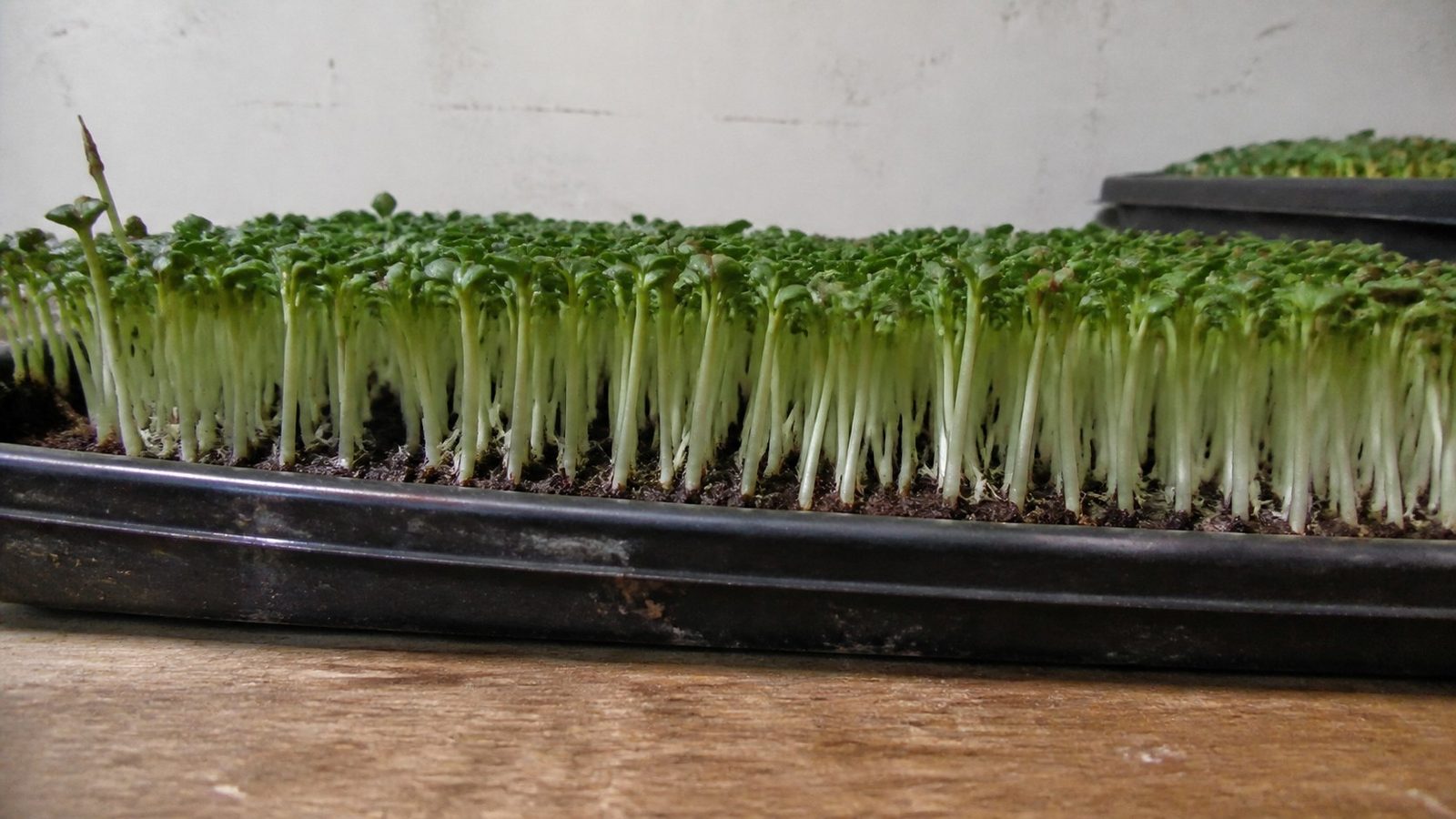
Most of the time it is root hair. That is the useful headline, and it is why so many good trays get binned.
But the honest second sentence matters as much: there is no test you can run at the tray that proves it. Telling the two apart definitively needs a lab, culture or microscopy. What you have at home is a screen, and this page is about running that screen properly and knowing exactly how far it gets you.
The one word that separates them: bridging
If you remember nothing else, remember where the fuzz attaches.
Three things that look similar and are not
Hover or tap a card to highlight it.
Root hair
Fine, bright white fuzz attached ROOT BY ROOT, in an even halo around individual roots, usually near the root and seed zone. The seedlings above it are upright, firm and normally colored. This is the plant working, not a problem.
Fungal growth
An irregular gray or white cobweb or MAT that crosses things. It bridges bare medium, seed hulls, stems, and several plants at once. That crossing between plants is the tell root hair never gives you.
Damping-off
Not fuzz at all. Water-soaked, constricted, brown or black soft stems at or below the medium line, bare patches, and collapse. This is a disease and it is a different question from the fuzz.
Root hair attaches. Mold travels. Everything below is a way of testing that distinction.
The mist test, and what it actually proves
This is the standard field check and it is published by extension services, so it is worth doing properly.
The five-minute sequence at the tray
- 1
Look at the plants first, not the fuzz
Is every seedling firm, upright and normally colored? If you see water-soaked or brown constriction at the medium line, root decay or collapse, stop here. Treat it as probable damping-off, isolate the tray, and do not eat it. The fuzz has become irrelevant.
- 2
Check where the fuzz sits
Is it an even halo on individual roots only, with no bridging across bare medium or between stems? If yes, root hair is plausible.
- 3
Mist ONE patch lightly
Clean water, enough to wet the fuzz, not enough to soak the tray. Do not stir it through the rest of the tray. Watch it immediately.
- 4
Read the response
Root hairs cling down to the root and nearly vanish, reappearing as they dry. Fungal growth stays as a mat or cobweb, stays gray, keeps bridging, or the patch is visibly expanding.
- 5
Check for odor, slime or decay
A musty or sour smell alongside visible growth or decay is a discard signal. Do not put your face down and sniff visible mold.
- 6
If it is still ambiguous, that is a real answer
NOT ESTABLISHED at the tray. Keep it away from other trays and do not eat it. A plant diagnostic service can settle the biology; it cannot retrospectively certify the food.
The mist response is a published field heuristic. It is not a laboratory diagnosis and it is not a food-safety clearance. It tells you which way to lean. It does not tell you what organism you have, and a negative result does not make a tray safe.
What each check can and cannot do
Worth being explicit, because every one of these gets oversold somewhere.
Hover or tap a row to highlight it.
| Check | What it can tell you | What it cannot |
|---|---|---|
| Sight | Attachment, bridging, color, whether plants are healthy | Separate early fungal growth from root hair when it is only white fuzz on healthy tissue. Color alone is especially unreliable |
| The mist test | Which way to lean, quickly, with nothing but water | Identify an organism, or clear a tray for eating |
| Smell | A musty or sour odor alongside visible growth is a discard signal | Diagnose anything. Absence of odor clears nothing |
| Touch | Firm stem and attached roots reassure; soft, slimy, water-soaked tissue does not | Prove mold or root hair either way, and it spreads contamination to tools, hands and neighboring trays |
| Hand lens | Attachment and bridging, more clearly | Species identification. Seeing hyphae is not guaranteed and misidentification stays likely |
| Thermometer, hygrometer, moisture meter | The room and medium context, useful for records | Anything about what the fuzz is. A moisture meter cannot prove overwatering either |
The general growing-room context those instruments give you is 60 to 70°F and 50 to 70 percent relative humidity, published as a production range rather than a diagnostic threshold. Being inside it does not mean the fuzz is fine, and being outside it does not mean the fuzz is mold.
Do not rub it with your fingers
The instinct is to touch it. It settles nothing and it actively makes things worse.
Pathogens move by tools, hose ends, water splash and hands, and plant to plant through shared media and irrigation water. A finger that touches a suspect patch and then another tray has done the one thing you were trying to avoid.
If you must handle it, clean hands or gloves, isolate the tray first, and clean the tools afterwards.
What is recoverable, and what is not
Hover or tap a row to highlight it.
| What you have | Recoverable? | What to do |
|---|---|---|
| Root hair, plants healthy | Nothing to recover | Nothing. The tray is normal. Carry on |
| Suspect fuzz, no decay, caught early | NOT ESTABLISHED for home food use | Isolate it and change conditions. Removing a patch is grower practice and does not prove the rest safe to eat |
| Damping-off signs, caught early | No | Infected seedlings rarely become vigorous. Extension guidance is to discard the whole infected flat, not just the symptomatic plants, along with its medium, then clean the area |
| Widespread, collapse, slime or odor | No | Discard. There is no rescue procedure here |
"Recovery" on this subject can only ever mean keeping unaffected plants for observation. It never means restoring diseased seedlings to full quality.
And record what happened: system, seed lot, medium, temperature, watering and timing. That is how you find a repeatable cause. It is not a cure and nothing on this page is.
Three things you will be told that do not hold up
Advice that fails the evidence check
Hover or tap a card to highlight it.
"Spray peroxide or cinnamon and it is safe again"
No recovery or food-safety trial supports this. It is widely recommended by growers and by at least one vendor troubleshooting page, with no trial behind it. Postharvest washing appears ineffective and may INCREASE contamination risk by damaging tissue, so the instinct to clean the problem away runs the wrong direction.
"Too much water is the cause"
Wrong as a universal claim. Some Pythium species favour cool wet conditions, while Rhizoctonia and other Pythium cause disease in drier, warmer ones. Moisture does not identify the organism and it does not diagnose the tray.
"Cut out the patch and eat the rest"
No authority was found supporting this for microgreens. It conflicts with how soft, high-moisture raw produce is handled everywhere else, and it ignores bacteria you cannot see. The visible patch is not the boundary of the problem.
The safety line, stated plainly
This is the part where a page like this earns its keep, because the honest answer is uncomfortable.
If you cannot tell, do not eat it. Microgreens are soft, high-moisture produce eaten raw, with no cooking step to fall back on. That combination is why the conservative call is the correct one here and not merely the cautious one.
A tray you are unsure about is not a tray to serve to somebody else, and it is emphatically not one to sell. The cost of being wrong is a few dollars of seed. We cover what is and is not documented about raw microgreen safety in the raw safety piece.
The reassuring part
Having said all that, the base rate genuinely is on your side, and it is worth ending there.
Fine white fuzz appearing at the roots of a vigorous, upright, normally colored tray, in an even halo along individual roots, not crossing between plants, is root hair almost every time. It is especially common on radish and on cabbage, which is exactly why those two crops generate so many panicked posts.
The trays that are actually in trouble usually tell you in a way that has nothing to do with fuzz: they collapse.
Terms on this page
Tap a term to see what it means.
Root hair. A fine outgrowth from a root that increases its surface area for taking up water. Normal, healthy, and the most commonly binned non-problem in this hobby.
Sources
- Oregon State Extension (PDF) - the wetting test and the practical distinction between fuzz that clings down when wet and a mat that stays visible and bridges.
- Penn State Plant Pathology, Pythium - why definitive identification needs diagnostics, and the note that root examination may not reveal Pythium structures.
- UC IPM, damping-off - Pythium and Rhizoctonia, rot at or below the medium line, and the point that different species favour different moisture and temperature conditions, which is what defeats "too much water" as a diagnosis.
- University of Minnesota Extension - the visual signs of damping-off, that infected seedlings rarely become vigorous, and movement plant to plant through media and shared irrigation water.
- UConn Extension (PDF) - transfer by tools, hose ends, water splash and hands, and the recommendation to discard the whole infected flat rather than only the symptomatic seedlings.
- Utah State University Extension - disposing of infected seedlings with their soil, and monitoring adjacent seedlings afterwards.
- University of Nevada, Reno Desert Farming Initiative (PDF) - postharvest washing appearing ineffective and potentially increasing contamination risk through tissue damage.
- Virginia Tech Extension (PDF) - the 60 to 70°F and 50 to 70 percent relative humidity production range, and thermometers and hygrometers as recordkeeping rather than diagnostic instruments.
- Island Microgreens - PRACTICE, not evidence: the widely repeated advice to excise a patch, and the peroxide and cinnamon recommendations, supplied with no trial.
Keep reading
Growing guides
Save it or compost it: three different questions with three different answers
Can I eat this, can I sell this, and will it recover are three separate decisions, and not one of the six pages checked kept them apart. The rescue everybody recommends is the one the evidence argues against.
Read Save it or compost it: three different questions with three different answersGrowing guides
Growing microgreens in a small space: what fits, and what a jar actually gives you
A windowsill and a shallow tray will grow microgreens; a rinsed jar grows something else. Jars produce sprouts, eaten whole, which FDA treats as a distinct risk category, so the method decides what you end up with.
Read Growing microgreens in a small space: what fits, and what a jar actually gives youGrowing guides
Leggy, pale and leaning microgreens
Long thin stems and pale leaves are a light problem, not a water problem. The stems will not shorten once stretched, and the internet's usual answer is not supported by any source that says so.
Read Leggy, pale and leaning microgreensGrowing guides
Microgreens with kids: the crops that finish inside a two-week unit, and covering the weekend
Pick from the 5 crops that reliably finish inside a two-week unit, and plan for the weekend, because every published protocol assumes daily care and a school week is five days in seven.
Read Microgreens with kids: the crops that finish inside a two-week unit, and covering the weekend