Growing microgreens in a small space: what fits, and what a jar actually gives you
Cal HewittPublished Checked
- method
- beginner
- food safety
- troubleshooting
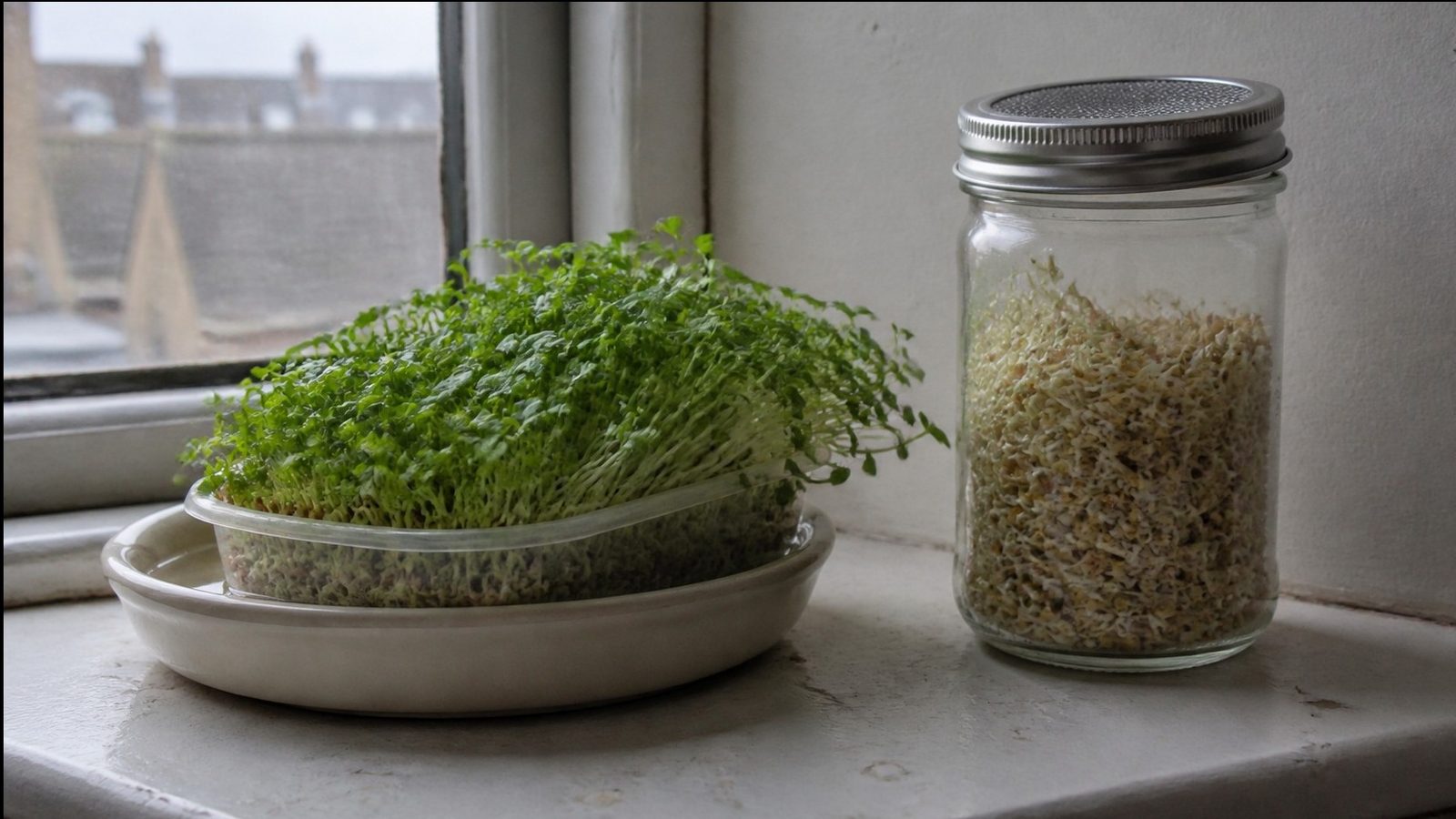
Small spaces work, and the choice that matters most is the vessel, because it changes what you are eating.
A microgreen is a substrate-grown seedling cut above its roots at cotyledon or true-leaf stage. A jar that is soaked, rinsed, drained and tipped out whole is a sprouting vessel, and what comes out of it is a sprout: seed, root and all.
Three of three pages promoting "microgreens in a jar" failed to make that distinction, or to mention the safety context that goes with it. One calls the technique soil-free; another says jars create a semi-hydroponic microgreen environment. Neither renaming changes the product.
And the risk model is genuinely different. FDA describes sprouts as grown in warm, moist, nutrient-rich conditions, which are the conditions it identifies as ideal for Salmonella, Listeria and E. coli. Its statement about home growing is unusually direct: even a few organisms on or in the seed can multiply to high levels during sprouting, under sanitary conditions.
Read that clause again, because it is the part the jar guides omit. The hazard is multiplication during sprouting, not dirt you can rinse off. A clean-looking jar and a diligent rinse do not address it.
The regulatory line runs the same way. Products grown in substrate and harvested above the roots sit outside the sprout-specific rule; sprouts do not. So, the word is not cosmetic: it marks a different product, a different hazard, and a different regulatory category.
None of this makes a jar wrong. Sprouts are a real food that people have eaten for a long time. It makes the label wrong, and the label is what tells a reader whether the safety guidance they just skipped applied to them. If you want sprouts, grow sprouts knowingly, use seed intended for edible sprouting, and know that those precautions reduce risk rather than remove it. FDA, CDC and Health Canada all advise children, older adults, pregnant people and people with weakened immunity to avoid raw or lightly cooked sprouts. See are microgreens safe to eat raw.
Whenever you meet a health claim about microgreens, check which material it was measured on. Microgreen, sprout, extract and mature vegetable are four different things, and the health articles turn on that distinction. It starts here, at the container.
What to actually do
- Call it what it is. Substrate plus a cut above the roots is a microgreen. Rinse, drain and eat whole is a sprout, with a different hazard and different guidance.
- If you want the jar, grow sprouts deliberately. Seed intended for edible sprouting, clean equipment, potable water, and the knowledge that this reduces risk rather than removing it.
- Start with one shallow drained food-grade container in a saucer. One to one and a half inches of clean soilless medium is the documented depth.
- Skip the fertilizer, and skip the equipment you cannot yet justify. Add the heat mat or the fan when the tray tells you which problem you have.
- Assess the sill instead of trusting the word. Direction, season and obstruction decide it, and a meter settles it. A lux app does not.
- If light is poor, pick from the documented list: lettuce, arugula, mustards and Asian greens.
- Expect about 3 ounces per square foot per week from a median crop, not 8 to 12. Weigh your own harvest and count the meals it actually covers.
- Run two containers offset by half a cycle rather than a fixed weekly rhythm, and use your own observed interval.
- Keep it out of the cooking zone and off cold glass, and put something waterproof underneath.
What the space actually has to be
There is no published minimum floor area, and the physical minimum is smaller than the conversation implies.
The requirement is a food-grade container that holds a shallow moist layer and lets you cut. Maryland specifies 1 to 1.5 inches of soilless medium and accepts plastic food containers alongside the 10 by 20 flat. UF and IFAS accept any sterile food-grade container 2 to 3.5 inches deep, with drainage preferred.
The 1020 is a standardization convenience, not a biological requirement. It matters for accessory fit and for making rates comparable, which is exactly why the tray setup page spends so long on what its area actually is. A 10 by 20 is 200 square inches, which is 1.39 square feet. Use something smaller when your sill, your appetite or your drainage says so.
What you cannot skip: a food-grade drained container, a watertight saucer under it, clean medium, water management, and light after emergence. What is optional: the 1020 itself, a rack, a heat mat, a fan, and artificial light, each of which is a tool for a problem you may not have. Fertilizer is not needed, and the fertilizer page covers what feeding actually buys and costs.
The windowsill question has no measured answer
"A sunny window is enough" is conditionally supported and has never been measured.
Maryland says a sunny window may suffice in some cases, and that microgreens generally grow best under lights, calling for about 16 total light-hours. UF and IFAS recommend a south-facing window with rotation. Minnesota's seedling guidance says window light is not enough for vigorous seedlings.
Those three are not contradicting each other. They differ by crop, latitude, season, window and quality goal, and every one of them is right somewhere.
What nobody has published is the number. No source measured a representative household windowsill's light against a named microgreen crop. The comparator only exists on the controlled side: the general target is 9 to 16 mol per m² per day, with arugula at 9 and mizuna and mustard at 12 or more. A USDA study grew kohlrabi, mizuna and mustard at 6, 12 and 18 mol per m² per day, and growth and shape changed with the level.
So, a sill is not a light setting, it is an unmeasured variable. If you want the comparison, a PAR meter gives it. A phone lux app is not a validated substitute.
The one documented shortlist for dim conditions is lettuce, arugula, mustards and Asian greens, named as growing acceptably under less-than-ideal light. Claims that pea, radish or sunflower are the best low-light crops are seller assertions with no measurements attached. Start with a crop that is actually documented as tolerant, and judge it on color and compactness against a lit trial rather than against a photograph.
The yield claim, checked
A widely repeated figure says one square foot produces 8 to 12 ounces a week. It is about three times too high.
The median published tray is 7.055 oz, taken across all 62 crops. A 1020 is 1.39 square feet, and the median crop finishes in about 11.5 days.
Hover or tap a row to highlight it.
| Step | Figure |
|---|---|
| Median published tray | 7.055 oz |
| Divided by the tray's 1.39 ft² | 5.08 oz per ft² per crop |
| At a median 11.5 day crop, scaled to seven days | about 3.1 oz per ft² per week |
| The claim in circulation | 8 to 12 oz per ft² per week |
| The claim, as a multiple | 2.6 to 3.9 times |
So, the figure people quote for feeding a household is roughly three times what a median crop actually produces, and nobody publishing it shows a trial behind it. Plan on about 3 oz per square foot per week, and weigh your own harvest before you count on anything.
Two honest caveats. A grower choosing only heavy croppers beats the median on purpose, and the arithmetic above assumes continuous occupancy with no reset gap, which yield, space and succession shows is optimistic. Both of those push the real number down, not up.
No credible household consumption figure exists either. How much a household needs depends on servings, crop, waste and whether the greens are a garnish or a salad. Weigh one harvest and count the meals it covers before adding a second container.
Rotation, and why a fixed weekly rhythm is not the answer
Two containers, staggered, is the smallest continuous system. Sow the second roughly halfway through the observed sow-to-harvest interval of the first, then adjust after two crops so the harvests overlap without both peaking together.
Use your own observed interval, not a rule. The broad range is 7 to 21 days, cabbage-family crops germinate faster than beets, and basil and cilantro are slow. A fixed "sow every seven days" is practice, not guidance, and it will desynchronize the moment you change crop.
Do not mix species in one container to save space. Maryland advises against it because germination and growth rates differ, which is the same reason the succession page says a formulated mix is a product somebody designed rather than a shortcut you improvise.
Apartment problems are the ordinary problems, harder to separate
A small space does not create new pathogens. It makes the usual conditions harder to keep apart.
Cool wet medium, low light, crowding, poor sanitation and slow growth are the conditions associated with damping off, and gentle air movement is the recommended counter. In an apartment, one tray can sit beside a cold pane, above a radiator, and next to cooking steam at the same time, which shifts temperature and humidity faster than a controlled setup ever would.
Diagnose by the plant, not the room. Water-soaked or pinched stem bases mean damping off; the named agents are Pythium, Fusarium and Rhizoctonia, and cobweb-like growth appears under high humidity. A persistently wet surface and condensation are a condition to correct, not a diagnosis. See mold or root hair.
Airflow is mechanistically supported and unquantified. A gentle nearby fan is advised around a dense crop, and excessive direct airflow damages seedlings and raises watering demand. No home trial has measured how much airflow reduces how much mold. Remove the germination cover at emergence or around half germination rather than leaving it on out of habit.
The kitchen is not a documented hazard, and it is a sensible thing to avoid anyway. No study isolates cooking steam, grease or temperature swings on microgreens. The food-safety evidence that does apply is about keeping produce equipment and surfaces away from raw meat, poultry and seafood. Keep the tray out of stove splatter, use a washable catch tray, and move it if you see condensation or rapid drying.
The household consequences growers report are real and unquantified: a funky smell around brassicas and fenugreek, fungus gnats in the medium, LED spill and fan noise in a bedroom. Those are reports, not rates. Act on a sour or decaying smell, visible mold, larvae or a leak by stopping harvest, discarding the affected material and cleaning, rather than by masking it.
If you rent, treat it as a contained appliance. Waterproof secondary tray, off a damageable sill, not blocking egress, no electrical or wall modification without permission, a listed fixture and timer, intact cords, and an outlet that is not already loaded.
What nobody has measured
- A minimum workable footprint, with usable yield and failure rate by container area and depth.
- What a real windowsill delivers, in any season, at any latitude. This is the largest gap on the page.
- A jar against a shallow tray, matched for crop and seed lot, on yield, quality or microbial outcome. The comparison at the center of the whole jar debate has never been run.
- Whether kitchen humidity, grease or heat swings affect a tray, as opposed to being sensible things to avoid.
- Household rates for smell, gnats, mess or spillage, which need diaries with denominators rather than anecdotes.
- How much a household actually eats, which is why no honest capacity recommendation exists.
- A cost figure. It depends entirely on what you already own, and a retailer's "under $20" is not a finding.
Terms on this page
Tap a term to see what it means.
Sprout. A germinated seed eaten whole, root and seed included, usually produced by repeated rinsing in a jar or vessel. A distinct product with distinct hazards.
Sources
Opened 2026-08-11. The yield comparison is arithmetic on a median published tray of 7.055 oz and a median 11.5 day crop, both computed from the yieldOuncesPer1020 and daysToHarvest fields across all 62 variety entries, divided by the 1.39 ft² a 1020 occupies. It assumes continuous occupancy with no reset gap, which overstates rather than understates the result. Grower forum reports are labeled as reports and carry no rate.
- University of Maryland Extension, growing microgreens and baby greens indoors - microgreens defined as closely spaced seedlings harvested at true-leaf stage including stem, cotyledons and emerging true leaves, 1 to 1.5 inches of soilless medium in a shallow food-grade container or a 10 by 20 flat, about 16 total light-hours with grow lights generally performing best and a sunny window sufficing in some cases, lettuce, arugula, mustards and Asian greens named as acceptable under less-than-ideal light, no fertilizer needed, a 7 to 21 day range with cabbage-family crops faster than beets and basil and cilantro slow, and the advice against mixing species because germination and growth rates differ.
- UF and IFAS Gardening Solutions, microgreens - any sterile food-grade container 2 to 3.5 inches deep with drainage preferred, a south-facing window with rotation, and cover requirements that differ by crop.
- FDA, selecting and serving produce safely - the warm, humid conditions sprouts grow in described as ideal for Salmonella, Listeria and E. coli, the statement that even a few organisms on or in seed can multiply to high levels during home sprouting under sanitary conditions, and the advice that people more vulnerable to foodborne illness avoid raw or lightly cooked sprouts of any kind.
- FDA, guidance for industry on sprouts - the sprout-specific standards, which regulate commercial covered farms rather than a household jar while the underlying risk explanation still applies.
- FDA, FSMA frequently asked questions - that soil and substrate grown products harvested without roots fall outside the sprout-specific rule, which is the regulatory form of the same distinction.
- Virginia Cooperative Extension, introduction to microgreen production (PDF) - a general daily light integral of 9 to 16 mol per m² per day with arugula at 9 and mizuna and mustard at 12 or higher, common commercial relative humidity of 50 to 70 percent, airflow fans advised, and the statement that light requirements vary by species and goal.
- USDA Agricultural Research Service, light level in kohlrabi, mizuna and mustard microgreens - the three crops grown at 6, 12 and 18 mol per m² per day, delivered as 105, 210 and 315 µmol per m² per second over 16 hours, with growth and morphology changing by light level.
- University of Minnesota Extension, preventing seedling damping off - Pythium, Fusarium and Rhizoctonia named, water-soaked and thin stems and cobweb-like growth under high humidity described, movement through medium and shared irrigation water, that window light is not enough for vigorous seedlings, and the association of cool wet media, low light, crowding, poor sanitation and slow growth with damping off.
- Utah State Extension, starting vegetable seeds indoors - a small fan advised, with the caution that excessive direct airflow can damage seedlings and increase watering needs.
- Practice sample, audited 2026-08-11 and used only as a record of what is being published: Wind River Greens jar guide and Biology Insights, two of the three jar pages that do not distinguish a rinsed whole-plant sprout from a cut substrate-grown microgreen, the latter describing jars as forming a semi-hydroponic microgreen environment; Wind River Greens small spaces guide and On The Grow, the source of the one square foot at 8 to 12 ounces a week claim; Aquager, the source of the pea, radish and sunflower low-light claim with no light measurements reported; and two Reddit discussions on growing in a bedroom and gnats and aphids, the sources of the smell, gnat, light spill and fan noise reports.
Keep reading
Growing guides
Microgreens with kids: the crops that finish inside a two-week unit, and covering the weekend
Pick from the 5 crops that reliably finish inside a two-week unit, and plan for the weekend, because every published protocol assumes daily care and a school week is five days in seven.
Read Microgreens with kids: the crops that finish inside a two-week unit, and covering the weekendGrowing guides
Outdoors and under glass: the tunnel is hottest exactly when you need it coolest
A high tunnel has been recorded at 120 to 140F in March and April and near 0F overnight in January, against a recommended 64 to 75F band. Ventilation cannot cool the air below what is outside.
Read Outdoors and under glass: the tunnel is hottest exactly when you need it coolestGrowing guides
Pests and mold on a tray: isolate it, do not spray it, and fix the next crop
For a tray that is already affected the answer is isolate and dispose, then clean the system before the next crop. Spraying is not an option on a seven-day crop, and prevention is where all the leverage actually is.
Read Pests and mold on a tray: isolate it, do not spray it, and fix the next cropThe journal
Four Bags Labeled Kale, Two Species and a 227 Percent Price Gap: How Microgreen Seed Actually Gets Named
Federal law makes a seed packet state its kind and variety, not its species. One catalog's four kale microgreen listings span two different species and $25.73 to $84.25 a pound.
Read Four Bags Labeled Kale, Two Species and a 227 Percent Price Gap: How Microgreen Seed Actually Gets Named