Growing Microgreens Without a Grow Light on a Windowsill
Cal HewittPublished Checked
- growing
- beginner
- equipment
Disclosure: this page contains affiliate links, and Microgreens Guru may earn a commission if you buy through them, at no extra cost to you.
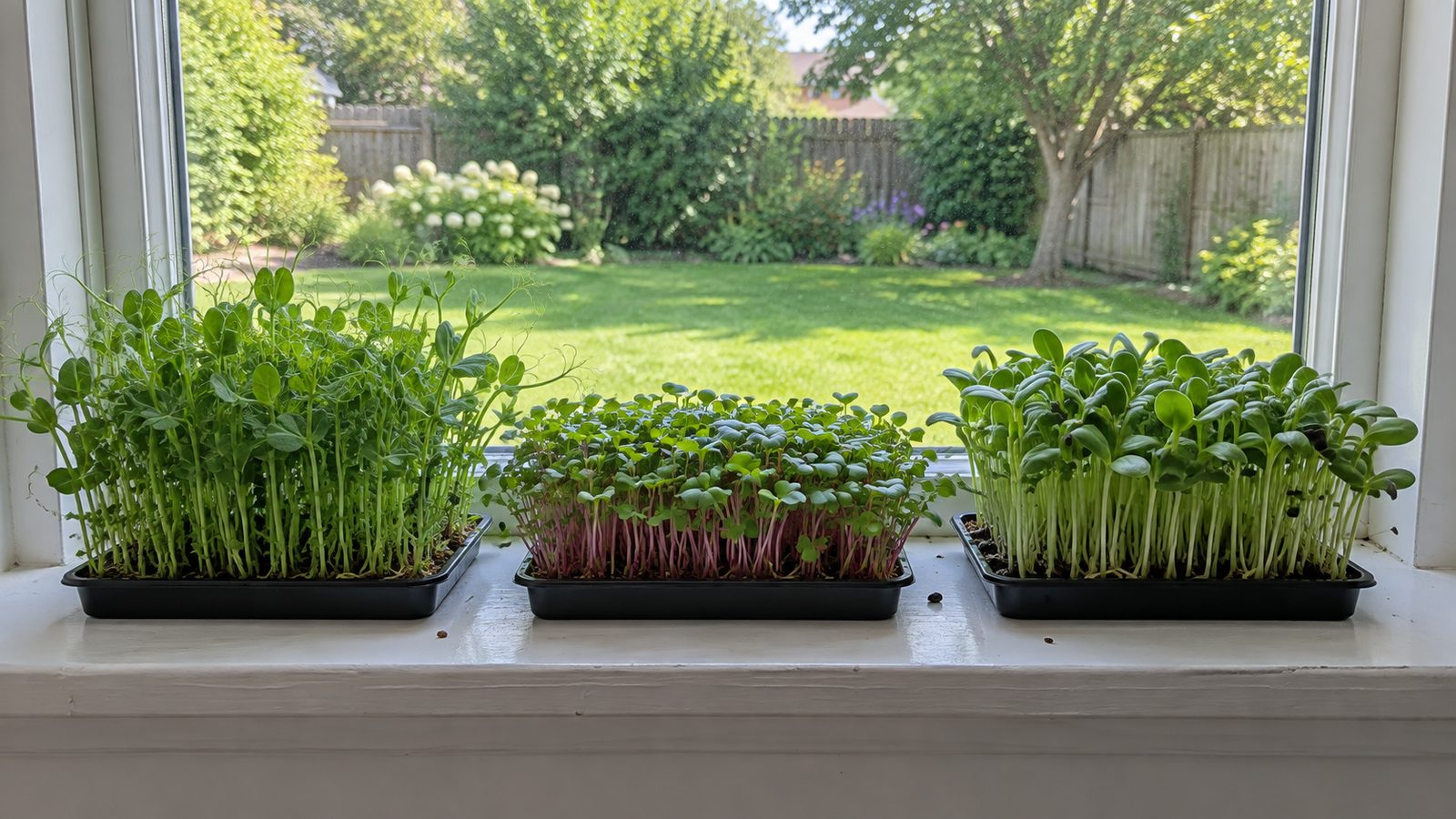
Yes, a bright window will grow a usable tray of many microgreens without a grow light. Expect the stems to come up longer and paler than the same crop under a light, and expect the tray to lean toward the glass unless you turn it. Put the tray in your sunniest window, ideally south facing, keep it close to the glass, turn it 180 degrees every day, and start with a leafy crop that tolerates dim light. If the tray still stretches and flops after all that, the fix is a light, and a basic one does not cost much.
The rest of this page covers which window and how many hours, what glass and curtains take away, what the research on low light actually found, which crops are the safer pick, and what to buy if the window falls short.
Which window, and how many hours
Use a south-facing window if you have one. Illinois Extension recommends a sunny south-facing window for growing microgreens indoors and says they need about six to eight hours of light per day. UF/IFAS Gardening Solutions also points to a south-facing window and calls the kitchen window an ideal place for a tray.
Distance from the glass matters more than most people expect. Illinois Extension's houseplant lighting categories put a spot directly in front of a south window at about 1,500 foot-candles, while a spot 3 to 10 feet back from the same window drops to about 150. Directly in front of an east or west window rates about 300 foot-candles, and directly in front of a north window about 150. Those are general houseplant categories in visible light, not a measurement of what a microgreen tray receives, so treat them as a ranking of your windows rather than a number to plan a crop around. The practical rule is simple: the sill itself, not a table across the room.
The same page notes that light indoors changes with the season, with tree cover and with the direction the window faces, and that summer foliage can block a window that was bright in spring. If you want a real number for your own sill, a light meter or a PAR meter held at tray height will give you one. Otherwise, grow one tray, note the date, the window and how the stems looked at harvest, and use that as your baseline. How the seasons shift your options is covered on the year-round and seasons page.
Turn the tray every day
A tray on a windowsill gets light from one side, and the seedlings bend toward it. UF/IFAS says to place the tray in a south-facing window and turn the container 180 degrees each day so the whole tray gets sunlight. That daily turn is the difference between an upright stand and a tray where the front half is lying down toward the glass by harvest.
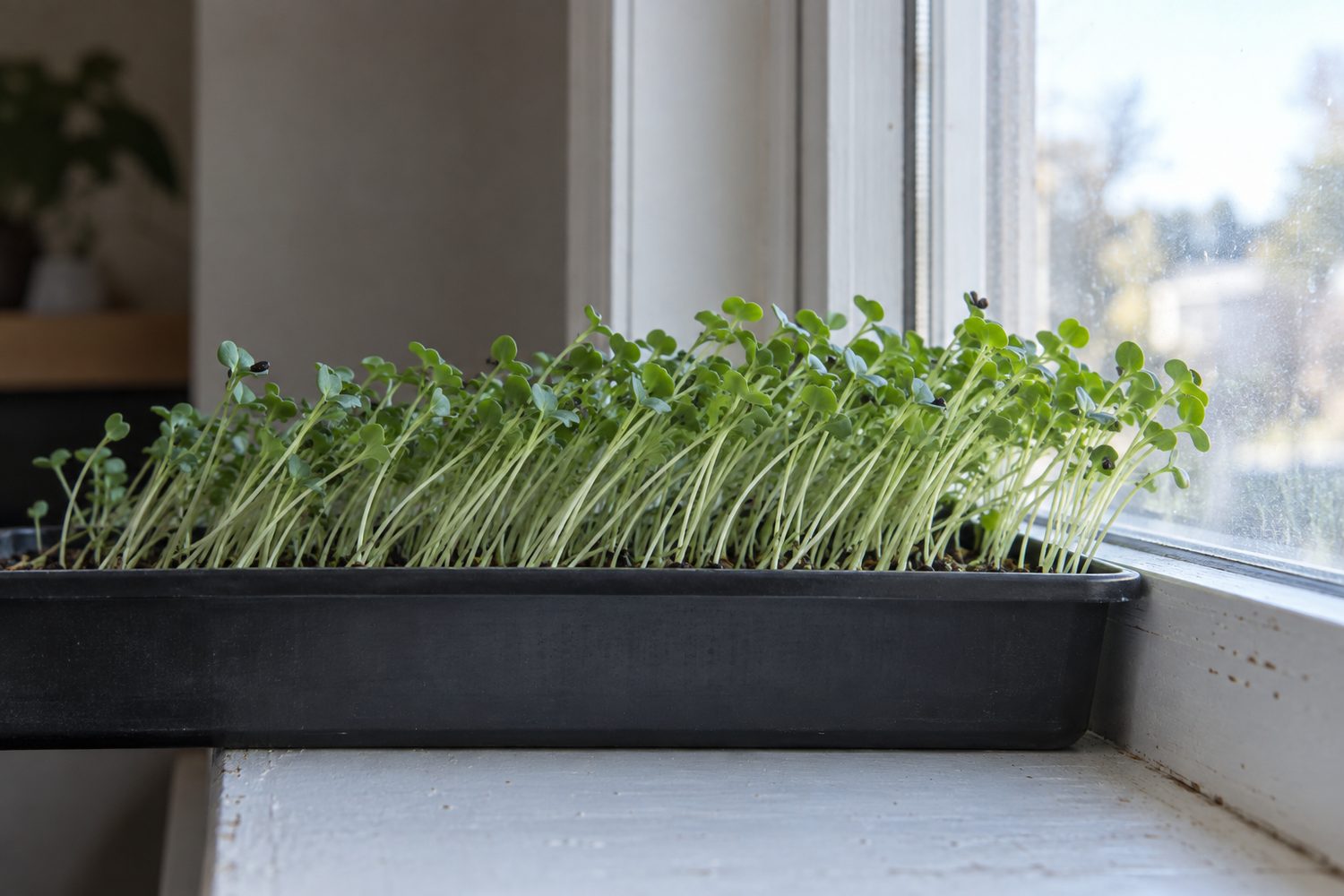
One seller, Aquager, describes the same thing from practice: turn a pea tray 180 degrees on day 3 to 4, or the front will lean noticeably toward the window. That is one grower's account rather than a trial, but it matches what the extension advice is guarding against.
Timing the move into light matters too. UF/IFAS says that the day after leaves emerge, you should remove the cover and move the tray to where it will get sunlight. University of Maryland Extension notes that a few days in the dark during germination lengthens stems, which can make harvest easier, but after that the tray needs light. On a windowsill, where stems already run long, do not leave the cover on any longer than germination requires.
What the glass and curtains take away
Your window glass cuts the light before it reaches the tray. The University of Alaska Fairbanks Cooperative Extension glazing table gives 85 to 95 percent transmission for single glass and 70 to 75 percent for factory-sealed double glass. Those are greenhouse glazing figures, but a sealed double-pane house window is the same basic construction, so a quarter or more of the outdoor light may never reach your sill.
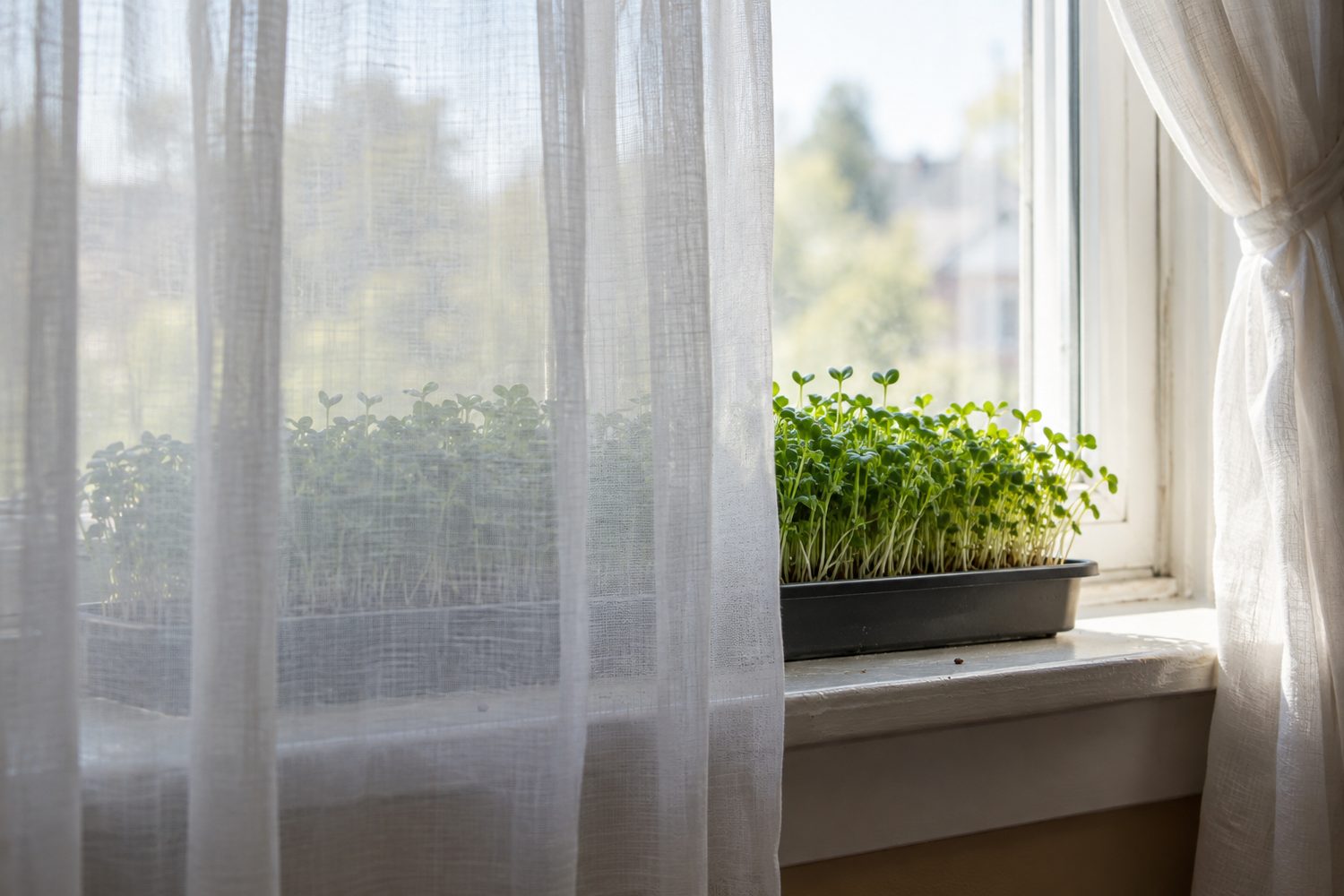
A sheer curtain takes more. In an Ask Extension answer dated October 21, 2019, Doug Gucker, MS, CCA, gives as a general rule of thumb that a sheer curtain reduces incoming light by 20 to 25 percent compared with a bare window, and that thread density, not fabric color, decides how much gets through. Pull the curtain aside for the tray, or set the tray between the curtain and the glass.
What low light does to a tray
No trial has grown microgreens on real windowsills and compared them with trays under a light. What exists are growth chamber trials that turned the light down on purpose, and they tell you a good deal about what a dim tray will look like.
The clearest is a broccoli study from the USDA-ARS Food Quality Laboratory (Shahkoomahally et al., 2025). Broccoli grew under white LEDs for 16 hours a day at four light levels and was harvested on day 13. Converted to a daily light total, the levels work out to about:
Hover or tap a row to highlight it.
| Light level (µmol per m² per second, 16 h) | Daily light integral (mol per m² per day) | Fresh weight result |
|---|---|---|
| 50 | about 2.9 | Same as 75 and 100 |
| 75 | about 4.3 | Same as 50 and 100 |
| 100 | about 5.8 | Same as 50 and 75 |
| 150 | about 8.6 | Lower than all three |
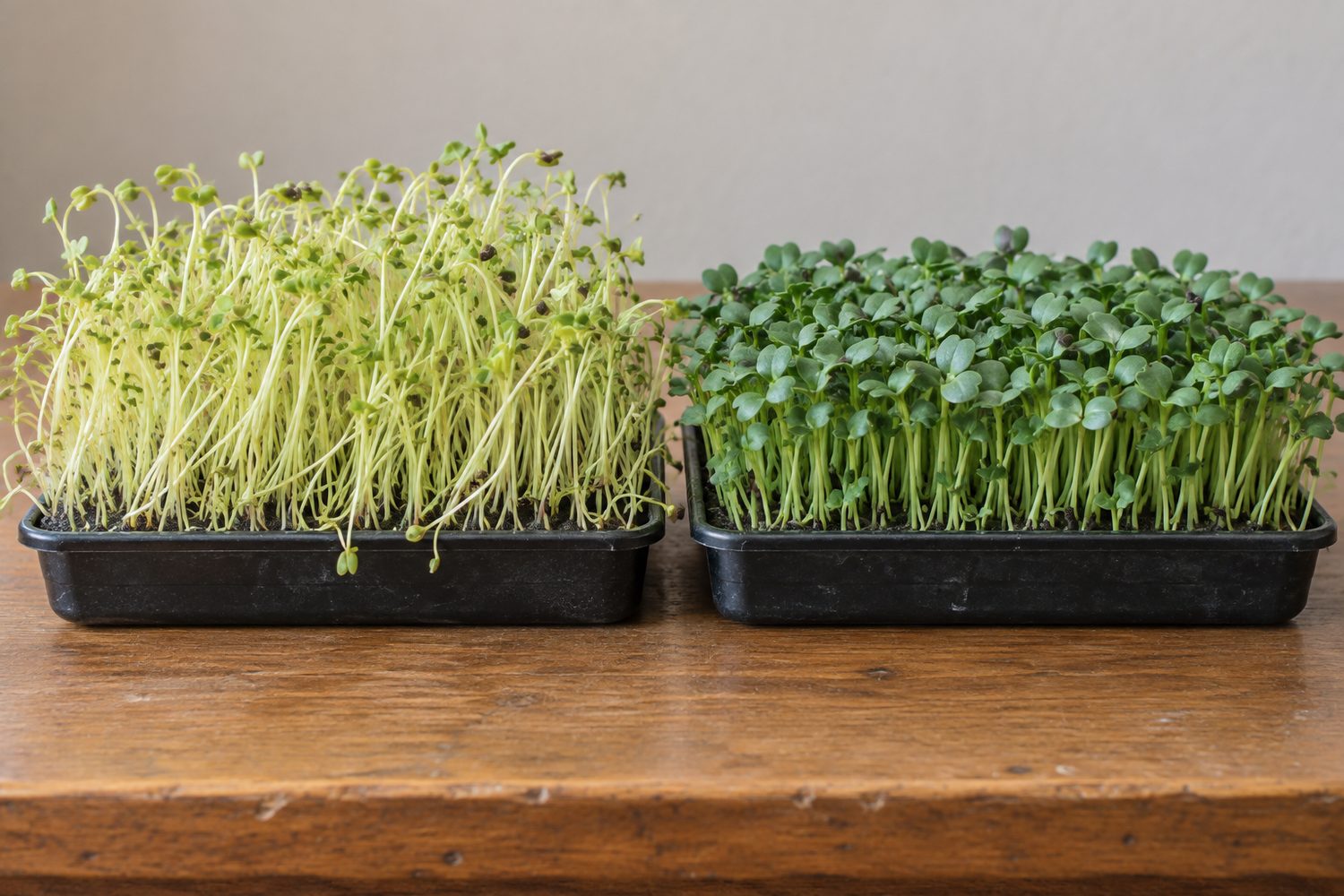
So, fresh weight at the three dimmest levels was statistically the same, and all three beat the brightest. The cost showed up in the stems: as the light fell, the stems (hypocotyls) got longer, and at 50 they were more than 30 percent longer than at 150. Chlorophyll and the red and yellow pigments were highest at 100 and 150, which is why a dim tray looks paler. Vitamin C and total phenolics ran higher at 50 and 75, and shelf life at 50 and 75 was better than at the two brighter levels. This is one crop in a chamber, but it is a fair description of a windowsill tray: a similar weight of greens, on taller, lighter-colored stems.
A second broccoli trial (Gao et al., 2021, South China Agricultural University) grew plants at 30, 50, 70 and 90 µmol with a 12-hour day. The best growth came at 50 µmol, about 2.2 mol per m² per day by calculation, with the highest fresh weight at 54.33 mg per plant. Chlorophyll rose as the light went up, and the authors rated 70 better for phytochemicals.
A USDA ARS study (Gerovac et al., 2016) grew purple kohlrabi, mizuna and mustard at 6, 12 and 18 mol per m² per day. As light went up, plants got shorter with smaller leaves, and fresh weight and leaf greenness increased. At the higher end, a study on arugula, broccoli, mizuna and radish (Shibaeva et al., 2022) found more fresh and dry weight at about 23.3 mol per m² per day under continuous light than at about 15.6 under a 16-hour day.
For comparison, Virginia Cooperative Extension gives 9 to 16 mol per m² per day as the general recommendation for microgreens, and its Table 1 lists lower figures from recent studies: arugula at 9, mizuna and mustard at 12 "or maybe higher," cabbage and Chinese kale at 70 to 90 µmol for 14 to 16 hours (about 3.5 to 5.2 mol per m² per day), and cabbage and radish at 200 µmol for 8 hours (about 5.8). The USDA-ARS broccoli paper adds that minimum light needs for microgreens are poorly studied, so no one can give you a hard floor for your window. What you can do is judge by the tray: if it reaches harvest upright and green enough for your use, the window is enough for that crop. If it flops or stays pale, it is not. The leggy and pale microgreens page covers how to tell stretch from other problems.
Which crops handle dim light
Start with the crops extension sources name. University of Maryland Extension says lettuce, arugula, mustards and Asian greens will grow acceptably well in less-than-ideal light. The same page is honest that light from a sunny window may suffice in some cases, while microgreens generally grow best under grow lights at about 16 hours of total light a day. That list is the research-backed shortlist for a windowsill.
You will also see a different list recommended for windows: pea shoots, radish and sunflower. That comes from one seller, Aquager, which says these grow well on a bright windowsill from spring through early fall and singles out pea shoots as especially suitable. The same page ranks crops in tiers by window, without any measurement behind them:
Hover or tap a row to highlight it.
| Seller tier (Aquager, practice) | Crops | Where the seller says they work |
|---|---|---|
| Tier 1 | Pea shoots, radish, sunflower, mustard | Most south, east or west windows |
| Tier 2 | Arugula, kale, clover, wheatgrass | South windows; marginal on east or west |
| Tier 3 | Broccoli, basil, cilantro, dill | Grow light recommended |
Treat that table as one shop's experience. The seller also sells grow lights and kits, and it places arugula in Tier 2 where Maryland Extension names it among the dim-light crops. Where the two agree, as with mustard, you have a reasonable first pick. Where they disagree, trust the extension list and keep notes from your own trays.
Seed density matters on a windowsill as well. Mississippi State University Extension's microgreens publication says seed quantity varies by variety and harvest stage, and Johnny's Selected Seeds notes that yield depends on density, variety, environment, natural versus supplemental light, and season. Sow at the rate on your seed packet, weigh what you cut, and write it down next to the window and month so the next tray starts from a real number. If you are working with a small kitchen or a jar setup, the small spaces and jars page has more on containers.
Keeping the tray healthy on a sill
A few habits make windowsill trays go better. Mississippi State Extension identifies bottom watering as effective for a kitchen windowsill, which keeps the leaves dry and the medium evenly moist. Maryland Extension recommends shallow containers for easier harvest and media that is moist but not saturated, so use a tray with drainage and do not leave it sitting in water.
Harvest when the seed leaves (cotyledons) have opened and the first true leaves appear, unless your seed supplier gives a different stage for that crop. Maryland Extension describes true leaves as the ones closer in shape and color to the adult plant. On a windowsill, that stage may arrive on a taller stem than the photo on the seed packet, and that is expected. If you are starting from scratch, the beginner microgreens post walks through the first tray.
If the window is not enough
The signs that a window is falling short are a tray that keeps coming up tall, weak or pale, a strong lean toward the glass even with daily turning, or a crop that never reaches the stage you want. At that point, add a light; a T5 shop-style fixture over the tray is the simple version. The microgreens lighting page explains how much light a tray needs and how to set a schedule.
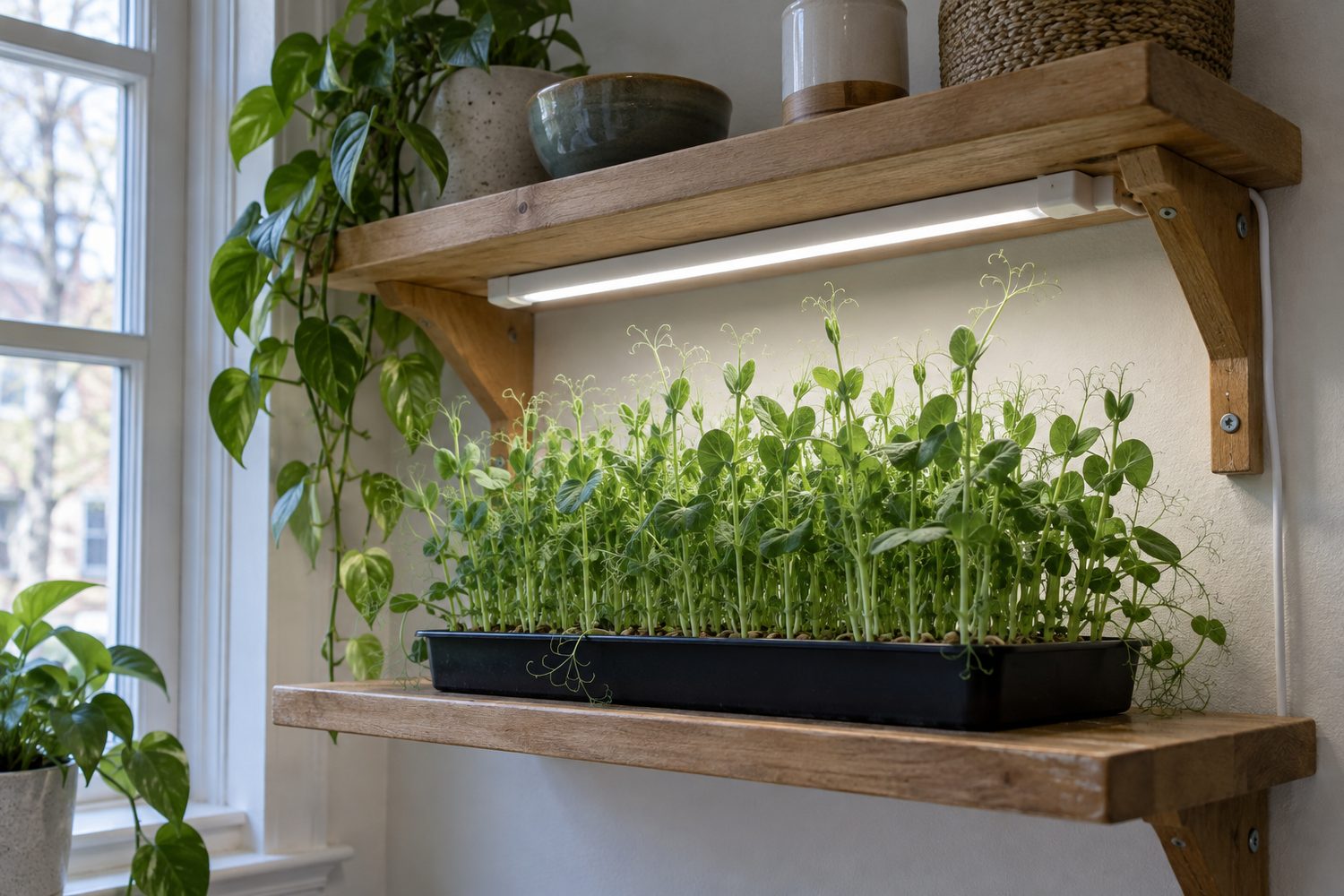
Basic fixtures are not expensive. On December 14, 2025, Home Depot's grow-light listing showed these prices:
Hover or tap a row to highlight it.
| Fixture | Price (December 14, 2025) |
|---|---|
| DYMOND 4-foot LED full-spectrum fixture (GL46BLKS1) | $39.99 |
| Feit Electric 2-foot, 19-watt fixture | $43.97 |
| Feit Electric 2-foot, 32-watt fixture | $75.61 |
Those are the most recent confirmed prices; current prices have not been confirmed, so check the listing before you buy. Price alone also does not tell you whether a fixture puts enough light on the tray, since these listings do not give a reading at tray height. The grow lights reviews compare fixtures in more detail.
Frequently asked questions
Can I grow microgreens in a north-facing window?
You can try, but it is the weakest option. Illinois Extension's categories put a spot directly in front of a north window at about 150 foot-candles, a tenth of the figure directly in front of a south window. Start with a dim-light crop such as lettuce or a mustard, and plan on adding a light if the tray stretches.
Does a screen or sheer curtain matter?
A sheer curtain does. The Ask Extension rule of thumb is a 20 to 25 percent cut in light compared with a bare window, set by how tightly the fabric is woven. No figure exists for an insect screen, so if you can take the screen out or set the tray inside it, do.
Will windowsill microgreens be less nutritious?
Not necessarily. In the 2025 broccoli trial, the dimmer trays had less chlorophyll and pigment but more vitamin C and total phenolics, and they kept better after harvest. That is one crop under LEDs, so it describes a trend rather than a promise for every tray.
How long will a windowsill tray take?
The low-light broccoli trial harvested on day 13 in a chamber, and a windowsill will vary with season and weather. Harvest by stage rather than by the calendar: once the seed leaves are open and true leaves are showing, cut it.
The short version
A bright south-facing window, six to eight hours of light, the tray right up against the glass and turned 180 degrees daily will grow many microgreens, especially lettuce, arugula, mustards and Asian greens. Expect taller, paler stems than under a light, and judge the result by your own harvest. If the tray keeps flopping, a basic light was about $40 as of December 2025, and it solves the problem any time of year.
Sources
Prices, stock and specifications are as the linked pages showed them on 2026-09-26.
- Illinois Extension
- UF/IFAS Gardening Solutions
- houseplant lighting categories
- Aquager
- University of Maryland Extension
- University of Alaska Fairbanks Cooperative Extension
- Ask Extension answer
- Shahkoomahally et al., 2025
- Gao et al., 2021
- USDA ARS study
- Shibaeva et al., 2022
- Virginia Cooperative Extension
- microgreens publication
- Johnny's Selected Seeds
Keep reading
The journal
The Best Microgreen Growing Kit for Home Growers
Shopping for the best microgreen growing kit? See what each one actually includes, what it leaves out, what refills cost, and who should skip a kit entirely.
Read The Best Microgreen Growing Kit for Home GrowersThe journal
Are Grow Lights a Fire Hazard? A Checklist for Tonight
Wondering if your grow lights are a fire hazard? Add up the actual watts and amps on your rack, then check them against your circuit and timer limits tonight.
Read Are Grow Lights a Fire Hazard? A Checklist for TonightThe journal
Best Potting Soil for Microgreens: Cost per Tray
Compare the best potting soil for microgreens by ingredients, bag size, trays filled per bag, and cost per tray, plus problems to expect from each mix.
Read Best Potting Soil for Microgreens: Cost per TrayThe journal
Can You Grow Microgreens in an AeroGarden? What Owners Do
The AeroGarden MicroGreens Kit is hard to find. Learn how owners still grow microgreens in an AeroGarden with a simple tray beside the light.
Read Can You Grow Microgreens in an AeroGarden? What Owners Do