Lighting microgreens: how much, how long, and when it starts
Cal HewittPublished Checked
- light
- method
- blackout
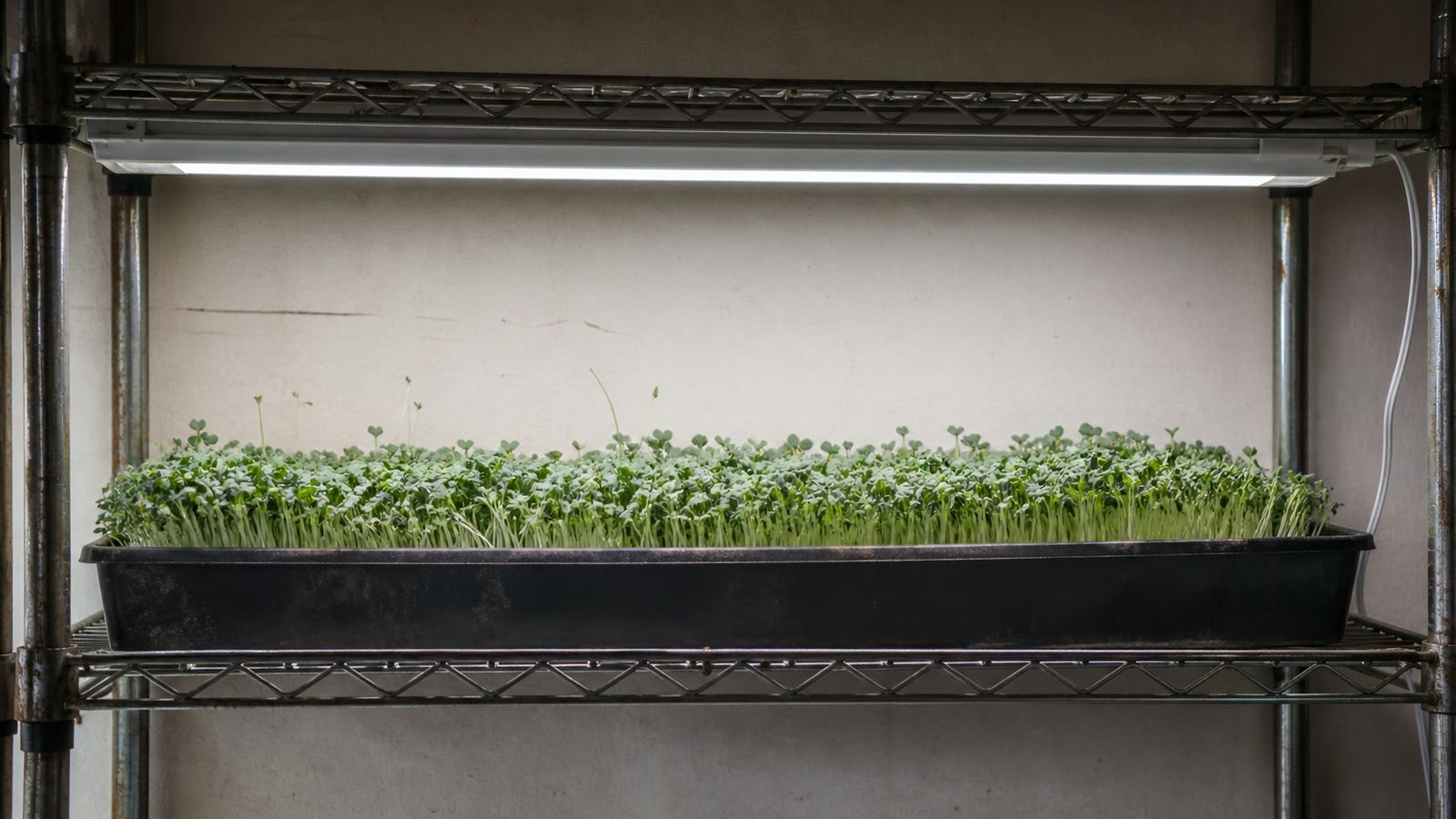
Lighting is the most-asked question about this crop and almost everything published about it is a shopping recommendation. Which fixture, which brand, how many watts. The questions people actually have are about use: how bright, how many hours, how close, and whether any of it does anything.
Those have been measured, on a handful of crops, and the answers are more useful than the fixture reviews.
Three findings carry most of the value:
- Brightness saturates. On arugula, fitted maximum yield sat at 358 µmol m⁻² s⁻¹, and 90 percent of that maximum was reached at 234. Going brighter than that buys very little.
- Hours move yield more than spectrum does. Extending from 16 to 24 hours raised fresh weight by 92.7 percent in amaranth. A spectrum trial on cress, meanwhile, found no significant yield difference at all while the pigments changed.
- Blackout is not a general good. The same five-day treatment raised sunflower yield 13 percent and cut arugula's by 24 percent. Opposite directions, one experiment.
And one unit problem underlies the whole subject: watts are not light. A wattage figure describes electricity drawn by the fixture, not photons delivered to the canopy. The honest units are PPFD for intensity and DLI for the daily total, and a fixture sold on watts alone is telling you about your electricity bill rather than your crop.
What to actually do
- Aim for roughly 230 to 250 µmol m⁻² s⁻¹ at the canopy. That is where the one fitted curve puts 90 percent of the available yield, and it matches what working facilities run.
- Sixteen hours is the well-supported default. Longer produces more on some crops, and nobody has shown it pays.
- Measure at the canopy, not at the fixture, and remember the canopy rises through the crop. A meter is the only way to know, and borrowing one for an afternoon tells you more than any purchase decision.
- Ignore watts. They describe your electricity, not your crop.
- Buy spectrum for color, not for yield.
- Take blackout from the crop's own entry, and if a crop's range has a top and a bottom, prefer the bottom until you have tested your own.
How bright, and where it stops paying
The best single piece of evidence here is a 2024 arugula trial that ran white LED at 100, 200, 300, 400, 500 and 600 µmol m⁻² s⁻¹ and measured yield, dry mass, cotyledon area, hypocotyl length, minerals, pigments, phenolics and vitamin C.
The one crop with a fitted intensity curve
Hover or tap a card to highlight it.
Maximum yield at 358
The fitted peak sat at 358 µmol m⁻² s⁻¹, not at the brightest setting tested.
90 percent of it at 234
Which is the number that actually matters. Most of the available yield arrives well before the curve tops out.
So, there is a point where more light stops paying
Between roughly 234 and 358 you are buying the last tenth of the yield with a third more light, and past 358 the fitted curve does not go up at all.
That is one crop, one study. Nobody has fitted a curve like it for anything else here, so treat 234 as a well-evidenced starting point rather than a universal target.
For orientation, published working figures across other trials and facilities run from 70 to about 255 µmol m⁻² s⁻¹, which brackets that number comfortably. A university facility runs about 250.
How many hours, and the case for very long days
Published photoperiods run from 8 hours to 24, which looks like chaos until you notice that the intensity moves with them: 8 hours at 200 PPFD, 14 to 16 hours at 70 to 90, 16 hours at 231, a facility running 18 at about 250.
They are not competing recommendations. At a fixed brightness, hours set the daily total. The unit that reconciles them is DLI, the daily light integral, which is simply how many photons land on the crop across the whole day.
And the daily total does move yield, substantially. A 2022 trial compared 14 against 21 DLI and 16 hours against 24 across four crops. Extending 16 hours to 24:
Hover or tap a row to highlight it.
| Crop | Gain |
|---|---|
| Amaranth | +92.7%, from 6.47 g to 12.47 g |
| Purple basil | +45.5% |
| Green basil | +43.1% |
| Collard | +21.1%, from 20.40 g to 24.70 g |
Continuous light did not fail. In that study the 21 DLI, 24 hour treatment gave the highest average fresh weight in all four crops, although purple basil responded to the higher daily total rather than the longer day: at the same daily total, its 24 hour and 16 hour trays grew about the same. That is worth knowing because "plants need a dark period" is repeated confidently everywhere, and for these four genotypes under these conditions it was not true.
Three honest limits before anybody runs their lights around the clock. It is four crops in a growth chamber. Nobody has measured what continuous light does to flavor, shelf life or injury on a commercial range. And nobody has costed it: a 50 percent increase in run hours for a 20 percent yield gain is a bad trade at some electricity price, and no published work reports kilowatt-hours per saleable gram.
The reasonable position: 16 hours is well supported and safe. Longer days demonstrably produce more crop on some species. Whether that pays is an arithmetic question about your own tariff that nobody has answered for you.
Spectrum changes the chemistry, not the crop
This is where the marketing is thickest, and the evidence points somewhere other than where you would expect.
- A 2026 cress trial held brightness constant at 255 µmol m⁻² s⁻¹ and varied blue, green, red and far-red ratios. Yield did not significantly differ. Anthocyanin and the phenolic index did.
- A 2016 six-species experiment on mustard, red pak choi, tatsoi, basil, beet and parsley varied wavelengths and found effects on nitrate content and antioxidants. It reports UV-A's growth effect as insignificant.
So, the honest summary is that spectrum is a quality lever, not a yield lever. If you want more crop, that is a job for intensity and hours. If you want deeper color in a purple crop, spectrum is where the measured effects actually are.
Do not turn a pigment result into a yield claim, which is the most common error in this corner of the subject. A study showing that a red-heavy spectrum raised anthocyanin has not shown that it grows more food.
"Full spectrum" is a marketing phrase before it is a specification. It has no agreed technical definition, and a fixture claiming it has not thereby told you its PPFD at your canopy height.
Blackout, and the finding that should stop a general recommendation
Blackout is a mechanical production treatment rather than a lighting recipe. Covering the tray holds moisture and darkness through germination, and the seedlings etiolate, producing longer stems before light arrives and greens them.
Whether that is good depends entirely on the crop, and there is a controlled result to prove it. A 2021 experiment put a black tray over sunflower and arugula for the first five days after sowing, against continuous 100 PPFD red and blue light:
Hover or tap a row to highlight it.
| Crop | Hypocotyl length | Yield |
|---|---|---|
| Sunflower | +26% | +13% |
| Arugula | +28% | −24% |
Both stretched. One gained a tenth of its yield and the other lost a quarter of it. "Blackout increases yield" is therefore false as a general statement, and it is repeated constantly.
Two things follow that are directly actionable.
Use your crop's own figure, not a rule of thumb. Every crop entry publishes blackout days, sourced individually, and that is the number to work from rather than a blanket four days.
And note where arugula's own range sits. The arugula entry gives 2 to 5 days. The study above cost arugula 24 percent of its yield at five. That does not invalidate the range, since the study used continuous light as its comparison and a real grower is not doing that, but if you grow arugula and you have been covering it for the full five days, the shorter end of that range is the one with evidence behind it.
Three crops break the pattern entirely, and they are worth knowing because they show blackout is not a fixed step:
- Lettuce has light-responsive seed, so it takes a clear humidity lid rather than a blackout. Its entry gives 0 to 1 days, and if a dark cover is used at all it is 12 to 24 hours. Stack it like a brassica for four dark days and you reduce or block germination outright.
- Mint is the stronger version of the same point: it barely germinates without light, so it is never covered dark at all. It is one of very few crops that take no blackout at all, and the handful that do are zero for different reasons. Mint's seed is light-responsive. Sorrel is not, and simply does not appear as a blackout crop in any published protocol.
- Popcorn shoots stay dark from sowing to harvest, and the darkness is the entire product: let light in and you get ordinary green corn grass.
What nobody has measured
- An intensity curve for any crop except arugula. One fitted maximum exists in the entire literature.
- Whether continuous light pays, in kilowatt-hours per saleable gram, on any crop.
- What continuous light does to flavor, shelf life or injury across a commercial range of species.
- Distance as an independent variable. Everything published about height is really about the intensity it produces, and no study has isolated it.
- Blackout against no blackout under realistic growing light for more than the two crops above.
- Anything at all for 60 of the 62 crops, on any lighting question.
Terms on this page
Tap a term to see what it means.
PPFD. Photosynthetic photon flux density, the number of usable photons landing on a surface each second, in µmol m⁻² s⁻¹. The honest measure of brightness at the canopy.
Sources
Opened 2026-08-11. The per-crop blackout days are sourced individually on each crop's own entry.
- White light intensities for maximum yield and quality of arugula microgreens, 2024 - white LED at 100 to 600 µmol m⁻² s⁻¹, with fitted maximum yield at 358 and 90 percent of maximum at 234, alongside dry mass, cotyledon area, hypocotyl length, minerals, pigments, phenolics and vitamin C.
- Continuous lighting can improve yield of microgreens, Frontiers in Plant Science 2022 (PDF) - 14 against 21 mol m⁻² d⁻¹ and 16 against 24 hours across amaranth, collard, green basil and purple basil, giving the fresh-weight gains quoted above, plus an energy-use efficiency measure.
- Early-stage dark treatment on sunflower and arugula microgreens, 2021 - a black tray for the first five days after sowing against continuous 100 PPFD red and blue light: hypocotyl length up 26 and 28 percent, yield up 13 percent on sunflower and down 24 percent on arugula. The landing page returned an internal error and the result comes from the opened search record.
- Blue-enriched LED light and cress microgreens, Frontiers in Plant Science 2026 - PPFD held at 255 while blue, green, red and far-red ratios varied; no significant yield difference, with anthocyanin and the phenolic index responding.
- Light quality: growth and nutritional value of microgreens, ISHS 2016 - mustard, red pak choi, tatsoi, basil, beet and parsley under varied wavelengths, reporting nitrate and antioxidant responses and an insignificant UV-A growth effect.
- Differential effects of low light intensity on broccoli microgreens, Agronomy 2021 (PDF) - 30, 50, 70 and 90 µmol m⁻² s⁻¹ following four dark days, measuring fresh weight, hypocotyl length and phytochemicals.
- Virginia Cooperative Extension, introduction to microgreen production, January 2026 and the PDF version - the crop-specific DLI, PPFD and photoperiod table behind the published working figures, and the 18 hours at about 250 facility practice.
- Photoperiod and light intensity ratio, 2022 - the 8 hours at 200 PPFD against 16 hours at 100 comparison on cabbage and radish.
- Singapore Food Agency, LED grow light energy efficiency, quality and intensity, 2024 (PDF) - the metric definitions, the DLI equation and PPFD distribution across a growing area. Government guidance.
- UF/IFAS Gardening Solutions, microgreens - extension cover and sunlight advice, with no PPFD measurement attached.
- On The Grow, fluorescent against LED on Rambo radish - a single grower's comparison, updated 2026, with no PPFD map. Practice rather than evidence.
- Product guides included in the ranking-page audit and used as practice only: Wind River Greens, its buyer's guide, Cree LED Revolution, Lawn Gear Lab and Global Vertical Gardening on fixture distance.
Keep reading
Growing guides
How long to blackout microgreens, crop by crop
Take the blackout days from your crop, not from a general rule. Across the 55 crops here that publish a figure the range runs 0 to 14 days, and 29 of them top out at 4 or 5.
Read How long to blackout microgreens, crop by cropGrowing guides
Leggy, pale and leaning microgreens
Long thin stems and pale leaves are a light problem, not a water problem. The stems will not shorten once stretched, and the internet's usual answer is not supported by any source that says so.
Read Leggy, pale and leaning microgreensGrowing guides
Cleaning trays between crops: the sequence, and how long the sanitizer actually needs
Published chlorine figures for food contact run 50 to 200 ppm depending on the job, and the required wet contact time is measured in seconds rather than minutes. The number that governs is the one on the bottle in your hand.
Read Cleaning trays between crops: the sequence, and how long the sanitizer actually needsGrowing guides
Do microgreens need fertilizer? It is worth 8 to 47 percent of the yield and up to 227 times the nitrate
In one peat trial, taking the feed away cost cabbage 7.9 percent of its yield and arugula 47.4 percent, while cutting nitrate in the cut crop by 98 to 227 fold. Feeding is the largest lever anyone has measured on either number.
Read Do microgreens need fertilizer? It is worth 8 to 47 percent of the yield and up to 227 times the nitrate