Do microgreens need fertilizer? It is worth 8 to 47 percent of the yield and up to 227 times the nitrate
Cal HewittPublished Checked
- method
- nutrition
- food safety
- yield
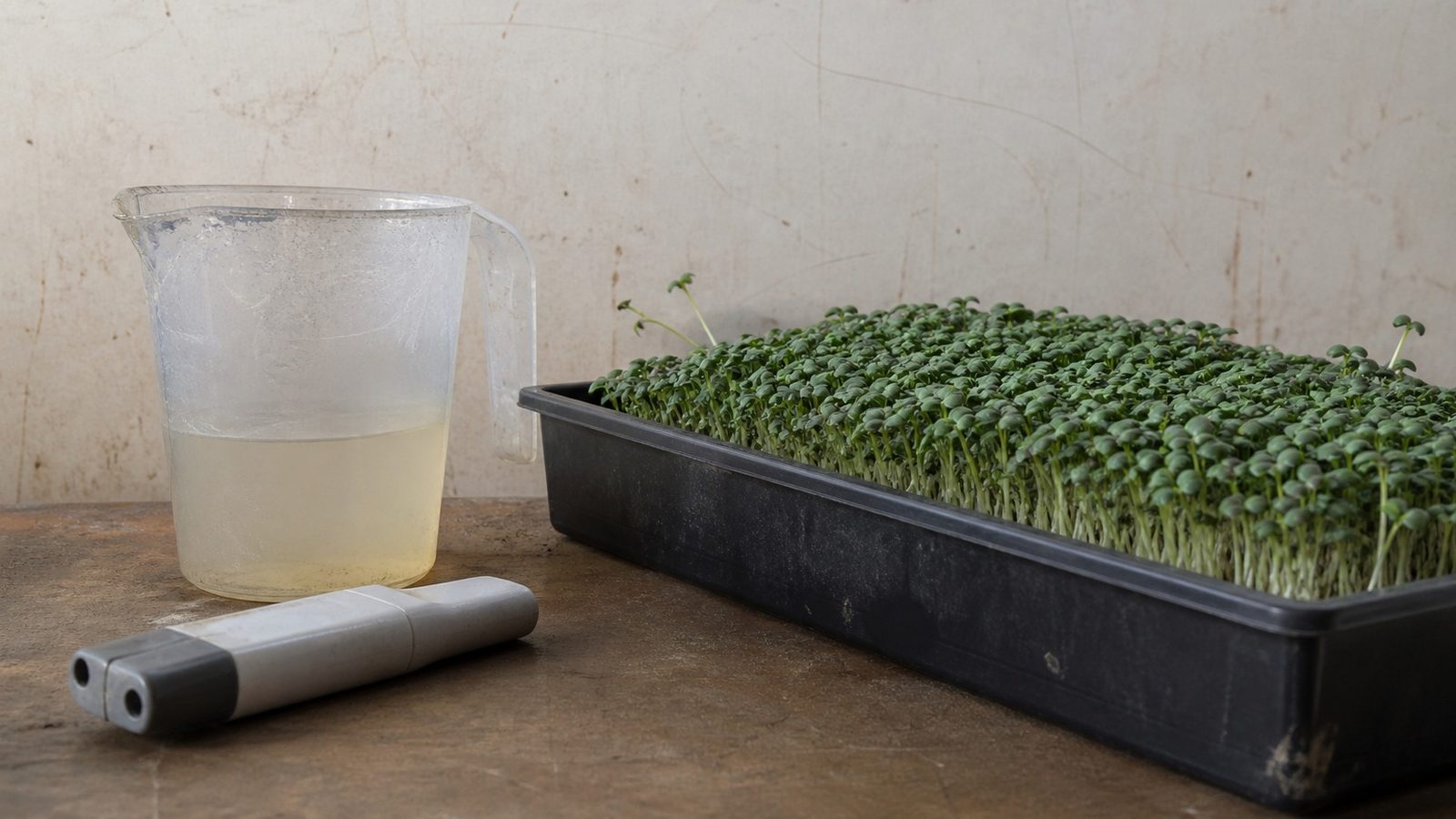
The seed carries enough to reach a cuttable crop. That is true, and it is the wrong end of the question.
"Does not need feeding to survive" and "does not respond to feeding" are different claims, and only the first one is supported. One controlled peat trial grew Brussels sprouts, green cabbage and arugula with a nutrient solution or with distilled water, and measured both what the feed bought and what it cost.
Hover or tap a row to highlight it.
| Crop | Fresh yield lost without feed | Nitrate when fed | Nitrate on distilled water | The nitrate multiple |
|---|---|---|---|---|
| Green cabbage | 7.9 percent | 396.9 mg/kg | 1.75 mg/kg | 227x |
| Brussels sprouts | 12.0 percent | 384.6 mg/kg | 3.94 mg/kg | 98x |
| Arugula | 47.4 percent | 536.2 mg/kg | 4.54 mg/kg | 118x |
Read the two halves against each other, because that is the entire decision. The feed is worth between a thirteenth and nearly half of the harvest depending on the crop, and it multiplies the nitrate in what you eat by roughly a hundred to two hundred fold.
Neither of those is a reason to feed or not to feed. Together they are the reason to decide on purpose.
And note which crop is which. Arugula gained six times more from the feed than cabbage did, in the same medium, in the same experiment, at the same time. There is no universal rate here, because there is not even a universal direction of importance.
What to actually do
- Decide by crop, medium and harvest stage, not by principle. The same trial found a sixfold difference between two brassicas in the same peat.
- Read the bag before you decide the tray is unfed. A peat or potting mix may carry a starter charge. A hemp mat almost certainly does not, and "coco" and "soil mix" are not specifications.
- Germinate on clean water. Then feed through the bottom water after most seedlings are up, or do not.
- Run the paired tray before you commit. Same seed lot, same density, same light, one tray on water and one on a low labeled rate, weighed at harvest. Three pairs across two sowings if you sell.
- If you feed, measure something. EC and pH, or a known ppm of nitrogen. A capful is not a concentration, and half strength outperformed lighter doses in the one trial that compared them.
- If nitrate matters to you, shorten the feed rather than diluting it. The spinach result gave back 70.7 percent of the nitrate for 12.6 percent of the yield, which no dilution has been shown to match.
- For a fast cotyledon crop in a fertilized mix, plain water first. The measured penalty for not feeding cabbage and Brussels sprouts was 8 and 12 percent, which is inside the noise of most home setups.
- Never apply raw manure or manure tea. No crop here comes within 55 days of the interval.
- Do not diagnose feeding by eye. Pale, slow or limp separates poorly from low light, water stress, salty source water, poor germination and damping off. Stop increasing the feed, run one tray on plain water, and look at the roots.
The nitrate figures you will meet came from a trial that over-fed
This is the part worth knowing before reading any nitrate figure anywhere.
The USDA controlled study of 17 microgreen species is the source of the numbers on several pages here: an average of 2,753 mg/kg fresh weight, running from 458.6 in sunflower to 4,602 in mizuna, with 11 of the 17 above 2,500. It is the study behind the heart and blood pressure page and the heavy metals and nitrate page.
Those crops were grown on a fiber mat with a modified half-strength Hoagland solution, and the authors say the nitrogen supplied likely exceeded most species' requirements.
So, mizuna's 4,602 mg/kg is not a property of mizuna. It is what mizuna did under one fertigation regime that the researchers themselves flag as more nitrogen than most of the crops needed. Change the feed and the trial above says the number moves by a factor of a hundred.
That is why published nitrate figures for the same crop vary by about 31-fold. The number depends on which paper you open, and one of the reasons those papers disagree is that they fed their plants differently. Almost none of them say so where a reader would look, so treat any single nitrate figure as a result from one feeding regime rather than a property of the crop.
What that means in a serving. The study cites a JECFA and WHO acceptable daily intake of 3.7 mg of nitrate per kg of body weight, which is 259 mg for a 70 kg adult, and an EPA reference dose of 7.0 mg/kg, which is 490 mg.
Hover or tap a row to highlight it.
| Nitrate level | Grams to reach the WHO ADI of 259 mg | Share of a median 7.055 oz tray |
|---|---|---|
| Sunflower, the lowest of the 17 | 565 g | 2.8 trays |
| The 17-species average, 2,753 mg/kg | 94 g | 0.47 of a tray |
| Mizuna, the highest of the 17 | 56 g | 0.28 of a tray |
An acceptable daily intake is not a toxicity threshold and this is not a warning. The same study reported its samples inside the then-cited EU limits for comparable leafy vegetables, and dietary nitrate genuinely reads two ways, as a possible cardiovascular benefit and as a contaminant question, with both readings legitimate. The point is only that the feeding decision is a decision about the composition of the food, and it is a large one.
Feeding duration is a dial, and the spinach trial calibrated it
Feeding is not on or off. One trial varied only the number of days.
Spinach held to its first two fully expanded true leaves was given solution for 0, 5, 10 or 20 days before harvest.
- 20 days produced the greatest fresh yield and the highest chlorophyll, lutein and beta-carotene.
- 10 days gave up 12.6 percent of that yield and removed 70.7 percent of the nitrate, and carried 7.0 percent more ascorbic acid than 20 days.
- 20 days had the lowest phosphorus, potassium, calcium and magnesium concentrations. The 0 and 5 day treatments were highest.
Giving up an eighth of the yield removed seven tenths of the nitrate. That is the most favorable trade anybody has published in this subject, and it exists because feeding duration and nitrate accumulation are not on the same curve.
And it retires "more feed means more nutrition" in the same breath. More days meant more pigment and less mineral concentration. A bigger, wetter harvest can show a lower concentration of a mineral while still carrying more of it per tray, so ask which basis a claim is on: milligrams per 100 g, or milligrams per tray. Those are different numbers and they can point opposite ways.
Feeding for biomass tends to move the chemistry the other way
A second study, varying a different input, points the same way.
The 2024 plant factory study crossed peat, coco coir and a hemp mat with solution at 0, 50 and 100 percent, on mustard, radish and pea. Water only, the hemp mat, or both together slowed growth in all three crops. Full strength, and half strength on peat, were the promising combinations for yield with reasonable nutritional value, and the authors note that half strength on peat saves fertilizer. Its antioxidant and phenolic trends ran opposite to yield.
Which agrees with what the bitter and off-flavor page already established from a different nutrient. In kale sprouts, total glucosinolates were highest at 0.5 mM sulfur and lowest at 2.0 mM, so more sulfur produced fewer of the compounds it builds. Two separate inputs, two separate trials, the same shape: pushing the tray for size does not push the phytochemistry with it.
Do not read either as "starve the crop for nutrition." The unfed treatments in the peat trial also lost yield and, in arugula's case, about 17.7 percent of its color chroma. What both results retire is the assumption that the settings which grow the most also produce the best-composed crop.
The published rates, and what each one is actually saying
Hover or tap a row to highlight it.
| Source | The figure | What it covers |
|---|---|---|
| Penn State | 50 to 100 ppm nitrogen from a 20-10-20 | A starting range for soilless substrate |
| Virginia Tech, general | EC at least 1.0 mS/cm, pH 5.5 to 6.0 | A typical hydroponic leafy green recommendation |
| Virginia Tech, own practice | EC 1.0, pH 5.9, from after most seedlings germinate to harvest | What one institutional facility actually runs |
| Three-brassica trial | Half strength modified Hoagland | Gave high yield and desirable height against eighth and quarter strength |
| Arugula trial, 14 days | EC 1.0 and 1.2 dS/m | Highest output and potassium accumulation, under its own formulations |
| Retailer practice | 2-0-3 at 0.5 oz per gallon in bottom water after germination | A recommendation, not a trial |
The units in that table are not interchangeable and the table does not average. Parts per million of nitrogen is a mass concentration of one element. EC is total dissolved ions and says nothing about which ones. A capful is a product volume. You cannot convert between them without the formulation.
One thing the trials agree on is that the ratio matters less than expected. Varying the ammonium to nitrate ratio did not change yield or growth in the three-brassica experiment, though it moved some quality measures. Half strength beat both eighth and quarter strength, so the common instinct to dose very lightly because the crop is short was tested and came second.
On timing, the defensible answer is after germination, through the root zone. Germinate on clean water, then feed by bottom watering once most seedlings are up. No benefit or residue outcome has been established for foliar spraying a nutrient solution onto a crop that will be cut and eaten within days, so do not do it because it is easier.
Manure, and why no microgreen crop can comply
This one is short and absolute.
FDA says untreated manure can carry pathogens including E. coli O157:H7 and Salmonella. While it completes its work on the interval, it says following the National Organic Program intervals is prudent: 120 days between application and harvest for a crop that contacts the soil, and 90 days for one that does not.
The longest microgreen crop anybody grows tops out at about 35 days, on parsley and thyme, and the median crop finishes inside 15.
So, the shorter of those two intervals is 55 days longer than the slowest crop you could grow. No microgreen crop can satisfy a raw manure interval during its own cycle, and the arithmetic is not close.
Do not use raw manure, uncomposted animal inputs, or homemade manure tea on a tray crop that will be eaten raw. "Organic" does not mean pathogen free. Use a clean, labeled input suitable for edible crop production, and keep the solution and the equipment clean.
What it costs, and whether it pays
One retailer publishes its own nutrient cost per 10 by 20 tray: about $0.15 with one product and $0.39 with another. That is a price snapshot from one buyer's invoices, not a fact about your supplier.
Against the $15.87 to $23.52 a median tray grosses at market, that feed is 0.6 to 2.5 percent of the gross.
Put that beside the yield column at the top of this page. The weakest measured response was cabbage at 7.9 percent, and the strongest was arugula at 47.4 percent. A cost of under 3 percent of the gross against a yield gain of 8 to 47 percent pays on every crop anybody has measured. Even the least favorable pairing, cabbage's 7.9 percent gain against the dearer product's 2.5 percent, returns more than three times what the feed costs.
Three honest limits on that. Only three crops have ever been measured this way, so the 8 percent floor is the floor of a very small sample. The calculation ignores the labor, the meters and the solution handling, which are real and are the reason many growers skip it. And if you are growing to eat at home there is no gross at all, so the entire economic argument evaporates and you are left choosing on yield, color and composition.
What nobody has measured
- When the seed reserve actually runs out, for any crop. The widely repeated one-week figure is an inference and no study measures it.
- Whether seed size predicts the response. Pea was tested alongside mustard and radish, and the result was species specific rather than size specific.
- A visual overfeeding threshold, or any way to separate fertilizer burn from the five other things that look like it.
- Whether a general houseplant fertilizer harms a tray. There is a real compatibility argument and no documented failure.
- Whether feeding rate changes disease incidence. Damping off is a documented concern and no trial links it to a nutrient rate.
- Flavor or shelf life under any feeding program. Pigments and chemistry have been measured. No blinded panel and no defined storage trial has.
- Any branded product. There are trials of nutrient programs at stated strengths. Not one retail bottle traces to a replicated trial of that bottle.
- Profitability for any real crop and market, which needs local invoices and local prices against a measured saleable yield.
Terms on this page
Tap a term to see what it means.
Seed reserve. The stored food and minerals in a seed that support germination and early growth. Enough to reach a cut, which is not the same as enough to reach the best crop.
Sources
Opened 2026-08-11. The nitrate multiples, the acceptable daily intake conversions and the cost against gross are arithmetic on the published figures and are shown in full above so they can be checked. The 35-day maximum and the 15-day median were computed for this page from the daysToHarvest field across all 62 variety entries here, 61 of which publish a numeric range. The median tray of 7.055 oz and the market gross are this site's own published figures.
- El-Nakhel and colleagues, nutrient solution against distilled water in three brassica microgreens, 2021 (PDF) - fresh yield reductions of 7.9 percent in green cabbage, 12.0 percent in Brussels sprouts and 47.4 percent in rocket when solution was replaced with distilled water, nitrate of 396.9, 384.6 and 536.2 mg/kg fresh weight when fed against 1.75, 3.94 and 4.54 unfed, the roughly 17.7 percent lower chroma in unfed rocket, and higher concentrations of some minerals in the unfed treatments.
- Petropoulos and colleagues, feeding duration in spinach microgreens, 2021 - solution for 0, 5, 10 or 20 days before harvest at the two-true-leaf stage, 20 days giving the greatest fresh yield and the highest chlorophyll, lutein and beta-carotene, 10 days giving 12.6 percent less yield with 70.7 percent less nitrate and 7.0 percent more ascorbic acid, and 20 days carrying the lowest phosphorus, potassium, calcium and magnesium concentrations against 0 and 5 days being highest.
- Di Gioia and colleagues, 17 microgreen species, 2023 - an average nitrate of 2,753 mg/kg fresh weight ranging from 458.6 in sunflower to 4,602 in mizuna with 11 of 17 genotypes above 2,500, production on a natural fiber mat with modified half-strength Hoagland solution, the authors' own statement that the nitrogen supplied likely exceeded most species' requirements, the samples sitting within the then-cited EU limits for relevant leafy vegetables, and the cited EPA reference dose of 7.0 mg nitrate per kg body weight per day alongside the JECFA and WHO acceptable daily intake of 3.7 mg/kg/day.
- Bantis and Koukounaras, substrate and nutrient solution strength in a plant factory, 2024 - peat, coco coir and a hemp mat crossed with solution at 0, 50 and 100 percent on mustard, radish and pea, water only and the hemp mat decelerating growth in all three, full strength and half strength on peat as the promising combinations, half strength on peat saving fertilizer, antioxidant and phenolic trends running opposite to yield, and substrate effects depending on species and variety.
- Bulgari and colleagues, nutrient solution strength and nitrogen form in three Brassica microgreens, 2020 - fertigation at eighth, quarter and half strength modified Hoagland with half strength producing high yield and desirable height, and varied ammonium to nitrate ratios changing some quality measures without changing yield or growth.
- Silva and colleagues, rocket microgreens at several formulations, 2024 - highest output and potassium accumulation at EC 1.0 and 1.2 dS/m over 14 days, under that trial's own formulations.
- Virginia Cooperative Extension, introduction to microgreen production - the Penn State starting range of 50 to 100 ppm nitrogen from a 20-10-20 for soilless substrate, an EC target of at least 1.0 mS/cm with pH 5.5 to 6.0 as a typical hydroponic recommendation, the facility's own practice of a two-part leafy green mix at EC 1.0 and pH 5.9 from after most seedlings germinate through harvest, that microgreens do not require a high rate because of the short cycle, and that organic-input application recommendations are limited.
- Virginia Cooperative Extension, introduction to microgreen production (PDF) - damping off caused by Pythium or Phytophthora, and mildews, named as production concerns in the moist controlled environment, with no link established to any nutrient rate.
- FDA, FSMA final rule on produce safety - the treatment of biological soil amendments of animal origin under the rule.
- FDA, raw manure under the FSMA produce safety rule - that untreated manure can contain pathogens including E. coli O157:H7 and Salmonella, and that pending the completion of FDA's work it is prudent to follow the National Organic Program intervals of 120 days where the crop contacts the soil and 90 days where it does not.
- FDA, draft guidance on the produce safety rule - the distinction between microgreens and sprouts, by later leaf stage and substrate-grown, above-substrate harvest.
- Practice sample, audited 2026-08-11 and used only as a record of what is recommended and at what price: On The Grow, the source of the 2-0-3 at 0.5 oz per gallon recommendation and of the $0.15 to $0.39 per tray nutrient cost, which also sells the products it names; RusticWise, the source of the roughly one-week reserve claim and of feed as an "absolute MUST" on soilless media; Biology Insights, which states that microgreens have not exhausted their seed energy at harvest; and Home Microgreens, which at least describes a small self-run kohlrabi and basil comparison, which is observational testing rather than a controlled study.
Keep reading
Growing guides
Growing microgreens for animals: no species has a published dose, and one tray costs ten pounds of layer pellets
No veterinary source sets a microgreen dose for any companion species, and the published guidance comes in four units that will not convert. Plus an on-farm tray weight of 7.31 oz, and why fodder did not cut hen feed costs.
Read Growing microgreens for animals: no species has a published dose, and one tray costs ten pounds of layer pelletsGrowing guides
What to grow microgreens in: the medium barely moves yield and roughly doubles nitrate
Every medium comparison argues about yield, where the honest spread between reasonable media is 13 to 16 percent. The measurement nobody quotes is nitrate, which moved about twofold across three crops in two independent trials, and not always in the same direction.
Read What to grow microgreens in: the medium barely moves yield and roughly doubles nitrateGrowing guides
Day 8 against day 14: what you are actually trading by waiting
The largest yield gain in the harvest-stage literature is 80.1 percent. Divide it by the five extra days it cost and it is worth 5.1 percent. Nutrient concentration does not peak; some compounds rise, some fall, and nobody reports the total per tray.
Read Day 8 against day 14: what you are actually trading by waitingGrowing guides
Do microgreens regrow after cutting?
A normal microgreen cut removes the growing point, so there is usually nothing left to regrow from. Roots do not make a new shoot; a surviving node does. The one documented path takes 3 to 4 weeks, about twice as long as sowing a fresh tray.
Read Do microgreens regrow after cutting?