Microgreens and Heart Health: What Has Been Tested in People, and What Has Not
Cal HewittPublished Checked
- health
- evidence
- heart
- nitrate
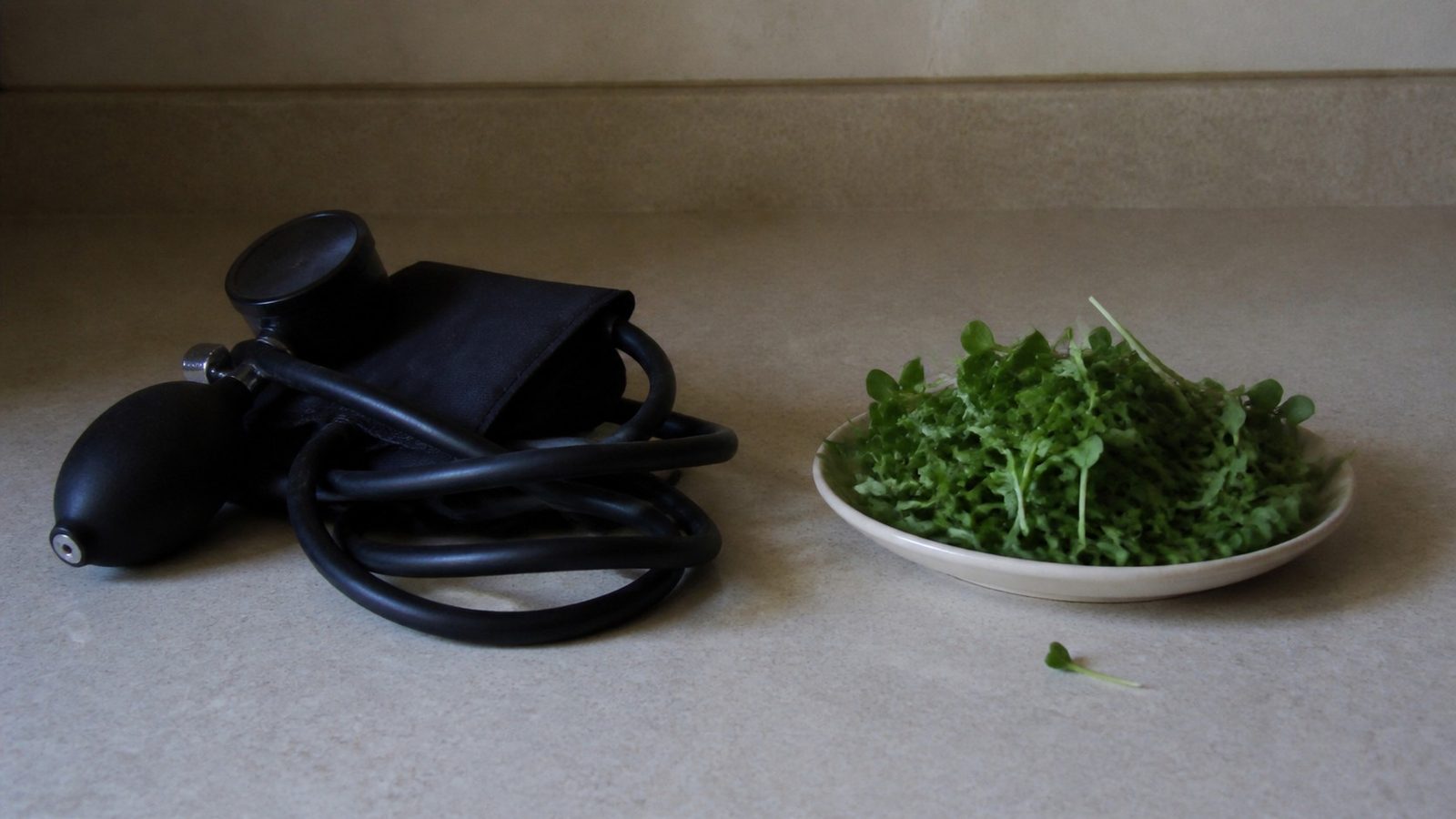
As of August 2026, not one completed human trial has reported blood pressure or cholesterol after a person ate a microgreen. Not a null result. No trial at all.
What to actually do
- Eat microgreens because you like them and because variety in vegetables is worth having. That is a sufficient reason and it is the only one currently supported.
- Do not replace or reduce prescribed blood pressure or cholesterol treatment. Nothing on this page comes close to justifying it.
- Read the material label on any claim you meet. Microgreen, sprout, sprout powder, extract or mature vegetable, and whether it was people or mice.
- Treat a within-group change as no result. The 136 to 122 mmHg drop covered below sits in a trial whose own between-group comparison was not significant.
- Distrust any nitrate figure for microgreens until a fresh-weight assay of your crop exists. The published figures differ 31-fold and the pages quoting them rarely say which they used.
- Do not chase a nitrate dose by eating more. On the highest assay the trial dose exceeds the EFSA daily intake guidance, and it did not lower blood pressure anyway.
- Watch for the funded 8-week red cabbage trial to report. It is the first study that could change this page, and it is not due yet.
What actually exists, sorted by what was eaten
The whole confusion in this category comes from four different materials being reported as one. A microgreen, a sprout, a sprout powder and a standardized extract are not the same thing, and neither is a mature vegetable.
Hover or tap a row to highlight it.
| Material | Completed human trials found | What they reported |
|---|---|---|
| Microgreen | 0 | nothing to report |
| Broccoli sprout and dried sprout powder | 3 | one triglyceride signal, otherwise null on blood pressure and LDL |
| Broccoli sprout extract | 1 | null on LDL, total cholesterol and triglycerides |
| Mature cruciferous vegetable | 1 small trial, plus cohorts | 2.5 mmHg systolic over two weeks at 300 g a day |
The cholesterol claim you have read everywhere traces to an 8-week mouse study, in which red cabbage microgreens made up 1.95 percent of the diet. It is real work and it is honestly labeled at the source. It is not a person.
Four prominent pages on this question were checked on 2026-08-12 and zero of the four cited a human microgreen cardiovascular trial, because there is not one to cite. Two of the four trace the LDL and triglyceride claim to animal or laboratory work, which is the right thing to do. The failure is further downstream, where a surrogate measured in a mouse becomes heart protection in a person.
Credit where it is due. Both consumer pages checked say plainly that microgreens and sprouts are different growth stages, and one states outright that it found no human studies on these conditions. That restraint is the correct instinct. The thing to watch for is whether the material label stays attached to the claim itself, rather than sitting in a paragraph three screens down.
The sprout evidence, which is not this crop
Three broccoli sprout trials carry most of the weight, and they are small and short.
- A hypertension trial gave 10 g a day of dried broccoli sprouts for 4 weeks and reported no significant change in blood pressure or endothelial function.
- An 81-person type 2 diabetes trial gave 10 g a day of broccoli sprout powder for 4 weeks and reported lower triglycerides and a lower oxidized-LDL to LDL ratio. The accessible record gives no magnitude for the change.
- A trial in people with both diabetes and H. pylori gave 6 g a day of sprout powder for 28 days. Systolic pressure in the sprout-plus-antibiotic group moved from 136 to 122 mmHg, and the adjusted between-group effects were not significant, at P=0.63 systolic and P=0.68 diastolic. The authors flag the antibiotic therapy as a confounder themselves.
That last one is worth dwelling on, because a 14 mmHg drop looks like a headline and the same paper says the comparison it belongs to was null. A within-group change is not an effect.
The one standardized extract trial is the most precise and the most null. Over 12 weeks in 74 people with prediabetes, the LDL difference was 0.0 mmol/L, 95 percent confidence interval -0.2 to 0.2, total cholesterol 0.1 (-0.2 to 0.3) and triglycerides 0.1 (-0.1 to 0.4). Those intervals are narrow enough to say something: not merely unproven, but close to no effect at the doses tested.
Dried sprout powder is a processed product, not a garnish. The authors of one trial estimate their 10 g of dried sprouts as roughly 100 g of fresh sprouts. Reporting either as a fresh microgreen serving is the substitution this whole page is about.
The nitrate case, which cannot be costed
The most plausible mechanism for a vegetable lowering blood pressure is dietary nitrate, reduced by oral bacteria to nitrite and then to nitric oxide, which affects vessel tone. So, the fair question is whether a realistic serving of microgreens could deliver a nitrate dose that has ever done anything.
Start with a dose that has been tested. A 5-week trial in 243 people supplied 300 mg of nitrate a day from leafy vegetables or pills and found no meaningful reduction in ambulatory blood pressure.
Now ask how many microgreens that is. The median published tray yield is 7.055 ounces, which is almost exactly 200 g, so a tray is a convenient unit.
Hover or tap a row to highlight it.
| Published fresh-weight assay | Nitrate | Grams a day | Median trays a day |
|---|---|---|---|
| Mizuna, highest of a 17-species study | 4,602 mg/kg | 65 g | 0.33 |
| Average across that 17-species study | 2,753 mg/kg | 109 g | 0.54 |
| Sunflower, lowest of those 17 | 458.6 mg/kg | 654 g | 3.3 |
| Broccoli, a 2025 six-microgreen study | 149.09 mg/kg | 2,012 g | 10.1 |
A third of a tray a day, or ten trays a day. A 31-fold spread, and none of it comes from the person or the dose. All of it comes from which paper you open.
That is the finding, and it is not a rounding problem. Two published fresh-weight datasets for nitrate in microgreens disagree by more than an order of magnitude. Until that is resolved, the nitrate mechanism cannot be argued either for or against microgreens, because nobody can say what a serving contains.
The same measurement is in trouble from the other direction too. The heavy metals and nitrate page sets out that the circulating nitrate figures are dry weight while the legal limits are fresh weight, that converting one published result with three real dry-matter figures spreads it across 1,045 to 11,307 mg/kg, and that one 2022 paper contradicts itself tenfold within a single document.
Both readings of nitrate are correct at once and they point opposite ways. It is a contaminant question with a regulatory limit, and it is a candidate mechanism for a benefit. Same molecule, same unresolved measurement, and anyone who treats it as purely good or purely bad has picked a side the evidence does not support.
One number makes the tension concrete. EFSA's acceptable daily intake for nitrate is 3.7 mg per kilogram of body weight, which is 259 mg a day for a 70 kg adult. The 300 mg dose that produced no meaningful blood pressure change is 116 percent of that. So, on the highest microgreen assay, the amount you would need for an effect nobody has demonstrated would also exceed the intake guidance.
What the funded trial will and will not settle
A US project running 2026 to 2029 proposes the first human microgreen trial for this question: 105 adults aged 45 to 75 with above-normal blood pressure, three arms, red cabbage microgreens at 0, 15 g and 30 g a day for 8 weeks, with blood pressure and fasting lipids as endpoints.
That is the right study and it does not exist yet. The project record says human effects are unknown and proposes rather than reports.
Its servings are small against a tray, and small against the nitrate benchmark.
Hover or tap a row to highlight it.
| Planned serving | Share of a median tray | Nitrate at the 17-species average | Share of the 300 mg null-trial dose |
|---|---|---|---|
| 15 g a day, one cup | 7.5% | 41 mg | 14% |
| 30 g a day, two cups | 15% | 83 mg | 28% |
If nitrate is the mechanism, the top planned dose delivers about a quarter of an amount that already failed in a larger and longer trial. That is not a prediction that the trial will be null, and it is a reason to watch which mechanism the investigators actually claim. If the mechanism is glucosinolates rather than nitrate, the arithmetic above does not apply at all and a small serving may be perfectly reasonable.
And on the lower assay the same 30 g supplies about 4.5 mg of nitrate, roughly one percent of the null-trial dose. The mechanism question cannot be separated from the measurement question.
What a heart-health claim would actually require
A blood pressure or cholesterol number is a surrogate. A heart attack, a stroke or a cardiovascular death is an outcome. No microgreen, sprout, extract or short mature-vegetable trial has measured enough outcomes to show anything about them.
The cohort evidence is about mature vegetables and about people's usual diets. A meta-analysis of prospective cohorts found higher mature cruciferous intake associated with lower cardiovascular outcomes, a relative risk of 0.91, 95 percent CI 0.85 to 0.98, with substantial heterogeneity reported. A Shanghai analysis covering 134,796 adults linked cruciferous intake with lower cardiovascular mortality. These are dietary-pattern signals. They do not randomize anything, they cannot establish cause, and they specify no microgreen dose.
For scale, here is what does move blood pressure, none of it microgreens:
- 300 g a day of mature cruciferous vegetables for two weeks: 2.5 mmHg systolic, in 18 completers.
- Dietary nitrate interventions over a week: -4.1 mmHg systolic, 95 percent CI -6.1 to -2.2.
- The DASH diet plus low sodium: 11.5 mmHg systolic in participants with hypertension.
- One half-standard-dose blood pressure medication at 150/90: about -6.7/-3.7 mmHg.
That list is context, not permission. It is here so a reader can see where a hypothetical microgreen effect would have to sit to matter, and it is not an argument for stopping anything a doctor prescribed.
What nobody has measured
- Any human microgreen trial with blood pressure or fasting lipids. The single largest gap and the reason this page exists.
- A microgreen dose-response, so there is no known plateau and no basis for a more-is-better claim.
- The same cultivar at microgreen and mature stage, at equal fresh weight, in people.
- Raw against cooked microgreens for any cardiovascular measure. The one mature-vegetable trial used cooked soups, which is another reason its result does not transfer.
- A reconciled fresh-weight nitrate figure for any commonly sold microgreen.
- Cardiovascular events, from any trial of any of these materials, at any duration.
- Whether people at different risk levels respond differently, since there is no human microgreen result to differ.
Terms on this page
Tap a term to see what it means.
Systolic and diastolic. The first and second blood pressure numbers, pressure while the heart contracts and while it relaxes.
Sources
Opened 2026-08-12. Every gram and percentage in the tables is arithmetic performed for this page on the published figures below, using the median published tray yield of 7.055 oz, which is almost exactly 200 g. Where a source page returned a bot check or access error on direct opening, that is noted, and no figure is used that was not visible in the accessible record.
- USDA NIFA project record, red cabbage microgreens - the funded 2026 to 2029 project, its statement that human effects are unknown, and the proposed 105-participant, three-arm, 8-week trial at 15 g and 30 g fresh a day with 1 cup defined as 15 g. A plan, with no results.
- USDA ARS, red cabbage microgreen study - the source of the widely repeated cholesterol claim, and confirmation that it is an 8-week study in mice at 1.95 percent of diet.
- Broccoli sprout hypertension trial - 10 g a day of dried broccoli sprouts for 4 weeks, with no significant blood pressure or endothelial change. The page returned a bot-check shell on direct opening.
- Broccoli sprout powder diabetes RCT - 81 participants, 10 g a day for 4 weeks, the significant triglyceride and oxidized-LDL ratio signal, with no magnitude in the accessible record. Full text returned an access error.
- Broccoli sprout powder and H. pylori therapy RCT - 6 g a day for 28 days, the 136 to 122 mmHg within-group movement, the non-significant adjusted between-group results at P=0.63 and P=0.68, the null LDL and HDL comparisons, and the authors' own note that antibiotic therapy confounds it.
- Broccoli sprout extract prediabetes RCT - 12 weeks in 74 analyzed participants, and the LDL, total cholesterol and triglyceride differences with their confidence intervals.
- VESSEL mature cruciferous RCT and its secondary report - 300 g a day for two weeks, 2.5 mmHg systolic in 18 completers, and the triglyceride difference. The primary page returned a bot-check shell. The trial protocol documents that the intervention was cooked soups.
- 17-species microgreen nitrate study, 2023 - the 2,753 mg/kg fresh-weight average and the 458.6 to 4,602 mg/kg range, and its own note that a very high nitrate crop could exceed the acceptable daily intake.
- Six-microgreen nitrate study, 2025 - the 149.09 mg/kg fresh-weight broccoli figure that disagrees with the study above by more than an order of magnitude. The full text (Balik et al., Scientific Reports, February 2025) opened on 2026-09-26 and shows the figure in its Table 5.
- Leafy vegetable nitrate RCT - 300 mg a day of nitrate for 5 weeks in 243 people, with no meaningful ambulatory blood pressure reduction. The benchmark dose used throughout this page. The page returned a bot-check shell.
- Dietary nitrate meta-analysis and the 2025 dose-response review - the -4.1 mmHg systolic pooled estimate for interventions over a week, and the per-mmol dose-response across 75 randomized trials. The first returned a CAPTCHA shell.
- EFSA nitrate assessment - the acceptable daily intake of 3.7 mg per kilogram of body weight, the same figure the heavy metals page uses. The page returned an access error.
- Prospective cohort meta-analysis and the Shanghai cohort report - the 0.91 relative risk with its confidence interval and reported heterogeneity, and the 134,796-adult analysis. Observational, on mature vegetables. Both returned bot or CAPTCHA shells.
- DASH-Sodium trial and an antihypertensive drug meta-analysis - the 11.5 mmHg and half-dose medication comparators used for scale only. Both returned access or CAPTCHA shells.
- Consumer pages, checked for how they frame the evidence rather than used as evidence: Cleveland Clinic, Healthline and a microgreen review. The first two correctly separate microgreens from sprouts and attribute the lipid claim to animal work; the review carries the same animal result further toward prevention. Counted on 2026-08-12; a page count is not a claim about search rankings.
Keep reading
The journal
Are Microgreens Anti-Inflammatory? What the Research Really Says
Nobody has fed a person microgreens and measured their inflammation. And when researchers pooled ten broccoli sprout trials, the combined result came out at something that could be zero.
Read Are Microgreens Anti-Inflammatory? What the Research Really SaysThe journal
Are Microgreens Low FODMAP? What Monash Research Shows
Are microgreens low FODMAP? Learn what Monash sprouting research shows, which crop families deserve extra caution, and how reintroduction testing works.
Read Are Microgreens Low FODMAP? What Monash Research ShowsThe journal
Are Microgreens Safe to Eat Raw?
For most people yes, and the frightening statistics belong to sprouts. At least 15 microgreen recalls and recall warnings are on record across two countries, and no illness outbreak has been linked to any of them. No public health agency has attributed an outbreak to a microgreen. That is not the same as zero risk.
Read Are Microgreens Safe to Eat Raw?The journal
Best Microgreens for Kidney Health: Potassium by the Serving
See measured potassium and phosphorus for the best microgreens for kidney health, from lowest to highest, plus what your renal dietitian needs to know.
Read Best Microgreens for Kidney Health: Potassium by the Serving