Microgreens and Diabetes: What Is Known About Blood Sugar
Cal HewittPublished Checked
- health
- nutrition
- evidence
- broccoli
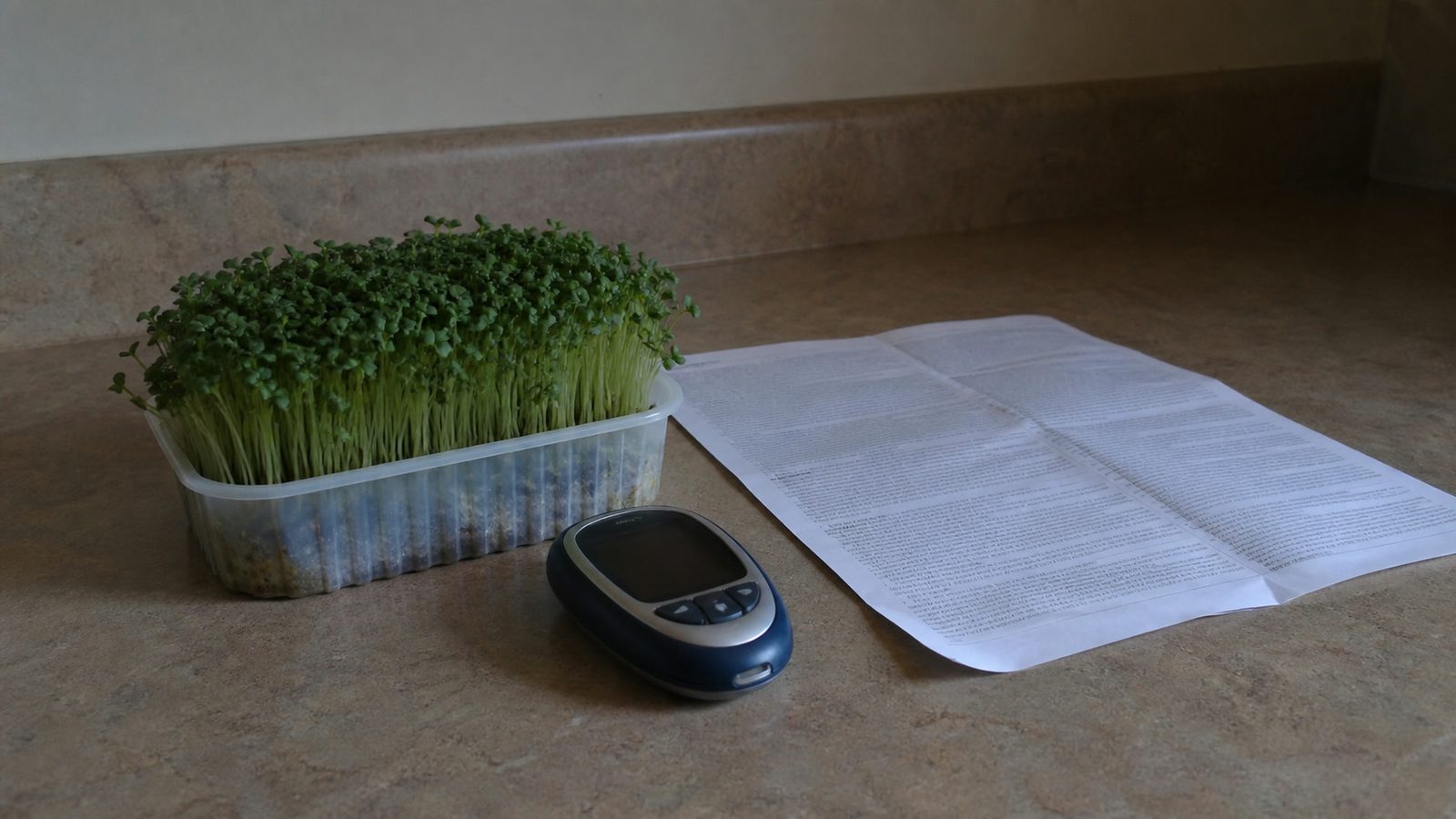
If you have diabetes or prediabetes, microgreens fit your plate the way any non-starchy vegetable does. The American Diabetes Association lists broccoli, kale, radish and watercress among non-starchy vegetables, and its advice is that a good meal plan for diabetes looks much like good eating for anyone. If you want to grow the crop the research is about, that is broccoli.
What they have not been shown to do is lower your blood sugar. No study has fed people fresh microgreens and then measured their glucose. Every human trial with a blood sugar result used broccoli sprout powder or a concentrated extract, and the newest one missed the target it set itself.
If you take warfarin, or you manage your glucose with medication, read the safety section below and talk to your doctor or dietitian before you change what you eat. The rest of this page is the evidence, so you can judge the claims you will see elsewhere for yourself.
Four things get called the same thing
This is the whole problem, and once you see it you cannot unsee it.
Hover or tap a row to highlight it.
| What | What it actually is | How concentrated |
|---|---|---|
| Microgreen | The seedling, cut above the soil, with its first leaves | Whatever the plant made |
| Sprout | Younger, germinated in water, eaten whole including the root | Whatever the plant made |
| Sprout powder | Sprouts dried and ground, sold by the gram | Water removed, so more per gram |
| Extract | Concentrated in a lab to a set amount of active compound | Standardized, often unreachable by eating |
The FDA treats microgreens and sprouts as different products with different rules, because sprouts are harvested before true leaves and grown in warm water, while microgreens are grown in a substrate and cut above it. The researchers treat them differently too. Consumer articles often do not.
Keep that table in mind for everything below, because almost every confident claim on this subject is a study of row three or four being described as row one.
What the studies actually used
Every human study with a blood sugar result used powder or extract. Here they are, all of them.
Hover or tap a row to highlight it.
| Study | People | What they got | What happened |
|---|---|---|---|
| Dwibedi 2025 | 74, prediabetes | Sprout extract, 12 weeks | Glucose down 0.2 mmol/L. Missed its own 0.3 target. No HbA1c change |
| Axelsson 2017 | 97, type 2 | Sprout extract, 12 weeks | Lower glucose and HbA1c in one subgroup |
| Bahadoran 2012a | 63, type 2 | Sprout powder, 4 weeks | Measured glucose, insulin, insulin resistance |
| Bahadoran 2012b | 81, type 2 | Sprout powder, 4 weeks | Improved triglycerides at the higher dose |
The newest one deserves a proper look, because it is the best designed and it is the one written up as good news.
Dwibedi and colleagues gave 74 people with prediabetes a standardized broccoli sprout extract for 12 weeks, in a double-blind randomized trial. Fasting glucose came down by 0.2 mmol/L. The researchers had decided in advance that 0.3 would count as a real result, so it missed the bar they set themselves. HbA1c did not move. Insulin resistance did not move. The extract group reported more stomach upset than placebo.
That is the strongest human evidence in existence on this question, and it is for a lab-standardized extract, not for anything you would put on a sandwich.
The one study that did use microgreens
There is exactly one, and it is small. Eleven people ate fresh broccoli microgreens and the researchers checked their urine afterwards. They found the active compound had been absorbed and processed.
That is genuinely useful. It means eating microgreens does get the compound into you, which is not something you can take for granted.
It did not measure blood sugar. Nobody has taken that next step.
What is actually in the crop
The chemistry is much better documented than the outcomes, and it is worth seeing because it shows how variable "microgreens" is as a category.
A laboratory study measured total glucosinolates in two brassica microgreens and found Savoy cabbage at 76.21 and Brussels sprout at 77.73 mg sinigrin equivalents per gram of dry matter. Separately, Weber's analysis found compost-grown broccoli microgreens carried about 1.73 times the minerals of mature broccoli florets, averaged across eight minerals.
Note the phrasing on that second one. The study says explicitly that the result depends on how the crop was grown. It is not a universal multiplier, and the popular version of this figure ("microgreens have 40 times the nutrients") erases both the crops where the number is lower and the fact that different studies used different units.
Growing conditions move the numbers on purpose, too. A USDA study found UV light before harvest raised the precursor compounds by 13.7 and 16.9 percent at two different doses, and that those levels then changed only slightly across 21 days of storage.
What has not been established is whether harvest stage matters. Nobody has grown the same cultivar to cotyledon and to first true leaf, measured both, and then tested either in a person.
Why you cannot work out a portion size
The obvious question is: the extract had a known dose, so how many grams of microgreens is that?
You cannot get there, and the reasons are worth knowing because they apply to every claim like this.
How much sulforaphane a plant actually delivers depends on the variety, how much precursor it grew, whether the enzyme that converts it survived preparation, how much you chew it, and your own gut bacteria. That last one is not a technicality: the 2025 trial found that a gut microbial gene associated with the conversion predicted how much compound reached people's blood.
So, the same plate of microgreens delivers different amounts to different people, and nobody has measured the range.
Any gram figure you see quoted for microgreens has been worked backwards from an extract study. It is a guess wearing a lab coat.
Two mechanisms, both stopping short of a person
There are actually two separate stories about how this might work, and most articles only tell one.
The liver story. Glucoraphanin becomes sulforaphane, sulforaphane activates a signalling pathway called NRF2, and that reduces the liver's production of glucose. Axelsson's team showed parts of this in cells in a dish, then in diabetic animals, then tested an extract in people. It is a coherent chain.
The starch story, which almost nobody mentions. The same laboratory that measured those glucosinolates also ran a simulated digestion and tested enzyme inhibition. Brassica microgreens inhibited alpha-amylase and alpha-glucosidase, the enzymes that break starch into sugar. Slow those down and less sugar arrives at once. That is how some diabetes drugs work.
It is an interesting result and it is in a test tube. Without knowing what concentration reaches a person's gut after eating, there is no way to say whether a plate of microgreens gets anywhere near what the assay used.
There is also animal work using microgreens rather than sprouts: Brassica carinata microgreen extract in diabetic rats lowered fasting glucose, improved glucose tolerance, and shifted the expression of IRS-1, GLUT2 and NF-kB. Again: an extract, and rats.
Laid out step by step, the liver version shows exactly where the ground gives way.
The liver chain, and the level each step has been shown at
- 1
The plant makes the precursor
Brassica microgreens carry glucoraphanin and related glucosinolates. Shown in PLANTS, by chemical assay.
- 2
Chewing converts it to sulforaphane
Damaged tissue lets the plant's own enzyme do the conversion, and gut bacteria do some of it too. Shown in PLANTS and in PEOPLE.
- 3
Sulforaphane is absorbed
Eleven people ate fresh broccoli MICROGREENS and the metabolites turned up in their urine. Shown in PEOPLE eating MICROGREENS. This is the strongest microgreen-specific step there is.
- 4
It activates NRF2
The signalling switch that reduces the liver's glucose production. Shown IN VITRO, in cells in a dish.
- 5
The liver makes less glucose
Shown in DIABETIC ANIMALS, and supported by an extract trial in people.
- 6
A person's blood sugar falls
Shown only for a standardized EXTRACT, by 0.2 mmol/L against a target of 0.3. NEVER SHOWN for a microgreen.
Where every version breaks is the same place. The crop contains the precursor. One small study shows the compound is absorbed. Nobody has shown that eating a microgreen produces extract-like exposure, changes anything in the liver or gut, and then moves a glucose reading against a control.
Where the confident claims come from
The most visible version of it is Cleveland Clinic's "6 Health Benefits of Microgreens", which says microgreens can help regulate blood sugar.
Follow its own links and the broccoli claim rests on an animal study and the fenugreek claim on cells in a dish. The page is not making anything up. It reports preclinical research accurately, under a headline a reader will take as being about people.
That is the pattern everywhere, and it takes three forms.
The three ways a claim gets ahead of its evidence
Hover or tap a card to highlight it.
Swapping the product
Extract results written up as microgreen results. That covers every human trial in the table above, all four of them.
Swapping the subject
Mouse or test-tube findings written up as human results. The rat study and the enzyme assay both get this treatment.
Inflating the finding
A small short-term change becomes disease prevention. This is how 0.2 mmol/L, which missed the study's own target, becomes "manages diabetes".
What about vegetables generally
Fair question, and the answer is softer than you would expect.
A review pooling 11 studies covering 754,729 people found those eating the most green leafy vegetables had about 9 percent lower rates of type 2 diabetes, and for cruciferous vegetables about 13 percent. Both results sat right on the edge of statistical significance, the studies disagreed with each other quite a bit, and the authors called the evidence unconvincing. An earlier pooling of six studies found a similar figure for leafy greens and nothing significant for vegetables or fruit overall.
Those follow people rather than testing anything, and they are about mature vegetables.
Nobody official says microgreens do this
Nothing from FDA, USDA, NIH or the American Diabetes Association says anything about microgreens and blood sugar. The ADA lists broccoli, kale, radish and watercress among non-starchy vegetables and names no microgreen as a treatment.
Their overall advice is dull and correct: a good meal plan for someone with diabetes is much the same as good eating for anyone, and their care standards say there is no single perfect eating pattern, which is why they direct people to individual planning rather than to a food.
Safety, which is a separate subject and a real one
None of this is about glucose. All of it matters more than the glucose question does, because these are risks that actually exist.
Warfarin. Leafy greens carry vitamin K, which interacts seriously with warfarin. The advice from NIH is consistency rather than avoidance: sudden changes in how much you eat are the problem. Worth a word with whoever manages your prescription.
Raw produce and higher-risk groups. These are eaten raw. There has been an FDA recall of broccoli, arugula and mixed microgreens for possible listeria, which matters most in pregnancy, immunocompromise and frailty. No confirmed illness was reported in that recall, and no published case report attributes harm to eating microgreens as a food. That is not the same as zero risk.
Microgreens are not sprouts, and the difference is measurable. FDA counted 52 sprout-associated outbreaks and more than 2,700 illnesses between 1996 and 2020. The warm, wet, nutrient-rich conditions sprouting requires are what amplify pathogens. Microgreens have no comparable record. Different does not mean risk-free.
Not every microgreen is the same. Borage microgreens were measured at 130 times the EU limit for a compound that affects the liver, as the borage page sets out. "Microgreens" is a category, not an ingredient, and treating it as one is the error this whole page is about.
So, should you eat them
Nobody knows whether they help your blood sugar. That is not the same as saying they do not. Nobody has run the study.
What is known is that they are a young vegetable with real nutrients, that the compounds are absorbed when you eat them, and that vegetables are in every sensible eating pattern there is.
If you want to grow the crop the research is actually about, that is broccoli, and broccoli microgreen seed is cheap, fast and about the most forgiving thing in the directory. Grow it because it is a good vegetable and you will eat more veg. Not because it will do something to your glucose, because that has not been shown.
If you are managing blood sugar with medication, talk to your doctor or dietitian before changing your diet. Nothing here is a reason to change a prescription, and the only human results that exist came from a standardized extract that is not what is on your plate.
What would settle it
A preregistered trial with enough people: adults with prediabetes or type 2 diabetes, randomly assigned to laboratory-characterized fresh broccoli microgreens or an equivalent amount of ordinary broccoli, measuring fasting glucose, HbA1c, continuous glucose monitoring after meals, insulin sensitivity and the compound's metabolites, over at least three to six months.
It has never been done. Compared with most nutrition research it would not be expensive, and the one thing this whole field is short of is a study that uses the actual food.
Terms on this page
Tap a term to see what it means.
Fasting glucose. Your blood sugar after not eating overnight. The standard single-point measure, and the one the trials on this page moved by 0.2 mmol/L.
Sources
- Dwibedi et al., 2025, Nature Microbiology - 74 people with prediabetes, broccoli sprout extract, 12 weeks; fasting glucose down 0.2 mmol/L against a prespecified 0.3, no HbA1c or insulin-resistance change, more stomach upset, and the gut microbial gene that predicted response.
- Axelsson et al., 2017 - 97 people, concentrated sprout extract, and the NRF2 liver mechanism in cells and animals.
- Bahadoran et al., 2012, insulin resistance trial and the lipid trial - broccoli sprout powder at 5 and 10 g/day.
- Fresh broccoli microgreens in 11 people - the compound is absorbed and metabolized; no blood sugar measured.
- Brassica microgreen composition and enzyme inhibition - Savoy cabbage 76.21 and Brussels sprout 77.73 mg sinigrin equivalents per gram dry matter, plus the alpha-amylase and alpha-glucosidase results after simulated digestion.
- Brassica carinata microgreen extract in diabetic rats - lower fasting glucose, better glucose tolerance, IRS-1, GLUT2 and NF-kB changes.
- Weber, 2017 - broccoli microgreens against mature florets, about 1.73 times across eight minerals, and the study's own note that it depends on growing method.
- USDA ARS, UV light and glucosinolates - 13.7 and 16.9 percent increases at harvest, small changes over 21 days of storage.
- Chen et al., 2018 - 11 studies, 754,729 people, mature vegetables, evidence called unconvincing by its own authors. Carter et al., 2010 - the earlier six-study pooling.
- FDA, sprouts and microgreens are different products, the sprout outbreak record, and the microgreen recall.
- NIH, vitamin K and warfarin.
- American Diabetes Association, diabetes myths and care standards.
- Cleveland Clinic, benefits of microgreens - the leading consumer claim and the animal and test-tube studies behind it.
- Borage pyrrolizidine alkaloid measurement - 130 times the EU maximum.
Keep reading
The journal
Microgreens and Gut Health: What One Small Study Actually Found
Eleven people, one serving, and the researchers looked at chemistry rather than symptoms. The constipation study often cited for this used sprouts, was paid for by a farm, and one good bacteria went down.
Read Microgreens and Gut Health: What One Small Study Actually FoundThe journal
Are Microgreens Safe to Eat Raw?
For most people yes, and the frightening statistics belong to sprouts. At least 15 microgreen recalls and recall warnings are on record across two countries, and no illness outbreak has been linked to any of them. No public health agency has attributed an outbreak to a microgreen. That is not the same as zero risk.
Read Are Microgreens Safe to Eat Raw?The journal
Are Microgreens Anti-Inflammatory? What the Research Really Says
Nobody has fed a person microgreens and measured their inflammation. And when researchers pooled ten broccoli sprout trials, the combined result came out at something that could be zero.
Read Are Microgreens Anti-Inflammatory? What the Research Really SaysThe journal
Best Microgreens for Kidney Health: Potassium by the Serving
See measured potassium and phosphorus for the best microgreens for kidney health, from lowest to highest, plus what your renal dietitian needs to know.
Read Best Microgreens for Kidney Health: Potassium by the Serving