Microgreens and Gut Health: What One Small Study Actually Found
Cal HewittPublished Checked
- health
- nutrition
- evidence
- broccoli
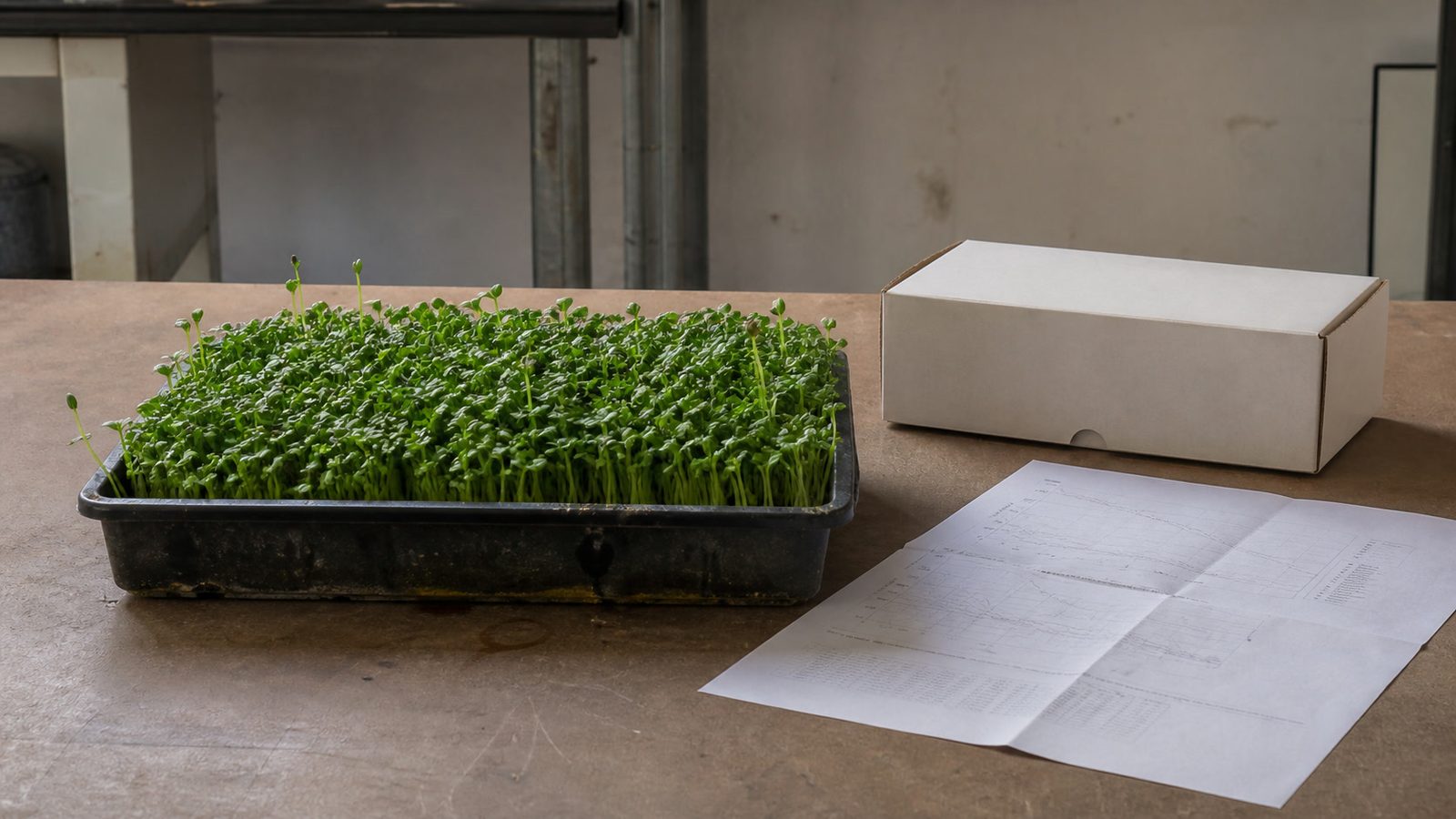
Nobody has tested whether eating microgreens changes your gut in a way you would notice. The one human microgreen study gave 11 people a single serving and measured chemistry rather than symptoms, and a normal serving holds a third of a gram of fiber at most. "Supports digestion" and "promotes a diverse microbiome" on a packet describe hopes, not measurements.
Three things could be measured: does eating this add useful fiber, does it change your gut bacteria, and does it sit well with you. Here is what has been checked on each.
There is one human microgreen study. It is eleven people.
Researchers gave 11 healthy people 16 g of fresh broccoli microgreens, once, then measured the compounds in their bodies along with a snapshot of their gut bacteria. The crop was 10 days old and it was analyzed properly: 12.8 micromoles per gram of glucoraphanin at one day after harvest, and 7.2 of sulforaphane.
That is a real study and it tells you something worth knowing: the compounds get absorbed, and gut bacteria are involved in processing them.
What it did not do is measure whether anything improved. No bloating, no regularity, no symptoms, no before-and-after over weeks. Eleven people, one meal. It also excluded pregnant and breastfeeding people and anyone with significant digestive disease, so it offers no reassurance about the groups most likely to be asking.
So, it is not that microgreens do nothing for your gut. The question has not been tested.
The constipation study, which used sprouts
Forty-eight adults with constipation took either broccoli or alfalfa sprouts, 20 g a day for four weeks. The broccoli sprouts contained 4.4 mg of the precursor compound per gram. The broccoli group's constipation score improved from 7.25 to 5.17, and their score for straining improved from 0.96 to 0.58.
That sounds like the answer. Three things sit next to it, all of them stated in the study itself.
Hover or tap a row to highlight it.
| What it found | What also needs saying |
|---|---|
| Constipation score 7.25 down to 5.17 (p = 0.0017) | Semi open-label. Participants knew what they were taking, and scored their own symptoms |
| Straining score 0.96 down to 0.58 (p = 0.0077) | Funded by a farm that sells sprouts, with the senior author holding an industry-supported endowed chair |
| Bifidobacterium went DOWN (p = 0.0498), and that is one of the headline "good" bacteria |
That last row matters more than the first. The study is regularly cited as evidence that these crops feed good gut bacteria, and what it actually measured was one of the headline good bacteria going the other way.
It is also sprouts, not microgreens.
The other human studies were measuring something else
Hover or tap a row to highlight it.
| Study | What people got | What was measured |
|---|---|---|
| Atwell 2015, 10 people | Fresh sprouts against a treated extract, 200 micromoles each | Compounds in blood and urine |
| Egner 2011, 50 people | Sprout drinks: 800 micromoles glucoraphanin, or 150 preformed sulforaphane | Compounds in urine |
| Clarke 2011, 12 people | 40 g fresh sprouts against six supplement pills | Compound levels over 48 hours |
None of them looked at the gut at all.
Two are worth a moment for a different reason, because together they say something useful about supplements. Atwell found people absorbed about three times more of the compound from fresh sprouts than from a myrosinase-treated extract. Clarke found the pills delivered less, and slower, than the fresh plant.
More concentrated does not mean more usable. Worth remembering any time a capsule is compared with a vegetable.
How much fiber a serving actually holds
This is the part specific to microgreens, and it is the reason to be careful about the whole category here. Microgreens do contain fiber, and it has been measured.
Then the question is not what is in a gram. It is what is in a serving.
Hover or tap a row to highlight it.
| Crop | Fiber per 100 g fresh | In a 16 g serving |
|---|---|---|
| Broccoli microgreens | 0.36 g | About 0.06 g |
| Radish microgreens | 1.78 g | About 0.28 g |
| Mustard microgreens | 2.08 g | About 0.33 g |
The left column is measured and published. The right column is our own arithmetic on it, using the 16 g serving from the human study.
Adult fiber guidance is set in tens of grams a day. The best crop in that table, at a realistic serving, contributes a third of one gram. To get a fiber effect out of microgreens you would have to eat them by the bowl rather than the pinch, and nobody has tested whether anyone will.
That is a genuine open question, not a rhetorical one, and you can settle your own version of it with a kitchen scale: weigh what actually goes on the plate and multiply.
If fiber is what you are after, the crops worth growing are the ones you eat in volume. Pea shoots and sunflower are the two people genuinely eat by the bowl, and sunflower yields more per tray than any other crop in the directory.
What fiber actually does, when it is enough of it
It is worth knowing what the target looks like, because the fiber literature is much stronger than anything microgreen-specific, so it is the right benchmark.
Researchers pooled 64 randomized human fiber trials covering 2,099 people.
Hover or tap a row to highlight it.
| Outcome | Effect | Range | Reading |
|---|---|---|---|
| Bifidobacterium | SMD 0.64 | 0.42 to 0.86 | A clear increase |
| Lactobacillus | SMD 0.22 | 0.03 to 0.41 | A small increase |
| Fecal butyrate | SMD 0.24 | 0.00 to 0.47 | Borderline. The range touches zero |
| Alpha diversity | No difference | The thing "a diverse microbiome" refers to did not move |
Read that last row again. Sixty-four trials of actual fiber interventions, and overall diversity did not shift. The phrase "promotes a diverse microbiome" is doing work that even proper fiber studies could not do.
Those were mostly concentrated prebiotic fibers, at doses far above anything a tray of microgreens delivers. It is the benchmark, not a microgreen result.
The mechanism, and where it stops
There are two proposed routes, and they have been shown to very different levels.
The two proposed routes, and the level each step has been shown at
- 1
Route one, the fiber route
Fiber escapes digestion in the small intestine and reaches the colon intact. Shown in PEOPLE, well established.
- 2
Bacteria ferment it into short-chain fatty acids
Shown in PEOPLE, with the pooled trial results above.
- 3
A microgreen serving delivers enough fiber to do that
NOT SHOWN, and the arithmetic above is the reason to doubt it.
- 4
Route two, the compound route
Damaged plant tissue lets myrosinase convert glucosinolates into isothiocyanates such as sulforaphane. Gut microbes can do a version of the same conversion. Shown in PLANTS and in PEOPLE.
- 5
The compounds reach you from a microgreen
Shown in PEOPLE eating MICROGREENS, in the 11-person study. This is the strongest microgreen-specific finding that exists.
- 6
Those compounds change the bacterial community
Shown IN VITRO and in MICE. Not in a person eating microgreens.
- 7
Symptoms or gut health change
NEVER SHOWN for a microgreen. No trial has measured it.
The mouse and test-tube work, with the numbers attached
The animal studies are real and they are the reason people are interested, so they deserve to be reported accurately rather than waved at.
In a 34-day colitis experiment, mice were fed a diet containing 10 percent steamed broccoli sprouts by weight. Disease measures were lower and the geography of the gut microbial community was better preserved than in controls. A second study fed 10 percent raw broccoli sprouts to mice bred to develop gut inflammation, and a gut inflammation marker came down. A third gave isolated sulforaphane at 2.5 to 20 mg per kg a day.
Ten percent of total food intake, of sprouts, in mice with induced disease. That is closer to a drug dose than a serving, and it cannot be converted into a human portion.
The artificial-gut experiment is the one worth reading closely. Researchers ran sulforaphane through a laboratory fermentation with stool bacteria from people with obesity. Total short-chain fatty acids after 24 hours came out at 42.29 mM with sulforaphane against 42.12 mM without it. Butyrate rose 1.21-fold and valerate 1.46-fold, which is the part that gets quoted.
Look at the two totals. They are the same number: total fermentation did not change, even though two individual acids rose.
The measured comparison, and why it still does not convert
The microgreen study measured fresh broccoli microgreens at about 13 micromoles per gram of glucoraphanin, and cited 16.6 for broccoli sprouts.
That looks like a conversion factor and it is not one. The two numbers come from different crops at different growth stages measured in different studies, and how much of the precursor becomes the active compound depends on the variety, the preparation, how much you chew, whether the plant's own converting enzyme survived, and your gut bacteria.
Converting a labeled dose from a sprout drink into grams of a different crop is arithmetic performed on things that are not comparable.
Which crop, grown how, stored how long
Composition is where the research is genuinely solid, and the answers are all crop-specific.
A laboratory digestion model measured total isothiocyanates in four microgreens at 633, 608, 801 and 810 mg per 100 g of dry weight for broccoli, kale, mustard and radish respectively, with 31 to 63 percent of it bioaccessible. Mustard and radish carry more than broccoli does, which is the reverse of where the attention goes. That was a simulated gut, not a person.
Growing conditions move the numbers. Preharvest UV-B raised total aliphatic glucosinolates in broccoli microgreens by 13.7 and 16.9 percent at two doses. More light raises them too, up to a point: one experiment found the difference between 70 and 90 micromoles per square meter per second was no longer significant, and individual compounds moved in different directions.
Storage is better news than you would expect. In the human study, glucoraphanin and sulforaphane did not differ significantly between day one and day six in the fridge. A separate storage experiment did see untreated broccoli microgreens fall from 30.10 to 24.53 micromoles per gram of total glucosinolates over three days, so it depends on the crop and how it was handled.
What none of it establishes is a link to anybody's gut. And harvest stage is open too: stage clearly changes the chemistry, with about 8 micromoles per gram of glucoraphanin reported in broccoli and about 14 of glucobrassicin in kale at their respective peaks, but the direction depends on cultivar and on which compound you are asking about.
What about mature broccoli
There are small controlled human studies on mature broccoli and gut bacteria, including a randomized crossover in which 18 healthy people ate 200 g a day of cooked broccoli plus 20 g of raw daikon for 18-day periods. That is better evidence than anything that exists for microgreens.
It is also 200 g of a cooked grown vegetable. Read it as evidence about broccoli, not about a 16 g portion of seedlings; swapping one for the other is the same move the next section describes.
Three ways this claim gets ahead of its evidence
Three ways this claim gets ahead of its evidence
Hover or tap a card to highlight it.
Swapping the material
Calling broccoli SPROUTS microgreens. A major health site ran a headline doing exactly this over a story about a laboratory germination study. The FDA classes them as different products.
Swapping the outcome
Turning "sulforaphane metabolites were detected after 16 g of microgreens" into "microgreens improve your microbiome". The study measured exposure. It did not measure a symptom or a benefit.
Swapping the dose
Treating a mouse fed 10 percent of its chow as sprouts, or a concentrated extract, as an ordinary human serving. This is how a pharmacology result becomes dinner advice.
Digestive tolerance, which is a different question
Worth separating out, because it is the one a reader might actually be asking.
Do microgreens upset people? There is no published study on that either, and no case report attributing digestive harm to eating them as a food. The National Institute of Diabetes and Digestive and Kidney Diseases lists cruciferous vegetables, including broccoli, cauliflower, collard greens and kale, among the foods whose carbohydrates can lead to excess gas. That is about the grown vegetables; it has not been measured for the seedlings, and a 16 g serving is far smaller than a portion of either.
For digestive symptoms generally, the American Gastroenterological Association's guidance on irritable bowel syndrome says that soluble fiber is effective for global IBS symptoms and that the low-FODMAP diet is the most evidence-based dietary intervention available. It does not mention microgreens, and that guidance is condition-specific rather than something to convert into a crop recommendation.
Safety, which is a separate subject and a real one
Warfarin. Leafy greens carry vitamin K, which interacts seriously with warfarin, and a sudden change in how much you eat is the thing that causes problems. Consistency is the advice.
Thyroid, oxalate and nitrate. Brassica glucosinolates have a plausible effect on iodine uptake, but a systematic review found the human evidence limited and inconsistent about what material was even tested. Oxalate is a documented concern in mature spinach, beet and chard for people with calcium-oxalate stones, and no microgreen threshold exists. Nitrate concerns are documented mainly for very young infants and for contaminated water or poor storage.
Raw produce. These are eaten raw. There has been an FDA recall of microgreens for possible listeria, with no illnesses reported, and a retail survey has detected pathogenic and potentially pathogenic bacteria in microgreens, sprouts and sprouted seeds. That is a hazard signal rather than documented harm, and it matters most in pregnancy, immunocompromise and frailty.
Microgreens are not sprouts, whose record is much worse: FDA counted 52 outbreaks and more than 2,700 illnesses from 1996 to 2020. Warm, wet, nutrient-rich sprouting conditions are what let a pathogen on a seed multiply.
Not every microgreen is the same. Borage is the live exception, with pyrrolizidine alkaloids measured far above the EU limit, as the borage page sets out. "Microgreens" is a category, not an ingredient.
So, do microgreens help your gut
Unknown, because it has not been tested.
Eating them adds some fiber and plant compounds, and the eleven-person study shows the compounds get absorbed and that gut bacteria are part of how they are processed. Whether that changes your bacteria in any way you would notice, or how you feel, has not been tested. On the fiber route specifically, the arithmetic says a normal serving is too small to be doing the work people credit it with.
What is solid: these are plant foods with real, crop-specific nutrients, and broccoli, kale, mustard and radish microgreens all carry measurable amounts of the compounds people are interested in. If you want the crop the one human study actually used, that is broccoli, and it is also the cheapest and fastest thing to start with. If you want the ones that measured highest for isothiocyanates, that is mustard and radish.
If you have a diagnosed digestive condition, take that to your doctor rather than to a microbiome claim on a website, including this one.
What would settle it
A randomized, controlled, assessor-blinded trial in adults with functional constipation or IBS-like symptoms, comparing a batch-assayed fresh broccoli microgreen against a matched low-glucosinolate leafy control. Measure total diet and what the microgreens displaced, symptoms and validated stool outcomes, stool sequencing plus short-chain fatty acids, and sulforaphane metabolites in blood and urine, over at least 8 to 12 weeks with follow-up.
The eleven-person study already did the hard part, which is showing the compounds get in. Nobody has done the part that would tell you whether it matters.
Terms on this page
Tap a term to see what it means.
Microbiome. The community of bacteria and other organisms living in your gut. Usually measured from a stool sample by sequencing the DNA in it.
Sources
- 2023 fresh broccoli microgreen human study, with methods and composition - 11 healthy people, a single 16 g serving of 10-day microgreens; glucoraphanin 12.8 micromol/g at day 1 and 13.6 at day 6, sulforaphane 7.2 and 6.4; metabolites in urine and stool, no symptom or efficacy endpoint, and pregnancy plus significant GI disease excluded.
- Yanaka, 2018 - 48 adults with constipation, 20 g/day raw broccoli or alfalfa sprouts for four weeks; constipation score 7.25 to 5.17 (p = 0.0017), defecation-attempt score 0.96 to 0.58 (p = 0.0077), Bifidobacterium percentage down (p = 0.0498), semi open-label, and the declared farm funding and endowed chair.
- Atwell et al., 2015 - 10 people, fresh sprouts against myrosinase-treated extract at 200 micromoles sulforaphane equivalents; about threefold higher metabolites from the fresh plant.
- Egner et al., 2011 - 50 people, sprout beverages at 800 micromoles glucoraphanin or 150 micromoles preformed sulforaphane, seven days each; urinary metabolite recovery only.
- Clarke et al., 2011 - 12 people, 40 g fresh sprouts against six supplement pills; lower and delayed exposure from the supplement.
- So et al., 2018, fiber meta-analysis - 64 randomized trials, 2,099 people; Bifidobacterium SMD 0.64 (0.42 to 0.86), Lactobacillus 0.22 (0.03 to 0.41), fecal butyrate 0.24 (0.00 to 0.47), and no difference in alpha diversity.
- Brassica microgreen composition review - fresh-weight fiber of broccoli 0.36, mustard 2.08 and radish 1.78 g/100 g. The per-serving figures on this page are our own arithmetic on those values.
- In-vitro microgreen digestion study - total isothiocyanates of 633, 608, 801 and 810 mg/100 g dry weight in broccoli, kale, mustard and radish, and 31 to 63 percent bioaccessibility.
- Kaczmarek et al., 2019 - 18 healthy adults, 200 g/day cooked mature broccoli plus 20 g raw daikon, 18-day periods; the mature-vegetable microbiome crossover.
- Steamed broccoli sprouts in a mouse colitis model - 10 percent of diet by weight, 34 days. Raw sprouts in IL-10 knockout mice - 10 percent of diet, lower fecal lipocalin. Isolated sulforaphane in mice - 2.5 to 20 mg/kg/day.
- In-vitro gut fermentation with sulforaphane - total SCFAs 42.29 mM against a 42.12 mM blank after 24 hours, with 1.21-fold butyrate and 1.46-fold valerate.
- Broccoli microgreen UV-B experiment - total aliphatic glucosinolates up 13.7 and 16.9 percent. Light-intensity study - the plateau between 70 and 90 micromol per square meter per second. Storage study - untreated total glucosinolates 30.10 to 24.53 micromol/g over three days. Crop-stage study - about 8 micromol/g glucoraphanin in broccoli and 14 of glucobrassicin in kale.
- American Gastroenterological Association on diet and IBS - soluble fiber for global symptoms, and low-FODMAP as the most evidence-based dietary intervention.
- FDA on sprouts and microgreens, the sprout outbreak record, the microgreen recall, and a retail microbiology survey.
- NIDDK, eating, diet and nutrition for gas in the digestive tract, last reviewed June 2021, read 2026-09-26: cruciferous vegetables, including broccoli, cauliflower, collard greens and kale, among foods containing carbohydrates that may lead to excess gas.
- NIH on vitamin K and warfarin, the Brassica and thyroid systematic review, the National Kidney Foundation on oxalate, and nitrate public-health context.
- Medical News Today - the headline that calls broccoli sprouts microgreens, and the researcher's own "further research is needed" caution.
Keep reading
The journal
Microgreens and Diabetes: What Is Known About Blood Sugar
Microgreens fit a diabetes plate like any non-starchy vegetable. Whether they lower blood sugar has never been tested: every human trial used broccoli sprout powder or extract, not the fresh greens.
Read Microgreens and Diabetes: What Is Known About Blood SugarThe journal
Are Microgreens Safe to Eat Raw?
For most people yes, and the frightening statistics belong to sprouts. At least 15 microgreen recalls and recall warnings are on record across two countries, and no illness outbreak has been linked to any of them. No public health agency has attributed an outbreak to a microgreen. That is not the same as zero risk.
Read Are Microgreens Safe to Eat Raw?The journal
Are Microgreens Anti-Inflammatory? What the Research Really Says
Nobody has fed a person microgreens and measured their inflammation. And when researchers pooled ten broccoli sprout trials, the combined result came out at something that could be zero.
Read Are Microgreens Anti-Inflammatory? What the Research Really SaysThe journal
Best Microgreens for Kidney Health: Potassium by the Serving
See measured potassium and phosphorus for the best microgreens for kidney health, from lowest to highest, plus what your renal dietitian needs to know.
Read Best Microgreens for Kidney Health: Potassium by the Serving