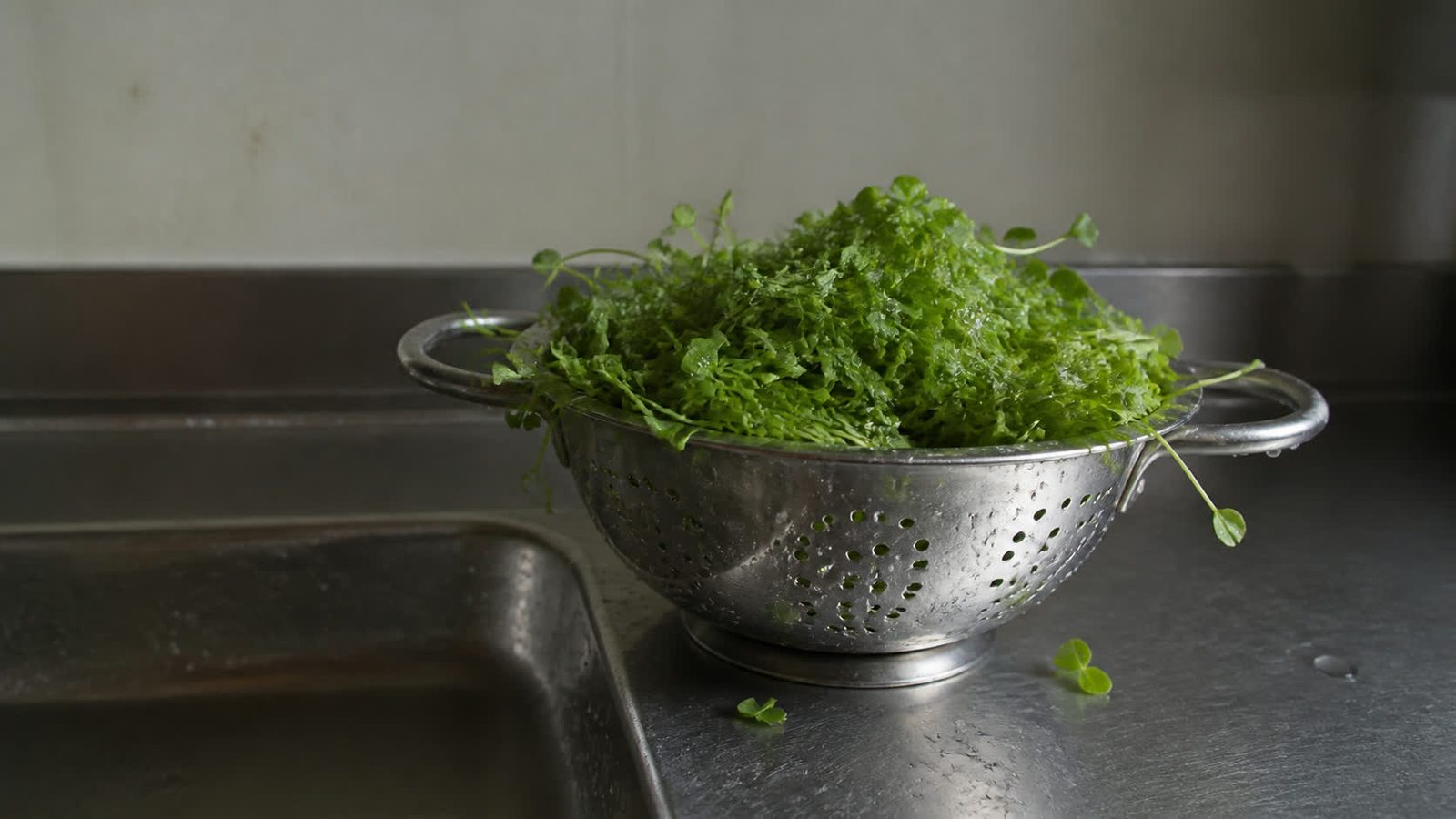
Short answer: for most people, yes, and the fear attached to them mostly belongs to a different food.
Microgreens get bundled with sprouts, and sprouts have a genuinely serious outbreak record running to thousands of illnesses. Microgreens do not have one. No public health agency has attributed a foodborne outbreak to microgreens, and no published case report attributes an illness to eating one.
That is not the same as saying nothing can go wrong. At least 15 microgreen recalls and recall warnings are on the public record, retail surveys do find bacteria, and one crop has a chemical problem that has nothing to do with bacteria at all.
The distinction that carries most of the answer
Almost every alarming statistic about "sprouts and microgreens" is a sprout statistic. FDA treats them as different products with different rules, and the line is drawn on harvest form, not on marketing language.
Hover or tap a row to highlight it.
| Sprouts | Microgreens | |
|---|---|---|
| Grown in | Warm, moist, nutrient-rich water | A substrate, in air |
| Harvested | Before true leaves, often before cotyledons | At cotyledon or first true leaf |
| You eat | The whole thing, seed and root included | The cut stem and leaves only |
| The seed | Goes in your mouth | Stays behind in the tray |
| FDA rules | Sprout-specific Subpart M | Covered produce, not Subpart M |
FDA's own definition turns on the root. It describes covered sprouts as hydroponic sprouts and soil or substrate sprouts harvested with roots, and it excludes substrate-grown product harvested without roots. Its inspection program lists microgreens explicitly as non-sprout produce. So, a thing sold as a "microgreen" but harvested root and all is a sprout for regulatory purposes, whatever the punnet says.
Read the "grown in" row twice, because it is the mechanism FDA actually gives. The temperature, water activity, pH and nutrients needed to produce a sprout are also ideal for growing bacteria, and FDA says sprout outbreaks commonly trace back to the seed. A pathogen on one seed multiplies through the vessel.
One caution about how far that argument goes. Microgreens are cut above the medium, so the seed and root stay in the tray. That is a real biological difference and it is not a measured one: nobody has run a study comparing illness risk between a cut-above-medium microgreen and a seed-and-root sprout from the same seed lot. The mechanism is sound. The comparison is unmeasured.
If you sell microgreens, this distinction also decides which federal rules apply to you, which we cover in the FDA Produce Safety Rule guide.
The sprout record, which is the number people are actually afraid of
It deserves to be stated plainly, because it is real and it is why raw sprouts carry a specific FDA warning.
Hover or tap a row to highlight it.
| Window | Outbreaks | Illnesses | Hospitalizations | Deaths |
|---|---|---|---|---|
| 1996 to July 2016 | 46 | 2,474 | 187 | 3 |
| 1996 to 2020 | 52 | more than 2,700 | 200 | 3 |
| One 2022 alfalfa outbreak | 1 | 63 | 10 |
Those first two rows are the same running tally at two points in time, not two separate findings. The tally grows, so a figure quoted without its dates cannot be compared with one that has them.
None of it belongs to microgreens.
What has actually happened with microgreens
At least 15 recalls and recall warnings, spanning 2016 to 2026, across two countries. No illness outbreak has been linked to any of them, and every notice here that reports on illness reports none. For how that record compares with the 2026 outbreaks on bagged lettuce and jalapenos, and what growing your own does and does not change, see the produce recalls and what growing your own actually changes.
Hover or tap a row to highlight it.
| Year | Product | Found | Illnesses |
|---|---|---|---|
| 2016 | Osage Gardens, Colorado and Kansas, **organic microgreens** | Salmonella | None reported |
| 2018 | Greenbelt Greenhouse, BC, broccoli | Listeria monocytogenes | None reported |
| 2018 | GoodLeaf, Nova Scotia, daikon radish | Possible Listeria | None reported |
| 2018, June 7 | GPM, **pea shoots** | Listeria monocytogenes | No outbreak on record |
| 2018, June 7 | Evergreen Herbs, **pea shoots** | Listeria monocytogenes | No outbreak on record |
| 2018, June 29 | Lufa Farms, **arugula** | Salmonella | No outbreak on record |
| 2019, April 19 | GPM, **pea shoots** | Listeria monocytogenes | No outbreak on record |
| 2019, May 22 | Pousses et Cie, **Mix Spicy microgreens** | Listeria monocytogenes | No outbreak on record |
| 2021 | Broadwood Farm, Ontario, broccoli and seasonal mix | Salmonella | None reported |
| 2021 | Prairie Microgreens, Alberta, broccoli | Salmonella | None reported |
| 2021/22 | Arcadia, Ontario, broccoli and salad mix | Salmonella | None reported |
| 2022 | Wegmans Organic, 7 US states, microgreens and sweet pea leaves | Salmonella, in supplied soil | None associated |
| 2026 | Kyan Culture and Farm Boy, ON/QC, broccoli and mixes | Possible pathogenic E. coli | None reported |
| 2026 | Micro-Verdure, Quebec, broccoli and mixes | Possible pathogenic E. coli | None reported |
| 2026, May 21 | Les Fermes Lufa, Quebec, **broccoli** | Pathogenic E. coli | None reported |
Two things about this table matter more than the count.
First, notice the crop. Broccoli appears in seven of them, more than any other crop. That is not proof broccoli is riskier, because broccoli is also far and away the most-sold microgreen, so it would dominate a recall list by volume alone. But it is worth a grower knowing.
Second, one record does name a route. Most of these positives were found in the plant product, with no seed, water or medium identified. The Wegmans notice is the exception: it says some of the soil the crop was grown in, supplied by a named company, tested positive for Salmonella by the supplier. So, the growing medium is a documented route on this record rather than a theoretical one. How to check a claim like this yourself, on the agency record rather than on a summary of it, is the two minute recall check.
There is a plausible upstream signal, and it is seed. In 2026 the Canadian authorities recalled a lot of Germina broccoli seed for possible pathogenic E. coli, and the two 2026 microgreen recalls are related to it. That makes seed a documented route of concern. It does not make it a proven seed-to-illness event, because no illness occurred.
The three mistakes that make this topic confusing
Almost every misleading claim you will read about microgreen safety is one of these three, and each one changes the question being answered.
How the numbers get misused
Hover or tap a card to highlight it.
Sprout-statistic substitution
Presenting FDA's 52 outbreaks and 2,700-plus illnesses as a microgreen record. FDA attaches that tally to SPROUTS, in its own product-specific wording, and separately classifies microgreens as non-sprout produce.
Category blending
The largest government survey that includes microgreens tested 1,189 samples of "fresh seed sprouts AND microgreens" together. Seventeen, or 1.4 percent, were flagged investigative, 15 for Listeria. Because the category is combined, that number CANNOT be reported as a microgreen prevalence, and it frequently is.
Material substitution
Using research on mature broccoli, or on concentrated broccoli-sprout extract, as though it were a study of raw brassica microgreens. Different material, different stage, different dose, different question.
The combined-survey point is worth sitting with. It is the single largest retail dataset touching this crop, and it cannot answer "how often are microgreens contaminated" because sprouts are mixed into the denominator. Nobody has published a microgreen-only retail prevalence figure.
Who should be more careful
FDA identifies pregnant people, young children, older adults and people with weakened immune systems as more vulnerable to foodborne illness. Its explicit raw-sprout warning is written for sprouts. No FDA or CDC statement located says "avoid raw microgreens" for any group.
The logic underneath it still transfers, and it is worth being precise rather than reassuring. These groups are not more likely to encounter a pathogen. They are the ones for whom the consequences are worst.
Listeria is the specific reason, and CDC publishes the numbers. CDC puts infection at about 1 in 25,000 pregnant women. And even when the pregnant person does not feel severely ill, 1 in 4 infected pregnancies ends in loss of the pregnancy or the death of the newborn. Listeria was the finding in six of the recalls above.
No dose threshold exists for microgreens, so nobody can tell you how much would matter. The honest framing is not that microgreens are unsafe for these groups. It is that raw produce carries a small residual risk, these groups pay a far higher price when it lands, and a clinician who knows the individual situation is better placed to weigh that than any website.
What is worth raising with a clinician, concretely: whether the condition or treatment makes a foodborne infection more consequential, whether the usual diet already contains substantial vitamin-K-rich greens, the identity of the crop, and what to do if a recall or symptoms follow.
The risks that are chemical, not bacterial
These get far less attention than the bacteria, and for one crop they matter considerably more.
Borage is the live exception. A 2025 study measured pyrrolizidine alkaloids in borage leaves, flowers and microgreens and reported that microgreen consumption could exceed regulatory exposure benchmarks. Those compounds affect the liver. No comparable signal has been found for any other named microgreen, so this is a crop problem rather than a category problem, and no amount of careful washing touches it. It is written up in full on the borage page.
Nitrate is measured and the spread is enormous. A 17-species study found nitrate ranging from 458.6 mg/kg fresh weight in sunflower to 4,602 mg/kg in mizuna, with a mean of 2,753 and 11 of the 17 above 2,500 mg/kg. A separate study put cress microgreens at 4,086 to 5,562 mg/kg. For context the study cites an acceptable daily intake benchmark of 3.7 mg of nitrate per kg of body weight per day. No microgreen-specific regulatory maximum was found, and no health effect has been demonstrated at these levels. These are crop measurements, not outcomes.
Vitamin K matters if you take warfarin. A study of 25 commercially available microgreens found phylloquinone from 0.6 to 4.1 micrograms per gram fresh weight, with garnet amaranth highest. The clinical issue with warfarin is consistency rather than avoidance: it is the sudden change in intake that causes trouble, so starting a tray-a-week habit is a real change worth mentioning to whoever manages your dose. No microgreen-specific management figures exist; the clinical guidance is written about mature leafy vegetables.
Oxalate is nearly a blank. It is a recognized issue in mature spinach, beet and chard for people who form calcium-oxalate stones. Of those three, only spinach has a published oxalate measurement at the microgreen stage, in a 2020 study of ten culinary microgreens (Ghoora et al.) whose values ran from 14.3 to 68.2 mg per 100 g across crops (PMC11464729). Beet and chard have none, and mature-leaf data cannot be substituted, because maturity, cultivar and growing conditions all change composition. There is no threshold to give you and this page will not invent one.
Thyroid concerns are about the wrong material. A 2024 systematic review of human studies found the evidence does not support simple claims that ordinary brassica consumption impairs thyroid function, and noted the two case reports involved unusually large exposures. That review is about mature brassica vegetables. No human thyroid trial has used brassica microgreens.
Should you wash them? Even the extension services disagree
Most food-safety instinct says wash raw produce. Here the guidance genuinely splits.
Purdue Extension tells consumers to rinse microgreens under cool running water immediately before use, dry them with paper towels or a spinner, and store them unwashed.
Penn State's grower guidance says post-harvest washing is not recommended unless necessary, because it can spread contamination, and that if it is done the water must be clean and free of E. coli.
They are not contradicting each other so much as answering different questions: one is a consumer about to eat, the other is a grower about to store and sell. Both agree on clean water and on not leaving the crop wet. The harvesting and washing review works through the grower side in full.
What washing actually achieves has been measured, once, and it is modest. In a daikon radish microgreen experiment, a 100 mg/L chlorine wash reduced initial aerobic bacteria and yeast and mold by 0.5 log CFU/g, and counts rebounded after day 7. A review of the post-harvest literature found the same pattern across radish and buckwheat: washes lower initial counts, storage brings them back, and washing plus dewatering was associated with faster deterioration.
A half-log initial reduction that rebounds within a week is not a sanitizing step. And FDA is explicit that soap, detergents and bleach solutions should not be used on raw fruits and vegetables at all.
The practical version: wash immediately before eating rather than before storing, use clean water, and dry gently and thoroughly. Water left sitting on a cut seedling is the problem.
Storage, and why sliminess is not a safety test
Cold is the lever. In the daikon radish work, 1 °C was the best tested storage temperature without causing chilling injury, and the review synthesizing the microgreen storage studies gives 5 °C or below as a preliminary target while noting quality can exceed 14 days depending on cultivar and conditions. Purdue's consumer estimate is 5 to 7 days unwashed, in a damp paper towel and a bag, in the crisper. The review reports 3 to 5 days at room temperature.
There is no single validated number, because the studies are narrow and crop-specific. The storage containers review reaches the same place from the buying side, and published shelf-life figures span 1 to 21 days across crops.
Now the part that matters most. Shelf life is a quality endpoint, not a safety cutoff. Sliminess and off-odor tell you the crop is deteriorating. They do not tell you whether a pathogen is present. Canadian food safety authorities state plainly that food contaminated with pathogenic E. coli may not look or smell spoiled. So "it still smells fine" is not a safety clearance, and "eat it before it goes slimy" is advice about quality that people mistake for advice about safety.
Where the risk actually enters
Seed to plate, and what changes the risk at each step
- 1
The seed
Seed-borne contamination is the origin of most sprout outbreaks, and a 2026 broccoli seed recall sits upstream of two microgreen recalls. For microgreens the seed stays in the tray and is not eaten, which removes the main sprout pathway without removing seed as a concern. Specify untreated seed sold for sprouting or microgreens, from a supplier that states its pathogen testing, and ask for the lot number.
- 2
The medium and the water
Plausible routes, and NOT traced in any recall record located. Penn State names water used for soaking, irrigation and washing as a potential route and says it should be free of E. coli. That is operational guidance, not an illness study.
- 3
The growing environment
Warm, wet and still amplifies bacteria. Airflow and not overwatering matter for food safety, not only for mold. NOBODY HAS CONVERTED temperature, humidity, density or system type into a consumer illness probability for this crop.
- 4
The cut
Cutting ABOVE the medium leaves seed and root behind. Clean blades and clean hands, because this is the first point the food is handled.
- 5
Washing
Optional, modest, and counterproductive before storage. A measured chlorine wash gave half a log and rebounded within a week.
- 6
Storage
Cold and dry, 5 degrees C or below. A wet clamshell in a warm kitchen is the highest-risk thing most people do to microgreens.
- 7
The plate
Raw produce carries a small residual risk that no home step removes entirely. For most people that is acceptable, and for a few groups it is worth a clinician's view.
The three things that actually change your risk
What matters, ranked
Hover or tap a card to highlight it.
Which crop you chose
This outranks every handling step. Borage carries a measured chemical problem that washing cannot touch, and nitrate varies tenfold between sunflower and mizuna. "Microgreens" is a category, not an ingredient.
Whether it is actually a sprout
If you are eating the seed and the root, grown in water, you are eating a sprout, and the sprout advice applies to you. FDA draws its line on harvest form, and the label on the punnet is not always right about this.
How wet it stayed
Water is the variable you control. Do not wash before storing, dry thoroughly if you wash at all, keep it at 5 degrees C or below, and do not treat smell as a safety test.
What is not known
Being straight about the gaps, because they are wider than the reassurance suggests.
- No microgreen-only outbreak rate, and no microgreen-only retail prevalence by species. The largest survey blends sprouts into the category.
- No study establishing that cutting above the medium reduces illness risk. The mechanism is sound and unmeasured.
- No home-scale evidence for vinegar, commercial produce washes, sanitizer rinses or any drying method on this crop.
- No safe intake established for any microgreen, for any group.
- No oxalate measurement at the microgreen stage of beet or chard, and one for spinach.
- No study separating digestive upset from microbial contamination after eating microgreens.
- No microgreen-specific clinical guidance for kidney disease, thyroid disease or anticoagulation.
- No representative survey of heavy metals, seed-treatment residues or medium contaminants in retail microgreens.
None of that is evidence of zero risk. It is evidence that the questions have not been asked properly, which is a different and less comfortable thing.
So, are they safe
For most people eating ordinary crops, yes, and more so than the statistics circulating on this topic suggest, because those statistics describe a food that is grown differently and eaten differently.
The strongest single fact is the absence: at least 15 recalls and recall warnings across ten years and two countries, and no illness outbreak linked to any of them. The weakest thing about that fact is that it is an absence. Microgreens are a small category, illnesses often go unreported, and nobody has run the surveillance that would turn "none found" into "none occurred". It means nobody has caught one, not that nobody has had one.
The realistic risks, in order: choosing a crop with a chemical problem, mistaking a sprout for a microgreen, and leaving the crop wet. All three are things you control.
If you are pregnant, immunocompromised, elderly or frail, or you take warfarin, that is worth a conversation with your doctor rather than with a website, including this one. Not because microgreens are dangerous, but because you are the person who pays if the small residual risk of raw produce lands.
Terms on this page
Tap a term to see what it means.
Sprout. A germinated seed eaten whole, root and seed included, usually grown in water. FDA draws the line on whether the product is harvested WITH roots, not on what it is called.
Sources
- FDA guidance on sprouts - the 1996 to 2020 tally of 52 outbreaks, at least 2,700 illnesses, 200 hospitalizations and three deaths, the mechanism by which sprout production conditions favor pathogen growth, and that outbreaks commonly trace to seed.
- FDA inspection program (PDF) - the definition of covered sprouts as harvested WITH roots, the exclusion of substrate-grown product harvested without roots, and microgreens listed explicitly as non-sprout produce outside Subpart M.
- Greenbelt Greenhouse recall, FDA - 2018 Listeria monocytogenes in broccoli microgreens, zero illnesses, and no identified seed, water or medium source.
- Osage Gardens recall, FDA (archived) - October 7, 2016, organic microgreens sold in Colorado and Kansas, Salmonella, no illnesses reported.
- Misra and Gibson, 2021, Food Protection Trends - reference list of CFIA recall warnings: GPM pea shoots (June 7, 2018 and April 19, 2019), Evergreen Herbs pea shoots (June 7, 2018) and Pousses et Cie Mix Spicy microgreens (May 22, 2019) for Listeria monocytogenes, and Lufa Farms arugula microgreens (June 29, 2018) for Salmonella; and the statement that no outbreaks are known to be associated with microgreens.
- Les Fermes Lufa recall, CFIA - broccoli microgreens, pathogenic E. coli, Quebec, May 21, 2026, no reported illnesses.
- GoodLeaf recall reporting - the 2018 daikon radish microgreen Listeria notice, no illnesses, no traced matrix.
- Arcadia Microgreens recall, CFIA - Salmonella in broccoli and salad-mix microgreens, with no published route or illnesses.
- Kyan Culture and Farm Boy recall, CFIA and Micro-Verdure recall, CFIA - the two 2026 possible pathogenic E. coli recalls, no illnesses, and the statement that contaminated food may not look or smell spoiled.
- Germina broccoli seed recall, CFIA - the 2026 seed alert sitting upstream of both microgreen recalls, which makes seed a documented route of concern rather than a proven cause.
- CFIA bacterial pathogens survey (PDF) - 1,189 samples of "fresh seed sprouts and microgreens" combined, 17 investigative results at 1.4 percent, 15 of them Listeria, and no way to split the category.
- Microbiological quality of microgreen seed sold online - a 2023 laboratory study distinguishing microgreen seed from sprout seed, run because reports on its microbiological quality were lacking.
- Turner, Buchanan and Luo, 2020 review (USDA record) - the post-harvest synthesis: chlorine washes lowering initial counts with rebound during storage, washing and dewatering associated with faster deterioration, 3 to 5 days at ambient, potentially more than 14 days cold, and 5 °C or below as a preliminary target.
- Daikon radish microgreen storage study - the 100 mg/L chlorine wash giving a 0.5 log CFU/g initial reduction with rebound after day 7, and 1 °C as the best tested storage temperature without chilling injury.
- Purdue Extension, microgreens - rinse under cool running water immediately before use, dry with paper towels or a spinner, store unwashed, and 5 to 7 days in a crisper.
- Penn State Extension, food safety in microgreens production - post-harvest washing not recommended unless necessary because it can spread contamination, and production water free of E. coli.
- FDA, fruits, veggies and juices for moms to be - the raw-sprout warning and its rationale, and the instruction not to use soap, detergents or bleach solutions on raw produce.
- FDA, people at risk of foodborne illness and CDC, food safety in pregnancy - the higher-risk groups, and that the explicit warning names sprouts rather than microgreens.
- CDC, Listeria risk factors - about 1 in 25,000 pregnant women infected with Listeria, and 1 in 4 infected pregnancies ending in loss of the pregnancy or death of the newborn.
- Borage pyrrolizidine alkaloid study - measurement in borage leaves, flowers and microgreens, reporting that microgreen consumption could exceed regulatory exposure benchmarks.
- Nitrate across 17 microgreen species and cress nitrate range - 458.6 mg/kg in sunflower to 4,602 in mizuna, mean 2,753, 11 of 17 above 2,500, cress at 4,086 to 5,562, and the 3.7 mg/kg body weight daily benchmark.
- Xiao et al., 25 microgreens (USDA record) - phylloquinone from 0.6 to 4.1 micrograms per gram fresh weight, garnet amaranth highest.
- Systematic review of brassica and thyroid function - human evidence does not support simple impairment claims, the two case reports involved unusually large exposures, and the material studied is MATURE brassica rather than microgreens.
- Mayo Clinic on warfarin and vitamin K - consistency of vitamin-K-containing foods as the clinical issue, discussed for mature leafy vegetables.
Keep reading
The journal
Microgreens and Diabetes: What Is Known About Blood Sugar
Microgreens fit a diabetes plate like any non-starchy vegetable. Whether they lower blood sugar has never been tested: every human trial used broccoli sprout powder or extract, not the fresh greens.
Read Microgreens and Diabetes: What Is Known About Blood SugarThe journal
Microgreens and Gut Health: What One Small Study Actually Found
Eleven people, one serving, and the researchers looked at chemistry rather than symptoms. The constipation study often cited for this used sprouts, was paid for by a farm, and one good bacteria went down.
Read Microgreens and Gut Health: What One Small Study Actually FoundThe journal
Heavy Metals and Nitrate in Microgreens: What Has Actually Been Measured
The nitrate figures circulating for microgreens are dry weight, and the legal limits are fresh weight. Convert the same published result and it lands anywhere from 1,045 to 11,307 mg/kg depending on the crop. Three species have been assayed for metals.
Read Heavy Metals and Nitrate in Microgreens: What Has Actually Been MeasuredThe journal
Microgreens and the Thyroid: How Much Would You Actually Have to Eat?
The one human dose threshold is 194 micromoles of goitrin. Reaching it takes about 110 g of a high-progoitrin kale or 1.94 kg of commercial broccoli, which is about 7 garnishes against 129.
Read Microgreens and the Thyroid: How Much Would You Actually Have to Eat?