Microgreens and the Thyroid: How Much Would You Actually Have to Eat?
Cal HewittPublished Checked
- health
- safety
- evidence
- brassica
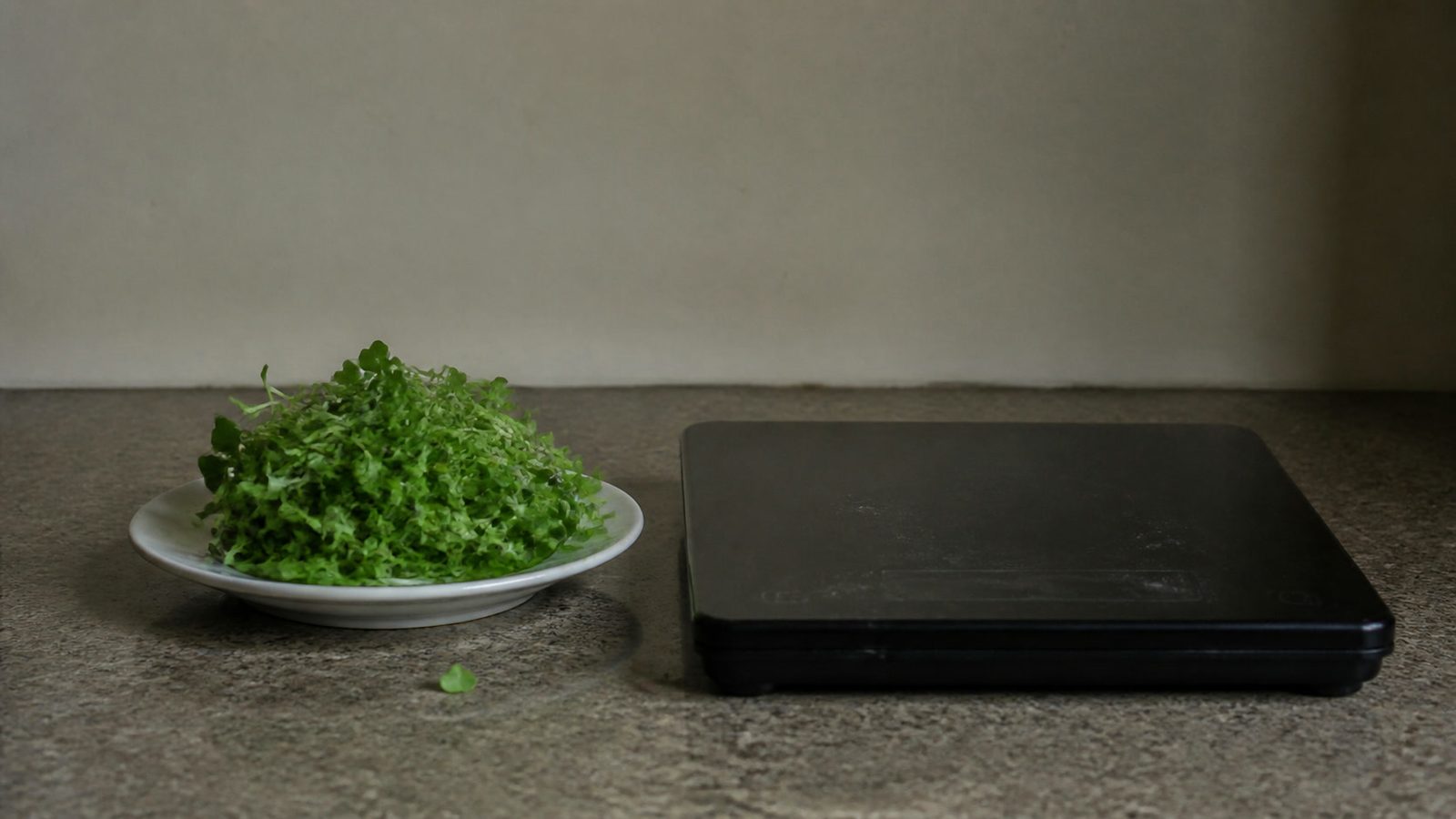
Three quarters of the crops grown as microgreens are brassicas or otherwise sharp, so the goitrogen question attaches to most of them. Nobody has answered it for a person.
The alarming version and the dismissive version are both wrong. The compounds are real, the mechanism is real, and the human evidence for harm at ordinary intakes is thin to absent. Here is what the numbers actually say.
What to actually do
- If you have a thyroid condition, this is a conversation with your clinician, not a decision to make from a web page including this one.
- Do not stop eating a vegetable on the strength of a claim with no dose attached. Four of seven pages gave a number and none of them could show where it came from.
- The crop matters more than the family. A high-progoitrin kale and commercial broccoli are eighteen times apart, so "brassicas" is not a useful unit for this decision.
- A garnish is a garnish. On broccoli, the arithmetic below puts the acute threshold at roughly a hundred of them, before accounting for the fact that most of the precursor never becomes the active compound.
- Your iodine status is the variable, and it is the one thing here you can actually have measured.
- Do not start taking iodine because of a web claim either. That is the same error in the other direction.
- If you are pregnant, have unstable thyroid tests or eat a very restricted diet, treat all of this as a reason to ask rather than a reason to act.
The only human dose threshold anyone has
One study gives an isolated dose that did something and a smaller one that did not.
Hover or tap a row to highlight it.
| Dose | Effect |
|---|---|
| 77 micromoles | Did not inhibit radioiodine uptake |
| 194 micromoles (25 mg) | Did inhibit it |
Read what that is before using it. It is isolated goitrin, not food. It is a single acute uptake measurement, not a thyroid hormone result, not a clinical outcome and not a safe intake limit. It is the only quantitative human handhold in this entire subject.
What 194 micromoles looks like on a plate
Take that figure and convert it into crops, and the answer depends enormously on which crop.
Hover or tap a row to highlight it.
| Crop | Published progoitrin | Fresh weight to reach 194 micromoles | As 15 g garnishes |
|---|---|---|---|
| Russian or Siberian kale | 176.6 micromoles per 100 g | about 110 g | about 7 |
| Commercial broccoli | under 10 micromoles per 100 g | over 1.94 kg | about 129 |
That is an eighteen-fold difference between two brassicas. "Brassicas are goitrogenic" describes a family whose members are two orders of magnitude apart.
Now read the last column against the serving. A typical microgreen garnish is 10 to 20 grams. On broccoli you would need something like a hundred of them in a day to reach the precursor equivalent of a dose that produced one acute measurement.
And the arithmetic is deliberately generous to the alarming side. It counts the PRECURSOR, progoitrin, as though all of it converted to goitrin and all of that reached the circulation. Neither is true, so the real requirement is higher than these figures, not lower. This is an upper-bound screening calculation, not a measurement, and it is offered to show the scale rather than to set a limit.
What is not established is the microgreen figure itself. Nobody has published matched fresh-weight progoitrin and goitrin conversion data for a microgreen cultivar, so the crop numbers above are for mature vegetables and the conversion for the microgreen stage is genuinely unknown.
What has actually been measured in people
Two human feeding studies point the same reassuring way.
- 150 grams a day of cooked Brussels sprouts for four weeks produced no thyroid hormone change.
- A broccoli sprout beverage over 12 weeks likewise.
Neither used microgreens, which is the standing limitation on every health claim in this category, and both used cooked or processed material rather than raw. But they are real human trials at intakes far above any garnish, and they found nothing.
The observational cancer literature runs mixed to inverse. A Sicilian hospital case-control study reported lower odds of thyroid cancer with cruciferous intake, at 0.30 with a confidence interval from 0.10 to 0.92. A Kuwaiti case-control study found no clear association. Those are observational and the confidence interval on the first one is very wide. They are not evidence that crucifers treat anything, and they are certainly not evidence of harm.
Iodine status is the variable that decides the answer
The same intake means different things in different people, and this is the part almost every page omits.
In the United States the overall population appears iodine adequate, with some pregnant women at risk. Among pregnant women in one national survey, median urinary iodine was 100 micrograms per liter for those who had eaten no dairy the previous day against 163 among dairy consumers.
Globally it is a different picture. Iodine insufficiency remained a public health problem in 25 countries, covering about 683 million people, with roughly 88 percent of households using iodized salt.
So, a reader in an iodine-replete population and a reader in a deficient one are asking different questions, and a page that answers only the first is not wrong so much as incomplete.
Cooking changes it, and by a measurable amount
Boiling for 9 to 15 minutes reduced total glucosinolates by 18 to 59 percent across cruciferous vegetables. High heat can also inactivate myrosinase, the enzyme that converts the precursor into the active compound.
Read that as a range rather than a rule. It is total glucosinolates rather than goitrin specifically, and the spread from 18 to 59 percent is wide enough that no single reduction figure is honest.
And it matters more here than usual, because a microgreen is eaten raw. That is the one place where this crop could genuinely differ from the cooked vegetables the reassuring trials used, and nobody has measured it.
The doses you will see quoted, and what stands behind them
Of seven pages checked, four state a dose or a quantity, which is better than this category usually manages:
- One says a kilogram of raw kale a day for months.
- One says 10 to 20 grams of microgreens.
- One says 30 to 50 grams, and 150 grams or more.
- One speaks only of "large" amounts.
Not one of them supplies a measured goitrin or thiocyanate concentration for a microgreen that would validate the threshold it names. The microgreen numbers in that list are practice, not evidence, and the difference matters because a number with no measurement behind it is indistinguishable from a guess.
What nobody has measured
- Progoitrin or goitrin in a microgreen, at fresh weight, for any cultivar. Every crop figure on this page is a mature vegetable.
- Any thyroid endpoint after eating microgreens, at any dose, in any population.
- Whether the raw microgreen stage differs from the cooked vegetables the reassuring trials used.
- A food intake threshold, as opposed to a threshold for an isolated compound.
- Whether the acute radioiodine result means anything for thyroid hormones over weeks or months.
Terms on this page
Tap a term to see what it means.
Goitrogen. A loose term for anything that interferes with thyroid function. It covers several different compounds and mechanisms and hides all of them.
Sources
Opened 2026-08-12. The fresh-weight conversions in the second table are arithmetic performed for this page on the published dose threshold and published progoitrin concentrations, and are labeled above as an upper-bound screening calculation rather than a measurement.
- Felker and colleagues, concentrations of thiocyanate and goitrin in human plasma, their precursor concentrations in brassica vegetables, and the effects on thyroid function, 2016 - the Langer result that 77 micromoles of isolated goitrin did not inhibit radioiodine uptake while 194 micromoles, being 25 mg, did; the progoitrin concentration of 176.6 micromoles per 100 g fresh for Russian and Siberian kale against under 10 for commercial broccoli; and the human feeding results including 150 g a day of cooked Brussels sprouts for four weeks with no thyroid hormone change.
- Glucosinolate retention in cooked cruciferous vegetables, review - the 18 to 59 percent reduction in total glucosinolates from boiling for 9 to 15 minutes, and the effect of heat on myrosinase.
- Sicilian case-control study of cruciferous vegetables and thyroid cancer - the odds ratio of 0.30 with a 95 percent confidence interval of 0.10 to 0.92.
- Kuwaiti case-control study - no clear association with cruciferous consumption, reported here as the other half of a mixed observational picture.
- NIH Office of Dietary Supplements, iodine fact sheet - that the overall US population appears iodine adequate while some pregnant women are at risk, the median urinary iodine of 100 micrograms per liter among pregnant women reporting no dairy the previous day against 163 among dairy consumers, and the global figure of 25 countries and about 683 million people with roughly 88 percent of households using iodized salt.
- Grower and consumer pages, used as practice only and as the source of the seven-page count: Microgreens World on cruciferous microgreens and thyroid, which supplies the 10 to 20 gram garnish description.
Keep reading
The journal
Are Microgreens Safe to Eat Raw?
For most people yes, and the frightening statistics belong to sprouts. At least 15 microgreen recalls and recall warnings are on record across two countries, and no illness outbreak has been linked to any of them. No public health agency has attributed an outbreak to a microgreen. That is not the same as zero risk.
Read Are Microgreens Safe to Eat Raw?The journal
Heavy Metals and Nitrate in Microgreens: What Has Actually Been Measured
The nitrate figures circulating for microgreens are dry weight, and the legal limits are fresh weight. Convert the same published result and it lands anywhere from 1,045 to 11,307 mg/kg depending on the crop. Three species have been assayed for metals.
Read Heavy Metals and Nitrate in Microgreens: What Has Actually Been MeasuredThe journal
Are Microgreens Anti-Inflammatory? What the Research Really Says
Nobody has fed a person microgreens and measured their inflammation. And when researchers pooled ten broccoli sprout trials, the combined result came out at something that could be zero.
Read Are Microgreens Anti-Inflammatory? What the Research Really SaysThe journal
Are Microgreens Low FODMAP? What Monash Research Shows
Are microgreens low FODMAP? Learn what Monash sprouting research shows, which crop families deserve extra caution, and how reintroduction testing works.
Read Are Microgreens Low FODMAP? What Monash Research Shows