Microgreens for Skin, Hair and Detox: What the Evidence Shows
Cal HewittPublished Checked
- health
- evidence
- detox
- wheatgrass
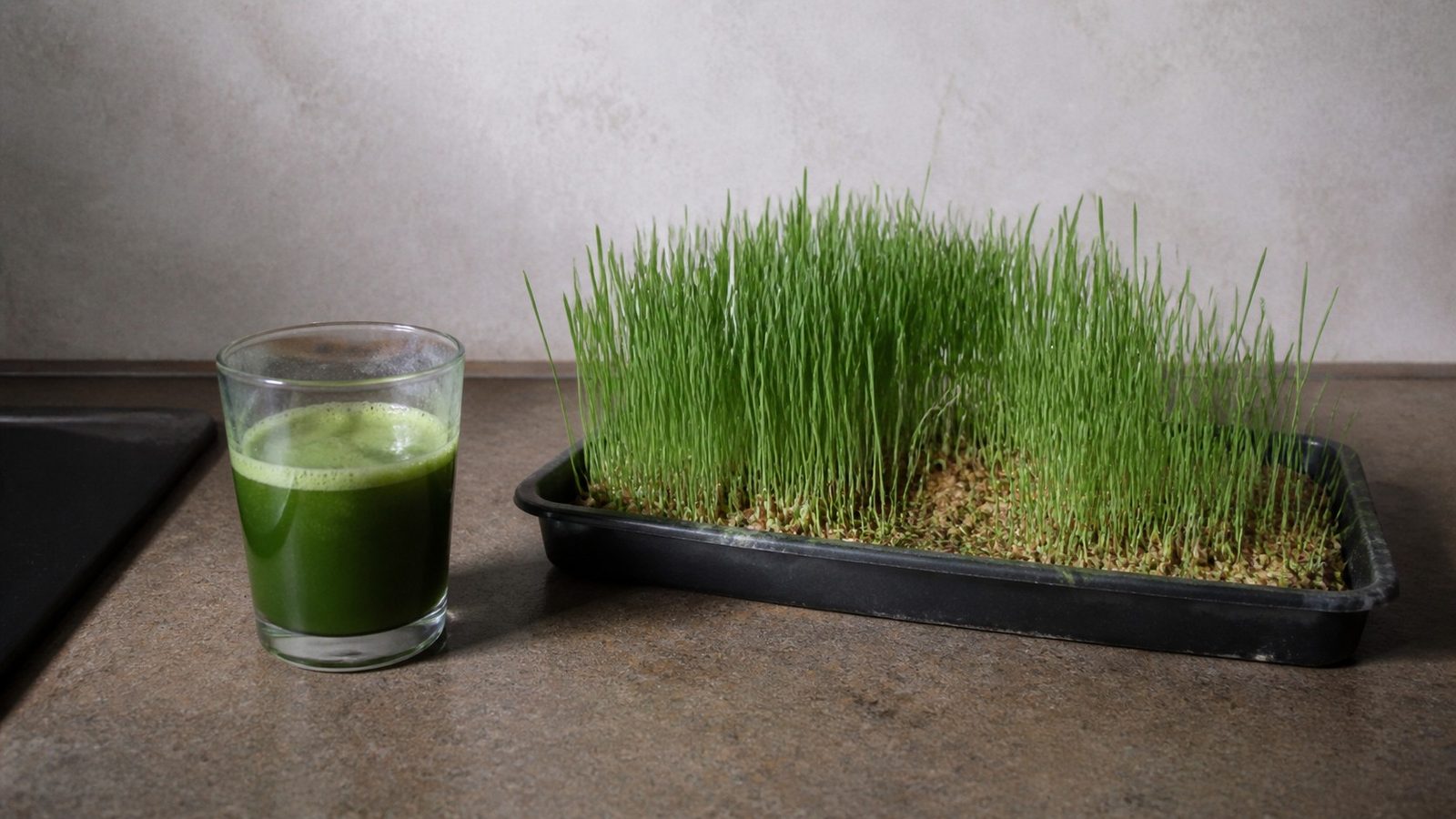
Five human wheatgrass trials exist, and not one of them measured a toxin, a skin endpoint or a hair endpoint. The skin and hair measurements are standard and used routinely elsewhere, so the gap is not a hard-to-measure problem. And a detox claim cannot be checked at all until somebody names the chemical.
What to actually do
- Ignore any detox claim that does not name a chemical, a sample and an elimination route. Without those it is not a weak claim, it is an untestable one.
- Eat wheatgrass or microgreens if you like them. That is a fine reason and it is the supported one.
- Do not expect a juice to clean anything. Your liver and kidneys are doing it, continuously, without a product.
- If your skin or hair has genuinely changed, see a clinician. Both can be signs of something diagnosable, and food is not the first step.
- Get tested before supplementing for hair. The dermatology guidance is explicit that biotin, iron and zinc go in after a blood test shows deficiency, not before.
- Do not read a topical result as a dietary one. The sulforaphane skin study put it on skin, in six people.
- Be careful with raw green juices if you are immunocompromised, pregnant, elderly or giving them to a child.
- If you take warfarin, treat a daily green juice as a real change in vitamin K intake.
What your body actually does with a foreign compound
Your body does have detoxification, and it is specific rather than general. The liver metabolizes foreign compounds, often making them more water soluble, and can route some into bile. Kidneys filter about 150 quarts of blood a day, of which 1 to 2 quarts leave as urine. The gut passes what it does not absorb, the lungs exhale volatile compounds, and sweat is a minor route. Metabolism also happens in the intestine, skin, kidney, lung and blood.
None of that is a cleanse, and none of it needs a product.
"Detoxification" is a real technical word for enzyme-mediated handling of a named chemical, and "detox" is also a clinical term for supervised withdrawal or poisoning treatment. It is not a testable claim when it means removing unspecified stored toxins.
A detox claim becomes testable only when it pre-specifies six things: the named toxin and its exposure source, a validated blood, urine, breath or stool assay, the material and verified dose, an equal control, a relevant endpoint such as 24-hour urinary excretion, and safety, including whether an apparent change is really reduced absorption, or just dehydration and diarrhea.
"Removes toxins" with none of those is not a weak claim. It is not falsifiable.
The regulators have already said so. The UK advertising authority states that a specific claim such as detoxing the colon is a health claim, acceptable only if it is on the approved register. The FTC brought an action in 2020 against detox tea claims that lacked reliable scientific evidence. NCCIH's 2025 summary reports only a small number of human studies of detox and cleanse programs, of low quality, with a 2015 review finding no compelling research for eliminating toxins.
Where the wheatgrass claim actually comes from
It traces to a person, not a study. The record leads to Ann Wigmore's raw and living food movement: she began using weeds and wheatgrass after ill health in 1955 and opened her institute in Boston in 1963.
The current pages still carry the original propositions, that chlorophyll neutralizes toxins, cleanses the colon and purifies the liver, with a companion page stating that liquid chlorophyll washes drug deposits from the body.
That is the origin and transmission of the claim. It is history, and it is not evidence.
Memorial Sloan Kettering states plainly that the chlorophyll-as-blood and wheatgrass detox claims are unsupported by current scientific understanding.
The chlorophyll science is thinner than the marketing. Chlorophyll is a plant pigment, digestion changes it into derivatives, and a 2021 review says the evidence on its absorption, distribution, metabolism and excretion still has important gaps.
There is one genuine named-toxin study, and read it carefully. In a 2009 crossover, four volunteers received a tiny labeled dose of aflatoxin B1, and three also received 150 mg of purified chlorophyll or chlorophyllin. Co-consumption reduced aflatoxin absorption measures.
Three things about that. It was purified chlorophyll, not wheatgrass. It reduced what got in, rather than increasing what came out. And it involved a named toxin with a validated assay, which is exactly what the marketing claim never supplies.
The wheatgrass trials that do exist
Five human wheatgrass trials exist, and not one measured a toxin.
Hover or tap a row to highlight it.
| Year | People | Material and duration | Endpoint | Result |
|---|---|---|---|---|
| 2002 | 23 | 100 cc/day juice, 1 month | ulcerative colitis symptoms | double-blind, placebo-controlled |
| 2004 | 16 | about 100 mL/day | transfusion need in thalassemia | 8 of 16 met the authors' criterion, each person their own control |
| 2009 | 53 | tablets, one year | transfusion requirement | not reduced, p=0.054 |
| 2018 | 69 children | 18 months | transfusion number and requirement | no difference between groups |
| 2020 | 100 | 60 cc/day with chemotherapy | immune measures | not randomized, by preference |
Two things follow and both matter.
Nobody has studied wheatgrass for detox, skin or hair. Every one of these is about colitis or thalassemia or immune markers. The claim that sells the product has never been tested.
And the two largest and longest studies were negative. The one-year study in 53 people did not reduce transfusion requirement at p=0.054, and the 18-month study in 69 children found no difference. The positive-looking one is the 16-person before-and-after design where each participant was their own control, which is the weakest arrangement on the table.
Juicing does not rescue any of this. It removes insoluble fiber and concentrates a fast-swallowed liquid. It does not create a new liver, kidney or elimination mechanism, and a result from fresh juice cannot be assumed to apply to a dried tablet or the reverse. Every study above used a specified juice or tablet, not "microgreens" in general.
Skin: measurable, and unmeasured for this food
Skin endpoints are well established and routinely used: corneometer hydration, transepidermal water loss for barrier function, cutometer elasticity, standardized wrinkle depth imaging, sebum, erythema, pigmentation, counted acne lesions, and wound area and time to closure. A 2025 placebo-controlled trial in 70 healthy adults measured moisture, water loss, elasticity and color at baseline, 6 and 12 weeks. The toolkit exists.
No human dietary trial of microgreens, sprouts or cruciferous vegetables measured any of those endpoints.
The nutrient roles are real and they are roles. Vitamin C is required for collagen synthesis, zinc supports protein and DNA synthesis, cell division and wound healing, vitamin A supports epithelial function. A role means deficiency is harmful. It does not mean an extra serving rejuvenates intact skin.
Vitamin C illustrates why more is not more. Plasma and tissue concentrations are tightly controlled, and at intakes of 200 mg a day and above, plasma rises only marginally. A realistic microgreen serving supplies a fraction of a day's vitamin C anyway.
There is one real skin result and it is topical. A 2007 study applied sulforaphane-rich extract from 3-day-old broccoli sprouts to the skin of six adults and reduced UV-induced erythema by a mean 37.7 percent.
Six people, applied to skin, measuring redness after ultraviolet light. It has a plausible local mechanism, because it is delivered directly and induces local protective enzymes. Eating requires digestion, absorption, distribution and an adequate concentration reaching skin, which is a different proposition entirely. A topical result and a dietary claim cannot support one another.
Hair: the endpoints exist and nobody has used them here
The claims are faster growth, less shedding, thickness, shine, stronger hair, and reversing gray. The named nutrients are usually biotin, iron, zinc, protein, vitamin C and chlorophyll.
Hair endpoints also exist and are used: hairs per square centimeter, shaft diameter, anagen and telogen proportions, shedding counts, hair-pull tests, standardized photographs and blinded assessment. A 2016 placebo-controlled trial in 96 women used shedding rate and phototrichogram fiber diameter.
None of them has been applied to microgreens, wheatgrass or barley grass.
And there is a pointed negative from the wider literature. A 2023 systematic review of nutritional interventions in people without known deficiency found no diet-based interventional studies meeting its criteria at all. A 2024 review of biotin found that its highest-quality placebo-controlled study showed no difference in hair growth.
The deficiency story is genuine and it is a different story. The American Academy of Dermatology says regrowth can occur when the body gets enough of a missing nutrient, and that biotin, iron or zinc should be supplemented only when a blood test shows deficiency. It also notes that too much vitamin A or selenium can itself be linked to hair loss.
So, the honest split is this. If you have a measured deficiency, correcting it can help your hair, and that is a clinical process starting with a test. If your levels are normal, no food trial supports a general enhancement claim, and the nearest supplement evidence is negative.
Safety, briefly and specifically
Wheatgrass is usually consumed raw. MSK reports nausea and difficulty swallowing from the taste, and flags possible microbial contamination because the leaves are grown and eaten raw.
NCCIH warns that unpasteurized juices can cause serious illness in children, older adults and immunocompromised people, and that restrictive detox regimens can cause dehydration, electrolyte imbalance or inadequate nutrition.
And the vitamin K point applies here too. Consistency matters if you take warfarin, and a green juice is a concentrated way to change intake quickly.
What the pages making these claims cite
Of six pages opened on 2026-08-12 across wheatgrass and barley grass detox, skin and hair searches, two cited any research item at all. The origin page made all three claims, detox, skin and hair, with no study citations.
Three of the six could not be read, so nothing is inferred from them; they are named in the Sources below rather than counted. It is a bounded sample on one day rather than a claim about the web.
What nobody has measured
- Any controlled human trial of wheatgrass, barley grass or a microgreen measuring elimination of a named toxin.
- Any human dietary trial of microgreens measuring a standard skin endpoint, despite the endpoints being routine.
- Any hair endpoint at all with microgreens, wheatgrass or barley grass.
- Whether eating a Brassica microgreen reproduces the topical UV result, which would need an entirely different study.
- Whether juice and dried powder or tablets behave alike, since every trial used one specified form.
- Chlorophyll's absorption, distribution, metabolism and excretion, which a 2021 review says still has important gaps.
- Whether any apparent detox effect is increased elimination or reduced absorption, which the one named-toxin study suggests is the question people are not asking.
Terms on this page
Tap a term to see what it means.
Detoxification. The enzyme-mediated handling of a specified chemical. A real process, and not the same as a marketed cleanse.
Sources
Opened 2026-08-12. Where PubMed or a publisher returned a challenge or an error, that is noted and the indexed record was the accessible source. No figure is used that was not visible in an accessible record.
- NCCIH on detoxes and cleanses, updated March 2025 - that only a small number of low-quality human studies of detox programs exist, that a 2015 review found no compelling research for eliminating toxins, and the safety cautions on unpasteurized juices and restrictive regimens.
- NIDDK on how the kidneys work and NIGMS on what happens to medicine in your body - the roughly 150 quarts filtered daily with 1 to 2 quarts becoming urine, and the actual routes by which the body handles foreign compounds.
- Poison Control on chelation therapy - the contrast between a real named-poison treatment and a marketing detox.
- ASA and CAP guidance on detoxing and the FTC's 2020 detox tea action - that a specific food detox claim is a health claim requiring register approval, and a concrete enforcement example.
- Memorial Sloan Kettering on wheat grass - that the chlorophyll-as-hemoglobin and raw wheatgrass detox claims are not supported by current scientific understanding, the characterization of the colitis evidence as small and the thalassemia evidence as mixed, and the nausea, swallowing and raw-contamination cautions.
- The Ann Wigmore Foundation wheatgrass page, the Ann Wigmore history and an older benefits page - the 1955 and 1963 timeline and the original wording on neutralizing toxins, cleansing the colon, purifying the liver, washing drug deposits, tightening skin and adding luster to hair. Practice and history, cited as the origin of the claim. The last returned a browser challenge.
- A 2021 chlorophyll metabolism review and Egner et al., aflatoxin and chlorophyll pharmacokinetics, 2009 - the remaining gaps in chlorophyll absorption, distribution, metabolism and excretion, and the four-volunteer crossover using 150 mg of purified chlorophyll or chlorophyllin that reduced aflatoxin absorption. Both returned reCAPTCHAs.
- The five human wheatgrass trials: the 2002 ulcerative colitis trial, 23 people at 100 cc a day for a month, whose publisher page returned an internal error; the 2004 thalassemia pilot, 16 people, each their own control; the 2009 one-year tablet study in 53 people, transfusion requirement not reduced at p=0.054; the 2018 study in 69 children over 18 months finding no difference; and the 2020 study in 100 people alongside chemotherapy, not randomized. All the PubMed records returned reCAPTCHAs.
- Talalay et al., topical broccoli sprout sulforaphane, 2007 - the six adults and the mean 37.7 percent reduction in UV-induced erythema, applied to skin rather than eaten. Returned a reCAPTCHA.
- NIH ODS vitamin C and zinc - the collagen and wound healing roles, and that plasma vitamin C rises only marginally at intakes of 200 mg a day and above.
- Kapoor et al., 2025 and Ablon, 2016 - the 70-adult skin trial measuring moisture, water loss, elasticity and color, and the 96-woman trial using shedding rate and phototrichogram fiber diameter. Cited to show the endpoints are routine, not as evidence about microgreens. Both returned reCAPTCHAs.
- Drake et al., systematic review of nutritional interventions for hair, 2023 and a 2024 biotin review - that no diet-based interventional studies met the review's criteria in people without known deficiency, and that the highest-quality placebo-controlled biotin study showed no difference in hair growth. The first returned a reCAPTCHA.
- American Academy of Dermatology on hair loss causes, diagnosis and treatment and management tips - that regrowth can follow correcting a missing nutrient, that biotin, iron and zinc should be supplemented only after a blood test shows deficiency, and that excess vitamin A or selenium is itself linked to hair loss.
- The pages audited for citation practice: Healthline on wheatgrass and on barley grass, which were the two carrying visible research citations, alongside WebMD on wheatgrass and on barley grass, both of which returned 403, and a video whose fetch was throttled. Counted on 2026-08-12; a page count is not a claim about search rankings, and nothing is inferred from the pages that could not be read.
Keep reading
The journal
Juicing Microgreens: One Glass Is Three Quarters of a Tray
Nobody has measured how much juice a microgreen tray gives. The one published figure is a seller's, for wheatgrass, on a tray 23 percent larger than a 1020. Rescaled, a 240 mL glass is three quarters of a tray.
Read Juicing Microgreens: One Glass Is Three Quarters of a TrayThe journal
Are Microgreens Anti-Inflammatory? What the Research Really Says
Nobody has fed a person microgreens and measured their inflammation. And when researchers pooled ten broccoli sprout trials, the combined result came out at something that could be zero.
Read Are Microgreens Anti-Inflammatory? What the Research Really SaysThe journal
Are Microgreens Low FODMAP? What Monash Research Shows
Are microgreens low FODMAP? Learn what Monash sprouting research shows, which crop families deserve extra caution, and how reintroduction testing works.
Read Are Microgreens Low FODMAP? What Monash Research ShowsThe journal
Are Microgreens Safe to Eat Raw?
For most people yes, and the frightening statistics belong to sprouts. At least 15 microgreen recalls and recall warnings are on record across two countries, and no illness outbreak has been linked to any of them. No public health agency has attributed an outbreak to a microgreen. That is not the same as zero risk.
Read Are Microgreens Safe to Eat Raw?