Juicing Microgreens: One Glass Is Three Quarters of a Tray
Cal HewittPublished Checked
- eating
- juicing
- wheatgrass
- evidence
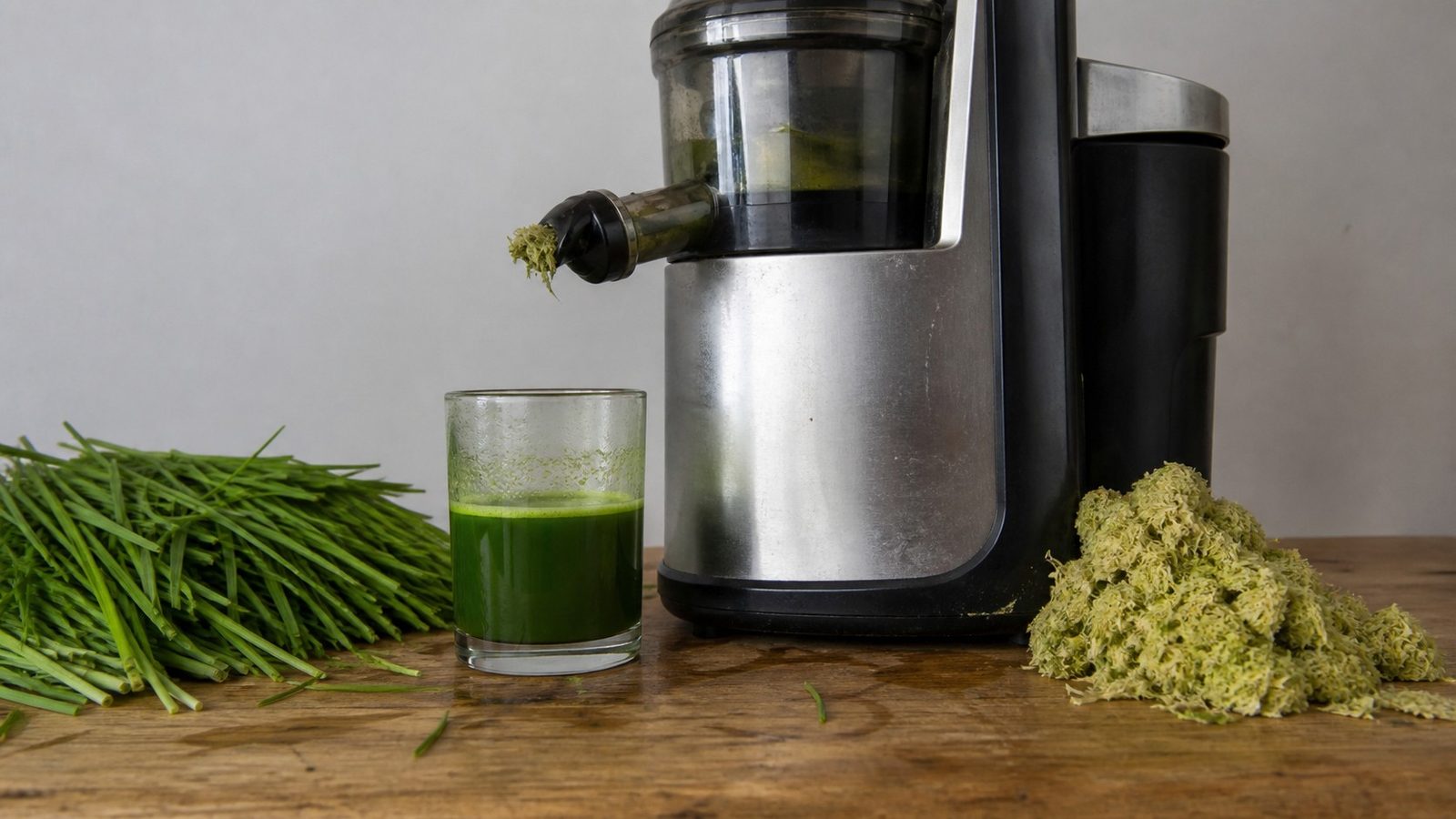
No peer-reviewed trial reports how much juice you get from a microgreen. Not for broccoli, kale, radish, pea, sunflower or any mix. The single tray-to-liquid figure anybody publishes is a seller's claim, it is about wheatgrass rather than a leafy microgreen, and it is measured on a tray that is not the standard one.
So, the arithmetic below is built on that one borrowed number.
What to actually do
- Blend and drink it rather than pressing it, unless you specifically want a strained shot. You keep the fiber and the yield question stops mattering.
- If you do press, use wheatgrass, and use a masticating or dedicated auger machine. It is the crop the equipment and the one published figure are both about.
- Do not juice expensive leafy crops. Three quarters of a tray for a glass is a poor trade when the tray could be eaten whole.
- Expect about $2.29 of seed in a glass of wheatgrass juice, and note that is the cheapest seed per pound there is, sown at the heaviest rate.
- Drink it fresh. Vitamin C is the fraction most sensitive to storage and heat.
- Treat home-pressed juice as raw and untreated, with the same handling and the same caution for vulnerable people that raw produce warrants.
- Do not weigh the pulp and call it nutrition lost. Nobody has measured what is in it.
The one number, corrected for tray size
A UK grower page says wheatgrass presses about 400 mL from a 510 by 310 mm tray.
That tray is not a 1020. At 51 by 31 cm it is 1,581 cm², against the 200 square inches, or 1,290 cm², of a standard 1020. The published tray is 22.5% larger.
Rescaled by area, the same claim gives about 326 mL from a 1020.
Hover or tap a row to highlight it.
| Figure | |
|---|---|
| Claimed yield, 510 by 310 mm tray | 400 mL |
| That tray's area against a 1020 | 22.5% larger |
| Rescaled to a 1020 | about 326 mL |
| A 240 mL glass, as a share of that tray | 0.74 of a tray |
So, one ordinary glass is roughly three quarters of a whole tray, on the only number that exists, for the crop that juices most easily.
Every step of that carries a caveat and they should all be said out loud. The 400 mL is a seller's unverified statement rather than a measurement. Rescaling by area assumes yield scales with area. And wheatgrass is a grass, with a long fibrous form that dedicated augers are built for; it is not a brassica microgreen and the figure should not be transferred to one.
What that costs in seed alone
Wheatgrass is sown at 450 grams a tray, the heaviest rate of any crop, and its entry puts the seed at $3.10 a tray. That is despite wheatgrass seed being the cheapest per pound; the rate is simply enormous.
Three quarters of that tray is about $2.29 of seed for one 240 mL glass.
Set that against an ordinary tray. The median seed cost across the 50 crops that publish one is $1.08 a tray. So a single glass of juice consumes about 2.1 median trays' worth of seed, and that is before medium, water, electricity, the tray itself, the labor, or the juicer.
The publisher of the 400 mL claim also says a tray costs roughly £2 to £3 to grow, which on its own assumptions puts £1.20 to £1.80 of crop inputs into a 240 mL glass. Different currency, different tray, same conclusion: juice is an expensive way to eat this crop.
What is actually unmeasured, which is nearly everything
- Juice yield per gram or per tray, for any microgreen. Not published for any crop.
- How much of a crop becomes pulp. No source measures the split by fresh mass or dry mass.
- What the pulp contains. This is the more interesting question and nobody has asked it. Pulp weight is not the same as nutrition lost.
- A grass-against-leaf yield difference, numerically. Only the mechanical difference is described.
- Any controlled comparison between juicer types on soft microgreens.
And you cannot infer yield from moisture. A 2025 review puts microgreens at 90 to 95% moisture, which is tempting and misleading: water held in tissue is not automatically recoverable as juice.
Equipment, where the advice is directionally right and not proven
Appliance testers consistently say masticating and cold-press machines suit leafy greens and centrifugals do not. One 2026 test guide describes cold-press machines as crushing and straining, better for leaves, and records poor leafy-green results from a centrifugal. Another explains the mechanism: light leaves get spun into the pulp bin before they are properly extracted.
That is buying evidence and a plausible mechanism, not a microgreen measurement. No study holds cultivar, harvest age, input mass and storage constant while comparing recovery and composition across centrifugal, masticating and hydraulic machines.
So, the fair statement is: choose a masticating juicer or a dedicated wheatgrass auger if you are going to try this. Not: a centrifugal cannot juice microgreens.
Price that decision against the arithmetic above before you make it. Masticating machines start around $66 and run past $150, and a dedicated manual wheatgrass press sits near $80. That is on top of a glass that already costs about 2.1 median trays of seed, so the machine is the second expense, not the first.
Half the "juice" recipes are not juice
In an eight-page set of juicing recipes, two are plainly blender recipes with a straining step, and one of them labels a pea-shoot blender drink as wheatgrass juice.
That matters for the arithmetic rather than for purity. Blending retains the whole suspended crop unless it is strained, so calling it juice hides both the fiber and the yield question this page is about. If you blend and drink it, you have eaten the crop and the yield problem disappears. If you press it, you have separated a liquid from a pulp, and nobody has measured what went where.
The weighed recipes that do exist are diluted. One publisher's 2025 shots use 15 to 20 g of wheatgrass plus 15 to 20 g of microgreens with 30 to 60 mL of water and other ingredients: a 30 to 40 g input, strained, rather than juice extracted from 30 to 40 g of greens. Another cold-press recipe lists 2 oz of wheatgrass and 2 to 3 tablespoons of other microgreens without a gram weight or a finished volume.
Fiber, vitamin C and the raw-juice question
Juicing removes fiber by design. That is the whole-fruit against juice principle federal food guidance already applies, and an evidence-informed university nutrition letter makes the same point about green juice specifically while pushing back on the more overblown claims made for it.
Vitamin C is the nutrient most exposed to the process, being sensitive to storage and heat. Drink it fresh rather than keeping it.
And raw juice is a food-safety category, not just a drink. Untreated packaged juice carries a required warning label in the United States, and the relevant guidance identifies at-risk groups. A home press is untreated juice by definition. The same care applies as for any raw produce, and washing has limits that federal produce guidance states plainly.
One more distinction worth holding. Wheatgrass is loosely marketed as a microgreen and is a grass; federal guidance distinguishes microgreens from sprouts by growth stage, and the categories are not interchangeable when it comes to either juicing behavior or safety rules.
What is still genuinely unknown
- Press yield for any microgreen, in mL per gram or per tray. The entire page rests on one seller's wheatgrass figure because there is nothing else.
- The pulp fraction and its composition, which is the question that would actually tell you what juicing costs nutritionally.
- How much of a named brassica microgreen makes a 240 mL glass.
- Whether masticating machines really do recover more from microgreens, as opposed to from leafy greens generally.
- Any dollar cost per glass that is not built on a borrowed number. The formula is simple; the measured inputs do not exist.
Terms on this page
Tap a term to see what it means.
Masticating juicer. A slow machine that crushes and presses. Recommended for leaves by appliance testers, on test results rather than microgreen trials.
Sources
Opened 2026-08-12. The tray-area correction, the rescaled 326 mL, the per-glass tray share and the seed cost per glass are arithmetic performed for this page, built on the one published yield claim below plus the seed figures in the wheatgrass entry.
- HydroponicsUK growing guide - the claim that wheatgrass presses about 400 mL from a 510 by 310 mm tray, and that such a tray costs roughly £2 to £3 to grow. A seller and grower statement, dated 2026-06-12 and opened 2026-08-12, and the only tray-to-liquid figure this page could find anywhere.
- A 2025 review of microgreen composition - the 90 to 95 percent moisture figure, used here only to make the point that tissue water is not recoverable juice.
- Process optimization for fresh Alternanthera sessilis microgreen juice, 2021 - the one peer-reviewed microgreen juice paper located. It measured processing quality of a formulation including ginger extract, sugar syrup and salt, and gives no harvest-to-juice yield.
- TechRadar juicer tests and Tom's Guide juicer tests - that cold-press and masticating machines crush and strain and suit leafy greens, the poor leafy-green result recorded for a centrifugal, and the mechanism whereby light leaves are spun to the pulp bin. Appliance testing, not microgreen measurement.
- Recipe practice, recorded to show what is actually being recommended: Cotyledon's weighed blender-and-strain shots using 15 to 20 g wheatgrass plus 15 to 20 g microgreens with 30 to 60 mL water; Tasty Little Leaves' cold-press recipe specifying a masticating machine, 2 oz wheatgrass and 2 to 3 tablespoons of other microgreens with no gram weight or finished volume; a Roots n Shoots recipe collection (PDF) containing blender recipes including a pea-shoot drink labeled as wheatgrass juice; and Goodnature's press recipe, which is a multi-ingredient press drink.
- FDA on juice safety - the required warning label on untreated packaged juice and the at-risk groups, plus the juice HACCP guidance for the processing context, and FDA on selecting and serving produce safely for raw-produce handling and the limits of washing.
- FDA sprout guidance (PDF) - the microgreen and sprout distinction by growth stage, which is why wheatgrass being called a microgreen matters here.
- NIH Office of Dietary Supplements vitamin C fact sheet - vitamin C in juice and its sensitivity to storage and heat.
- USDA Food Buying Guide, fruits - the whole food against juice fiber principle, and Tufts on green juice for an evidence-informed account of the fiber question and the overblown claims made for green juice.
- The Green Ninja - a commercial example of frozen untreated broccoli, pea and sunflower shots, recorded as practice.
- Ranking-page claims audited rather than relied on: MicrogreensWorld on juicing microgreens, which carries an unsupported multiplier claim, and a seller's repetition of it.
Keep reading
The journal
Microgreens for Skin, Hair and Detox: What the Evidence Shows
The wheatgrass detox claim traces to one person in 1955, not to a study. There are five human wheatgrass trials, they are about colitis and thalassemia, and the two largest were negative.
Read Microgreens for Skin, Hair and Detox: What the Evidence ShowsThe journal
Are Microgreens Low FODMAP? What Monash Research Shows
Are microgreens low FODMAP? Learn what Monash sprouting research shows, which crop families deserve extra caution, and how reintroduction testing works.
Read Are Microgreens Low FODMAP? What Monash Research ShowsThe journal
Best Microgreens for Kidney Health: Potassium by the Serving
See measured potassium and phosphorus for the best microgreens for kidney health, from lowest to highest, plus what your renal dietitian needs to know.
Read Best Microgreens for Kidney Health: Potassium by the ServingThe journal
Can You Cook Microgreens? Yes, and Pea Shoots Are the One With Real Evidence
Yes, and the technique is the whole answer: add them late. Every documented method adds them at or near the end, and pea shoots are the one crop with a real cooked recipe behind it.
Read Can You Cook Microgreens? Yes, and Pea Shoots Are the One With Real Evidence