Are Microgreens Anti-Inflammatory? What the Research Really Says
Cal HewittPublished Checked
- health
- nutrition
- evidence
- red cabbage
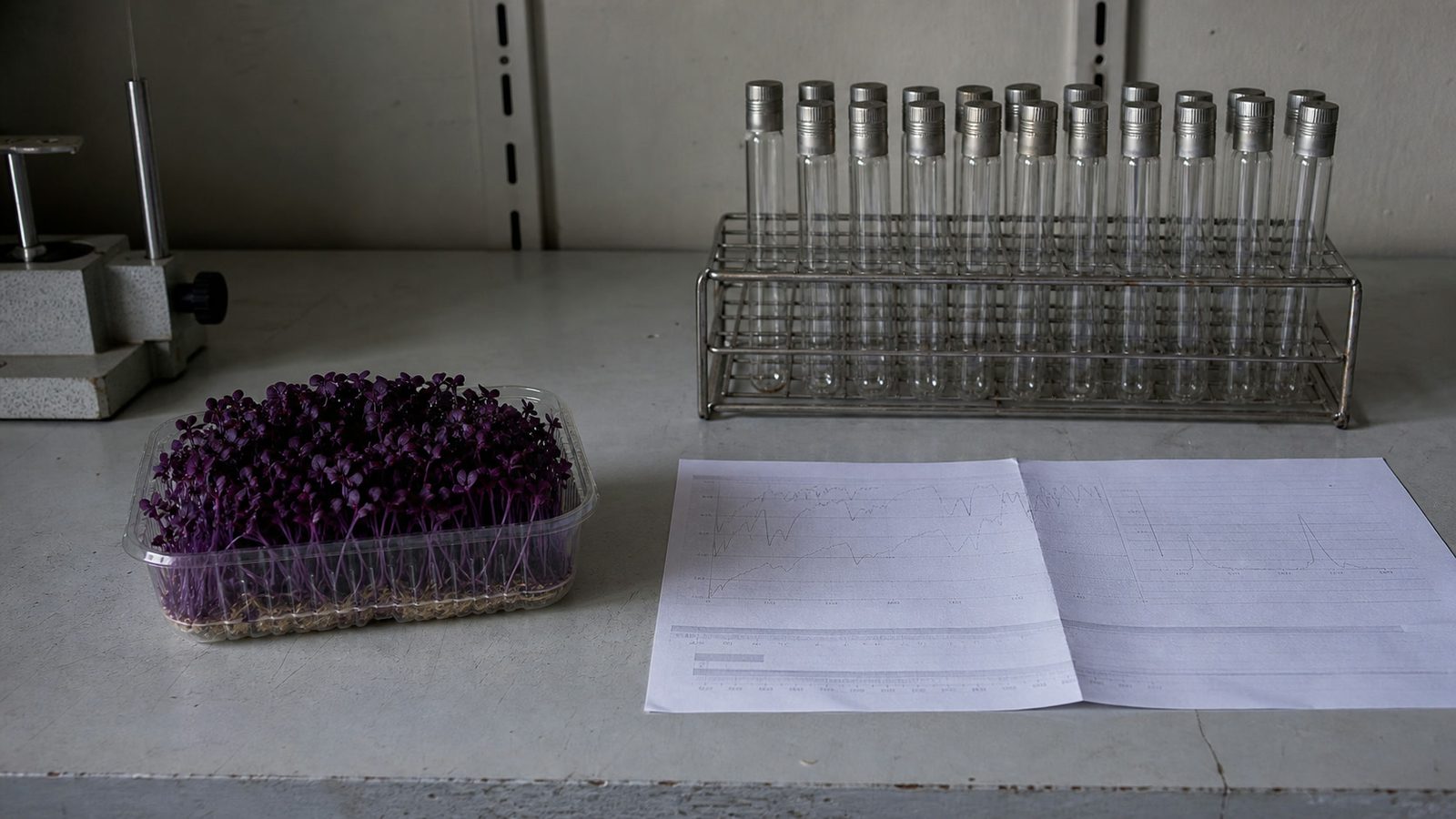
Short answer: nobody has tested it. No study has ever fed a person microgreens and then measured their inflammation. Not once.
"Anti-inflammatory" is the easiest thing in the world to say about a food, because it sounds like a fact without naming anything you could check. Inflammation is measured with blood markers, the research behind the claim is real research, and almost none of it is about microgreens.
The step where the evidence runs out is always the same one.
The one human microgreen study, and what it looked at
A 2025 trial did give red cabbage and beet microgreens to 26 healthy middle-aged and older adults, 24 of whom finished, in a randomized crossover design.
It was a feasibility and tolerability study. The question it asked was whether people would eat the things and get on with them. It reported a questionnaire result, not a blood test, and its own summary says plainly that the human health effects are unknown.
That is the whole of the direct human evidence on microgreens and inflammation. One study, 24 people, no blood markers.
The study everyone quotes used sprouts
Lopez-Chillon and colleagues, 2018 is the one you will have seen, and it is a genuinely interesting piece of work. Forty healthy overweight adults ate 30 g of broccoli sprouts a day for 10 weeks, then went 10 weeks without. IL-6 fell from 4.76 to 2.11 pg/mL by day 70. CRP fell from 2.42 to 1.52 mg/mL.
Those are large moves. Three things sit between them and the claim they get used for.
There was no control group. Everybody got sprouts. Nothing was compared against anything, so there is no way to separate the sprouts from the season, the weather, or the fact that people who sign up for a vegetable study tend to change other habits too.
The authors say so themselves. They write that the lack of a parallel randomized control group is a limitation and that the finding "will have to be tested in a proper trial". That is the sentence that never survives the trip into a wellness article.
The sprouts were not ordinary sprouts. They had been biostimulated with methyl jasmonate to push their compound content up. What was on the plate is not what is in the punnet at the store.
And underneath all three: sprouts are not microgreens. The FDA treats them as different products with different rules, because sprouts are germinated in water and harvested before true leaves, while microgreens are grown in a substrate and cut above it.
Hover or tap a row to highlight it.
| Study | People | Material | Result |
|---|---|---|---|
| Lopez-Chillon 2018 | 40, healthy overweight | Fresh broccoli sprouts, 30 g/day, 10 weeks | IL-6 4.76 to 2.11 pg/mL, CRP 2.42 to 1.52 mg/mL. No control group |
| Bahadoran 2012 | 81 with type 2 diabetes, 63 analyzed | Sprout powder, 5 or 10 g/day, 4 weeks | hs-CRP down 16.4% and 20.5%. IL-6 and TNF-alpha changes not significant |
| 2025 feasibility trial | 24 healthy adults | Red cabbage and beet microgreens | Tolerability questionnaire. No blood markers measured |
Read down the material column. The only row that used microgreens is the only row with no blood result in it.
The number that changes the picture
Here is the figure that almost never appears in an article about this, and it is the most important one on the page.
Researchers pooled ten broccoli sprout trials and calculated the combined effect.
Hover or tap a row to highlight it.
| Marker | Combined effect | Range the true answer sits in | Verdict |
|---|---|---|---|
| CRP | -0.28 ng/mL | -0.75 to +0.20 | Could be zero |
| IL-6 | -1.09 pg/mL | -3.07 to +0.90 | Could be zero |
Both ranges cross zero. That is the statistical way of saying the effect might not be there at all. The IL-6 studies also disagreed with each other violently, at an I-squared of 93.4 percent, which means almost all the variation between them was real difference rather than chance. The review's authors add that no intervention-versus-control difference reached significance for the variables they reported.
So, even for sprouts, which are the wrong product, adding up all the human evidence gives you nothing conclusive. A microgreen claim built on top of that is an assumption stacked on an inconclusive result.
The mechanism, and the exact point it stops
There is a real biological story here. It is coherent, it is well studied, and every one of its early steps has been demonstrated. Laying it out step by step is also the fastest way to see where it breaks.
The proposed chain, and the level each step has actually been shown at
- 1
The plant makes the precursor
Broccoli microgreens carry the glucosinolate precursors, but mostly the wrong one for this story: glucoerucin at 28.1 against glucoraphanin at 0.9 micromoles per gram of dry weight. Shown in PLANTS, by chemical assay.
- 2
Chewing releases the enzyme
Damaging the tissue lets myrosinase meet glucoraphanin and convert it to sulforaphane. Gut bacteria do some of the same job further down. Shown in PLANTS, and in PEOPLE eating sprouts.
- 3
Sulforaphane is absorbed
In the sprout study, intact plant compounds were not found in 24-hour urine at all. They had been broken down and rebuilt first, and the metabolites that did appear tracked with the marker changes. Shown in PEOPLE eating SPROUTS.
- 4
Sulforaphane releases the switch
It modifies cysteines on Keap1, the catch that normally holds Nrf2 down, so Nrf2 is freed. Shown IN VITRO, in cells.
- 5
Protective genes turn on
Freed Nrf2 raises expression of the cell's own cytoprotective genes. Shown IN VITRO.
- 6
Inflammatory signalling quiets down
Experimental systems report knock-on effects on NF-kB, the hub that drives IL-6 and TNF-alpha production. Shown IN VITRO, and in ANIMALS for red cabbage microgreens.
- 7
Blood markers move in a person
NEVER SHOWN FOR A MICROGREEN. The best attempt is an uncontrolled sprout study, and pooling ten sprout trials gives a result that could be zero.
The chain breaks after composition and exposure. It is fair to say a broccoli microgreen contains glucosinolates. It is not established that a person absorbs a predictable amount of sulforaphane from it, reaches the concentration the cell experiments used in the tissue that matters, changes Nrf2 or NF-kB there, and then moves a blood marker against a control.
Every confident article on this subject is describing the first two steps and implying the last one.
What is actually in the crop
The chemistry is far better documented than the outcomes, and it is worth seeing, because the spread is the story.
Researchers measured 25 different microgreens in a laboratory food analysis. No people, no animals, just the plants.
Hover or tap a row to highlight it.
| Nutrient | Range across 25 crops | Highest of those tested |
|---|---|---|
| Vitamin C | 20.4 to 147.0 mg per 100 g fresh | Red cabbage |
| Beta-carotene | 0.6 to 12.1 mg per 100 g | Cilantro |
| Lutein and zeaxanthin | 1.3 to 10.1 mg per 100 g | Cilantro |
| Vitamin K1 | 0.6 to 4.1 micrograms per gram | Garnet amaranth |
| Vitamin E | 4.9 to 87.5 mg per 100 g | Green daikon radish |
Look at the ranges rather than the headline. The top of the vitamin C range is seven times the bottom. The vitamin E range spans a factor of eighteen. A single number for "microgreens" is close to meaningless, and the crop you grow matters far more than the category does.
USDA's own summary of that work says microgreens averaged about five times the vitamins and carotenoids of mature leaves. That is an average across 25 crops, not a promise about any one of them, and it is a composition measurement rather than a health outcome. The popular version, that microgreens have forty times the nutrients, erases both the crops where the figure is lower and the fact that different studies used different units.
For brassicas specifically, the glucosinolate measurements above are real and useful. What nobody has is a clean matched measurement of the same cultivar grown to maturity under the same conditions, so there is no validated microgreen-to-mature ratio. The one direct comparison available reports that microgreens carried more total aliphatic glucosinolates than mature florets and leaves, while the mature tissue was more concentrated in glucoraphanin specifically. One compound up, another down, in the same crop. That is the opposite of a simple multiplier.
Nor is there one for harvest stage. Nobody has grown the same cultivar to cotyledon and to first true leaf, measured both, and then tested either in a person. Glucoraphanin concentration is known to fall as a plant puts on biomass, which suggests the stage matters, but suggests is all it does.
How you grow it and store it moves the chemistry
This is where the research gets genuinely practical, and it is worth knowing whether or not you care about a blood marker.
USDA researchers gave broccoli microgreens a dose of UV-B light before harvest and measured what it did. At 0.09 and 0.27 Wh per square meter, glucoraphanin, glucoerucin and total aliphatic glucosinolates rose by 13.7 and 16.9 percent respectively, on the day of harvest. Pairing the UV-B with a 10 mM calcium chloride treatment was associated with better quality across 21 days of storage.
And the compounds held. Glucosinolate levels changed only slightly over those 21 days, which is a good deal more robust than the leaf itself.
The leaf is the fragile part. A review of microgreen handling notes that washing and dewatering damages them and makes them more susceptible to microbial growth afterward. That lines up with what our harvesting and washing review found: three extension services say do not wash microgreens you intend to store.
What none of this establishes is a link to a person. No study has shown that blackout length, growing medium, light recipe or storage time changes anybody's CRP.
Why nobody can tell you a portion size
The obvious question: the sprout study used 30 g, so how many grams of microgreens is that?
You cannot get there, and the reasons are worth knowing because they apply to every claim shaped like this one.
The sprouts in that study were measured at 6.22 micromoles per gram fresh weight of total aliphatic glucosinolates, delivering 51.08 mg of glucoraphanin in a 30 g serving. Converting that into a microgreen amount would require a batch-specific assay of the microgreen and a known conversion yield, and neither exists. The powder trial reports grams of powder and a nominal concentration, which is further away still.
Then there is you. How much sulforaphane actually arrives depends on the cultivar, how much precursor it grew, whether the myrosinase survived preparation, how thoroughly you chew, and your own gut bacteria. The same plate delivers different amounts to different people, and nobody has measured that range for any microgreen.
Any gram figure you see quoted has been worked backwards from a sprout or powder study. It is a guess wearing a lab coat.
The mouse study, which really did use microgreens
Sixty male mice were randomly assigned to diets for eight weeks. One group's feed contained 1.09 percent red cabbage microgreens, another 1.66 percent mature red cabbage, against controls. In the mice on a high-fat diet, the microgreen diet lowered expression of inflammatory cytokines in the liver, and improved lipid outcomes too.
That is a real result with the right material in it, and it is the strongest evidence there is.
It is also a mouse, on a controlled laboratory ration, at a percentage of total food intake. Turning "1.09 percent of a mouse's diet" into a human portion is not a calculation anybody can do honestly, because the species, the body size, the total energy intake and the metabolism all differ. Reviews also describe broccoli microgreen powder experiments in rats, which adds a concentrated material to the same problem.
Cells in a dish, which is where most of the mechanism lives
Sulforaphane and broccoli sprout extract have been tested on immune cells provoked with a bacterial toxin, the standard laboratory way of switching inflammation on, and in an animal model of liver injury. The extract calmed the cells down.
The catch is the concentration. Cell culture experiments use micromolar amounts in the medium directly. Comparing that with what a person reaches by eating requires knowing the blood and tissue levels that food produces, and for fresh microgreens nobody has measured them. So, the comparison cannot be made, in either direction.
What about ordinary vegetables
Fair question, and the honest answer is that the vegetable evidence is not as clean as you would expect either.
A randomized crossover trial fed 63 healthy adults mature cruciferous vegetables at 7 or 14 g per kilogram of body weight. For an average adult that is several hundred grams of broccoli and cabbage a day, on a controlled diet, which is not ordinary eating by any definition. Marker effects were variable. No microgreens were involved.
Three ways a claim gets ahead of its evidence
Once you have seen the pattern you will spot it on every page about this, and it takes three forms.
Three ways a claim gets ahead of its evidence
Hover or tap a card to highlight it.
Swapping the product
A broccoli SPROUT study written up as evidence about microgreens. The 30 g sprout trial is the one this happens to most. The FDA classes them as different products grown different ways.
Swapping the subject
A MOUSE or a cell result written up as a human result. The 60-mouse red cabbage experiment gets presented as proof of a human CRP change fairly regularly.
Turning composition into an outcome
A nutrient ASSAY becoming a health claim. The 25-crop vitamin study measured chemicals in plants. It did not measure CRP, IL-6, TNF-alpha, or anybody's health.
Nobody official says this
Nothing from FDA, USDA or NIH says microgreens lower inflammation. USDA says its assay measured vitamins and carotenoids and that levels varied widely by crop, which is a statement about chemistry. FDA addresses microgreens as produce and distinguishes them from sprouts, and says nothing about inflammation at all.
The American Heart Association's framing is the sensible one to borrow. It names green leafy and yellow vegetables and whole grains among foods associated with lower inflammation, then says plainly that one food does not counterbalance an otherwise pro-inflammatory diet, and that diet does not replace prescribed anti-inflammatory medicine.
The questions nobody has even asked yet
It is worth seeing the size of the gap. For microgreens and inflammatory markers, there is no human study of: whether any named crop changes any marker; how broccoli, kale, radish, arugula, cabbage, beet, pea and sunflower compare with each other; whether more does more; how often or how long you would need to eat them; whether anything persists after you stop; what happens in people with a diagnosed inflammatory condition; what happens alongside medication; whether your baseline diet, age, sex, genotype or gut bacteria change the answer; or whether fresh, dried and cooked differ.
Not one of those has been answered. That is not a field with gaps in it. That is an empty field.
Safety, which is a separate subject and a real one
None of this is about inflammation, and all of it matters more than the inflammation question does, because these are risks that actually exist.
Warfarin. Leafy greens carry vitamin K, which interacts seriously with warfarin. NIH's advice is consistency rather than avoidance: it is the sudden change in intake that causes the problem. Worth a word with whoever manages your prescription before you start eating a tray a week.
Raw produce and higher-risk groups. These are eaten raw. FDA advises pregnant people, older adults, children and anyone immunocompromised to avoid raw sprouts, advice written for sprouts and not automatically transferable. Microgreens have a much better record, though not a perfect one: there has been a recall of broccoli microgreens after a listeria positive, with no illnesses reported. No published case report attributes an illness to eating microgreens. That is not the same as zero risk.
Microgreens are not sprouts, and the difference is documented. FDA counted 52 sprout-associated outbreaks and more than 2,700 illnesses between 1996 and 2020, including a 2022 alfalfa outbreak with 63 illnesses and 10 hospitalizations. The warm wet conditions that sprouting requires are what amplify pathogens. Microgreens have no comparable record.
Not every microgreen is the same. Borage microgreens were measured at 130 times the EU limit for a class of compound that affects the liver, as the borage page sets out. "Microgreens" is a category, not an ingredient, and treating it as one is exactly the error to avoid.
So, are they anti-inflammatory
Nobody knows. Not proven, not disproven, untested.
What is true is that these are young vegetables with genuinely good nutrient numbers, that people tolerate them well, and that eating more vegetables is sound advice for reasons that have nothing to do with a blood marker.
If you want to grow the crop with the most research anywhere near it, that is broccoli, and broccoli microgreen seed is one of the cheapest and most forgiving crops in the directory. If you want the one from the mouse study, that is red cabbage, which is also the best-looking thing on the shelf.
Grow them because they taste good and you will eat more vegetables. If you are managing an inflammatory condition, that is a conversation with your doctor and not with a nutrient table, and nothing here is a reason to change a prescription.
What would settle it
A preregistered, adequately powered, parallel randomized trial. Adults with stable raised hs-CRP and no acute infection, randomly assigned to a batch-characterized brassica microgreen or an equal-calorie mature brassica control, with hs-CRP as the primary outcome, IL-6 and TNF-alpha secondary, plus adherence and adverse events, run long enough to tell a passing change from a sustained one.
It has never been done. Compared with most nutrition research it would be cheap, and the one thing this field is short of is a study that uses the actual food.
Terms on this page
Tap a term to see what it means.
CRP. C-reactive protein. A substance the liver makes when there is inflammation somewhere in the body. It is the marker doctors order most often, and it is a general alarm rather than a diagnosis.
Sources
- Lopez-Chillon et al., 2018, Clinical Nutrition - 40 adults, 30 g/day fresh broccoli sprouts, 10 weeks; IL-6 4.76 to 2.11 pg/mL, CRP 2.42 to 1.52 mg/mL, no control group, methyl jasmonate biostimulation, the 6.22 micromol/g chemistry, the urine metabolite finding, and the authors' own caution.
- 2023 meta-analysis of broccoli sprout trials - ten trials pooled; CRP -0.28 ng/mL (-0.75 to 0.20) and IL-6 -1.09 pg/mL (-3.07 to 0.90), I-squared 93.4 percent, and no significant intervention-versus-control differences.
- Bahadoran et al., 2012, Journal of Functional Foods - 81 randomized, 63 analyzed, broccoli sprout powder at 5 and 10 g/day for 4 weeks; hs-CRP down 16.4 and 20.5 percent, IL-6 and TNF-alpha not significant within arms.
- 2025 red cabbage and beet microgreen trial - 24 healthy adults, randomized open-label crossover, feasibility and tolerability, no blood inflammatory endpoints, and its own statement that health effects are unknown.
- Huang et al., 2016, J. Agric. Food Chem. - 60 male mice, eight weeks, 1.09 percent red cabbage microgreens against 1.66 percent mature red cabbage; lower liver cytokine expression on a high-fat diet.
- Sulforaphane and broccoli sprout extract in provoked macrophages and a liver-injury model - the in vitro and animal mechanism work.
- Mature cruciferous vegetable crossover trial - 63 healthy adults at 7 and 14 g per kg body weight, variable marker effects, no microgreens.
- USDA microgreen nutrient assay and its summary - 25 crops, the vitamin and carotenoid ranges, and where the "about five times" average comes from.
- Broccoli microgreen and mature comparison, with storage chemistry - glucoerucin at 28.1 against glucoraphanin at 0.9 micromol/g dry weight, glucoerucin 20-fold higher than glucoraphanin in every microgreen sample, about four times the total aliphatic glucosinolates of mature leaves and florets, and glucoraphanin the major one in the mature tissue at over 50 percent of floret glucosinolates. Read at source on 2026-08-12, which settled a labeling conflict between two research files that had the pair reversed.
- USDA ARS, UV-B and calcium chloride on broccoli microgreens - 13.7 and 16.9 percent glucosinolate increases at harvest, and 21-day storage quality.
- Turner review on handling microgreens - washing and dewatering damage and increased microbial susceptibility.
- American Heart Association on inflammation and diet - dietary patterns, the one-food caution, and that diet does not replace medicine.
- FDA on sprouts and microgreens, the raw sprout advice, the sprout outbreak record, the 2022 alfalfa outbreak, and the microgreen recall.
- NIH on vitamin K and warfarin.
- Borage pyrrolizidine alkaloid measurement - 130 times the EU maximum, average factor.
Keep reading
The journal
Do Microgreens Really Have 40 Times the Nutrients?
The number is real. It belongs to one nutrient in one crop. Used for microgreens as a category it is wrong in both directions, because some pairs run far above 40 and for at least one compound the mature plant is the more concentrated of the two.
Read Do Microgreens Really Have 40 Times the Nutrients?The journal
Best Microgreens for Kidney Health: Potassium by the Serving
See measured potassium and phosphorus for the best microgreens for kidney health, from lowest to highest, plus what your renal dietitian needs to know.
Read Best Microgreens for Kidney Health: Potassium by the ServingThe journal
Do Microgreens Help You Lose Weight? Two Claims, One Answer
One of these claims is probably true and has nothing to do with microgreens. The other was tested by injecting a compound into mice. Here is which is which.
Read Do Microgreens Help You Lose Weight? Two Claims, One AnswerThe journal
Heavy Metals and Nitrate in Microgreens: What Has Actually Been Measured
The nitrate figures circulating for microgreens are dry weight, and the legal limits are fresh weight. Convert the same published result and it lands anywhere from 1,045 to 11,307 mg/kg depending on the crop. Three species have been assayed for metals.
Read Heavy Metals and Nitrate in Microgreens: What Has Actually Been Measured