Do Microgreens Help You Lose Weight? Two Claims, One Answer
Cal HewittPublished Checked
- health
- nutrition
- evidence
- sunflower
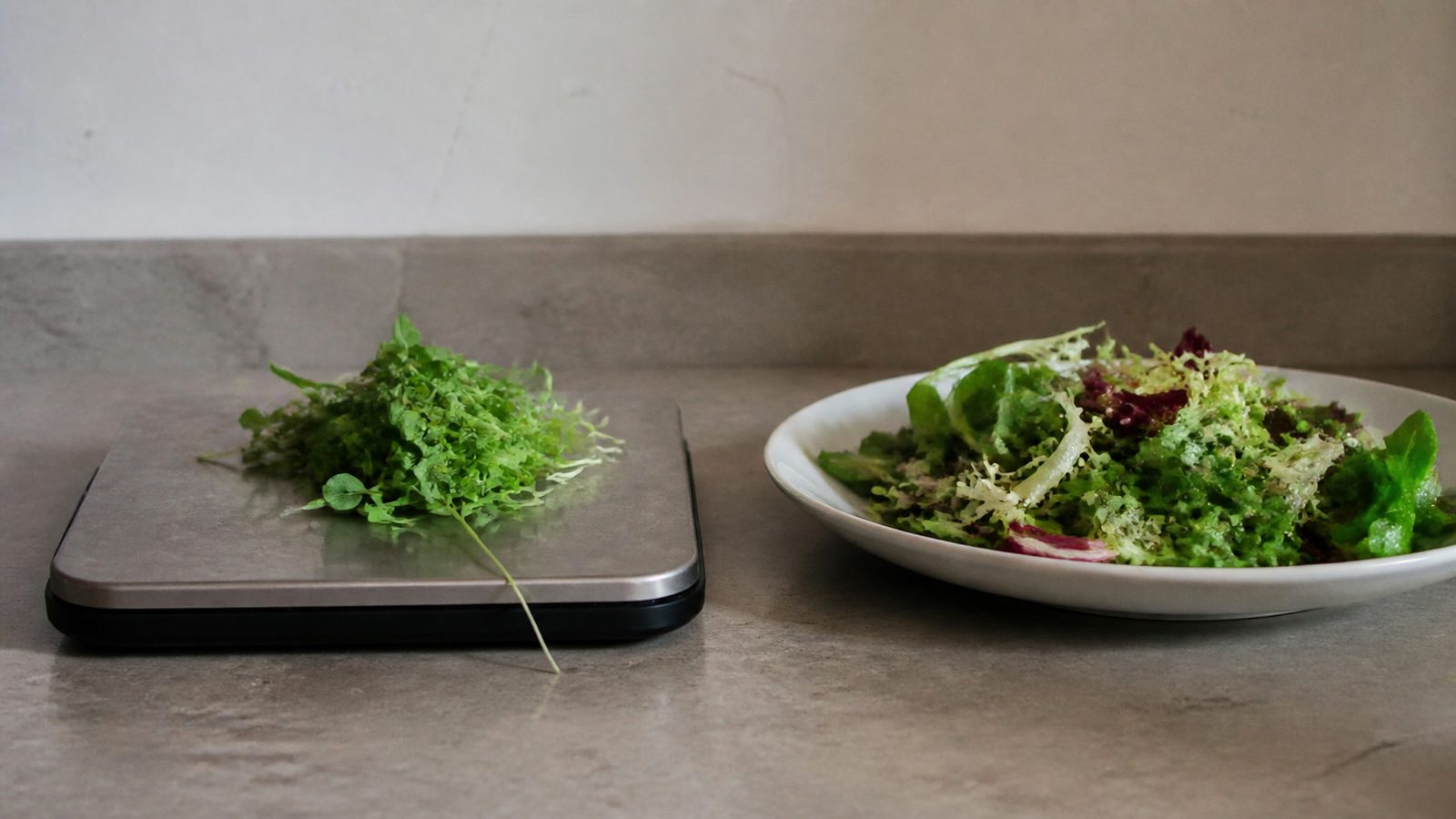
There are two completely different claims tangled up in "microgreens help with weight loss", and almost nobody separates them. Once you do, the answer gets a lot clearer.
Hover or tap a row to highlight it.
| The claim | Is it plausible | Has it been tested |
|---|---|---|
| They replace something heavier on the plate | Yes, obviously | Not with microgreens, but the principle has been tested in vegetables generally |
| Something in them changes your metabolism | Only in mice, and only when injected | No human study at all |
The first is a swap. Put a low-calorie vegetable where a higher-calorie thing was and you eat fewer calories. That is true of lettuce, cabbage and cucumber too. It is not really a fact about microgreens.
The second is what people usually mean, and it is the one with a problem.
Nobody has tested microgreens for weight
Not for weight, not for how full you feel, not for the calorie density of your diet, not for diet quality. The human microgreen studies that exist looked at chemistry, or at whether people would eat them at all.
That is the finding. The rest is the next-nearest evidence and the reasons it does not transfer.
The closest study found no weight change
Forty adults with overweight ate 30 g of fresh broccoli sprouts every day for 10 weeks. Average starting weight 85.8 kg, average BMI 28.9, so exactly the group you would want to see something in.
Their weight did not change. Their BMI did not change. Body fat percentage dipped slightly at week 10, to a ratio of 0.947 against each person's own starting point, and then drifted back toward baseline once the sprouts stopped. There was no control group, so nothing can be pinned on the sprouts anyway, and the authors say so: they write that their findings "can only be extrapolated to these type of population and not to the overall" population, and that a parallel randomized control would be needed to establish cause.
That serving was not a token amount either. Each 30 g carried about 51 mg of glucoraphanin and 121 mg of total glucosinolates, and the sprouts had been deliberately treated with methyl jasmonate to raise those levels. Ten weeks of a boosted daily dose of the compound everyone is excited about, in the right population, and the scale did not move.
The other human sprout studies do not help, because they were not looking at this at all.
Hover or tap a row to highlight it.
| Study | What people got | What was measured |
|---|---|---|
| van den Munckhof 2024, 12 people | 16 g sprouts, one serving, before a high-calorie challenge | Inflammatory, endothelial and metabolic stress markers |
| Bahadoran 2011, 81 randomized, 63 analyzed | Sprout powder, 5 or 10 g/day, 4 weeks | Oxidative stress markers |
| Kensler 2006 | Sprout extract, three times daily for 7 days after a crucifer-free run-in | Phase I: tolerance and how the body processes it |
None of these is a weight study. A study measuring something unrelated is not a weight-loss study, and relabeling them is how a thin body of research ends up looking substantial.
What vegetables in general actually do to the scale
Here is the part that gets skipped, and it is the honest ceiling on the whole subject. If the mechanism is really just "eat a vegetable instead of something else", then the vegetable literature already tells you roughly how big that effect is.
Hover or tap a row to highlight it.
| What was pooled | Result | Range | Reading |
|---|---|---|---|
| 7 trials, 1,026 people, more fruit and veg with no wider weight program | -0.54 kg | -1.05 to -0.04 | Real, small, and the studies disagreed a lot (I-squared 73%) |
| Trials intended for weight or fat loss | SMD -0.16 | -0.78 to +0.46 | Could be zero. P = 0.60 |
Roughly half a kilogram, from mature fruit and vegetables generally, in trials that mostly ran a few months. And when researchers looked specifically at trials designed to lose weight, the pooled result crossed zero.
Neither review included microgreens, sprouts or any single crop. But it sets the scale: the substitution effect is real and it is modest. Nothing about a microgreen makes it a bigger lever than a cabbage.
The metabolism claim was injected into mice
The interesting version of the claim is that sulforaphane does something to fat cells, nudging energy-storing white fat toward the more active brown kind.
Researchers tested that in 28 female mice on a high-fat diet, given 10 mg per kg of purified sulforaphane by injection into the abdominal cavity, daily, for about 36 days. The mice gained less weight, their fat cells were smaller, and the browning markers shifted. Food intake did not differ between groups, which the authors take as evidence the effect was metabolic rather than appetite driven.
Read that back slowly. Purified compound. Injected. Mice.
Pooling the rodent work gives you a number, and the number is worth seeing. Six rodent studies of sulforaphane supplements pooled to a body weight difference of -2.76 g (95% confidence interval -4.19 to -1.34), and -3.30 g in obesity models specifically. Grams, in animals that weigh about 30 of them. The doses, routes and study designs varied enormously.
There is also a rat study using dried broccoli sprouts at 300 mg per kg of body weight three times a week from four months of age until death. Dried material, rodents, and a lifetime protocol. Not fresh microgreens and not a human meal.
Cells in a dish, where the mechanism actually lives
Mouse fat-cell precursors exposed to isolated sulforaphane accumulate less fat, with an IC50 of 7.3 micromoles per liter. The Liu team used 1, 5, 10 and 20 micromolar in a different cell line.
Those are concentrations in culture medium, applied directly to the cell. Getting from there to "eat this many grams" requires digestion, absorption, first-pass metabolism through the liver, distribution and clearance, and no human blood level has ever been established as the target for this outcome.
The chain, and where it stops
The proposed metabolic chain, and the level each step has been shown at
- 1
The plant makes the precursor
Brassica microgreens contain glucoraphanin and other glucosinolates. Shown in PLANTS, by chemical assay.
- 2
Chewing converts it
Damaged tissue lets the plant's myrosinase turn glucoraphanin into sulforaphane. Gut bacteria do some of the same job, with variable efficiency between people. Shown in PLANTS and in PEOPLE.
- 3
Sulforaphane is absorbed
A study fed 11 people fresh broccoli MICROGREENS and found the metabolites in their urine afterward. Shown in PEOPLE eating MICROGREENS. This is the strongest microgreen-specific step there is.
- 4
It reaches fat tissue at an active concentration
NOT SHOWN. No human blood or tissue target has been established for this outcome, so there is nothing to compare a food amount against.
- 5
Fat cells change behavior
Less fat accumulation, altered browning markers. Shown IN VITRO at 7.3 micromolar, and in MICE given injections.
- 6
A person's weight changes
NEVER SHOWN for a microgreen. The nearest food-form human study ran 10 weeks on sprouts and found no change in weight or BMI.
Step three is genuinely good news and it is worth saying clearly: eating microgreens does get the compound into you. That is not something you can take for granted with a plant compound. It is also the last step anybody has demonstrated.
Why you cannot convert the sprout serving into microgreens
The 30 g of sprouts contained about 51 mg of the precursor, which looks like a number you could do arithmetic with. You cannot.
How much a plant contains varies with the genotype, the harvest day, the growing conditions, processing, how much you chew, and how much of the converting enzyme survived. Those particular sprouts had also been treated to boost their levels, so they were not ordinary produce. Powders and extracts are further away still, because drying changes water content and can concentrate or alter the active compounds.
Getting a real answer would take a batch analysis of the exact microgreen you are eating, reporting glucoraphanin and sulforaphane per gram of fresh weight. Any gram figure you see quoted today has been worked backwards from a study of something else.
The crop matters far more than the category
Where the research is genuinely strong is composition, and it says something useful: "microgreens" is not one food.
A laboratory analysis of 25 commercially grown microgreens measured vitamins and carotenoids in the plants, then compared them against published values for the mature crop.
Hover or tap a row to highlight it.
| Crop and nutrient | Microgreen | Mature | Ratio |
|---|---|---|---|
| Red cabbage, vitamin C | 147.0 mg/100 g | 24.4 mg/100 g | About 6 times |
| Red cabbage, beta-carotene | 11.5 mg/100 g | 0.044 mg/100 g (a 2006 study the paper cites); USDA lists 0.670 | About 260 times on the paper's figure, about 17 on USDA's |
| Red cabbage, lutein and zeaxanthin | 8.6 mg/100 g | 0.3 mg/100 g | About 29 times |
| Cilantro, lutein and zeaxanthin | 10.1 mg/100 g | 0.9 mg/100 g | About 11 times |
| Cilantro, beta-carotene | 11.7 mg/100 g | Reported as one third | About 3 times |
| Golden pea tendrils grown dark, beta-carotene | 0.6 mg/100 g | Lower than light-grown | The study's lowest |
That last row is why the popular "microgreens have 40 times the nutrients" line is not a rule. The same study that produced the 260-fold red cabbage figure (about 17-fold against USDA's mature value) also produced its lowest carotenoid reading, in a crop grown without light. Broccoli microgreen minerals behave the same way: compost-grown material averaged 1.73 times mature broccoli across eight minerals, while hydroponic cultivation changed both the direction and the size of the difference.
Growing conditions move the numbers on purpose too. A plant experiment on cabbage and Chinese kale microgreens found lower nitrate at higher light intensity, and light and photoperiod both shifted glucosinolates and vitamin C.
None of it is a weight result. All of it is a reason to be specific about which crop, grown how.
The bit specific to microgreens that nobody mentions
Here is the practical problem with the swap argument as it applies to this crop.
A microgreen serving is tiny. A garnish does not replace anything. For the substitution to do any work, the greens have to take up space on the plate that something denser would have occupied, and that means eating them by the handful rather than the pinch.
Which raises the real question: would you eat that many, and what would it cost to grow them?
Hover or tap a row to highlight it.
| Crop | Yield per 1020 tray | Why it works here |
|---|---|---|
| Sunflower | About 19 oz, the highest of any crop | Substantial enough to eat as a salad base |
| Pea shoots | About 8 oz | Sweet, tender, and people eat them by the bowl |
| Most brassicas | 8 to 11 oz | Fine, but you will use them as a topping |
Those two are the crops people genuinely eat in quantity. The rest of the directory is mostly garnish, and a garnish is not a calorie strategy.
What the swap actually buys you
Since the substitution argument is the one that holds up, it is worth being concrete.
Microgreens are mostly water and very low in calories, like most leafy greens. The effect on your intake comes from what they replace, not from what they are. Swap greens for chips and the difference is real. Add the same greens on top of the chips and the difference is zero.
That is the whole mechanism, it is not specific to microgreens, and it is why the honest version of this advice is boring: eat more vegetables, in place of other things, most days.
Where microgreens do genuinely differ from a bag of lettuce is flavor intensity per gram. That is an argument for using them to make vegetables more appealing, not for their metabolic effect. If a peppery radish topping is what gets you eating a salad you would otherwise skip, that is a real benefit, and it has nothing to do with fat cells.
Three ways this claim gets ahead of its evidence
Three ways this claim gets ahead of its evidence
Hover or tap a card to highlight it.
Swapping the material
"Sulforaphane reduced obesity" becomes evidence for broccoli microgreens. The mouse work used the isolated compound, injected. A plant that contains a precursor is not a syringe of the product.
Swapping the model
A result in cultured fat cells or high-fat-fed mice written as a human result. The 7.3 micromolar figure is a property of a culture dish and has no eaten equivalent.
Turning nutrient density into efficacy
"Four to six times more nutrients" becomes "burns fat" or "boosts metabolism". The assay measured chemicals in plants. It did not measure appetite, calories eaten or anybody's weight.
Nobody official says this
MedlinePlus, the US government's consumer health service, has a page on microgreens. It describes them as early leaves and stems, 7 to 14 days old, and covers nutrient density. Its own alternative-name metadata includes the phrase "Weight loss, microgreens", and the text of the page makes no such claim. That gap is a fair summary of the whole subject: the association is in the filing system, not in the evidence.
FDA addresses microgreens as produce and distinguishes them from sprouts. Nothing from FDA, USDA, NIH or the American Heart Association states that microgreens affect weight, appetite, energy density or diet quality.
The AHA's own framing is the whole dietary pattern: a variety of vegetables and fruits, whole grains, healthy proteins, minimally processed foods, and an energy balance that fits the weight you want to hold. It says adding fruit and vegetables supports weight management. It does not single out any crop.
Safety, which is a separate subject and a real one
Warfarin. Leafy greens carry vitamin K, and NIH describes a serious interaction with warfarin where a sudden change in intake can shift bleeding or clotting risk. This is more relevant here than elsewhere: the 25-crop assay found many microgreens at a vitamin K density equal to or above broccoli, so "I have started eating a tray a week" is exactly the kind of abrupt change that matters. Consistency is the advice, and it is worth a word with your prescriber.
Thyroid, oxalate and nitrate. Brassica glucosinolates can produce compounds with a plausible effect on iodine uptake, but a systematic review found the underlying studies inconsistent about what material was even used, and nothing establishes a microgreen-specific clinical effect. Oxalate is a recognized issue in mature spinach, beet and chard, and no validated microgreen threshold exists. Nitrate varies widely across 17 microgreen species, with no established harm or benefit at those levels.
Raw produce. FDA recorded a recall of microgreens after growing soil tested positive for salmonella, with no illnesses linked to it, and notes the risk falls hardest on young children, frail or older adults and people with weakened immune systems. Sprouts are the higher-risk category: FDA counted 46 US sprout-associated outbreaks from 1996 to July 2016, with 2,474 illnesses, 187 hospitalizations and three deaths. That record belongs to sprouts and must not be assigned to microgreens.
Not every microgreen is the same. Borage microgreens were measured at 130 times the EU limit for a class of compound that affects the liver, as the borage page sets out. No weight benefit offsets that.
The honest answer
Microgreens are a good thing to eat and a poor thing to rely on.
There is no evidence they do anything special to your metabolism. The mechanism people cite was demonstrated by injecting a purified compound into a mouse, there is no known human threshold for it, and the one long human study using a food form found no weight change at all.
If they displace something heavier on your plate, that helps, exactly as any vegetable would, and the vegetable literature puts that at roughly half a kilogram.
If you are managing your weight with medical support, that belongs with your doctor or dietitian rather than with a nutrient table.
What would settle it
A preregistered, adequately powered, parallel-group randomized food trial. Adults seeking weight management, randomly assigned to a specified fresh, batch-analyzed microgreen built into otherwise similar meals, or to a control food matched for taste and texture. Measure what people actually eat and validated appetite ratings in the short term, then energy density, diet quality, weight, waist and DXA fat mass over 6 to 12 months, recording adherence and what got displaced from the plate.
That last part is the whole point of the design: it is the only way to tell "a low-calorie green pushed something else off the plate" apart from "this crop does something".
It has never been done, and compared with most nutrition research it would be cheap.
Terms on this page
Tap a term to see what it means.
Satiety. How full you feel and how long it lasts. Measured with validated rating scales, and separately from how much you actually eat, because the two do not always agree.
Sources
- Lopez-Chillon et al., 2018, Clinical Nutrition - 40 adults with overweight, mean 85.8 kg and BMI 28.9, 30 g/day fresh broccoli sprouts for 10 weeks with no control group; weight and BMI unchanged, body fat ratio 0.947 at day 70 (P = 0.02586) returning toward baseline, 51 mg glucoraphanin and 121.11 mg total glucosinolates per serving, methyl jasmonate biostimulation, and the authors' own extrapolation warning.
- van den Munckhof et al., 2024, Frontiers in Nutrition - 12 people, double-blind randomized crossover, one 16 g broccoli sprout serving against pea sprouts before a high-calorie challenge; inflammatory, endothelial and metabolic stress markers, no weight outcome.
- Bahadoran et al., 2011, European Journal of Clinical Nutrition - randomized double-blind placebo-controlled, broccoli sprout powder at 5 and 10 g/day for 4 weeks, 81 enrolled and 63 analyzed; oxidative stress endpoints.
- Kensler et al., 2006 - phase I placebo-controlled pharmacokinetic study of broccoli sprout glucosinolate and isothiocyanate extracts, three times daily for seven days after a crucifer-free run-in; tolerance and metabolism.
- Kaiser et al. fruit and vegetable meta-analysis and the World Cancer Research Fund energy balance report - -0.54 kg (95% CI -1.05 to -0.04) across seven trials and 1,026 people with I-squared 73%, and SMD -0.16 (95% CI -0.78 to 0.46, P = 0.60) in trials intended for weight loss.
- Liu et al., 2021, Frontiers in Pharmacology - 28 female mice on a high-fat diet, 10 mg/kg/day intraperitoneal purified sulforaphane for about 36 days; less weight gain, smaller fat cells, browning markers, no food-intake difference. Also the 1 to 20 micromolar cell work.
- Rodent sulforaphane meta-analysis - six studies, weighted mean difference -2.76 g (95% CI -4.19 to -1.34), I-squared 58.9%, and -3.30 g in obesity models.
- Dried broccoli sprouts in Long-Evans rats - 300 mg/kg three times weekly from four months of age to death.
- Choi et al., sulforaphane in 3T3-L1 preadipocytes - IC50 7.3 micromoles per liter for triglyceride accumulation, and cell-cycle arrest during adipogenesis.
- Xiao et al., microgreen nutrient assay - 25 crops; vitamin C 20.4 to 147.0 mg/100 g, beta-carotene 0.6 to 12.1, lutein and zeaxanthin 1.3 to 10.1, the mature-crop comparisons, and the dark-grown golden pea tendril result.
- USDA FoodData Central, red cabbage, raw (SR Legacy, FDC 169977) - 0.670 mg beta-carotene per 100 g, about 17 times below the red cabbage microgreen figure; the paper's 260-fold comparison uses a 2006 value of 0.044 mg.
- Weber, 2017 - broccoli microgreen minerals against mature broccoli, mean 1.73 across eight minerals in compost-grown material, with cultivation method changing the result.
- Light intensity and photoperiod in cabbage and Chinese kale microgreens - lower nitrate at the higher light intensity tested, and shifts in glucosinolates and vitamin C.
- Fresh broccoli microgreens in 11 people - sulforaphane bioavailability from microgreens; exposure only, no weight or appetite outcome.
- MedlinePlus on microgreens - the 7 to 14 day definition, the nutrient framing, and the "weight loss" alternative-name metadata that the page's own text does not support.
- American Heart Association diet and lifestyle recommendations and its fruit and vegetable guidance.
- FDA on sprouts and microgreens, the microgreen salmonella recall, and the sprout sampling study and outbreak count.
- NIH on vitamin K and warfarin, the Brassica and thyroid systematic review, the National Kidney Foundation on oxalate, and nitrate across 17 microgreen species.
- Borage pyrrolizidine alkaloid measurement - 130 times the EU maximum, average factor.
Keep reading
The journal
Are Microgreens Anti-Inflammatory? What the Research Really Says
Nobody has fed a person microgreens and measured their inflammation. And when researchers pooled ten broccoli sprout trials, the combined result came out at something that could be zero.
Read Are Microgreens Anti-Inflammatory? What the Research Really SaysThe journal
Best Microgreens for Kidney Health: Potassium by the Serving
See measured potassium and phosphorus for the best microgreens for kidney health, from lowest to highest, plus what your renal dietitian needs to know.
Read Best Microgreens for Kidney Health: Potassium by the ServingThe journal
Do Microgreens Really Have 40 Times the Nutrients?
The number is real. It belongs to one nutrient in one crop. Used for microgreens as a category it is wrong in both directions, because some pairs run far above 40 and for at least one compound the mature plant is the more concentrated of the two.
Read Do Microgreens Really Have 40 Times the Nutrients?The journal
Heavy Metals and Nitrate in Microgreens: What Has Actually Been Measured
The nitrate figures circulating for microgreens are dry weight, and the legal limits are fresh weight. Convert the same published result and it lands anywhere from 1,045 to 11,307 mg/kg depending on the crop. Three species have been assayed for metals.
Read Heavy Metals and Nitrate in Microgreens: What Has Actually Been Measured