Do Microgreens Really Have 40 Times the Nutrients?
Cal HewittPublished Checked
- health
- nutrition
- evidence
- red cabbage
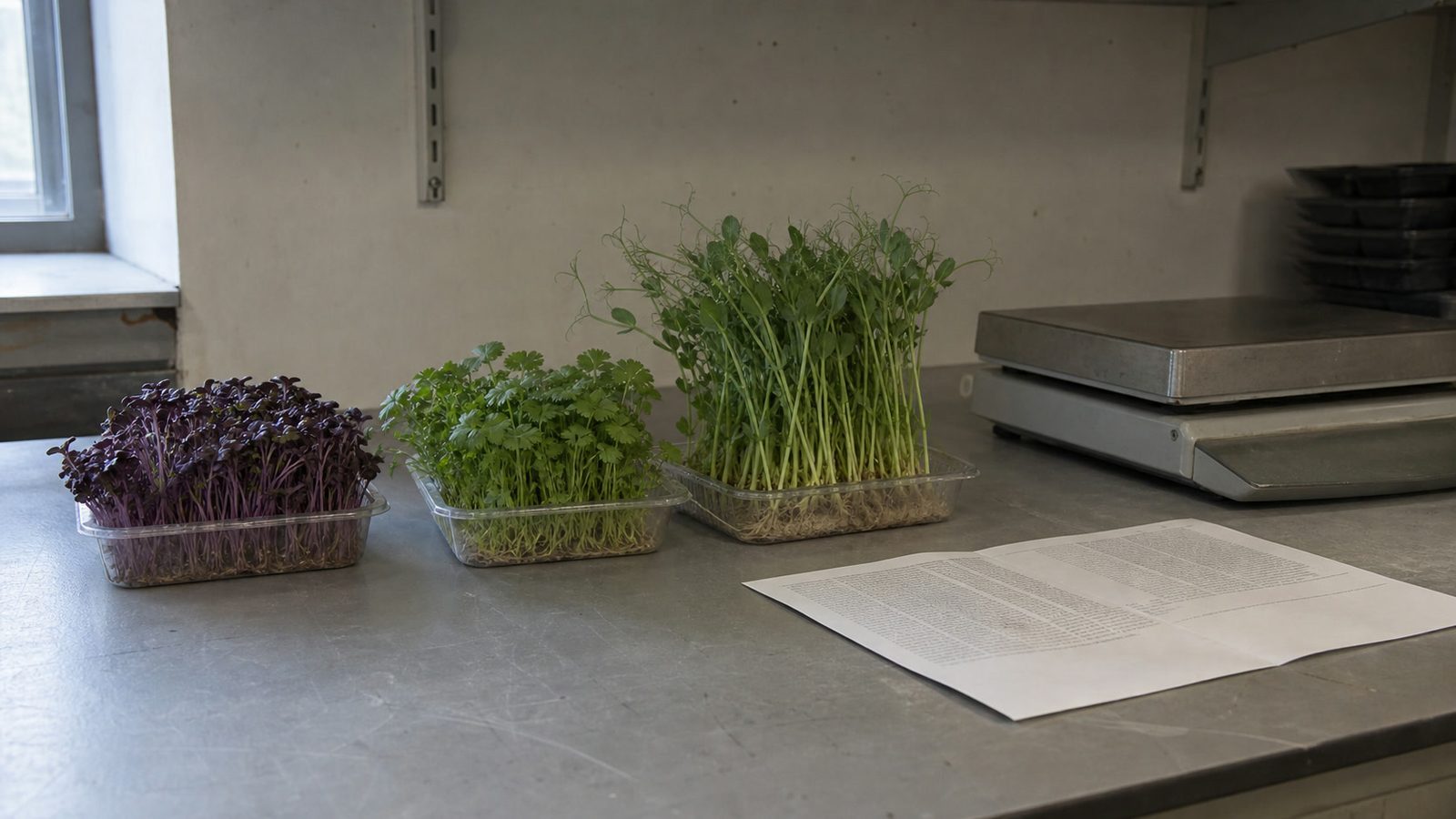
Short answer: the number is real, and it describes one nutrient in one crop. Red cabbage microgreens were measured at more than 40 times the vitamin E of mature red cabbage. That is a genuine laboratory result from a genuine study.
Then it escaped. "Microgreens have 40 times the nutrients" is now the most repeated sentence in this hobby, and as a statement about the category it is wrong in both directions. Some crop-and-nutrient pairs come in far above 40, including the vitamin E pair itself at about 400 and a red cabbage beta-carotene pair at about 260 against a 2006 figure for the mature leaf, or about 17 against USDA's value. And for at least one compound, the mature plant is the more concentrated of the two.
Where the number came from
One paper, and it is a good one. Researchers assayed 25 commercially grown microgreens in a laboratory food analysis and compared them against published values for the mature crop. No people, no animals. Plants on a bench.
It is worth being clear what that means before anything else: this is a measurement of chemicals in a vegetable. It is not a health outcome, and it has never been shown to change anybody's blood work. That is a separate question, and on blood sugar, inflammation and gut health the answer is the same: nobody has tested it.
What the study is excellent for is telling you which crop to grow if you want a particular nutrient. That is a real, useful answer, and it is not the one the multiplier gives you.
What the study actually found, pair by pair
Here are the comparisons the paper made between a microgreen and its own mature version. Read the right-hand column down the page.
Hover or tap a row to highlight it.
| Crop and nutrient | Microgreen | Mature | Ratio |
|---|---|---|---|
| Red cabbage, beta-carotene | 11.5 mg/100 g | 0.044 mg/100 g (a 2006 study the paper cites); USDA lists 0.670 | About 260 times on the paper's figure, about 17 on USDA's |
| Red cabbage, vitamin E | 24.1 mg/100 g | 0.06 mg/100 g | "More than 40 times" as published, about 400 on those two numbers |
| Red cabbage, lutein and zeaxanthin | 8.6 mg/100 g | 0.3 mg/100 g | About 29 times |
| Cilantro, lutein and zeaxanthin | 10.1 mg/100 g | 0.9 mg/100 g | About 11 times |
| Red cabbage, vitamin C | 147.0 mg/100 g | 24.4 mg/100 g | About 6 times |
| Cilantro, beta-carotene | 11.7 mg/100 g | Roughly a third of it | About 3 times |
Six comparisons in one study, and the ratios run from about 3 to about 400. The famous 40 is the second row, and it is not typical of the other five. It is simply the one that got repeated.
There is a twist in that row worth pausing on. The paper reports red cabbage microgreen alpha-tocopherol at 24.1 mg per 100 g and takes its mature comparator, 0.06 mg per 100 g, from a separate published study rather than from the USDA database it uses elsewhere. Those two numbers divide to about 400, and the paper described the result as "over 40 times." That is literally true, because 400 is over 40, and it understates the paper's own finding by roughly an order of magnitude.
So, the most repeated number in this hobby is a conservative phrasing of a single result that was then generalized to everything. The claim is wrong about scope, and the number it carries is not even the one its own source supports.
No single multiplier can describe a spread that covers two orders of magnitude. Picking 40 out of it is not a summary, it is a selection.
The official number is five, not forty
This is the part that surprises people. USDA, whose own researchers did the work, summarized it as microgreens carrying about five times the vitamins and carotenoids of mature leaves, on average, across the 25 crops.
An average across 25 crops is not a promise about any one of them. It is a description of a spread, and you have just seen how wide that spread is. Applying it to the crop in front of you is the same error as applying 40, only quieter.
The crop that came in lowest, and why
The most useful single result in the study is not in that table at all, because it is not a microgreen-against-mature comparison. It is a microgreen against itself.
Golden pea tendrils grown without light had the lowest beta-carotene of all 25 crops, at 0.6 mg/100 g, and the authors specifically note they carried much lower vitamin and carotenoid levels than pea tendrils grown in light. Same species, same seed, same laboratory. The growing method alone put one of them at the bottom of the study.
Carotenoids are made in response to light. Grow a crop in the dark and you get a paler, sweeter, more tender shoot with less of them. That is a real trade and plenty of growers make it on purpose.
Which tells you the multiplier is not even a property of the crop. It is a property of the crop as you grew it. Two trays of the same seed, one blacked out longer than the other, are not the same food, and no number printed on a bag can know which one you produced.
Minerals tell a different story, and a smaller one
Vitamins and carotenoids are where the dramatic numbers live. Minerals behave nothing like that.
A separate analysis found compost-grown broccoli microgreens averaged 1.73 times mature broccoli across eight minerals: phosphorus, potassium, calcium, magnesium, manganese, iron, zinc and sodium.
Not 40. Not even 5. About 1.7, and the study says explicitly that the result depends on how the crop was grown, with hydroponic cultivation changing both the size and the direction of the difference against compost.
So, the honest version is: young brassica leaves are modestly more mineral-dense than the grown head, sometimes, depending on the medium.
Sometimes the same crop goes both ways at once
The clearest single demonstration that "more nutrients" is not a coherent claim comes from broccoli glucosinolates, the compounds behind most of the health interest in this crop.
Comparing broccoli microgreens against mature florets and leaves, the microgreens carried more total aliphatic glucosinolates, while the mature tissue was more concentrated in glucoraphanin specifically, which is the one that becomes sulforaphane.
One measure up, another down, in the same crop, in the same paper. "Microgreens have more" does not survive contact with that, and neither does "mature has more".
Two traps that make the numbers look bigger
Most wildly inflated figures you see come from one of these, and they are easy to spot once named.
Trap one: dry weight against fresh weight
Fresh microgreens are mostly water. Dry the sample and every concentration per gram rises sharply, because you removed the water and not the nutrient.
Papers legitimately report both. Broccoli microgreen glucosinolates get quoted at 28.1 micromoles per gram of dry weight, while a classic measurement of mature broccoli florets is 1.08 micromoles per gram of fresh weight. Set those side by side and you appear to have a 26-fold difference. You do not. You have two different units and no comparison at all.
And it is worse than a unit problem, because they are not even the same compound. Read at source on 2026-08-12, the 28.1 figure is glucoerucin, which is the predominant glucosinolate in broccoli microgreens at twenty times the glucoraphanin level. The 1.08 floret figure is glucoraphanin. So, the popular comparison sets one molecule in one unit against a different molecule in a different unit, and reports the result as a nutrient multiplier.
If a ratio does not tell you the units on both sides, it is not a ratio.
Trap two: concentration against serving
This is the bigger one, and it is the reason the multiplier matters much less than it sounds.
Every figure above is per 100 g. Nobody eats 100 g of microgreens. The human feeding study on this crop used a 16 g serving, and that is a generous handful, not a garnish.
Hover or tap a row to highlight it.
| Crop and nutrient | Per 100 g | In a 16 g serving | Mature crop needed to match |
|---|---|---|---|
| Red cabbage, vitamin C | 147.0 mg | About 23.5 mg | About 96 g of mature red cabbage |
| Red cabbage, beta-carotene | 11.5 mg | About 1.84 mg | About 4,200 g at the paper's 2006 mature figure, about 275 g at USDA's |
| Cilantro, lutein and zeaxanthin | 10.1 mg | About 1.62 mg | About 180 g of mature cilantro |
| Golden pea tendrils grown dark, beta-carotene | 0.6 mg | About 0.10 mg | About 218 g of mature red cabbage at the paper's figure, about 14 g at USDA's |
The left column is measured and published. The other three columns are our own arithmetic on those figures, using the 16 g serving from the human study.
Look at what that does to the story. On vitamin C, a handful of red cabbage microgreens is worth roughly a small bowl of shredded red cabbage, which is good and unremarkable. On beta-carotene, the same handful is worth about 275 g of mature red cabbage on USDA's figure, a big bowl, and far more on the paper's older one. And the dark-grown pea tendrils, from a serving the same size, deliver about one nineteenth of the beta-carotene the red cabbage microgreens do.
Same crop family, same study, same serving. Three completely different answers. That is what a category-wide multiplier hides.
How a real measurement became a slogan
The journey of the 40, step by step
- 1
A laboratory measures 25 crops
Vitamins and carotenoids assayed in microgreens and compared against published mature values. Accurate, useful, and explicitly crop-by-crop.
- 2
One pair produces a big number
Red cabbage vitamin E comes out at more than 40 times its mature counterpart. Still accurate, and still about ONE nutrient in ONE crop.
- 3
The crop is dropped
"Red cabbage microgreens have 40 times the vitamin E" becomes "microgreens have 40 times the vitamin E". The claim now covers 25 crops on the evidence of one.
- 4
The nutrient is dropped
It becomes "40 times the nutrients". Now it covers every compound in every crop, including the minerals that came in at 1.73 and the broccoli compound the mature plant holds more of.
- 5
The health claim is bolted on
"40 times the nutrients" becomes a reason the food does something to your body. The study measured chemicals in plants. It measured nothing in a person.
- 6
The number gets rounded up
"Up to 40" becomes "40", and on some pages "40 to 100". At which point it is no longer connected to anything that was measured.
Every step keeps the previous sentence's authority while widening what it covers. Nobody has to lie for this to happen.
So, what should you take from it
How to read any microgreen nutrient claim
Hover or tap a card to highlight it.
Ask which crop and which nutrient
A ratio with neither is not a finding. The real numbers in this one study run from about 3 to about 260 depending entirely on which pair you pick (the 260 rests on a 2006 mature figure; USDA's gives about 17), and for broccoli glucoraphanin the mature plant wins.
Ask for the units on both sides
Dry weight against fresh weight manufactures a large multiplier out of nothing but water. If the units are missing, so is the comparison.
Ask what a serving delivers
Concentration is per 100 g and you will eat about 16 g. A big ratio on a tiny serving can still be a small amount of food, and a modest ratio can be plenty.
The practical version is short. Grow for the crop, not for the category. If you want carotenoids and vitamin C, red cabbage and cilantro measured best of the 25 and they are two of the easiest things to grow. If you want vitamin E, green daikon radish led that group. If you are blacking a crop out for tenderness, accept that you are trading away some of the pigment compounds, because that is a real trade rather than a rumor.
You can grow all three from red cabbage seed, cilantro seed and radish seed, and every one of them is in the directory with its own numbers.
The ranges, if you want the whole picture
For completeness, this is the spread across all 25 crops. The width of each range is the real finding of the study.
Hover or tap a row to highlight it.
| Nutrient | Range across 25 crops | Highest of those tested |
|---|---|---|
| Vitamin C | 20.4 to 147.0 mg per 100 g fresh | Red cabbage |
| Beta-carotene | 0.6 to 12.1 mg per 100 g | Cilantro |
| Lutein and zeaxanthin | 1.3 to 10.1 mg per 100 g | Cilantro |
| Vitamin K1 | 0.6 to 4.1 micrograms per gram | Garnet amaranth |
| Vitamin E | 4.9 to 87.4 mg per 100 g | Green daikon radish |
Vitamin C spans a factor of seven. Vitamin E spans a factor of eighteen. Beta-carotene spans a factor of twenty. The variation between crops is bigger than most of the microgreen-to-mature ratios being advertised, which is the whole argument on one line.
So, is it true
It is true about one nutrient in one crop, and it is not true about microgreens.
What is fair to say: microgreens are young vegetables, several of them are genuinely nutrient-dense, a few crop-and-nutrient pairs are dramatically higher than the grown plant, minerals are modestly higher at best, at least one compound is more concentrated in the mature plant, how you grow the crop moves the number as much as which crop you chose, and all of it is a measurement of chemistry rather than a measurement of anybody's health.
What is not fair to say is any sentence that starts "microgreens have" and ends in a number.
What would settle it
Matched pairs, grown and measured together. The same cultivar raised to microgreen stage and to maturity under identical conditions, assayed in the same laboratory, reported on both a fresh-weight and a dry-weight basis, for a defined list of nutrients, across a decent number of crops.
Almost none of the multipliers in circulation come from a design like that. They come from a microgreen measured in one study set against a mature value from a database compiled somewhere else by somebody else, which is a reasonable thing for researchers to do and a poor foundation for a slogan.
Terms on this page
Tap a term to see what it means.
Fresh weight. The plant as you would eat it, water included. The basis most food composition figures use, and the one that matches a serving.
Sources
- Xiao et al., 2012, vitamin and carotenoid concentrations in 25 microgreens - the source of the "40 times" figure. Vitamin C 20.4 to 147.0 mg/100 g fresh, beta-carotene 0.6 to 12.1, lutein and zeaxanthin 1.3 to 10.1, phylloquinone 0.6 to 4.1 micrograms/g, alpha-tocopherol 4.9 to 87.4 mg/100 g; red cabbage vitamin C 147.0 against 24.4 mature, beta-carotene 11.5 against 0.044 (a mature value the paper takes from Singh et al., 2006), lutein and zeaxanthin 8.6 against 0.3, vitamin E more than 40-fold mature; cilantro beta-carotene 11.7 at about threefold and lutein and zeaxanthin 10.1 against 0.9; and the dark-grown golden pea tendrils at 0.6 mg/100 g beta-carotene, below light-grown.
- USDA FoodData Central, red cabbage, raw (SR Legacy, FDC 169977) - 0.670 mg beta-carotene per 100 g, which puts the red cabbage microgreen figure at about 17 times the mature leaf rather than 260.
- USDA ARS summary of that assay and the publication record - the "about five times on average" statement, and the note that levels varied widely by crop.
- Weber, 2017 - compost-grown broccoli microgreens averaging 1.73 times mature broccoli across eight minerals, with the study's own statement that the result depends on growing method and that hydroponic cultivation changed both magnitude and direction.
- Broccoli microgreen and mature comparison - higher total aliphatic glucosinolates in the microgreens, with the mature tissue more concentrated in glucoraphanin.
- Fahey et al. - mature broccoli florets at 1.08 micromol glucoraphanin per gram FRESH weight, the figure most often set against dry-weight microgreen numbers.
- Fresh broccoli microgreens in 11 people - the 16 g serving used for the per-serving arithmetic on this page. The serving-size and matching-amount columns are our own arithmetic on the published concentrations, not figures from any study.
Keep reading
The journal
Are Microgreens Anti-Inflammatory? What the Research Really Says
Nobody has fed a person microgreens and measured their inflammation. And when researchers pooled ten broccoli sprout trials, the combined result came out at something that could be zero.
Read Are Microgreens Anti-Inflammatory? What the Research Really SaysThe journal
Best Microgreens for Kidney Health: Potassium by the Serving
See measured potassium and phosphorus for the best microgreens for kidney health, from lowest to highest, plus what your renal dietitian needs to know.
Read Best Microgreens for Kidney Health: Potassium by the ServingThe journal
Do Microgreens Help You Lose Weight? Two Claims, One Answer
One of these claims is probably true and has nothing to do with microgreens. The other was tested by injecting a compound into mice. Here is which is which.
Read Do Microgreens Help You Lose Weight? Two Claims, One AnswerThe journal
Heavy Metals and Nitrate in Microgreens: What Has Actually Been Measured
The nitrate figures circulating for microgreens are dry weight, and the legal limits are fresh weight. Convert the same published result and it lands anywhere from 1,045 to 11,307 mg/kg depending on the crop. Three species have been assayed for metals.
Read Heavy Metals and Nitrate in Microgreens: What Has Actually Been Measured