Broccoli Sprouts vs Broccoli Microgreens: How to Grow and Eat
Cal HewittPublished Checked
- eating
- broccoli
- comparisons
- food safety
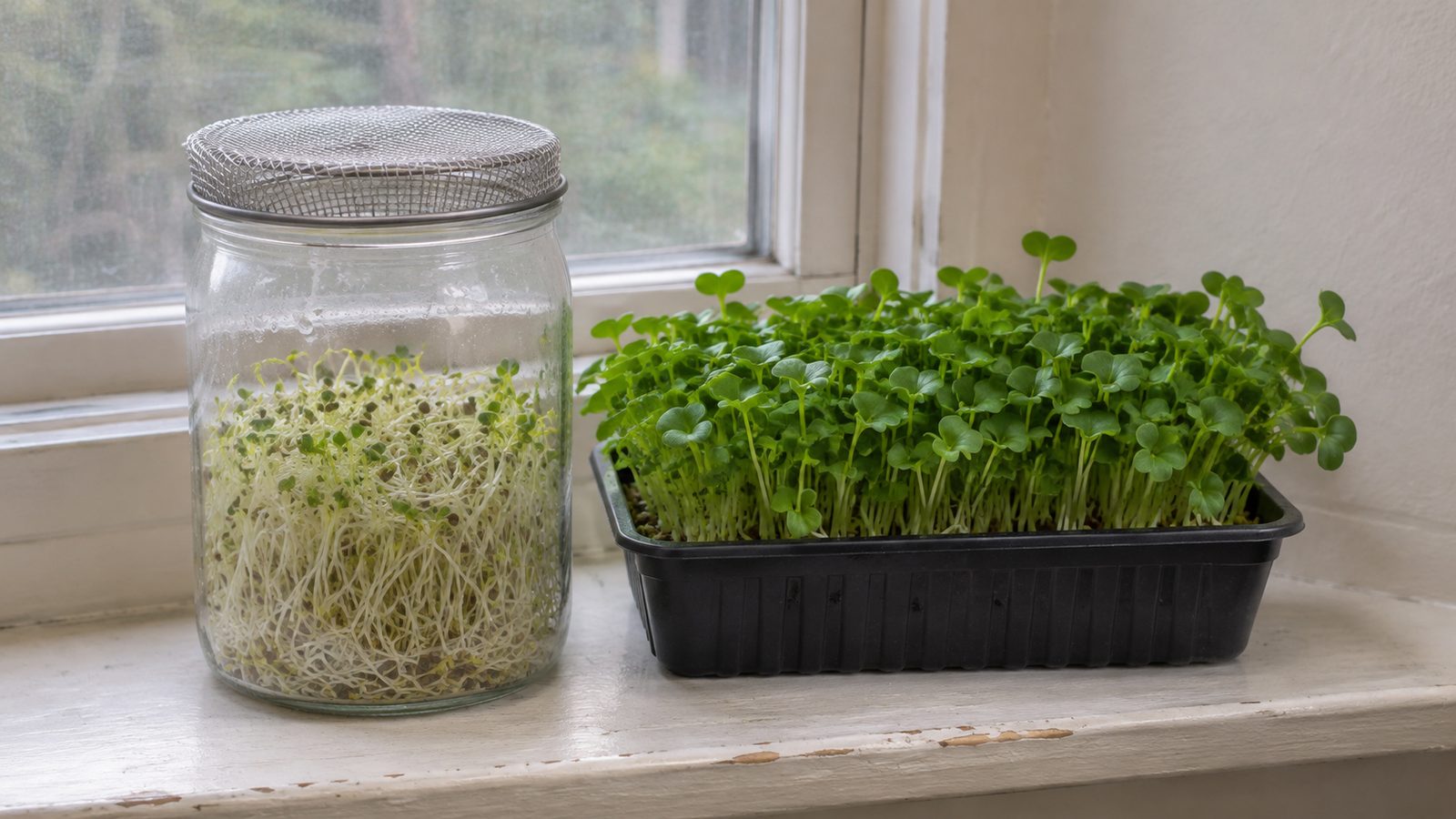
In one 2023 study, broccoli sprouts harvested at day 3 held about 8.0 g/kg dry weight of glucoraphanin, against 3.7 g/kg dry weight in microgreens harvested at day 17. The amount per gram falls as the plant grows, so the younger crop carries more of it by weight.
Before you set one figure beside another, check three things: whether it is dry weight or fresh weight, which cultivar was grown, and how many days the plants had grown. A number missing any of those can look like a comparison and still tell you nothing.
Below you will find the measured figures with those conditions beside them, what cutting and chewing change, what the safety record says for sprouts and for seed, and how each crop is grown.
What glucoraphanin and sulforaphane are, and why the basis matters
Glucoraphanin is a compound in broccoli that the plant stores until its tissue is damaged. Sulforaphane is what forms when glucoraphanin meets an enzyme called myrosinase, and that meeting happens when the plant is cut, chopped, blended or chewed. So, a tray can hold plenty of glucoraphanin and still give you little sulforaphane, depending on what happens to it afterward.
Dry weight means the sample after the water has been removed. Fresh weight means the sample as you would pick it, water included. Fresh-weight values are commonly about one-tenth of the dry-weight values for the same tissue, because fresh tissue is mostly water. If one seller quotes a dry-weight number and another quotes a fresh-weight number, the gap between them is mostly arithmetic.
What the measurements show from seed to microgreen
The oldest study worth knowing here is the 1997 work by Fahey, Zhang and Talalay in PNAS. They measured three-day-old broccoli sprouts and found 10 to 100 times more glucoraphanin by weight than in mature broccoli of the same cultivars. The range is wide because the study emphasized cultivar variability, not one value for all broccoli. You can read it at Fahey et al., PNAS, 1997.
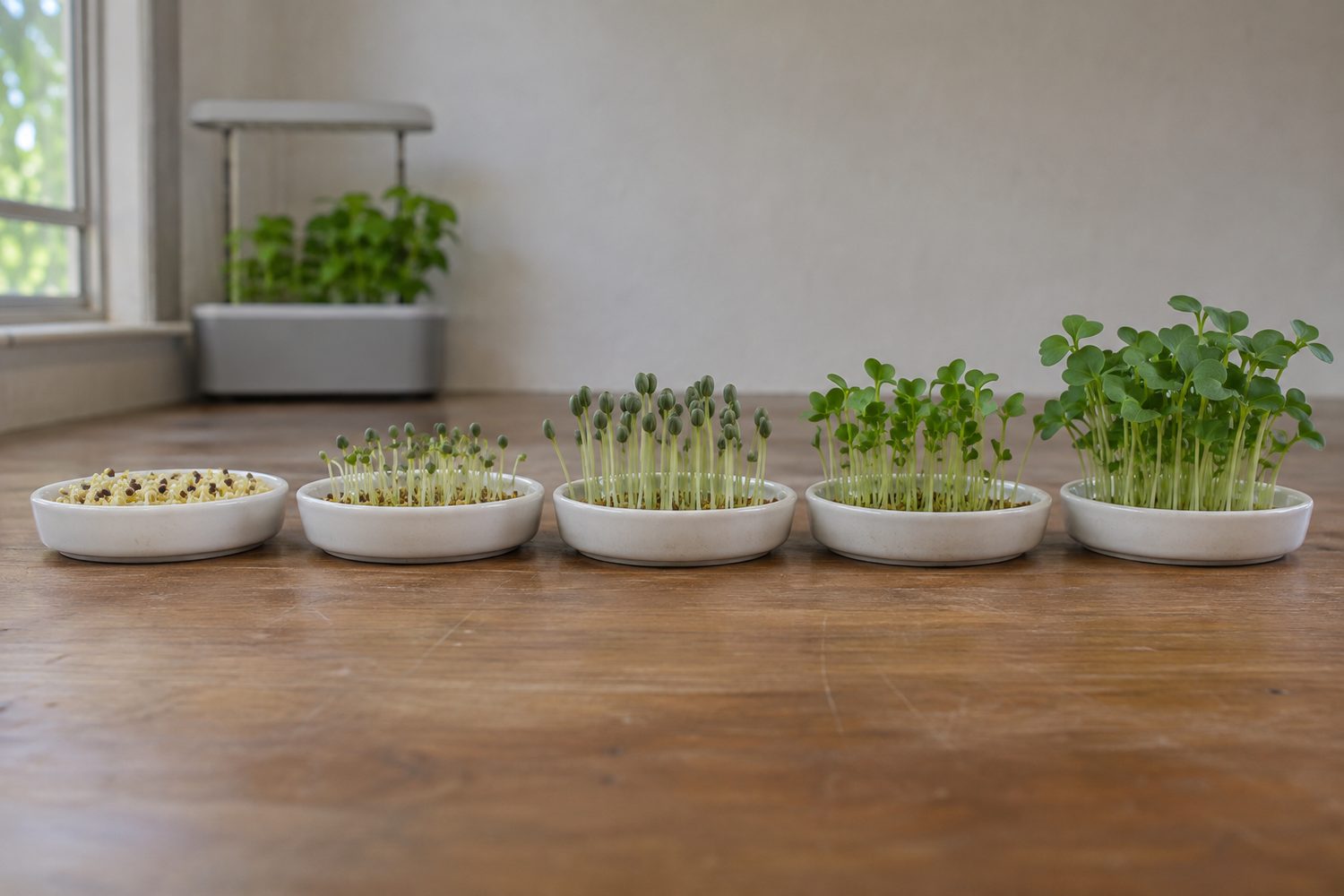
The 2023 series by Cano-Lamadrid and colleagues is the one that puts sprouts and microgreens in the same experiment. The plants were grown at 20°C, and the values are on a dry-weight basis. Cultivar changes these numbers, so treat them as one study's result and not a rule for every seed lot. The source is Cano-Lamadrid et al., 2023.
Hover or tap a row to highlight it.
| Harvest age | Crop stage | Glucoraphanin (g/kg dry weight) | Sulforaphane (mg/kg dry weight) |
|---|---|---|---|
| Day 3 | Sprout | about 8.0 | about 108 |
| Day 5 | Sprout | about 6.4 | about 122 |
| Day 7 | Sprout | about 6.3 | about 223 |
| Day 12 | Sprout | about 4.4 | about 97 |
| Day 15 | Sprout | about 4.1 | about 98 |
| Day 17 | Microgreen | about 3.7 | about 95 |
Glucoraphanin only goes down across those 14 days. Sulforaphane does not follow it. It rose from about 108 mg/kg at day 3 to 223 mg/kg at day 7, then sat at 95 to 98 mg/kg from day 12 to day 17. So, the day-7 sprouts were the high point for sulforaphane in this study, and the day-3 sprouts were the high point for glucoraphanin.
Seed is where the concentration starts. The Johns Hopkins review gives fresh-weight ranges across commercial cultivars, and they are ranges, not one cultivar's path. They sit on a different basis from the table above, so they get their own table. The source is the Johns Hopkins review, 2021.
Hover or tap a row to highlight it.
| Stage | Glucoraphanin (µmol/g fresh weight) |
|---|---|
| Seed | 2 to 124 |
| Three-day-old sprout | 0.3 to 17 |
| Market-stage broccoli floret | less than 0.1 to 1.6 |
A falling concentration does not mean a tray holds less in total as it grows. The plant gains water and mass, so the amount per gram can drop through dilution even while the whole tray changes differently. The same review notes that the decline continues through about 10 to 14 days as the plant expands. None of this sets one best harvest age for every cultivar and growing system.
What a human study measured
The 2023 study by Mullaney and colleagues fed 11 people one serving of fresh broccoli microgreens, described as about 7 to 14 days old. Their mean urinary sulforaphane-metabolite excretion over two days was 50.5 ± 2.7 µmol. The microgreens were tested one day after harvest and again six days after harvest. You can read it at Mullaney et al., 2023.
That number measures what the body excreted after eating, not what a tray holds. It does not tell you how much sulforaphane any particular tray of broccoli microgreens contains, and it should not be set next to the table above.
What cutting, chewing and heat change
Cutting, chopping, blending and chewing bring glucoraphanin and myrosinase together, and sulforaphane starts to form from that contact. How much forms depends on the cultivar, the enzyme activity, the temperature and the pH. A competing reaction can also send glucoraphanin toward sulforaphane nitrile instead. For these reasons, treat any single chewing count or chopping time as specific to its own conditions. The Johns Hopkins review describes chewing as the wounding event but does not give a waiting time or a conversion percentage.
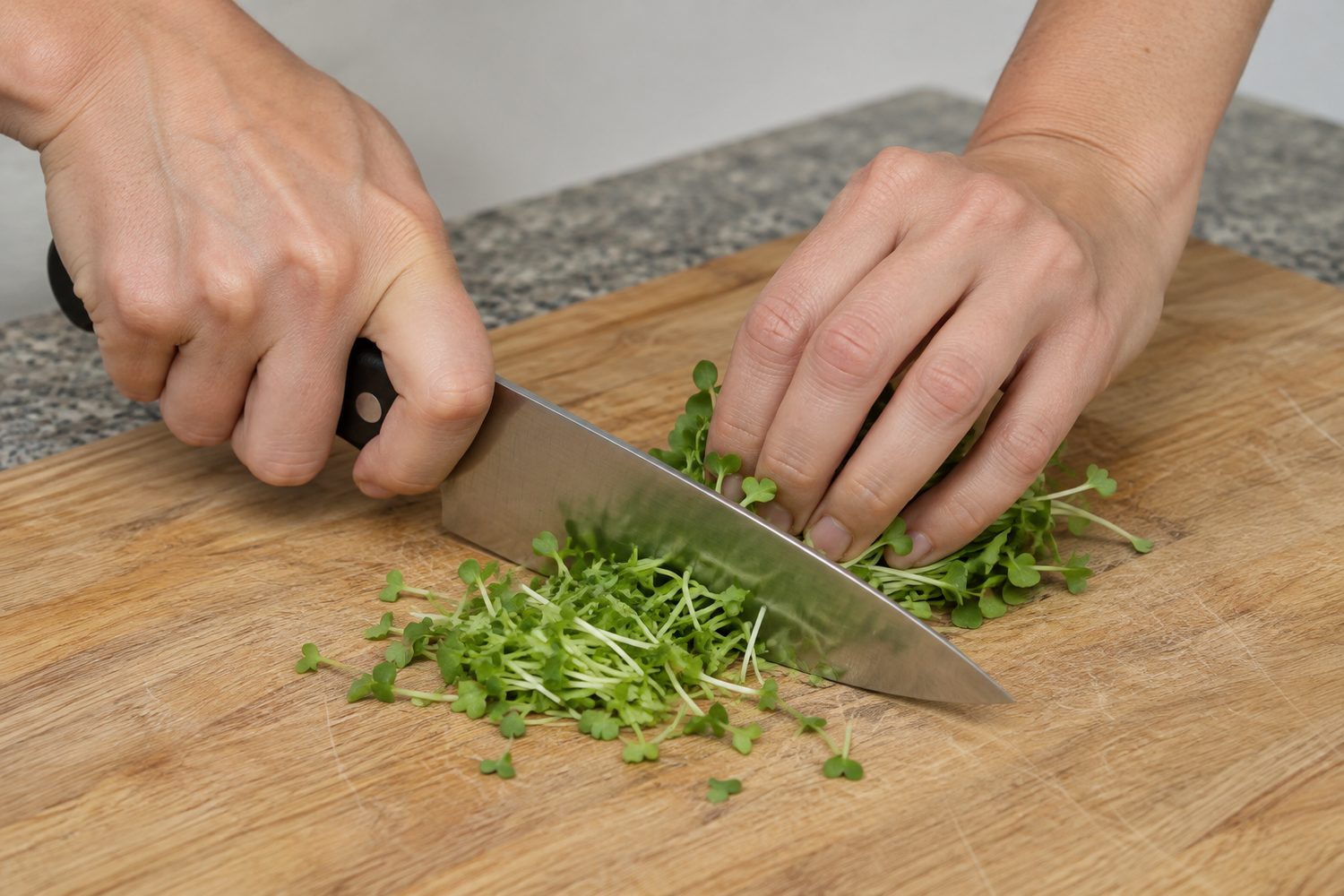
Heat works the other way once it is high enough to inactivate myrosinase, because the enzyme is what makes the conversion happen. If your goal is to keep the enzyme working, raw material is the straightforward choice.
There are laboratory results that look different, and they are worth reading as lab conditions. A 2022 blanching study took fresh broccoli sprouts from 16.6 ± 0.4 µmol sulforaphane/g dry weight to 54.3 ± 0.20 µmol/g dry weight with a blanch at 61°C for 4.8 minutes, a 3.3-fold increase. It is a controlled treatment in a laboratory, not a kitchen rule, and it does not show that cooking in general raises sulforaphane. The details are in Maximization of Sulforaphane Content in Broccoli Sprouts by Blanching, 2022.
Freezing is condition-dependent as well. One study stored five-day-old broccoli sprouts at -20°C or 4°C for one week and reported better sulforaphane retention after freezing, which may reflect tissue rupture letting myrosinase and glucoraphanin mix. Commercially blanched, frozen mature broccoli, on the other hand, has shown lower sulforaphane bioavailability than fresh broccoli, because blanching destroys myrosinase. That result comes from mature broccoli and should not be carried over to unblanched frozen sprouts or microgreens. The sources are Optimisation of enzymatic production of sulforaphane, 2017 and the fresh versus frozen broccoli bioavailability study.
Which is safer to eat?
Sprouts have the stronger documented outbreak record, and the two records are not counted the same way. For sprouts, FDA reported 46 US sprout-associated foodborne outbreaks from 1996 through July 2016, across various sprout types. That count is a sprout figure, and it does not carry over to microgreens. Raw sprouts are grown warm and wet, which can let pathogens already on the seed multiply.
The seed is where the problem tends to start. FDA sampling from 2014 through 2016 found Salmonella in 2.35% of seed samples, compared with 0.21% of finished sprout samples. See the FDA sprout sampling study and the FDA 2014 to 2016 sprout sampling report.
The most recent broccoli event is the 2026 Salmonella Bovismorbificans outbreak. FDA and CDC reported 34 illnesses in six states, three hospitalizations and no deaths, with illness onset from July 7 through September 11, 2026. Epidemiologic, laboratory and traceback evidence linked it to broccoli sprouts and seed from one lot imported from New Zealand. Evergreen Fresh Sprouts samples tested positive and matched the outbreak strain by whole-genome sequencing. CDC closed the investigation on November 4, 2026. The full record is on the FDA 2026 outbreak investigation page and the CDC 2026 outbreak summary.
One interviewed person reported eating a microgreen mix that contained broccoli microgreens, but CDC's final summary named broccoli sprouts as the food that made people sick. The outbreak was traced to a contaminated seed lot. It was not a separate outbreak from independently grown broccoli microgreens, and contaminated seed can also reach a microgreen tray.
The recalls covered these products:
- Evergreen Fresh Sprouts broccoli sprouts, 215 cases of six 4-ounce bags, with use-by dates of September 7, 9, 11, 14 and 16, 2026 (recall notice).
- Eden Brothers Calabrese broccoli seeds, lots 1022067 and 1022068, supplier lot W4105, sold in packets, 1-ounce and 1-pound sizes (recall notice).
- Gardeners Basics Waltham 29 broccoli sprouting seeds, one-pound bags, UPC 848137042889, marked "Packed for 2027" (recall notice).
- Home Grown green sprouting Calabrese broccoli seeds sold by EAK Distribution, including the recalled supplier lot and an 8-ounce product listing.
The action is the same for both crops. Do not plant recalled seed, whether you are sprouting it or sowing it on a tray, and check the FDA and CDC outbreak and recall pages before you buy sprouts or seed. If you are growing to sell, the same check applies to every seed lot before it goes into a tray.
How each one is grown
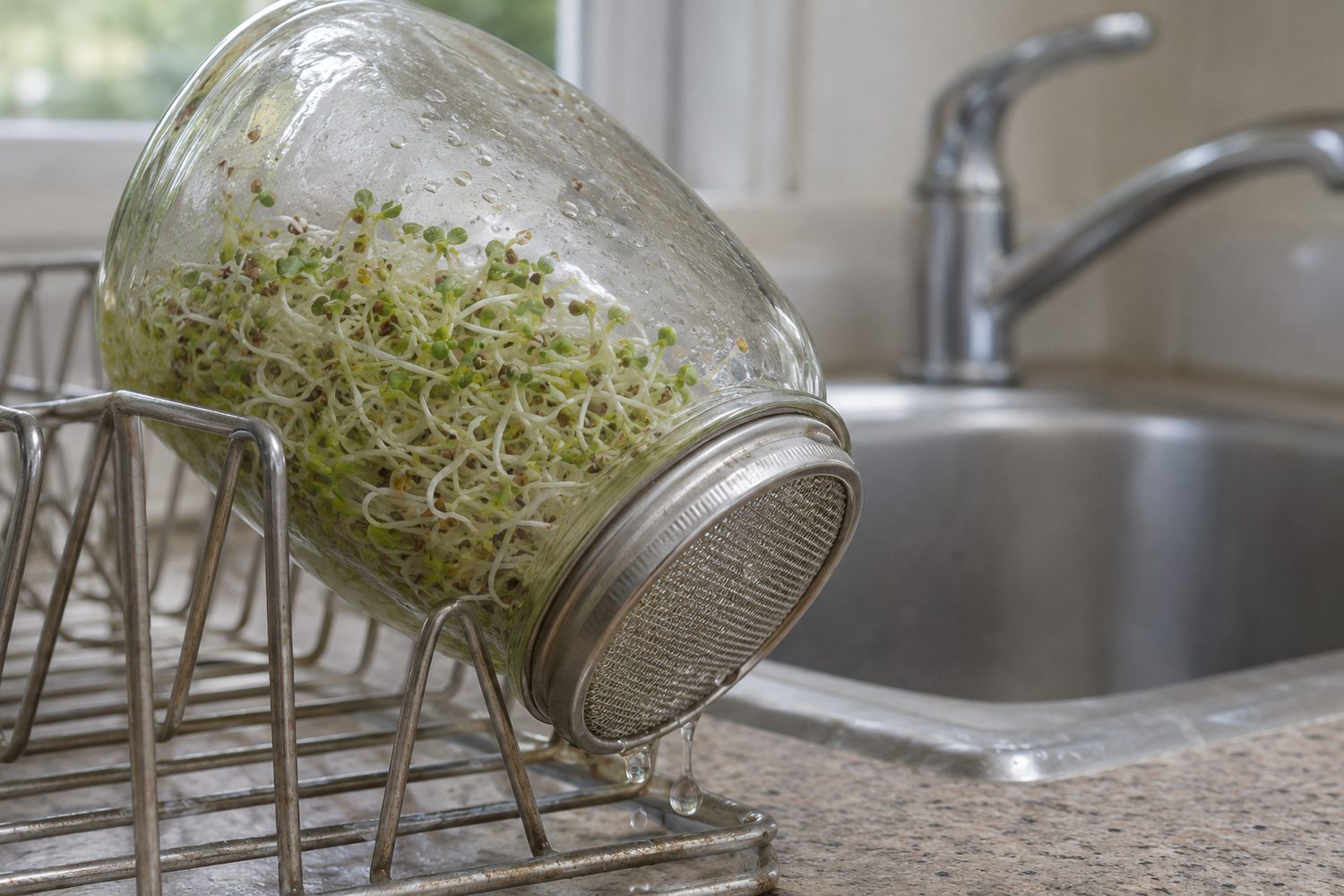
Sprouts grow in a jar or sprouting vessel with no soil. You soak the seed, then rinse and drain it repeatedly, keeping the jar tilted so water leaves. Sprouts can be grown without a window or grow light, since they are harvested before sustained leaf development, and you eat the seed, root, stem and seed leaves together. Colorado State University Extension describes them as a quick harvest option and shows them developing in a jar over several days. See Growing Sprouts and Microgreens at Home.
Microgreens grow densely in a shallow tray on seed-starting mix, coconut coir or a hydroponic mat. The tray is covered or weighted during early germination, then moved into sunlight or grow lights. If you are buying seed for a tray, True Leaf Market sells broccoli microgreen seed. Utah State University Extension recommends about 74°F during germination, 72°F with lights on, 68°F with lights off, and 18 hours of light with 6 hours of dark. Its broccoli table gives 2 to 4 covered days and an estimated harvest at 8 to 12 days. See Grow Your Own Microgreens.
Hover or tap a row to highlight it.
| Sprouts | Microgreens | |
|---|---|---|
| Vessel | Jar or sprouting vessel | Shallow tray |
| Medium | None, rinsed and drained repeatedly | Seed-starting mix, coir or hydroponic mat |
| Light | Generally dark or low light | Covered 2 to 4 days, then light |
| Typical harvest | Around 3 to 5 days | Around 8 to 12 days (Utah State) |
| What you eat | Seed, root, stem and seed leaves | Growth above the medium, usually seed leaves |
Peer-reviewed studies have also used 13- to 17-day stages for microgreens, so a longer harvest age than 12 days is not unusual in the literature. For the wider comparison of the two crops, see microgreens vs sprouts, and for the crop itself, the broccoli microgreens entry.
Taste, seed cost and your own yield numbers
Sprouts are tender, wet and stem-heavy, with a concentrated brassica or mustard-like flavor. Microgreens have firmer stems, open seed leaves and a milder broccoli flavor, according to the Utah State guide. Sensory work on Brassica sprouts and microgreens found that profiles changed with growth stage and with glucosinolate composition, and it did not settle one preference for broccoli.
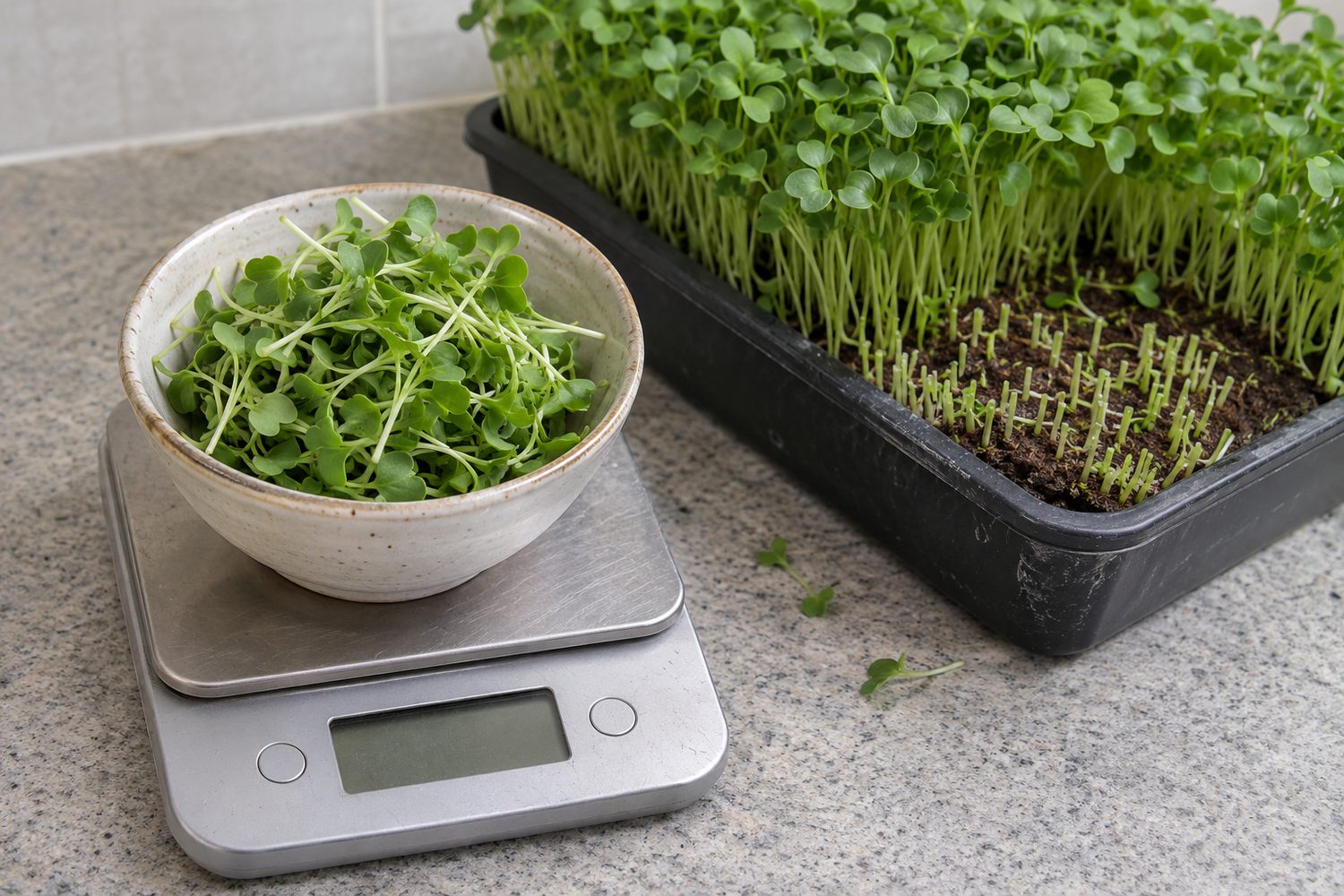
For a tray, Utah State lists 28 g of broccoli seed per 1020 tray at $19.58 per pound of seed, using prices dated January 8, 2026. Johnny's Selected Seeds lists broccoli microgreen seed at $5.94 per ounce with a recommended 13 g per tray, a retailer price that can change. The University of Missouri Extension's 2024 planning budget assumes 11.5 ounces of microgreens per tray, a 12.5-day growing period and a $4.00 sales price per ounce. Those are planning assumptions, not a measured yield or a market price. See the Missouri microgreens budget and the Johnny's broccoli microgreen seed page.
For sprouts, a jar yield per ounce of seed depends on the protocol, so take the seller's current package price and stated jar instructions, grow one batch, and record the harvest weight. Write the weight down with the seed amount and the harvest day. Your own number will tell you more than any figure from another grower's conditions.
Frequently asked questions
Does a higher glucoraphanin number mean more sulforaphane? Not by itself. In the 2023 series, glucoraphanin fell steadily from day 3 to day 17, while sulforaphane peaked at about 223 mg/kg dry weight at day 7. Sulforaphane also depends on whether the tissue is damaged and the enzyme is active.
Can I compare a number from a seller's page to the table above? Only if it has the same basis, cultivar and harvest age. A fresh-weight value is commonly about one-tenth of the dry-weight value for the same tissue, so a seller's fresh-weight figure and these dry-weight figures will not line up.
Should I blanch my sprouts at 61°C for 4.8 minutes? That condition comes from a 2022 laboratory study on fresh broccoli sprouts, where it raised sulforaphane from 16.6 to 54.3 µmol/g dry weight. It is a lab setting, not a kitchen instruction.
What should I check before planting broccoli seed? Compare your packet against the current FDA and CDC recall pages, including the lot numbers listed in the 2026 recalls. Do not plant recalled seed for sprouts or for microgreens.
Choosing between the two
If you want the highest glucoraphanin by weight, the measured figures point to the youngest harvest, around day 3. If you are looking at sulforaphane in that same study, day 7 was highest. If you want a crop with a firmer stem and a milder flavor, a tray is what produces that. Pick by the figure that matches what you want, hold the unit, basis, cultivar and age beside it, and check the FDA and CDC pages for the seed in your hand before you plant it.
Sources
Prices, stock and specifications are as the linked pages showed them on 2026-11-09.
- Fahey et al., PNAS, 1997
- Cano-Lamadrid et al., 2023
- Johns Hopkins review, 2021
- Mullaney et al., 2023
- Maximization of Sulforaphane Content in Broccoli Sprouts by Blanching, 2022
- Optimisation of enzymatic production of sulforaphane, 2017
- fresh versus frozen broccoli bioavailability study
- FDA sprout sampling study
- FDA 2014 to 2016 sprout sampling report
- FDA 2026 outbreak investigation
- CDC 2026 outbreak summary
- recall notice
- recall notice
- recall notice
- Growing Sprouts and Microgreens at Home
- Grow Your Own Microgreens
- Missouri microgreens budget
- Johnny's broccoli microgreen seed page
Keep reading
The journal
Are Microgreens Safe From Cyclospora?
Are microgreens safe from cyclospora? Learn how the parasite spreads, what washing and cooking do and do not do, and the steps that matter at home.
Read Are Microgreens Safe From Cyclospora?The journal
Can You Eat Microgreens While Breastfeeding?
Major breastfeeding guidance says you do not need to avoid specific foods. Here is how that applies to microgreens while breastfeeding, and what to watch.
Read Can You Eat Microgreens While Breastfeeding?The journal
How to Find Local Microgreens Near You
Searching for local microgreens? Learn where to look, including farmers market directories and local food listings, and what to ask a grower before you buy.
Read How to Find Local Microgreens Near YouThe journal
Microgreens for Babies and Children: Cook Them First, and Here Is Why
Cooking is the step that addresses the pathogen risk for under-fives, and it is the one thing you can act on. No pediatric or federal body sets a starting age, so here is exactly what is established.
Read Microgreens for Babies and Children: Cook Them First, and Here Is Why