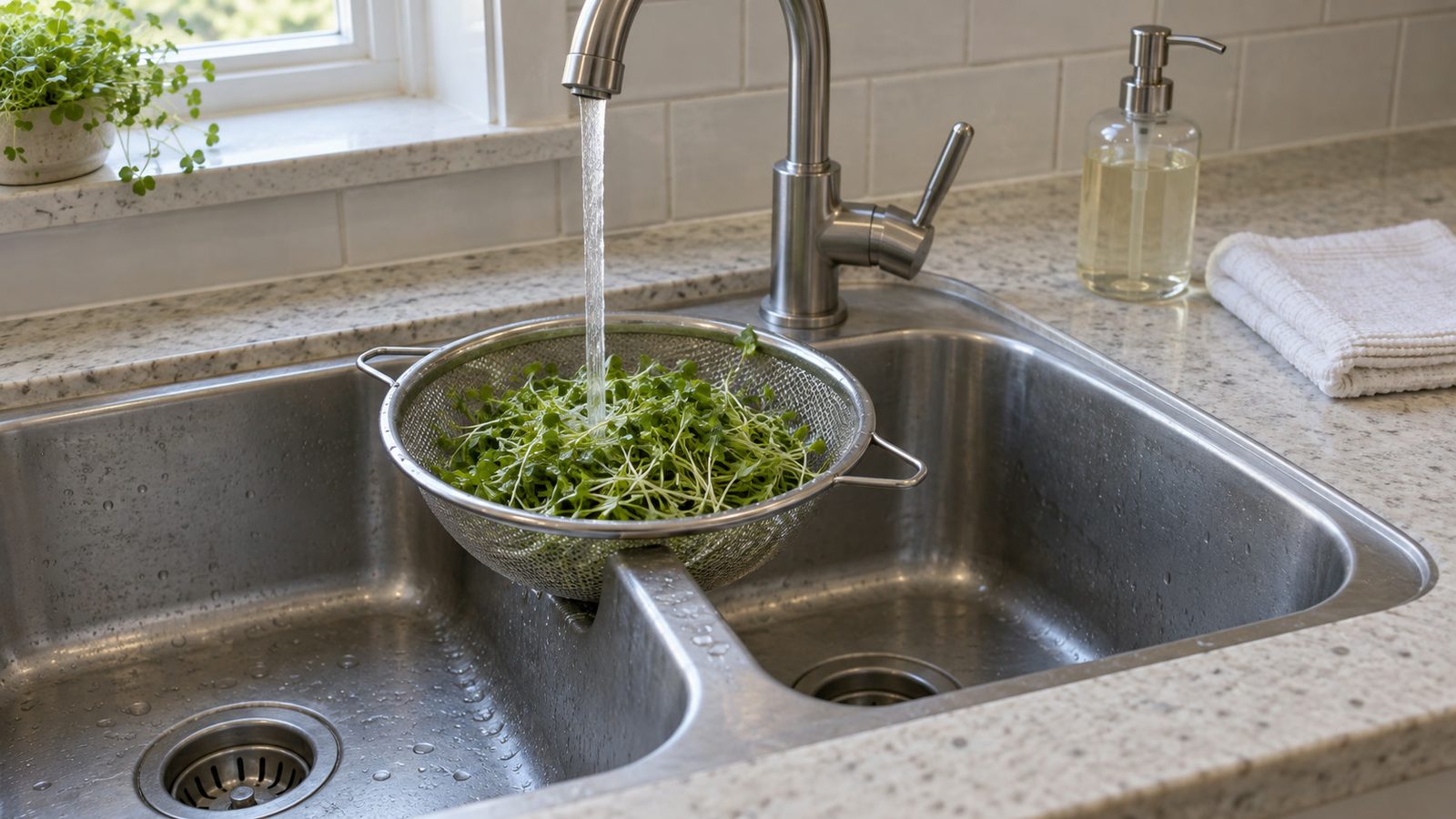
Microgreens are not immune to Cyclospora, so treat them like any other raw produce. The parasite reaches food when an infected person's feces gets into water, onto hands or tools, or onto the food itself, and that can happen to any raw produce, whether it grew in a field, a greenhouse or on a rack in your kitchen.
No published outbreak investigation has named a microgreen or a sprout, but that is not proof they are safe. What protects your trays and the people who eat from them is hygiene and handling: the water you use, clean hands and tools, and cooking when the dish allows it.
How Cyclospora gets onto produce
Cyclospora cayetanensis is a single-celled parasite that causes an intestinal illness called cyclosporiasis. You get it by swallowing food or water carrying the parasite, and people are its only known host. An infected person, including someone with no symptoms at all, sheds it in their stool, and FDA names poor hygiene, septic systems and water sources as the ways it moves from there into food, water and the environment (FDA).
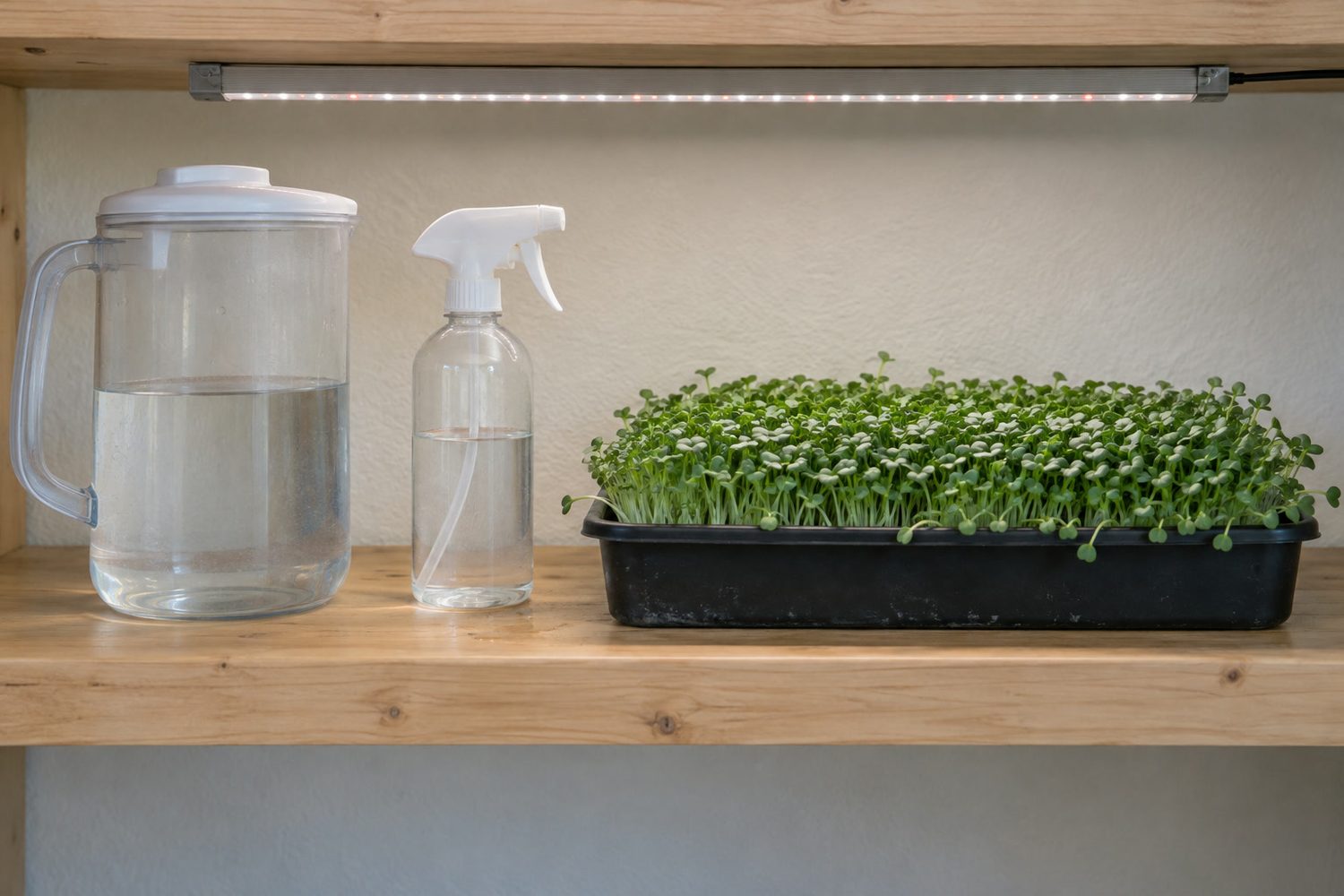
One detail shapes everything else on this page. The parasite leaves the body unable to infect anyone. CDC says the shed stage, called an oocyst, needs at least 1 to 2 weeks in the environment to mature before it can make another person sick (CDC). So, it rarely passes straight from one person to the next. It travels by sitting in water, on a surface or on food long enough to mature, and then somebody eats it.
That route has nothing to do with the name of a crop. FDA's herb sampling report lists irrigation water splashing up from soil, unsanitary wash water, harvest equipment and hand harvesting as the openings for contamination on fresh herbs (FDA herb sampling). Every one of those has a version in a microgreen setup: the water in your reservoir or spray bottle, your scissors, your harvest bowl and your hands. Potting mix or soil would only matter if human waste had reached it. Nothing published shows ordinary potting mix or compost carrying this parasite, so put your attention on water, hands and tools.
That is also why the summer's outbreak matters to you even though its notices did not name microgreens. CDC's final update on September 11, 2026 linked it to processed iceberg lettuce from Taylor Farms de Mexico and counted 12,883 illnesses, 570 hospitalizations and 2 deaths in 21 states (CDC investigation); the recall and what it means for growing your own are covered in produce recalls and growing your own microgreens.
What US and international outbreak records show
Over the years, US outbreaks have been tied to raspberries from Guatemala, mesclun lettuce from Peru, snow peas, basil, cilantro from Mexico, prepackaged salad mixes and vegetable trays (CDC 2000 to 2017 review; CDC 2011 to 2015 surveillance; CDC 2018 report). FDA's historical list, updated September 11, 2026, also includes cabbage, parsley, broccoli, sugar snap peas and leafy greens (FDA).
No published outbreak investigation in US CDC and FDA records, Canada's CFIA survey of imported herbs (CFIA) or UK guidance (UKHSA) has named a microgreen or a sprout. That is worth knowing, and it is not proof of safety. Those records were not built to track every crop on its own.
FDA's "leafy greens" category is broad and not broken down, so the list alone can't show that a microgreen was never part of a case. A short-lived product may be eaten or thrown out before anyone can test it, and a traceback can stop at a broader ingredient. Read the absence as "not named so far," and handle your greens as carefully as you would basil or cilantro.
Does growing indoors or hydroponically change the risk?
Do not count on indoor or hydroponic growing to lower Cyclospora risk by itself. What indoor growing can do is take specific routes off the table. If your trays never touch field irrigation water or runoff that could carry sewage, those routes are gone. What stays is everything else: the people handling the crop, the water you start with, any recirculating equipment, and each step from tray to plate.
Water is where the unknowns are largest. FDA says surface water is exposed to runoff and sediment, groundwater more often carries fewer microorganisms because soil filters it, and a poorly built or maintained well can still be compromised. FDA also says the data on whether municipal water treatment inactivates Cyclospora are limited and inconclusive, and that microfiltration, ozone or UV may be needed to reduce it in irrigation water where the parasite is common (FDA).
Water source matters, so judge a tap, well or recirculating setup by how it is run: a known source, treatment suited to the hazard, regular cleaning and clean hands on the equipment. The setup side is covered in water quality for growing microgreens.
Growing your own works the same way. It changes who handles the crop and what water it sees, not the biology of the parasite. If you are deciding between the two, growing or buying microgreens lays out the tradeoffs.
What washing, sanitizers, freezing and cooking can and can't do
Most of the usual kitchen habits help a little or not at all against this parasite. Only one step reliably kills it.
Rinsing lowers the odds but does not kill it
Rinsing under running water is reasonable risk reduction, and CDC says routine disinfecting and sanitizing are unlikely to kill Cyclospora (CDC). Michigan's health department, in an FAQ revised July 24, 2026, said that for pre-washed lettuce, "rinsing the lettuce under the kitchen tap won't do any better" than the factory wash, and that washing is less effective for this parasite, so peeling and cooking have to carry more of the load (Michigan MDHHS FAQ).
Leaves also hold on to the parasite unevenly. In a 2012 lab experiment, plain water recovered 17.5% of the oocysts placed on basil and 38.3% to 45.9% from the lettuces tested (Shields et al., 2012). Those are lab recovery figures, not what a kitchen rinse removes, and no one has measured a home rinse on microgreen leaves. Rinse as one layer of care and don't let it replace the others. Timing and method are covered in should you wash microgreens.
Chlorine and produce washes are not a kill step
FDA says chlorine and other common chemical treatments are not effective against Cyclospora (FDA). In a 2008 study, basil and lettuce treated for 20 minutes with 4.1 mg/L of chlorine dioxide gas saw fewer Cryptosporidium, Encephalitozoon and E. coli, but the treatment did not affect whether the Cyclospora oocysts matured (Ortega et al., 2008). Don't count on bleach, vinegar, soap or a store-bought produce wash to make greens safe from this parasite. Keep cleaning your trays and tools for all the usual reasons, following cleaning and sanitation for microgreens, but don't treat a soak of the greens themselves as protection.
Freezing and the fridge leave it able to mature
Freezing is not a demonstrated kill step. Oocysts on basil or in water still matured after up to 2 days at minus 20°C (minus 4°F), and a week at 4°C (39°F) did not affect them (Sathyanarayanan and Ortega, 2006). NC State Extension says home freezing does not make contaminated produce safe (NC State Extension). Refrigerate your harvest because that is good food handling, not because it does anything about Cyclospora.
Cooking to 158°F (70°C) is the step that works
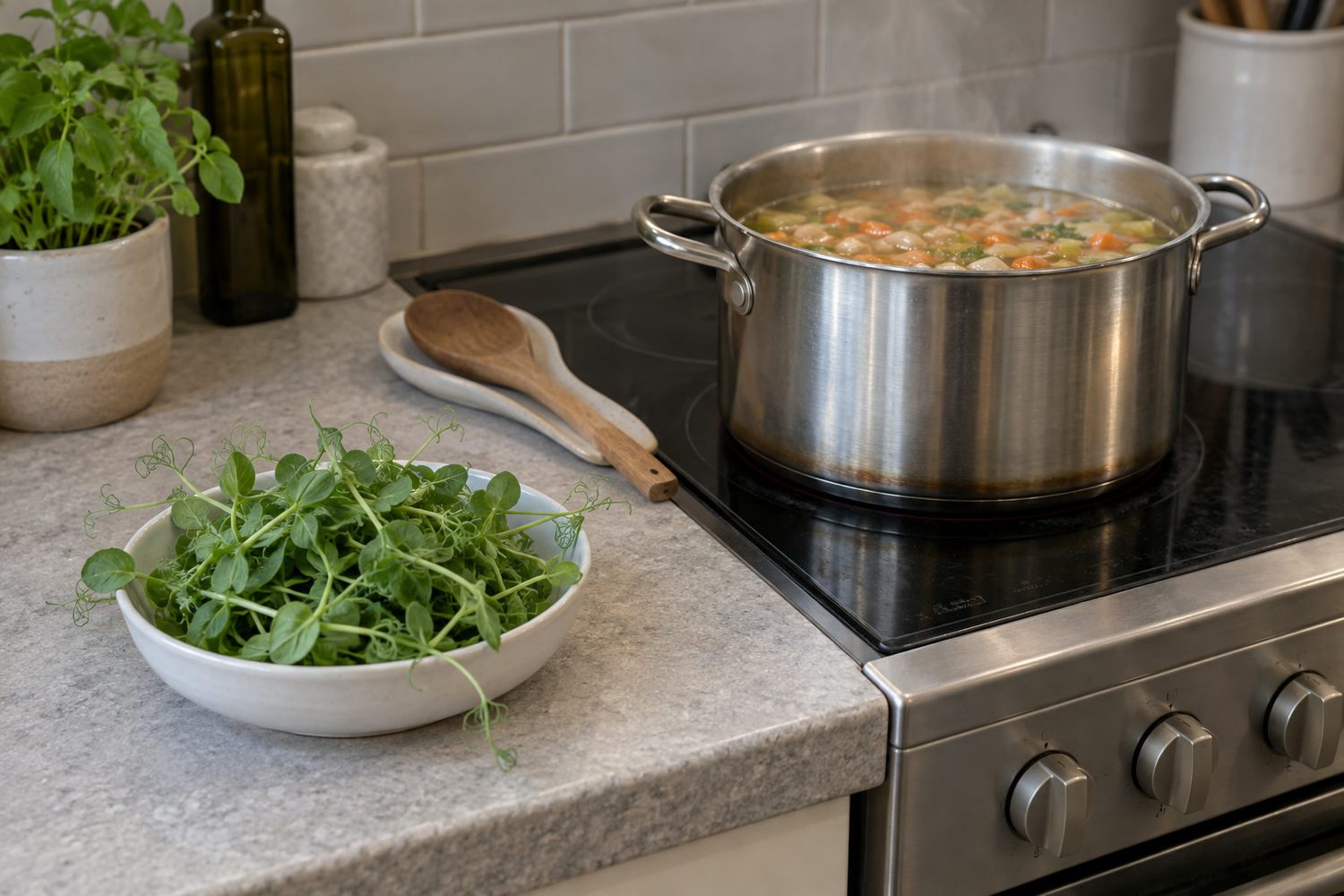
NC State Extension names cooking produce to 158°F (70°C) as the dependable kill step (NC State Extension). For microgreens, that means greens cooked through in soup, eggs or a stir-fry, not a handful scattered on top after the pan is off the heat. For a particular dish, check the food with an instant-read thermometer rather than guessing, especially when you are cooking for someone at higher risk. Most people eat microgreens raw, and are microgreens safe to eat raw covers that choice.
Who faces a higher risk, and what symptoms look like
Anyone can get cyclosporiasis. FDA says people with weakened immune systems, including people living with HIV or taking immune-suppressing medicines, older adults and children may have more severe illness and dehydration and may need longer treatment (FDA). If you grow or sell for people in those groups, the hygiene steps below and cooking when you can matter most.
CDC says symptoms start about a week after exposure on average, with a range of 2 days to 2 weeks or more. Watery diarrhea is typical, and loss of appetite, weight loss, cramps, bloating, gas, nausea and fatigue can come with it. Most US labs don't test for Cyclospora routinely, so a clinician usually has to request it specifically, and more than one stool sample on different days may be needed (CDC). If you have these symptoms, or someone at higher risk does, contact a clinician and mention the possible exposure.
Questions to ask a grower before you buy
Asking a grower a few specific questions tells you far more than a label does. A good grower should be able to answer them plainly:
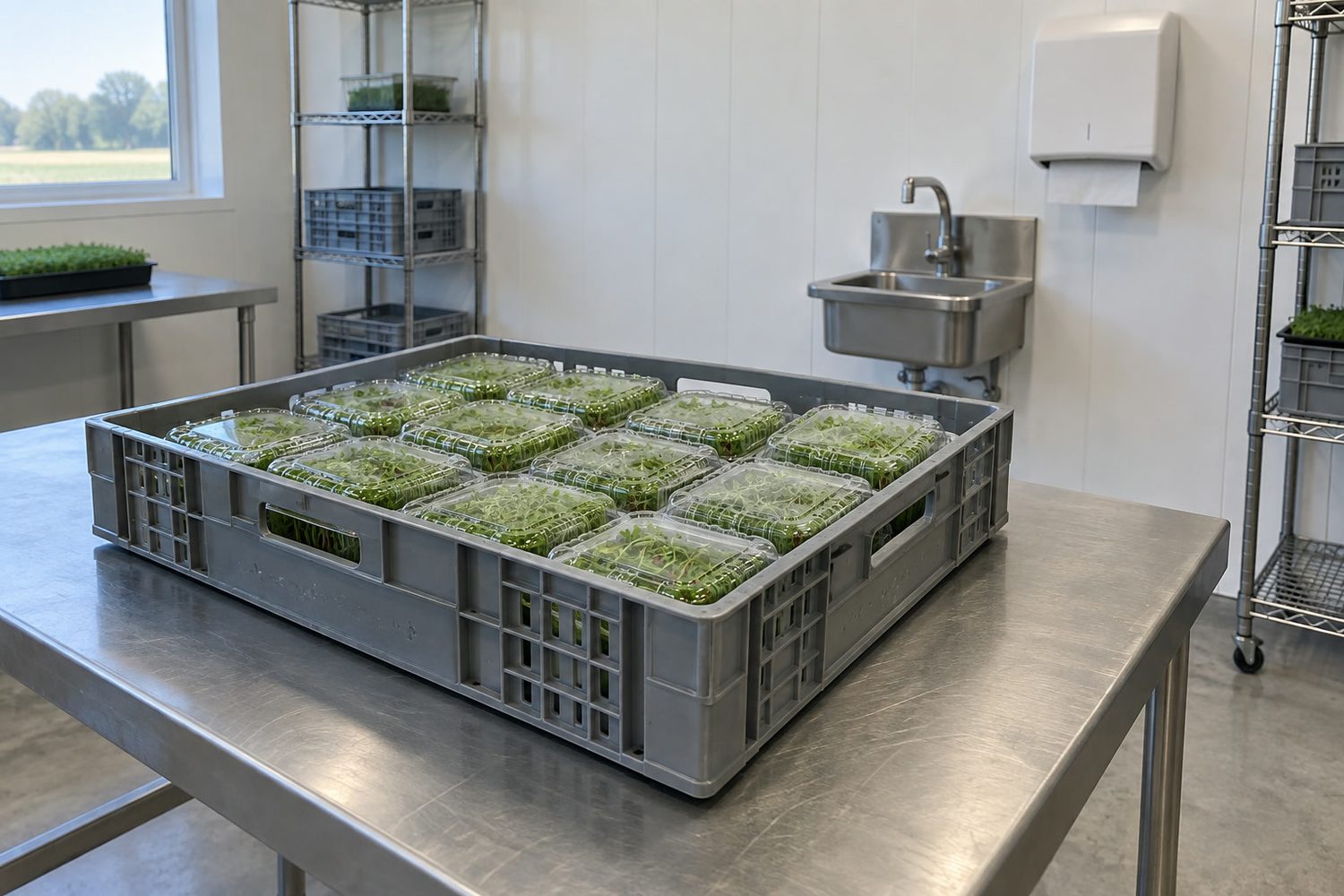
- Water: what water reaches the crop and the harvest surfaces (municipal, well or recirculated), and how do you protect, inspect and maintain it? FDA requires covered farms to assess their water source and the hazards around it (FDA water FAQ).
- People: what are your handwashing, toilet and sick-worker rules, and how do you clean harvest tools? FDA names these as Cyclospora controls (FDA).
- Records: can you tell me the sow and harvest dates for this lot, how it was handled and where else it went? That makes a traceback possible if something goes wrong. It is not a safety certificate.
Skip "Are you Cyclospora-free?" A general yes can't be shown. The only answer that means anything is a dated test result for a specific lot, and even that covers only the sample tested. If you hear about a recall and want to know whether it touches what you bought, start with checking whether a recall notice is genuine.
What to change in your own grow space
These steps come from FDA's controls for human-source contamination and ordinary tray practice. None has been tested as a home Cyclospora intervention, but each one closes a route the parasite uses:
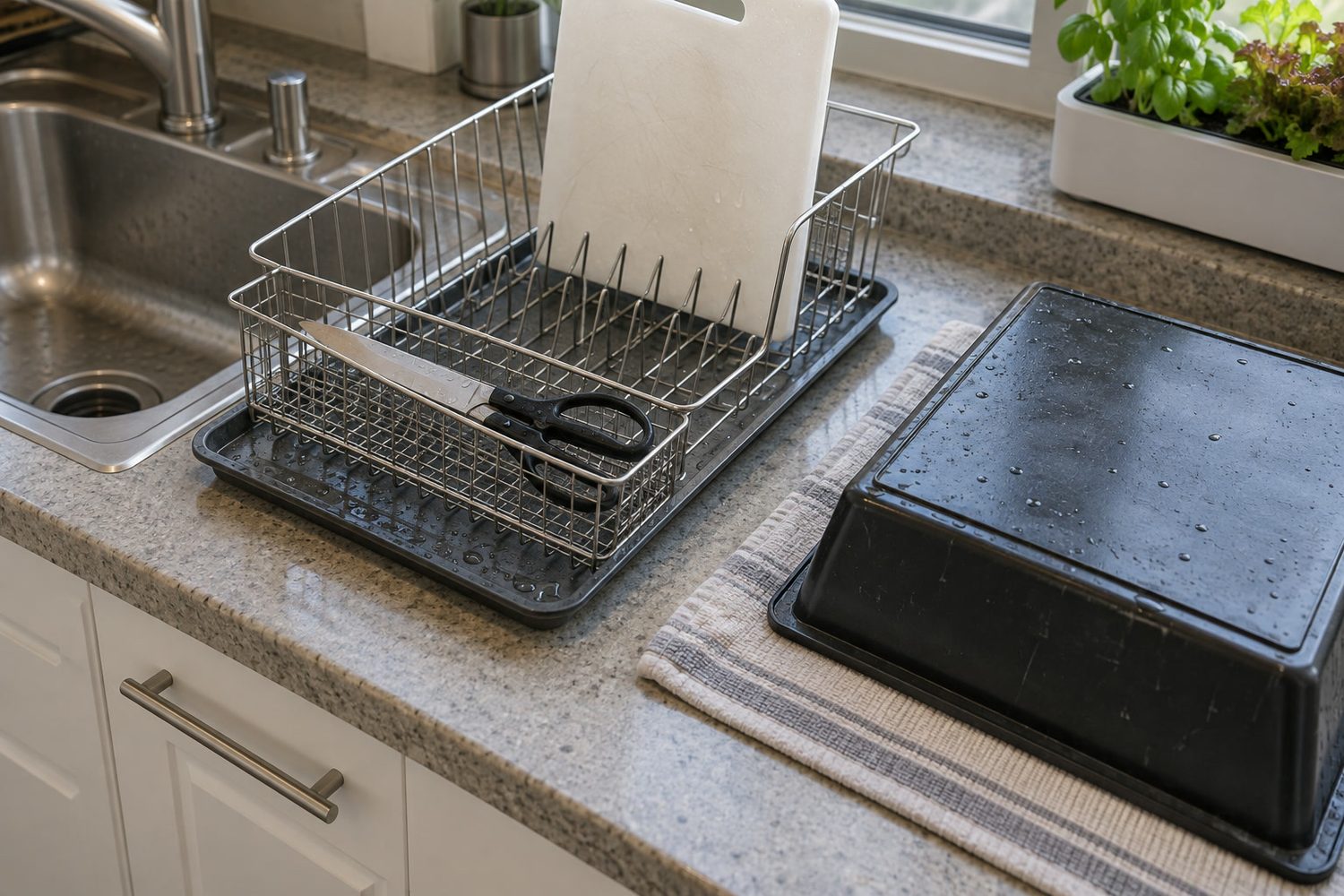
- Know your water. Use water whose source and protection you understand, and keep sewage and any human waste well away from water, trays and harvest gear.
- Wash your hands before you harvest. Use soap and running water. Health Canada says to wash for at least 20 seconds before and after handling fresh herbs (Health Canada).
- Clean what touches the greens. Scissors or a harvest knife, trays, harvest bowls, counters and cutting boards all count.
- Don't harvest while you are sick with diarrhea. Let someone else cut the trays, or wait. FDA requires covered farms to keep ill workers away from tasks that could contaminate produce (FDA).
- Use a soilless mix indoors. Maryland Extension recommends a soilless mix over garden soil, for the practical reason that garden soil is too dense for containers, not because of Cyclospora (Maryland Extension). Food-grade containers are a sensible match.
- Cook when the dish allows it. For anyone at higher risk, cooked greens are the one option with a dependable kill step.
Some things you can't control from home: whether seed, mix or incoming water already carries the parasite, whether someone handling the crop is shedding it without symptoms, and whether a raw tray holds an oocyst nobody can see. Since no test at home will settle those, keep the habits above every harvest rather than only when an outbreak is in the news. If you sell, write down sow dates, harvest dates and who bought each lot, so you can answer a question quickly if one comes.
Common questions
These come up often once you start thinking about Cyclospora and a tray of greens.
Is Cyclospora more common at certain times of year?
Yes. FDA says US-acquired cases tend to occur from May through August (FDA). CDC's review of 2000 to 2017 found foodborne outbreaks from December through July, peaking in May, June and July (CDC review). That is a pattern across the country, so keep the same habits with a winter tray.
Has Cyclospora turned up on fresh herbs sold in the US?
It has. FDA's sampling from 2017 to 2021 found it on basil in 11 of 120 samples and on cilantro in 7 of 553, and on none of 139 parsley samples (FDA herb sampling). Microgreens were not sampled, and FDA cautions that the results are not representative enough to apply broadly.
Can a lab test prove my microgreens are free of Cyclospora?
No. FDA's current method detects the parasite's DNA and can't show whether what it found was alive and able to infect, and FDA does not publish one detection limit or turnaround time that fits every product (FDA BAM Chapter 19b). Canada's CFIA found Cyclospora DNA in 4 of 1,730 imported leafy herb samples, and noted its method could not tell living parasites from dead ones (CFIA).
Is city tap water a risk for my trays?
Michigan's health department says tap water from US municipal systems "is not a known way to catch Cyclospora" (Michigan MDHHS FAQ). FDA adds that data on whether municipal treatment inactivates the parasite are limited (FDA). If you are on a well, its construction and upkeep are what to watch.
Do FDA's farm rules apply to a small microgreen business?
That depends on whether FDA's Produce Safety Rule treats your operation as a covered farm, which turns on the rule's definitions and your circumstances, not on the word "microgreen." Covered farms must train workers in hygiene, keep ill workers from contaminating produce, provide handwashing and toilet facilities, and inspect water systems under their control at least once a year (FDA Produce Safety Rule; FDA water FAQ). FDA decides coverage, so check its rule resources for your operation.
The short version for your next tray
Microgreens have not been named in a Cyclospora outbreak, and they are not protected from one either. The parasite follows people, water and tools, not crop types or growing rooms. Know your water, wash your hands before every harvest, keep scissors and trays clean, stay out of the grow space when you are sick, and cook the greens when someone at higher risk is eating them. When you buy, ask about water, handwashing and lot records, and give more weight to a plain answer than to a promise.
Sources
Prices, stock and specifications are as the linked pages showed them on 2026-09-13.
- FDA
- CDC
- FDA herb sampling
- CDC investigation
- CDC 2000 to 2017 review
- CDC 2011 to 2015 surveillance
- CDC 2018 report
- FDA
- CFIA
- UKHSA
- Michigan MDHHS FAQ
- Shields et al., 2012
- Ortega et al., 2008
- Sathyanarayanan and Ortega, 2006
- NC State Extension
- FDA water FAQ
- Health Canada
- Maryland Extension
- FDA BAM Chapter 19b
- FDA Produce Safety Rule
Keep reading
The journal
Alfalfa Sprouting Seed Recall: What to Do With Your Seed Now
This alfalfa sprouting seed recall covers Berlin Seeds lot SAL2-24JB; find out what to do with your seed, trays, and any sprouts you already grew.
Read Alfalfa Sprouting Seed Recall: What to Do With Your Seed NowThe journal
Is Homegrown Safer? What the Produce Recalls Actually Change
Partly, and not for the reason people think. Growing your own does not remove contamination risk, it moves it onto seed, substrate and water, which are three things you can act on. And one tray is one to two days of one adult's vegetables, not a replacement.
Read Is Homegrown Safer? What the Produce Recalls Actually ChangeThe journal
Is That Recall Real? How to Check Before You Throw Food Out
A recall post going around may be years old, and two of the salad recalls that spread in 2026 are really from 2021 and 2023. Here is the two minute check, on the agency record, before anything goes in the bin.
Read Is That Recall Real? How to Check Before You Throw Food OutThe journal
The Downsides of Microgreens: What Is Real, What Is Overstated, and What Is Invented
No published case report attributes an illness to eating a named edible microgreen, and at least eight recalls have produced zero illnesses. The real downsides are not health risks. They are cost, bench time and a nutrition claim that does not hold.
Read The Downsides of Microgreens: What Is Real, What Is Overstated, and What Is Invented