The Downsides of Microgreens: What Is Real, What Is Overstated, and What Is Invented
Cal HewittPublished Checked
- eating
- evidence
- safety
- cost
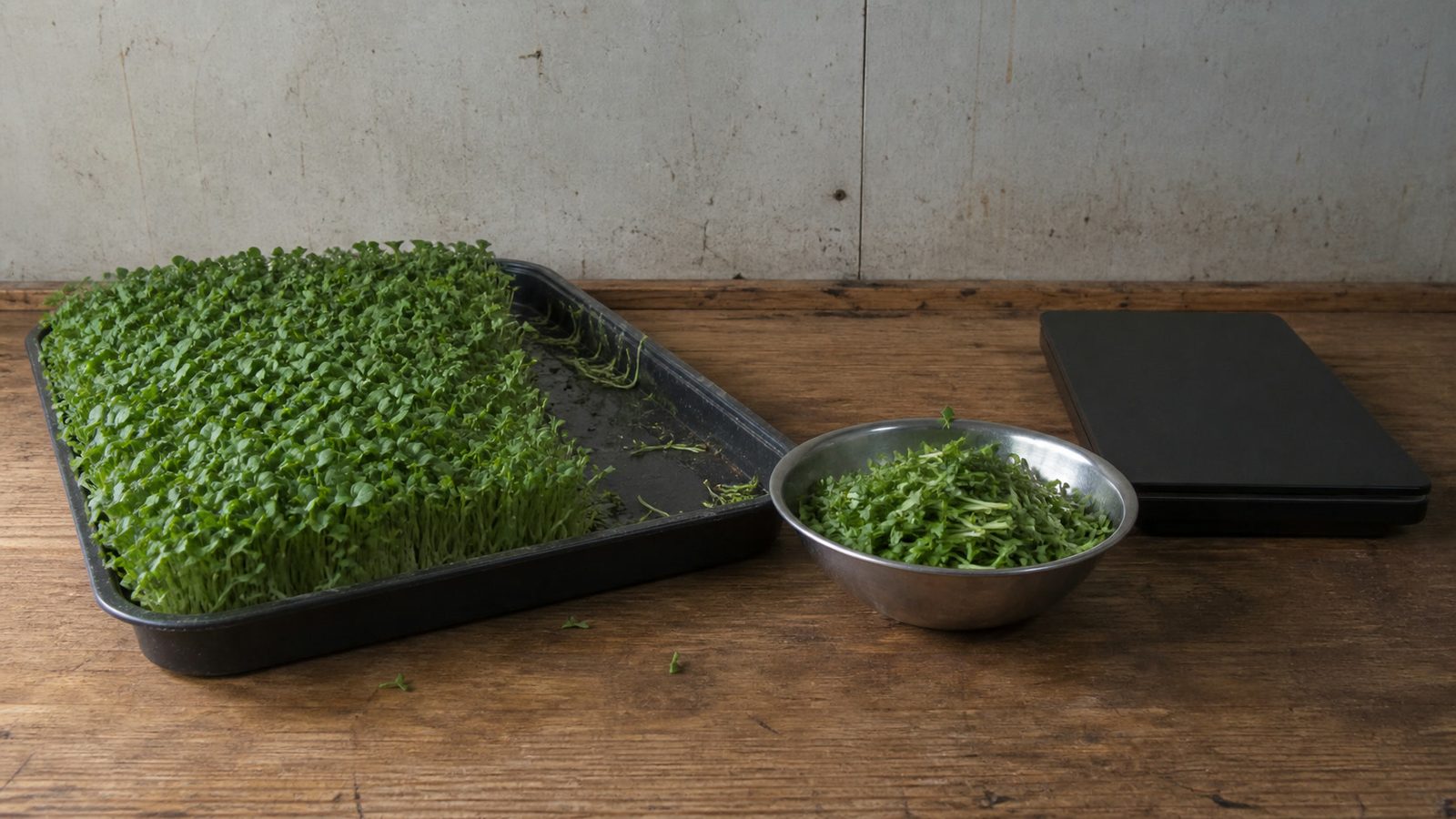
Microgreens have real drawbacks, some claimed drawbacks that are overstated, and a few that were invented outright. If you are deciding whether to start, or whether to keep going, the three are worth telling apart before you spend anything.
Here is the summary.
The health risks are almost entirely theoretical. No published case report or outbreak investigation attributes an illness, a poisoning or an allergic reaction to eating a named, normally edible microgreen. At least eight recalls are on record across two countries between 2018 and 2026, with zero illnesses in every one of them.
The real downsides are costs. Money, bench time, failure rate, and a headline nutrition claim that does not survive contact with the research. Those are all real, all measurable, and none of them is what the "side effects" pages want to talk about.
And there is exactly one hard prohibition, which has nothing to do with any of that.
The one thing that is genuinely dangerous
Nightshade seedlings are not food. Tomato, potato, pepper, eggplant, tomatillo and ground cherry contain toxic alkaloids in their leaves and shoots. Raw or cooked, at any quantity, they are excluded. Cooking is not a workaround.
That is the whole list. It is short, it is unambiguous, and it is the only item on this page that reads as a warning rather than a trade-off.
What has actually harmed anybody
Nothing on record, and the absence is worth stating precisely rather than triumphantly.
- No published case report attributing illness to a named edible microgreen was located. The nearest toxic-plant record in the sources is not a microgreen at all: a single poison-center record since 1997 involving a child who ate a "pie" containing tomato leaves along with cedar, grass and other material, where vomiting could not be attributed to the leaves.
- Five recalls, zero illnesses. Two of the five named Salmonella. In the one where a source was identified, the supplied soil tested positive, not the crop or the seed.
- The microgreen literature is composition, sensory, production and challenge microbiology. There is essentially no clinical adverse-event literature to search, which is itself the finding.
This is an absence of identified reports, not proof that nothing can happen. Nobody maintains a registry linking a microgreen product to a clinical diagnosis and an exposure date, so a small number of unattributed cases would be invisible. Read it as "no signal has been found", not "no risk exists".
The plausible route has been demonstrated in a laboratory, and the result has a twist. USDA researchers deliberately contaminated seed and recovered Salmonella and E. coli O157:H7 from broccoli, mustard, red cabbage and daikon microgreens. Recovery was lower at a 14-day harvest than at day 7, which runs against the intuition that a longer crop is a riskier one. That establishes a mechanism from contaminated seed; it is not human illness from retail product.
Regulators do not treat this crop as a sprout, and the distinction is deliberate. FDA's 2023 guidance has a microgreens-specific section saying they are grown in a substrate and cut above it, and are therefore not subject to the sprout-specific Subpart M, while remaining covered produce under the rule's other subparts. Importing sprout outbreak history onto microgreens is the single most common error on this subject, and the regulator has explicitly separated them.
The compounds, at servings people actually eat
This is where "side effects" pages invent things, usually by quoting a compound with no dose. Here is what has been measured, converted to a realistic 30 g serving.
Hover or tap a row to highlight it.
| Compound | Measured range | In a 30 g serving | What actually matters |
|---|---|---|---|
| Oxalic acid | 19.16 to 58.94 mg per 100 g fresh, highest in Sango radish | 5.7 to 17.7 mg | There is no universal upper limit. It matters against an individual kidney-stone or renal diet plan, not a general threshold |
| Vitamin K1 | 0.6 to 4.1 µg/g fresh across 25 crops | 18 to 123 µg | Only if you take warfarin, and then the issue is consistency, not a safe amount |
| Nitrate | Measured in 17 species, varying with fertiliser, light and harvest | Not calculable | The accepted daily intake is 3.7 mg per kg body weight, about 259 mg for a 70 kg adult. No crop-and-lot figure exists to compare against it |
The vitamin K point is the one worth getting right, because it is the most consequential and the most often mangled. If you take an anticoagulant, a sudden change in vitamin K intake is what destabilises clotting, in either direction. A small regular serving may sit fine inside a prescribed diet. Starting a large daily one without telling your anticoagulation clinician is the actual risk. There is no published "safe microgreen serving" and there was never going to be one.
One gap in this directory is worth naming here. The 2020 study that measured oxalate in ten culinary microgreens described them as low, and it did not include sorrel, which is the one crop here defined by its sourness and whose extension sources warn against eating it in quantity. Sorrel's own entry says the same thing. Two independent sources arriving at the same gap is a reason to treat it as a real one.
Allergens are real and under-tested. Sesame is the ninth major US allergen and sunflower seed allergy is documented if uncommon. In both cases nobody has tested whether the seedling still carries the allergenic proteins, so the honest position is that it is unknown rather than safe or dangerous.
Two worries that turn out to be unfounded
The trap on a page like this is to accumulate warnings. Two of the most repeated do not survive checking, and saying so is as much the job as listing the real ones.
Vitamin toxicity from a normal serving. The reasoning goes that microgreens are nutrient dense, therefore a large serving risks overdose. For vitamin K specifically, the NIH position is that vitamin K has not been shown to cause harm. The interaction with warfarin is real; general toxicity from eating vegetables is not the thing that was established.
A blanket ban in pregnancy. No microgreen-specific prohibition was located anywhere. This one is imported wholesale from raw-sprout advice, and the regulator has explicitly separated the two products. That does not excuse poor hygiene and it does not override an individual clinician, but the blanket rule is borrowed rather than evidenced.
The downsides that are actually real
None of these will hurt you. All of them are reasons somebody stops.
It is expensive per unit of food. Retail runs 16 to 21 times the seed cost per ounce. Growing it yourself is far cheaper in seed, at well under three cents a serving on every crop this site has costed, but that number excludes the tray, the medium, the light, the electricity and your time, which is where the real cost sits.
Some crops are a poor use of a shelf, and the gap between them is large. Cilantro returns 6 oz in 13 to 25 days for $1.10 of seed. Broccoli returns 11.5 oz in 7 to 15 days for 79 cents. Nearly twice the crop, in about half the time, for less money. Choose badly and you will occupy a bench for three weeks for a bowl of garnish.
Nine crops here cannot be costed at all, because nobody publishes a seed rate, a yield, or both. If you want to know what a tray of them costs you, nobody can tell you.
It keeps badly. Shelf life across the 38 crops with a published figure runs from 1 day to 21, and every one of those figures assumes the crop was never washed. Buy a clamshell and forget about it for a week and you may have thrown away most of it.
And the headline nutrition claim does not hold. The "40 times more nutrients" figure is not establishable as a single number: across the study it comes from, ratios run from about 3 to about 260 depending which crop and which nutrient you pick (the 260 compares red cabbage beta-carotene with a 2006 figure for the mature leaf; against USDA's value it is about 17), and for broccoli glucoraphanin specifically the mature plant wins. Microgreens are a genuinely good vegetable. They are not a multiplier.
What nobody has measured
- Any registry linking a microgreen product to a clinical diagnosis, which is why the absence of case reports is weaker evidence than it looks.
- Whether the allergenic proteins survive into the seedling, for sesame or sunflower.
- Oxalate in sorrel, the one crop where it most obviously matters.
- A crop-and-lot nitrate figure that could be compared against the accepted daily intake.
- Any human dose-response study for a named microgreen, at any intake, for any outcome.
- The home failure rate. Nobody has published what proportion of trays a beginner loses, which is probably the single most useful downside figure that does not exist.
Terms on this page
Tap a term to see what it means.
Alkaloid. The class of compound that makes nightshade leaves and shoots toxic. Not affected by cooking.
Sources
Opened 2026-08-11. Costs, yields and shelf lives are this site's own, sourced per crop.
- FDA, guidance for seeds used for sprouting, September 2023 - the microgreens-specific section establishing that they are cut above the substrate, are not subject to Subpart M, and remain covered produce under the rule's other subparts.
- USDA FoodData Central, red cabbage, raw (SR Legacy, FDC 169977) - 0.670 mg beta-carotene per 100 g, the mature value that puts red cabbage microgreens at about 17 times rather than 260.
- USDA Agricultural Research Service project record - inoculation work recovering Salmonella and E. coli O157:H7 from broccoli, mustard, red cabbage and daikon microgreens grown from contaminated seed, with lower recovery at day 14 than day 7.
- 2024 controlled study of oxalic acid in microgreens - 19.16 to 58.94 mg per 100 g fresh weight, highest in Sango radish.
- Ghoora et al., 2020, ten-crop composition study - described its measured culinary microgreens as low in oxalate. Sorrel was not among them. The page returned an internal error and is recorded rather than relied on.
- 2024 production and composition review (PDF) - reports the phylloquinone measurement of 0.6 to 4.1 µg/g fresh weight across 25 commercially available microgreens, and states that more same-crop, same-conditions nutritional work is needed.
- NIH Office of Dietary Supplements, vitamin K - that vitamin K has not been shown to cause harm, and that the warfarin issue is consistency of intake rather than a threshold.
- Nitrate in 17 microgreen species - measured but varying with species, fertiliser, light and harvest. Full text was behind a bot challenge; only the accessible abstract was used.
- EFSA on nitrate in vegetables - the acceptable daily intake of 3.7 mg nitrate per kg body weight per day. The page was rate-limited and only the accessible summary was used.
- NC State Extension, Solanum lycopersicum - the single poison-center record since 1997, involving mixed plant material and an unattributable outcome.
- FDA, selecting and serving produce safely - general raw-produce handling, and the limits of appearance and smell as safety checks.
Keep reading
The journal
How Much Microgreens Per Serving, and What It Actually Costs
2.5 grams a person is the only weighed serving in a published recipe. Computed from the yield and seed figures for 38 crops, that serving costs about 1.5 cents of seed, against retail at 16 to 21 times as much per ounce.
Read How Much Microgreens Per Serving, and What It Actually CostsThe journal
Are Microgreens Safe From Cyclospora?
Are microgreens safe from cyclospora? Learn how the parasite spreads, what washing and cooking do and do not do, and the steps that matter at home.
Read Are Microgreens Safe From Cyclospora?The journal
Are Microgreens Low FODMAP? What Monash Research Shows
Are microgreens low FODMAP? Learn what Monash sprouting research shows, which crop families deserve extra caution, and how reintroduction testing works.
Read Are Microgreens Low FODMAP? What Monash Research ShowsThe journal
Best Microgreens for Kidney Health: Potassium by the Serving
See measured potassium and phosphorus for the best microgreens for kidney health, from lowest to highest, plus what your renal dietitian needs to know.
Read Best Microgreens for Kidney Health: Potassium by the Serving