How to Store Microgreens, and How Long Do They Last?
Cal HewittPublished Checked
- eating
- storage
- evidence
- shelf life
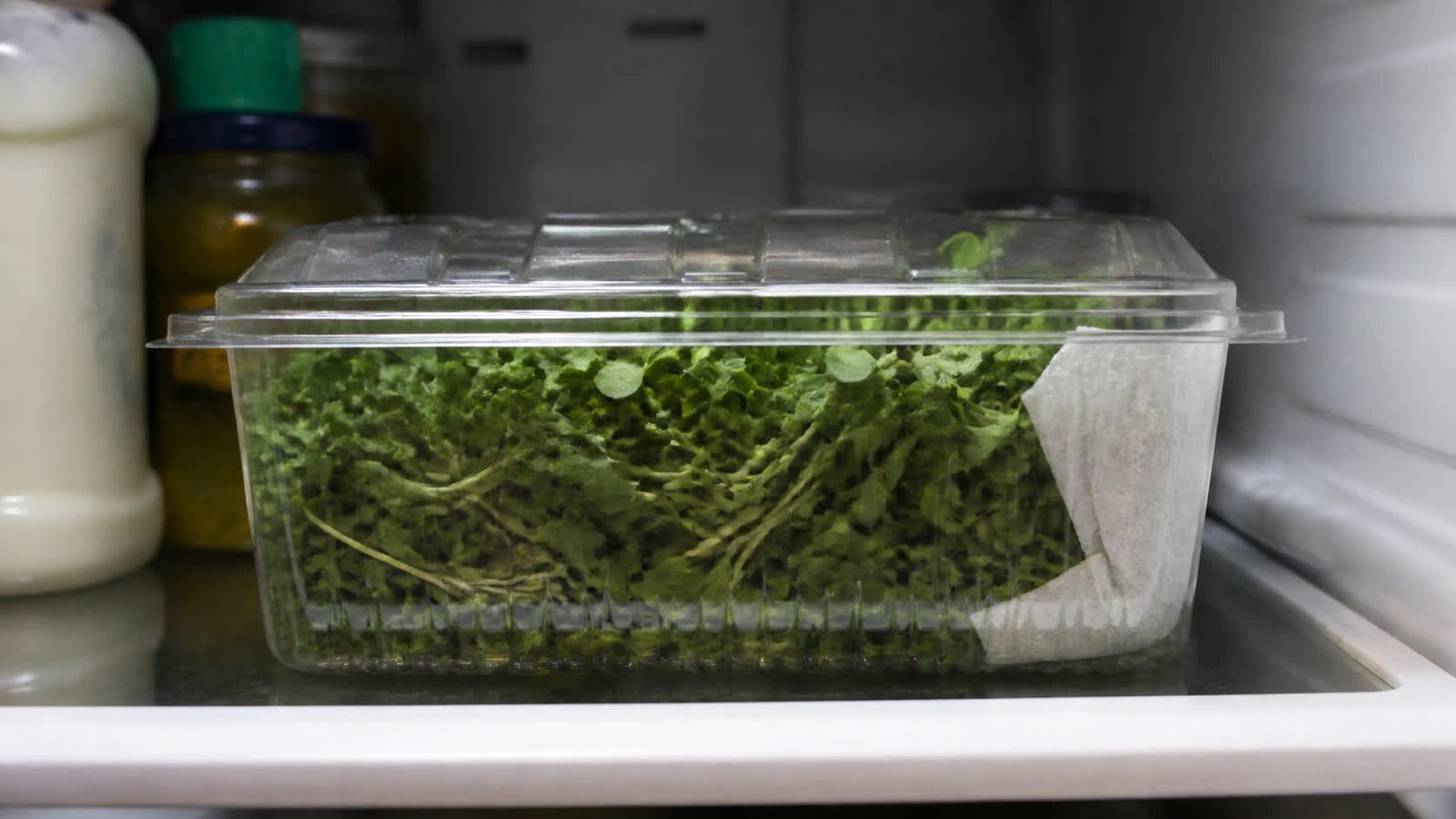
Cold, dry, unwashed, and in something that lets it breathe. That is the whole practical answer, and everything below is about how thin the evidence under it is.
Almost none of the advice you will find cites a study. Of the first eight non-extension results checked on 2026-08-11, none supplied a peer-reviewed or extension source for its central claim about days, container or method. Two linked to general government handling advice elsewhere on the page. None supported the number it was actually giving you.
Controlled studies do exist, and they disagree with each other. Between them they cover about a dozen crops out of sixty-two.
What to actually do
- Buy or cut it as close to eating as you can. Everything below is damage limitation.
- Do not wash it until the moment it goes on the plate, because washing shortens shelf life.
- Coldest shelf of the fridge, not the door. Around 4°C is inside the tested range for every crop anybody has studied. A fridge thermometer is the only way to know you are there, and on the spoilage evidence a fridge at 10°C instead of 4°C cost a week or more of quality.
- Except basil, which browns in the cold. Keep it warmer and eat it sooner.
- Leave it in the vented container it came in, with a dry paper towel, and pour off any condensation.
- Do not stack anything on it. Compression bruises this crop faster than time does.
- Check the crop, not the calendar. A buckwheat tray and a basil tray are twenty days apart.
There is no single right temperature, and the number everyone repeats came from nowhere
These published trials tested storage on named microgreen crops:
Hover or tap a row to highlight it.
| Crop | Best temperature tested | Held acceptable to | Year |
|---|---|---|---|
| Daikon radish | 1°C (34°F), with no chilling injury | Day 28 | 2014 |
| Buckwheat | 5°C (41°F) | Day 21 | 2013 |
| Tartary buckwheat | 5°C, best of 5 to 25°C tested | Day 8 study window | 2022 |
| Arugula, radish, red cabbage | 4°C beat 10°C | Three-week observation | 2012 |
| Mustard, washed before packing | 5°C (41°F) | Day 14 | 2023 |
| Mungbean, Indian mustard | 4°C only | About day 4 | 2022 |
| Lentil | 4°C only | Day 6, when the trial ended | 2022 |
| Chicory, lettuce, broccoli | 5°C | Not beyond day 10 | 2018 |
| Sunflower | Cold storage in LDPE and PP film | No day count in the summary | 2026 |
One says 1°C, and the rest point to 4 to 5°C. Even the same species can disagree: mustard held 14 days in one trial and about 4 in another. These are different crops, different packaging and different endpoints, and there is no basis for collapsing them into a category-wide optimum.
The "33°F, just above freezing" advice you will find everywhere traces to nothing. It was followed back for this page and it terminates in unattributed handling advice and commercial product pages, never in a trial. The closest real number is the radish study's 1°C, which is 33.8°F, on one crop, in controlled packaging, after a chlorine wash. A wholesale distributor separately specifies 38 to 40°F as ideal with a 32 to 39°F working zone, which is a commercial handling specification rather than a cited result.
Your fridge is probably fine. A domestic refrigerator runs around 4°C, which is inside or adjacent to every optimum anybody has tested. The useful instruction is coldest shelf, not the door.
With one exception that matters. Basil is the documented cold-sensitive crop: a distributor flags micro basil as browning or blackening below 40°F. That is practice rather than a trial, but it lines up with the published figures. Basil's shelf-life minimum is 1 day, the shortest of any crop alongside amaranth, against a corpus that reaches 21. Two unconnected sources agreeing about the same crop is worth more than either alone. Keep basil warmer than the rest and use it the day you get it.
Chilling injury below 4°C is otherwise unresolved. Radish showed none at 1°C. Tartary buckwheat showed higher electrolyte leakage at 5 and 10°C than at 15°C, which its authors read as possible susceptibility during prolonged storage. Nobody has produced a susceptibility list across common crops, so if you are going colder than a normal fridge, test your own crop.
What the per-crop figures say, and the caveat on all of them
Thirty-nine of the 62 crops publish a shelf life, running from 1 day to 21 days. Those are sourced per crop, and two things about them matter here.
First, nearly all of them assume the crop was never washed. Of the 47 shelf-life source notes checked, almost none states a wash status, because the underlying sources rarely do. The clear exception is mustard's 14 days, measured on microgreens washed in water and drained before packing. Washing before storage shortens life; nobody has published by how much. So, read the shelf-life figures, here and anywhere, as "if you never wash it."
Second, the spread is not arbitrary, and there is a mechanism behind it. The 2012 study measured carbon dioxide production during storage and found arugula and red cabbage had the highest respiration and declined visibly soonest. The per-crop figures agree in direction: arugula publishes 10 days and red cabbage 5 to 10, against buckwheat at 21, the longest here. A crop that respires hard keeps badly, which is a better predictor than anything on the packet.
Packaging is not inert, and a sealed tub is not a clever trick
This is the part the common advice gets most wrong, and it has a real mechanism behind it.
The crop keeps breathing after you cut it. It consumes oxygen and produces carbon dioxide inside whatever you put it in. In the Tartary buckwheat trial, package oxygen fell and carbon dioxide rose sharply within the first two days, and at 5°C the oxygen was depleted less than at warmer temperatures.
So, the headspace is set jointly by the crop's respiration and the film's permeability, not by the container alone. Commercial modified-atmosphere packaging is engineered around that: the buckwheat work identified a target of 14.0 to 16.5 kPa oxygen and 1.0 to 1.5 kPa carbon dioxide for its crop.
A tightly sealed home container is not modified-atmosphere packaging. It is a sealed box in which a living crop consumes its own oxygen. And a film result for one crop does not transfer to another, because the respiration rate differs.
What that means practically:
- Keep the vents. If it came in a vented clamshell, leave it in the vented clamshell.
- Do not seal it airtight unless you are deliberately running a tested system.
- The paper towel is doing a real job, which is absorbing the water the crop transpires, not adding humidity.
- Watch for condensation. Water on the inside of the lid can come from a temperature swing or greens packed warm, and it is a signal you can see and act on.
Humidity has never been established for this crop. The controlled studies measured package gases, weight loss, quality and microbes, and none of them ran a room-humidity comparison. Sellers suggest 95 to 98 percent while warning against free water on the leaves, which is a plausible heuristic and not a result. Do not borrow a mature-leafy-vegetable target and call it microgreen evidence.
The living tray: entirely unmeasured
A lot of microgreens are sold as a living tray, and the appeal is obvious: cut what you need, when you need it.
No controlled study has ever tested one. Every published trial cut and packaged the crop first. What exists instead is seller care advice, and the sellers disagree:
- 2 or more weeks by a bright window with light watering.
- 7 to 10 days on the counter.
- 7 days or more at room temperature, out of direct sun, watered lightly each day.
All three come from companies selling living trays, at $35 to $40 a tray or subscription, and none is a measurement.
Whether a living tray actually keeps better than the same crop cut is also unmeasured. It is biologically reasonable, since uncut tissue avoids cut-surface damage, but "better" needs a defined outcome and nobody has defined one. And do not put a living tray in the fridge on the strength of the radish result. A rooted, watered tray has different respiration, water and light needs from a cut packaged crop, and nobody has tested whether it resumes growth afterwards.
How to tell it has gone
There is no measured age threshold for any of this, so it comes down to inspection, and the honest limits of inspection are worth stating.
- Condensation or standing water in the package. A signal you can see and act on.
- Loss of turgor. Shoots that are no longer crisp and upright.
- Slime, obvious mold, or a sour or musty smell. Discard, do not rinse and rescue.
Appearance and smell cannot prove safety. That is the FDA's position on produce generally: throw away anything that looks rotten or smells suspicious, and understand that passing those checks is not a guarantee. A seller's window of 7, 10 or 14 days is not a substitute for opening the box and looking.
What nobody has measured
- Storage conditions for about fifty of the 62 crops. About a dozen have been tested.
- A relative humidity optimum, for any crop.
- Anything at all about a living tray: temperature, duration, whether it beats cutting, whether it survives the cold.
- A chilling-injury susceptibility list, which would need named crops at 0, 1, 4, 5, 8 and 10°C with visual injury, electrolyte leakage, microbial counts and tasting.
- How much washing before storage actually costs you, in days, for any crop.
- Where the 33°F recommendation came from. It is repeated everywhere and attributable nowhere.
Terms on this page
Tap a term to see what it means.
Respiration. The crop continuing to consume oxygen and produce carbon dioxide after harvest. Higher respiration means faster decline, and it is the best available predictor of shelf life.
Sources
Opened 2026-08-11. Per-crop shelf lives come from each crop's own entry.
- Xiao et al., LWT, 2014, daikon radish microgreens - storage temperature, package oxygen transmission rate and a 100 mg/L chlorine wash; acceptable quality through day 28 at 1°C with no chilling injury.
- Kou et al., LWT, 2013, buckwheat microgreens - 1 to 20°C with films and wash treatments; 5°C with 14.0 to 16.5 kPa oxygen and 1.0 to 1.5 kPa carbon dioxide best, acceptable at day 21.
- Yan et al., 2022, Tartary buckwheat microgreens (PDF) - 5 to 25°C over eight days with PE, LDPE and HDPE films; 5°C and LDPE best on visual quality and weight loss, and the electrolyte-leakage reading behind the chilling-injury caution.
- Berba and Uchanski, 2012, postharvest physiology of microgreens - carbon dioxide evolution at harvest and through three weeks for arugula, radish and red cabbage; arugula and red cabbage highest respiration and earliest visible decline; 4°C beat 10°C.
- Dayarathna et al., 2023, packaged mustard microgreens - Brassica juncea washed and drained, then held in polyethylene bags; good overall sensory quality for 14 days at 5°C.
- Priti et al., 2022, mungbean, lentil and Indian mustard microgreens - about 4 days at 4°C in LLDPE zip-lock bags for mungbean and Indian mustard, and lentil still salable on day 6, when the trial ended.
- Paradiso et al., 2018, chicory, lettuce and broccoli microgreens - fresh-cut microgreens with a shelf life not exceeding ten days at 5°C.
- Azarpazhooh et al., 2026, sunflower microgreens in modified-atmosphere packaging - LDPE and PP films preserving color, antioxidant levels and freshness in cold storage.
- Ghoora and Srividya, 2020 - radish and roselle at 5°C in macro-perforated PET clamshells against LDPE self-seal bags. Publisher copy was blocked; recorded for completeness rather than relied on.
- FDA, selecting and serving produce safely - discard produce that looks rotten or smells suspicious, and the limits of appearance and odor as safety checks.
- John Vena Inc. microgreens handling - a wholesale distributor's 38 to 40°F ideal and 32 to 39°F zone, and the micro basil cold exception. Commercial specification, not a trial.
- Deliseeds harvest and storage and Purvey'd - the 95 and 98 percent humidity suggestions, both from sellers, both without a measurement.
- Living-tray care claims are from San Diego Microgreens, Magnolia Greens and Robby Ds, all of which sell living trays or fresh product. Prices seen 2026-08-11.
Keep reading
The journal
Can You Freeze Microgreens? What Survives Drying and Freezing, and What Does Not
A microgreen is 87 to 94 percent water, so a whole tray dries down to a couple of spoonfuls. Drying is not a kill step, freezing does not make greens keep their crunch, and only one crop has ever been measured.
Read Can You Freeze Microgreens? What Survives Drying and Freezing, and What Does NotThe journal
How Long Do Microgreens Last by Crop and Temperature
How long do microgreens last in the fridge depends on the crop and the temperature. See measured storage life by crop and what to do when no figure exists.
Read How Long Do Microgreens Last by Crop and TemperatureThe journal
Should You Wash Microgreens? Yes, But Not When You Think
Wash them immediately before eating and never before storing. A plain-water rinse removes half to three quarters of the bacteria, not all of it, and every shelf-life number you have ever read for microgreens silently assumes the crop was never washed.
Read Should You Wash Microgreens? Yes, But Not When You ThinkThe journal
Have These Gone Bad? Judging a Box of Microgreens in the Fridge
A warm fridge costs days: arugula, radish and red cabbage lost a week of quality at 10C against 4C, and one mustard study lost ten. And no visible sign has ever been validated as a safety test.
Read Have These Gone Bad? Judging a Box of Microgreens in the Fridge