How Long Do Microgreens Last by Crop and Temperature
Cal HewittPublished Checked
- storage
- eating
- evidence
Disclosure: Microgreens Guru may earn a commission if you buy through some links on this site. It does not change what the studies below report.
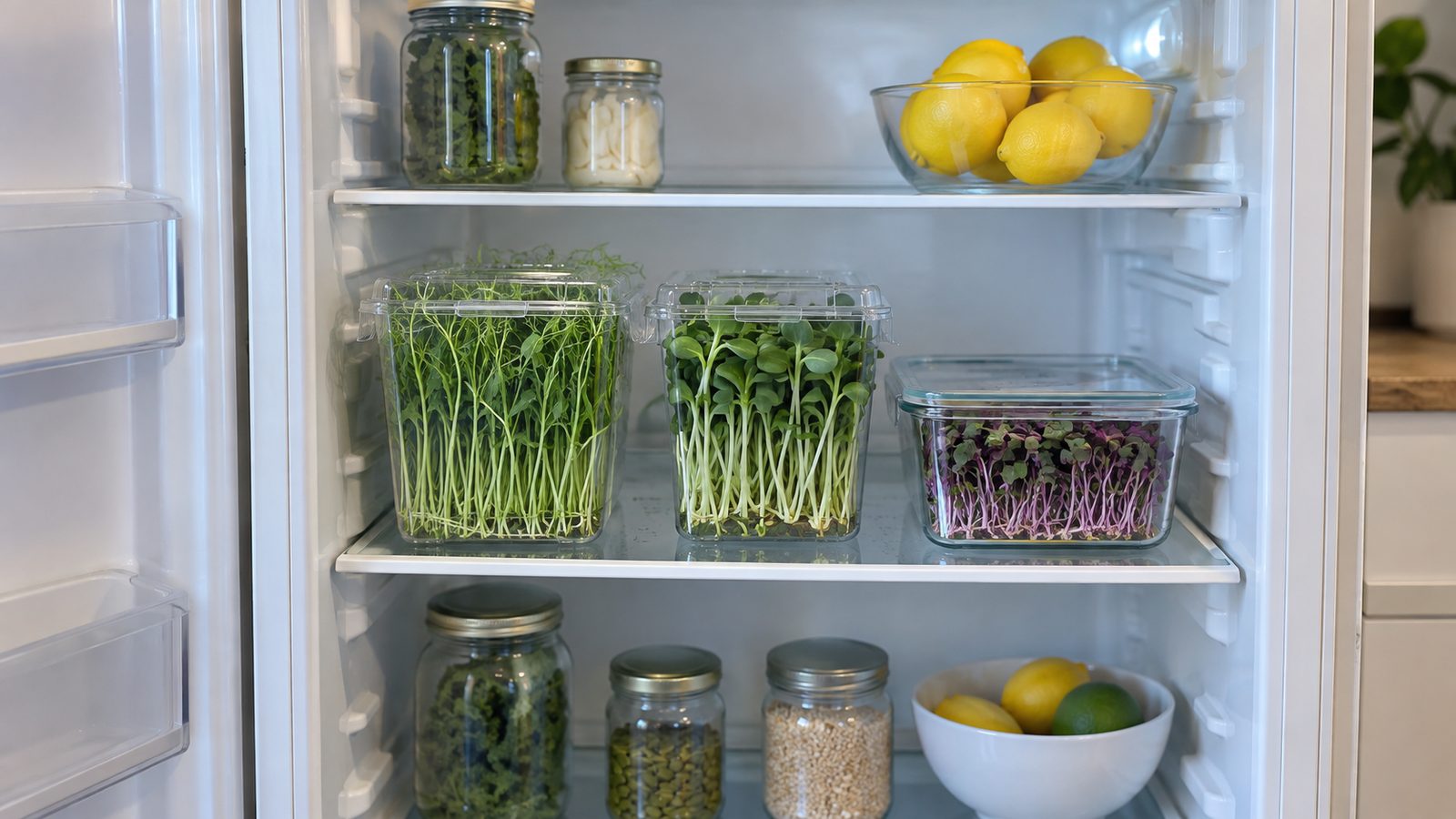
In cold storage, most of the crops that have been measured held good quality for one to three weeks, and the spread depends on the crop, the temperature and the container. Radish kept going longest: 21 days at 4°C (39°F) in a vented clamshell, and daikon radish was still above the salable line at 28 days at 1°C (34°F) in film bags. Arugula and red cabbage lasted 14 days at 4°C. Mungbean and one mustard study managed only about 4 days. Find your crop below, match it to your fridge, and use the signs at the end to decide on the tray in front of you.
Every day count on this page is a quality endpoint, the point where a panel or a rating scale said the greens no longer looked or tasted good enough. None of them is a food-safety limit. Some counts mark the day the crop failed its score; others mark the day the trial simply stopped, with the greens still passing. That difference matters, so each figure below says which it is.
The day counts at a glance
The table puts every measured figure side by side. Read the "What ended it" column before you compare two rows, because a trial that stopped at 21 days with the greens still good is telling you something different from a crop that failed on day 7.
Hover or tap a row to highlight it.
| Crop | Temperature | Packaging | Washed? | Days | What ended it | Study |
|---|---|---|---|---|---|---|
| Daikon radish | 1°C (34°F) | Sealed film bags | No | 28 | Trial stopped; still above the salable score | Xiao et al., 2014 |
| Daikon radish | 5°C (41°F) | Sealed film bags | No | 14 | Trial stopped; still acceptable | Xiao et al., 2014 |
| Daikon radish | 10°C (50°F) | Sealed film bags | No | 7 | Failed; unacceptable by day 10 | Xiao et al., 2014 |
| Radish | 4°C (39°F) | Vented clamshell | No | 21 | Trial stopped at three weeks; still passing | Berba and Uchanski, 2012 |
| Radish | 10°C (50°F) | Vented clamshell | No | 14 | Last passing weekly check | Berba and Uchanski, 2012 |
| Red cabbage | 4°C (39°F) | Vented clamshell | No | 14 | Last passing weekly check | Berba and Uchanski, 2012 |
| Red cabbage | 10°C (50°F) | Vented clamshell | No | 7 | Last passing weekly check | Berba and Uchanski, 2012 |
| Arugula | 4°C (39°F) | Vented clamshell | No | 14 | Last passing weekly check | Berba and Uchanski, 2012 |
| Arugula | 10°C (50°F) | Vented clamshell | No | 7 | Last passing weekly check | Berba and Uchanski, 2012 |
| Mustard | 5°C (41°F) | Sealed polyethylene bags | Yes, water | 14 | Good sensory quality held for the full trial | Dayarathna et al., 2023 |
| Mustard | 10°C (50°F) | Sealed polyethylene bags | Yes, water | 4 good (14 total) | Dropped from "good"; rated "fair" at day 14 | Dayarathna et al., 2023 |
| Mustard | 15°C (59°F) | Sealed polyethylene bags | Yes, water | 2 good (7 total) | Dropped from "good" | Dayarathna et al., 2023 |
| Indian mustard | 4°C (39°F) | Zip-lock LLDPE bags | Not stated | About 4 | Fell below the salable score | Priti et al., 2022 |
| Mungbean | 4°C (39°F) | Zip-lock LLDPE bags | Not stated | About 4 | Fell below the salable score | Priti et al., 2022 |
| Lentil | 4°C (39°F) | Zip-lock LLDPE bags | Not stated | 6 or more | Trial stopped at day 6; still passing | Priti et al., 2022 |
| Chicory, lettuce, broccoli | 5°C (41°F) | Packaged, fresh cut | Not stated | 10 at most | Upper bound, not a tested day | Paradiso et al., 2018 |
Radish: the longest-lasting crop measured
If you are holding radish, you have the most durable crop in the studies. In Berba and Uchanski's trial (Journal of Young Investigators, July 2012), unwashed radish was fan-dried after harvest, packed 36 g to a hinged deli clamshell with four 3 mm holes in the lid, and kept in a dark walk-in cooler. The greens were rated weekly on a 1 to 5 visual scale, and a score of 3 or more counted as acceptable. At 4°C, radish was still at or above 3 when the three-week trial ended at 21 days. That means 21 days is where the study stopped looking, not where the radish gave out. At 10°C (50°F), the same radish held for 14 days.
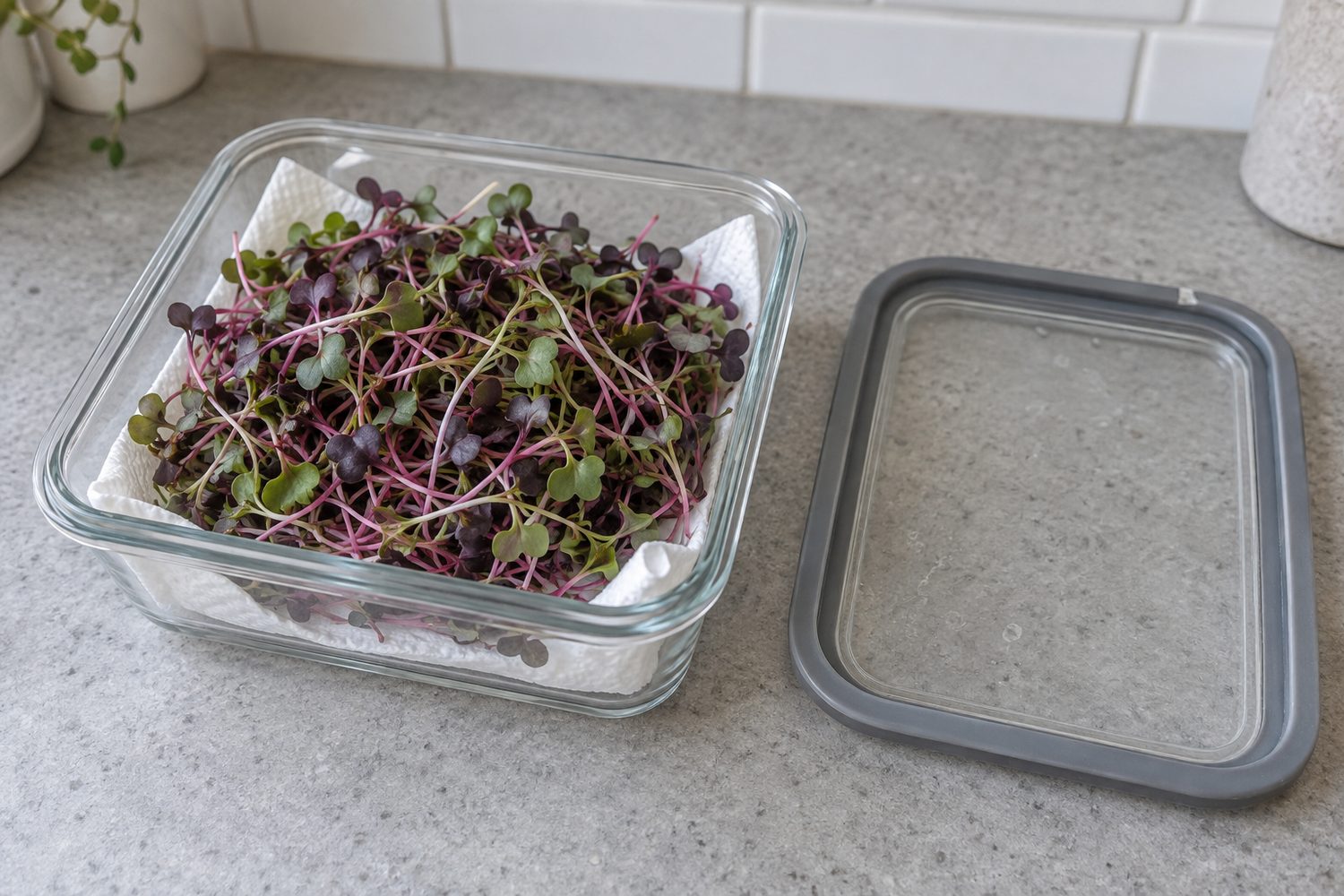
Daikon radish goes further again, but treat it as its own case. Xiao and colleagues (LWT Food Science and Technology, 2014, with full methods in Xiao's University of Maryland dissertation, chapter 4) packed 15 g of unwashed daikon into sealed polyethylene bags made from five different films and stored them dark at 1°C. On a 9-point visual scale where 6 is the limit of salability, every film scored 7.3 to 7.5 at day 28, when the trial ended. The film's oxygen rate changed the gas inside the bag but did not significantly change quality over those 28 days.
The same group ran a shorter temperature trial that shows how fast warmth costs you days. At 1°C and 5°C, daikon was still acceptable at day 14, the end of that trial, scoring 7.9 and 6.5. At 10°C it was acceptable to day 7 at a score of 7.6, began yellowing after that, and scored an unacceptable 4.8 by day 10.
Because the temperature, the container and the scale all differ between the two studies, do not read 28 days as the radish number in general. It is the number for unwashed daikon in sealed film at 1°C. If your fridge runs nearer 4°C and your radish is in a clamshell, 21 days or more is the closer match.
Arugula and red cabbage: two weeks cold, one week cool
Arugula and red cabbage were in the same Berba and Uchanski trial as the radish, in the same vented clamshells, unwashed. Both passed at the two-week check at 4°C and were below the acceptable score by the three-week check, so 14 days is the last day they were seen to pass. At 10°C both dropped to 7 days.
That halving between 4°C and 10°C is the clearest temperature effect in the whole set, and it happened in two different crops under identical conditions. If your fridge runs warm, or the tray sits in the door, plan on the shorter figure.
Mustard: two studies, two very different numbers
Mustard is the crop where you will have to use your own eyes most, because the two studies that measured it do not agree.
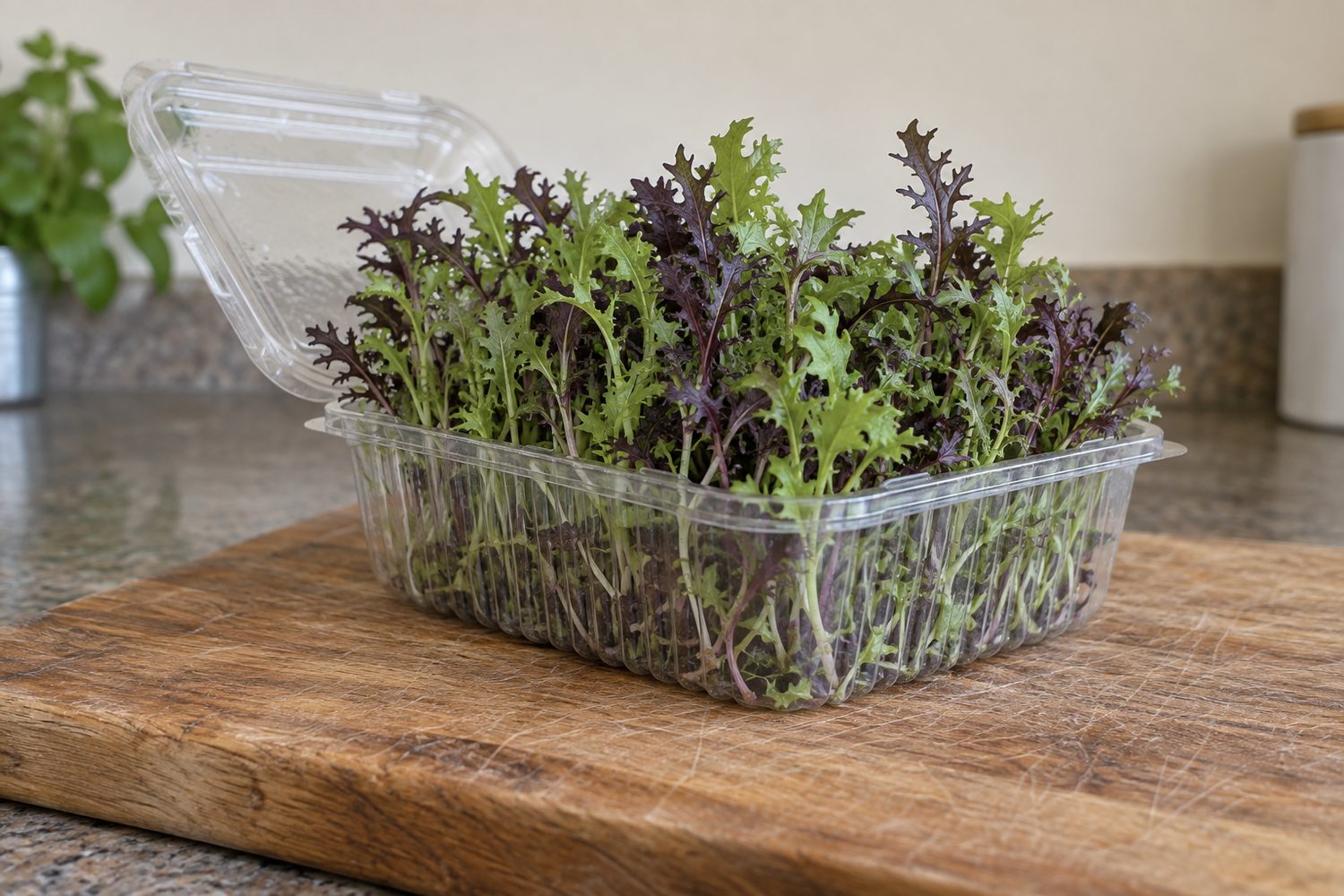
In Dayarathna et al. (Life, 2023, Sri Lanka), mustard was washed in water to remove potting material, drained for 15 minutes, and sealed 15 g to a 150 micrometer polyethylene bag. At 5°C it kept good overall sensory quality for 14 days. At 10°C it stayed "good" for 4 days, although the same samples lasted to day 14 and were rated "fair" by then. At 15°C it was "good" for 2 days and lasted 7. At 20°C and 25°C it deteriorated beyond eating within a day. There was no unwashed comparison, so the study says nothing about whether the wash helped or hurt.
In Priti et al. (PLoS One, 2022, India), Indian mustard, the same species (Brassica juncea), was packed 8 g to a 51 micrometer zip-lock LLDPE bag and kept dark at 4°C. Seven semi-trained judges scored color, aroma, taste and overall acceptability, and it stayed above the salable score of 6 for about 4 days.
That is roughly 14 days against roughly 4 at almost the same temperature, for the same species. The two studies differ in bag, portion size, panel and scoring, and neither settles which of those accounts for the gap. For your own mustard, start checking it closely from day 4, and if it still looks and smells right, keep going.
Mungbean and lentil: one study each
The only measured figures for these two come from the same Priti et al. trial, in zip-lock LLDPE bags at 4°C. Mungbean stayed above the salable score for about 4 days. Lentil was still above it on day 6, the last day tested, so its real limit is somewhere past that.
Neither number has been repeated in a second study. Treat about 4 days for mungbean as the day to start inspecting, not the day to throw it out, and treat lentil's 6 days as a floor.
Chicory, lettuce and broccoli: a ceiling, not a count
Paradiso et al. (Food & Function, 2018) packaged fresh-cut chicory, lettuce and broccoli microgreens, two genotypes of each, and reported a shelf life "not exceeding ten days at 5 °C." That is an upper bound across all six, with no crop-by-crop figure. If you have one of these at 5°C (41°F), expect 10 days at the outside and look it over well before then.
Sunflower: packaging mattered, but there is no day count
A 2026 study of sunflower microgreens by Azarpazhooh and colleagues (Sustainable Food Technology) compared four modified-atmosphere packages, low-density polyethylene and polypropylene films, each active and passive, at 4°C and 12°C, and checked them on days 3, 5 and 15. The active polypropylene package (PP-MP1) at 4°C kept the best overall physical and microbial stability: less weight loss, more moisture, chlorophyll and vitamin C, and lower microbial and mold counts. The active polyethylene package (PE-MP1) looked and smelled best over the 15 days. The study does not call 15 days a shelf-life endpoint, so it tells you the container makes a difference for sunflower without telling you when a tray is done.
Colder generally bought more days
Across the studies that compared temperatures, colder storage extended quality life every time: radish in both trials, arugula, red cabbage and mustard. Xiao's group tested 1°C, 5°C and 10°C and found 1°C best for daikon, with no chilling injury.
That is a pattern across five crops, not a rule proven for every microgreen. What it does tell you is practical: keep the tray on a cold shelf toward the back rather than in the door, and if you can set the fridge nearer 34 to 39°F without freezing anything (a fridge thermometer shows where yours actually sits), the measured crops lasted longer that way. Temperature swings also cause condensation, which Penn State Extension says can shorten post-harvest life. For container and wrapping choices, see how to store microgreens, and if you would rather dry or freeze a harvest, dehydrating and freezing microgreens covers that.
What washing does to the day count
Most of the trials above stored greens unwashed, and the one that washed (the Dayarathna mustard) had no unwashed comparison. The clearest test of washing is the daikon work. At 1°C over 28 days, unwashed, water-washed and 50 mg/L chlorine-washed samples all scored 7.8 to 8.0 and did not differ in visual quality. The 100 mg/L chlorine wash cut microbial counts at first, but they rebounded after day 7, and those samples ended with the lowest score, 7.2, still above the limit. Xiao linked the faster microbial growth on washed radish partly to moisture left on the leaves.
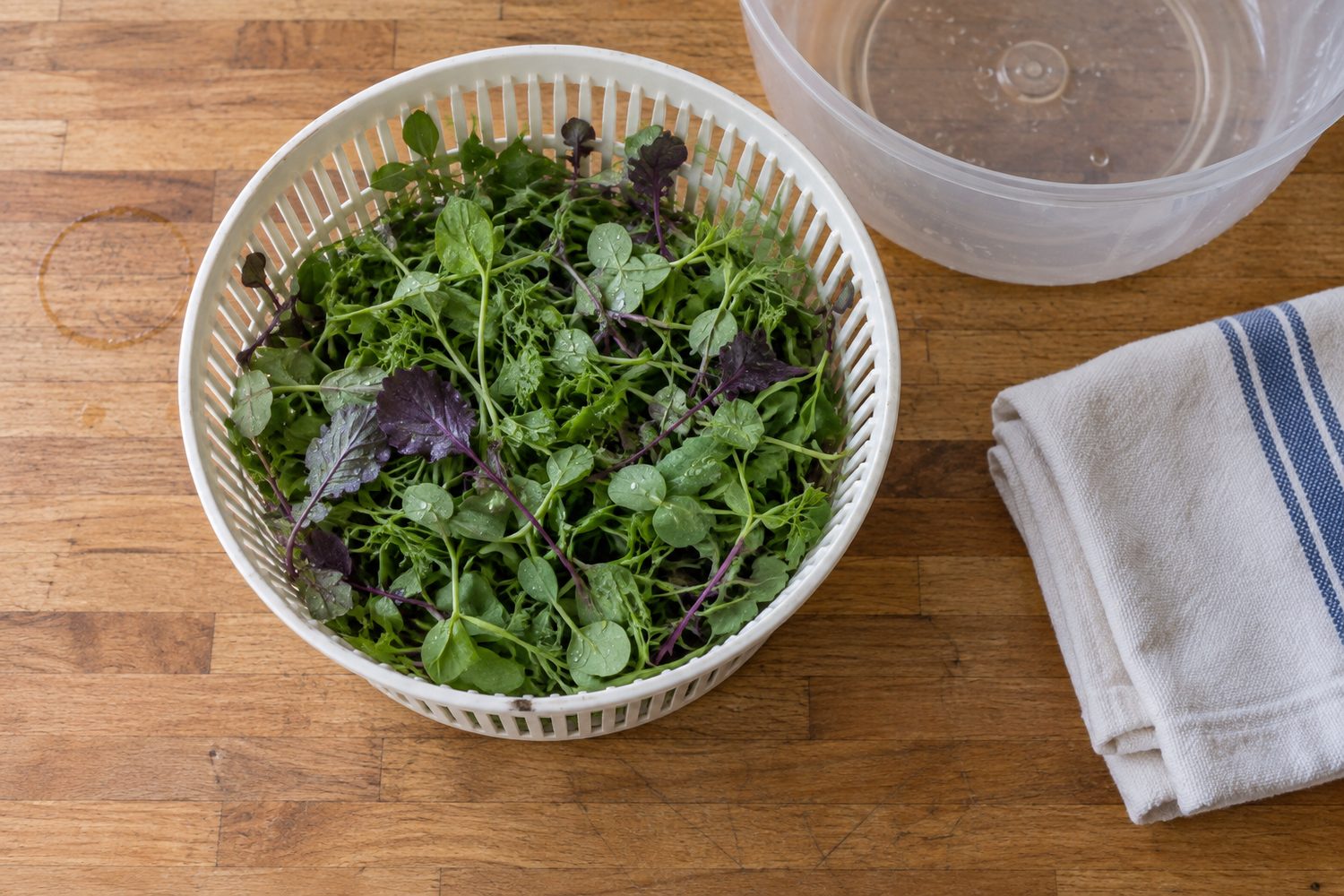
For a home fridge, that points to storing greens dry and rinsing just before you eat them, which is what Purdue Extension advises. More on the tradeoffs is in should you wash microgreens.
If your crop has no measured figure
Pea, beet, kale, basil, cilantro and most other crops have no controlled day count. The general guidance is 5 to 7 days in the refrigerator from both Purdue Extension, for unwashed greens wrapped lightly in a damp paper towel inside a plastic bag, and UConn Extension. Penn State Extension says dark storage at 41°F can reach 10 to 14 days, against 2 to 4 at room temperature. These are practice recommendations, not crop-by-crop measurements.
For an unmeasured crop, write the harvest or purchase date on the container, start checking it at day 5, and note the day it goes. After one or two trays you will have a number for your crop in your fridge, which is more useful to you than any average. If you keep trays alive and uncut, how to store microgreens in soil covers that option.
What seller dates mean
The date on a clamshell from a grower is that grower's practice, not a tested endpoint. Kerr Microgreens says its fresh jars are best enjoyed within 7 to 10 days. Farmbox Greens in Seattle says most of its microgreens last 7 to 10 days at 36 to 38°F, with micro basil at 3 days. Wind River Greens gives radish 8 to 12 days and beet 5 to 8 days at 35 to 40°F. None of these publishes a test method. Use them as a guide to that seller's product, and if you are buying rather than growing, how to tell if microgreens are fresh helps you judge a clamshell before you pay for it.
The rules for restaurants and markets
If you sell to or work in a food establishment, the FDA Food Code treats cut leafy greens as a time and temperature control food. FDA guidance says they must be held at 41°F (5°C) or below, discarded within 7 days of cutting or of opening a commercial package, and kept out of temperature control for no more than 4 hours under written procedures (Food Code section 3-501.19). These are food-service rules for the leafy greens the Code names, such as lettuce, spinach, kale, arugula and cabbage. The Code's definition does not name microgreens, so ask your local health department how it applies them. At home, the FDA says to keep perishable produce at 40°F or below.
When a tray is done, whatever the day
The day counts tell you when to start looking hard. These signs tell you when to stop:
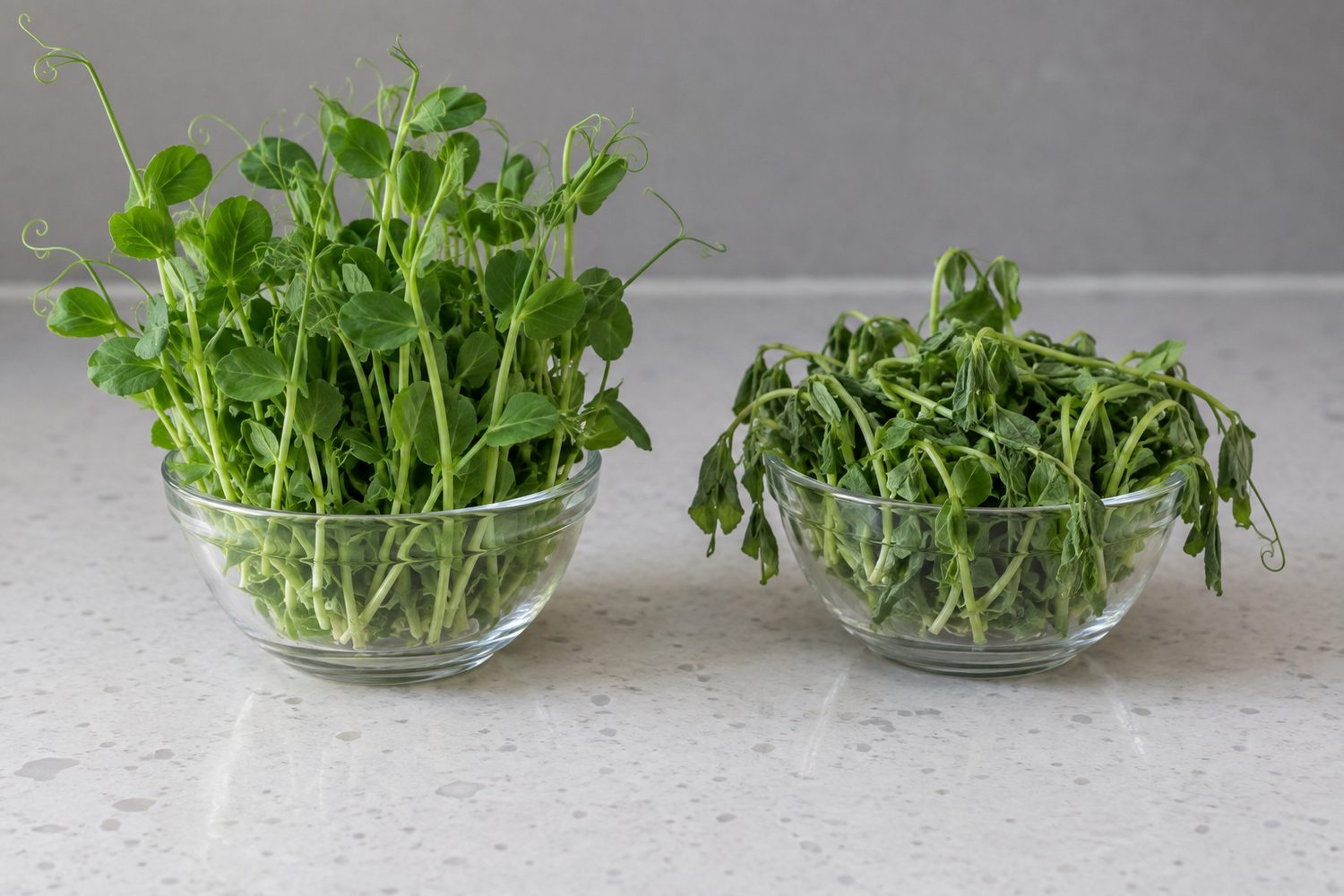
- Limp or wilted greens. Purdue says to choose crisp greens and pass on limp ones.
- Yellowing or darkening. In the daikon trial, yellowing was the first visible sign at 10°C, starting after day 7.
- Slime, mushy leaves or a strong, sour smell. Throw the tray out.
- Mold or visible rot. The FDA says to throw away any produce that looks rotten.
- Heavy condensation or standing water in the container. It is not proof the greens are unsafe, but wet greens went downhill faster in the radish work, so eat them soon or dry them out.
Looking fine is not proof of safety. The FDA warns that pathogens can grow on cut leafy greens while they still look acceptable, which is one more reason to keep them cold and not stretch the upper end of a count. For a fuller check, see have microgreens gone bad.
Frequently asked questions
Do microgreens last longer in a clamshell or a bag?
It depends on the crop, and no study has compared containers side by side across crops at the same temperature. A 2024 review summarizes one study where radish and roselle microgreens at 5°C kept better quality in PET clamshells than in self-seal LDPE bags, and the 2026 sunflower study found the package type changed quality over 15 days. Try both, a clamshell and a zip bag, with your own crop and note which lasts longer.
Do microgreens last longer if I leave them uncut?
Selling or keeping them in living trays is common practice, and Shoot, a UK seller, lists living micro herbs at 7 to 14 days at 5°C against 7 to 10 days cut. That is a seller claim, not a controlled comparison. If you try it, keep the tray cool and lit, and record how many extra days you actually get.
How long do microgreens last at room temperature?
Much less time. Penn State Extension puts ambient storage at 2 to 4 days, and in the mustard study, samples at 20°C and 25°C (68°F and 77°F) deteriorated beyond eating within a single day. Get harvested greens into the fridge as soon as you can.
Does Chinese cabbage last as long as red cabbage?
Not in the one figure available. A 2024 review summarizes a 2012 study in which Chinese cabbage washed in chlorinated water and sealed in plastic bags at 5°C degraded from fungal contamination by day 5, while citric acid treatments held it to day 7. Check Chinese cabbage from day 4 onward.
The short version
Find your crop in the table, match it to your fridge temperature, and use that count as the day to start looking closely, not a promise. Keep greens cold, dry and toward the back of the fridge, rinse them just before eating, and throw out anything slimy, sour, moldy or badly yellowed no matter what the calendar says. For a crop with no figure, date the container and keep your own count; two trays in, you will know your number.
Sources
Prices, stock and specifications are as the linked pages showed them on 2026-09-26.
Keep reading
The journal
Can You Freeze Microgreens? What Survives Drying and Freezing, and What Does Not
A microgreen is 87 to 94 percent water, so a whole tray dries down to a couple of spoonfuls. Drying is not a kill step, freezing does not make greens keep their crunch, and only one crop has ever been measured.
Read Can You Freeze Microgreens? What Survives Drying and Freezing, and What Does NotThe journal
How to Store Microgreens, and How Long Do They Last?
Cold, dry, unwashed and vented, and basil is the exception. Controlled studies cover about a dozen crops out of sixty-two, and they disagree on the best temperature.
Read How to Store Microgreens, and How Long Do They Last?The journal
Should You Wash Microgreens? Yes, But Not When You Think
Wash them immediately before eating and never before storing. A plain-water rinse removes half to three quarters of the bacteria, not all of it, and every shelf-life number you have ever read for microgreens silently assumes the crop was never washed.
Read Should You Wash Microgreens? Yes, But Not When You ThinkThe journal
Have These Gone Bad? Judging a Box of Microgreens in the Fridge
A warm fridge costs days: arugula, radish and red cabbage lost a week of quality at 10C against 4C, and one mustard study lost ten. And no visible sign has ever been validated as a safety test.
Read Have These Gone Bad? Judging a Box of Microgreens in the Fridge