Can You Freeze Microgreens? What Survives Drying and Freezing, and What Does Not
Cal HewittPublished Checked
- eating
- storage
- evidence
- preserving
Yes to both, and neither does what most people hope.
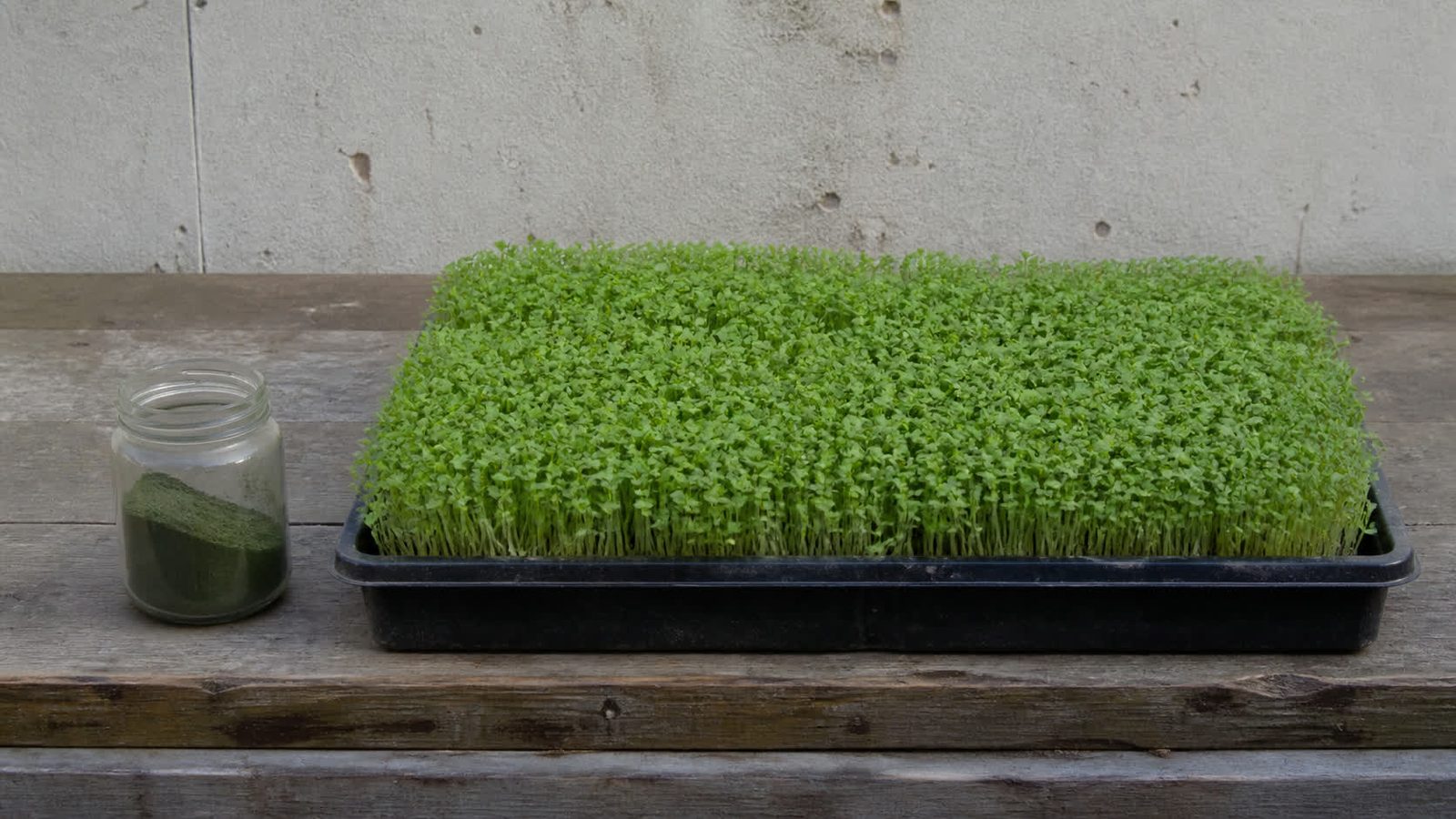
A microgreen is 87 to 94 percent water. That single measured figure, from the brassicas somebody actually weighed, decides everything else on this page. Take the water out and a whole 1020 tray becomes about two tablespoons of powder. You are not preserving a salad. You are making a seasoning, and it is a different product.
Drying is not a kill step. This is the part that matters most and gets said least. Pathogens survive low-moisture dried produce, and freeze-drying involves no heat at all, so it preserves microorganisms that can grow again once you rehydrate them. Never dry a tray you were unsure about. Drying a suspect crop gives you a shelf-stable suspect crop.
And freezing does not give you back a fresh microgreen. It arrests growth, it does not kill bacteria, and thawed greens go into something cooked or blended. They do not come back as a garnish.
What to actually do with the powder
The commercial serving directions are modest and consistent:
- 2 g, about a teaspoon, in 8 to 12 oz of water, juice or a smoothie.
- 0.75 g in a single-serve stick.
- A quarter teaspoon sprinkled over a dish.
One grower recipe uses 2 oz of dried radish microgreens in a lentil soup for four, which is a recipe choice rather than a dose.
Use it as a seasoning or a smoothie ingredient. It is a concentrated green flavor and a color. It will not restore texture to anything, and the wider serving evidence is that no dietary intake has ever been established for microgreens fresh, let alone dried.
What a tray actually becomes
The measured water content of brassica microgreens is 87 to 94 percent, and 39 of the 62 crops have a measured harvested yield. Put those together and you get the figure that decides whether drying is worth doing: how much dried product a tray of a named crop actually makes.
Hover or tap a row to highlight it.
Read the dried column against the fresh one. A broccoli tray that would fill a large salad bowl becomes somewhere between four and eight teaspoons of powder. One tray of each of the 39 crops with a measured yield comes to about 8.4 kg fresh and half a kilo to a kilo dried.
The water percentage is a brassica figure and the range is wide, so treat these as the right order of magnitude rather than a promise. If you are drying to sell, weigh your own fresh and finished product and publish both.
The economics, stated honestly. A commercial 30 g jar of microgreen powder retails around CAD $30, and a 60 g broccoli powder around US $29.99. One broccoli tray at 79 cents of seed produces roughly enough to fill a 30 g jar. That gap looks enormous and it is seed cost only: it excludes the dehydrator, the electricity, the hours, the packaging, any testing, and everything you fail to sell. That is not a business case. It is the input side, which is the half that usually goes unpublished.
Drying: the one crop anybody measured
Published drying evidence for microgreens is one crop. Radish, hot-air dried at three temperatures against a freeze-dried control.
Hover or tap a row to highlight it.
| What was measured | 113°F | 149°F | 203°F |
|---|---|---|---|
| Total phenolics | 91% | 79% | 100% |
| Glucoraphenin | stable | stable | 78% |
| Thiamine (B1) | stable | stable | stable |
| Folate (B9) | stable | stable | stable |
| Riboflavin (B2) | up to 65% across the treatments | ||
| Niacin (B3) | up to 64% across the treatments | ||
| Vitamin C | up to 37% across the treatments |
At the hottest setting the study also reports about 100 percent of protein, 70 to 80 percent of macrominerals, and 50 to 80 percent of phenolics and glucosinolates relative to freeze-dried.
Two things to take from that, and they point in opposite directions. Most of what was measured survived drying better than you would guess, including at the highest temperature. And vitamin C did not, losing roughly two thirds. If you are drying for the vitamin C, stop.
Do not treat "everything concentrates" as a benefit. Drying concentrates what is left per gram of powder because it removed the water. It does not increase the total amount that was in the tray. The radish glucoraphenin figure proves it: at the highest heat there is 78 percent of the compound left, in a much smaller mass. Per gram it looks like a huge gain. In total it is a loss.
The temperature question, and why nobody can answer it
Here is what the practice pages recommend for drying microgreens:
- 95 to 105°F for four to eight hours
- 92 to 118°F for two to four hours
- Around 170°F in an oven for two to four hours
That is not three opinions about an optimum. It is evidence that no optimum has been established. The only measured work used 113, 149 and 203°F and did not publish a home-use time at all.
So, dry by the endpoint rather than by the recipe. One thin layer, check pieces from several positions, and stop only when every piece is brittle with no cool or damp center when you snap one.
If you intend to sell it, "brittle" is not good enough. The measure that matters is water activity, and it is not the same as feeling dry. The regulatory low-water-activity threshold is 0.85; dried fruit sits around 0.60 and dried vegetables and herbs can reach 0.03. No water activity figure has ever been published for a dried microgreen, so measure your own on the actual product in its actual package.
How it fails, and all of these are checkable: pliable rather than brittle leaves, a damp center when a piece is broken, condensation appearing in the container after a day, powder that clumps, or mold. Any of those means re-dry, not package.
Store it sealed and cool in something genuinely moisture-proof, with the crop, the process and the date written on it. Dried microgreens pick up humidity readily, and a softening powder is a reject signal rather than a cosmetic one. Nobody has published a shelf life for dried or freeze-dried microgreens by crop and package, so do not borrow a "five years" claim from an uncited guide.
Freezing, which answers a question people ask constantly
Freezing arrests growth. It does not kill bacteria. Whatever was on the crop is still there, and it resumes once the crop thaws. That is general food-preservation science rather than a microgreen finding, and it is the whole answer to whether freezing makes a doubtful batch safe. It does not.
A thawed microgreen is not a fresh one. Cell walls rupture, and what comes out is soft. That is fine for a soup, a smoothie or anything cooked, and it is useless as a garnish. Nobody has measured freeze-thaw texture on any named microgreen crop, so there is no crop-by-crop guidance to give.
One crop has an explicit instruction against it. Washington State says freezing damages the leaf tissue of pea shoots, which is the only published crop-specific position on freezing for any of these crops. What growers do instead, and it is sound, is blend the surplus into pesto and freeze that, in ice-cube portions.
Freeze-drying is a different process and should not be confused with freezing. It freezes the crop and then removes the ice by sublimation, so the structure survives in a way ordinary freezing does not. It is also the control condition in the one drying study, which is why that table reads "against freeze-dried". It applies no heat, which means it preserves microorganisms rather than reducing them.
What nobody has measured
- Drying data for 61 of the 62 crops. Radish is the only one, and it was dried rather than cooked.
- Water activity for any dried microgreen, which is the number a seller actually needs.
- Shelf life of dried or freeze-dried microgreens, by crop and by package.
- Freeze-thaw texture for any named crop.
- A mass balance. Nobody has published fresh mass, dry mass, concentration and total compound per original tray together, which is the only way to settle the concentration question properly.
- Nitrate or any undesirable compound after drying, in any crop.
- Which cultivar dries evenly, at home or anywhere else.
Terms on this page
Tap a term to see what it means.
Water activity (aw). The available water in a food, on a scale to 1.0, and the measure that decides shelf stability. Not the same as moisture content and not the same as feeling dry. The regulatory low-water-activity line is 0.85.
Sources
Opened 2026-08-11. Fresh yields and seed costs are this site's own, sourced on each crop's entry.
- Penn State, hot-air drying of radish microgreens and the peer-reviewed paper - retention at 45, 65 and 95°C against a freeze-dried control, including the phenolics, glucoraphenin, B-vitamin and vitamin C figures and the 95°C protein and mineral summary.
- Foods, composition of brassica microgreens - the 87 to 94 percent water content that the dried-yield table rests on.
- University of Minnesota Extension, safely dehydrating produce - that pathogens of concern survive low-moisture dried produce, the requirement for a hazard analysis and validated process, and the inspection and conditioning method.
- University of Minnesota Extension, freeze-drying - what freeze-drying is, that it applies no heat and preserves microorganisms that regrow on rehydration, and the packaging list.
- University of Minnesota Extension, blanching vegetables - that freezing arrests growth without killing bacteria, and that thawing allows survivors to grow again.
- FDA, water activity in foods - the 0.85 low-water-activity threshold and the requirement to control it in storage.
- Frontiers in Plant Science, radish cultivar yields (PDF) - 61.6 to 97.3 g fresh from 10 g of seed across five cultivars at day 10, at 4.75 to 7.65 percent dry matter. An experimental tray, not a 1020.
- Wind River Greens, dehydrating microgreens for powder and Microgreens World - two of the three conflicting home drying schedules, and the consumer against commercial dehydrator price range. Grower practice, not evidence.
- Greens4u microgreens powder, Latria broccoli microgreen supplement and Be Happi - the retail powder products behind the 30 g and 60 g prices and the 2 g, 0.75 g and quarter-teaspoon serving directions.
Keep reading
The journal
How Long Do Microgreens Last by Crop and Temperature
How long do microgreens last in the fridge depends on the crop and the temperature. See measured storage life by crop and what to do when no figure exists.
Read How Long Do Microgreens Last by Crop and TemperatureThe journal
How to Store Microgreens, and How Long Do They Last?
Cold, dry, unwashed and vented, and basil is the exception. Controlled studies cover about a dozen crops out of sixty-two, and they disagree on the best temperature.
Read How to Store Microgreens, and How Long Do They Last?The journal
Should You Wash Microgreens? Yes, But Not When You Think
Wash them immediately before eating and never before storing. A plain-water rinse removes half to three quarters of the bacteria, not all of it, and every shelf-life number you have ever read for microgreens silently assumes the crop was never washed.
Read Should You Wash Microgreens? Yes, But Not When You ThinkThe journal
Have These Gone Bad? Judging a Box of Microgreens in the Fridge
A warm fridge costs days: arugula, radish and red cabbage lost a week of quality at 10C against 4C, and one mustard study lost ten. And no visible sign has ever been validated as a safety test.
Read Have These Gone Bad? Judging a Box of Microgreens in the Fridge