Have These Gone Bad? Judging a Box of Microgreens in the Fridge
Cal HewittPublished Checked
- safety
- storage
- evidence
- buying
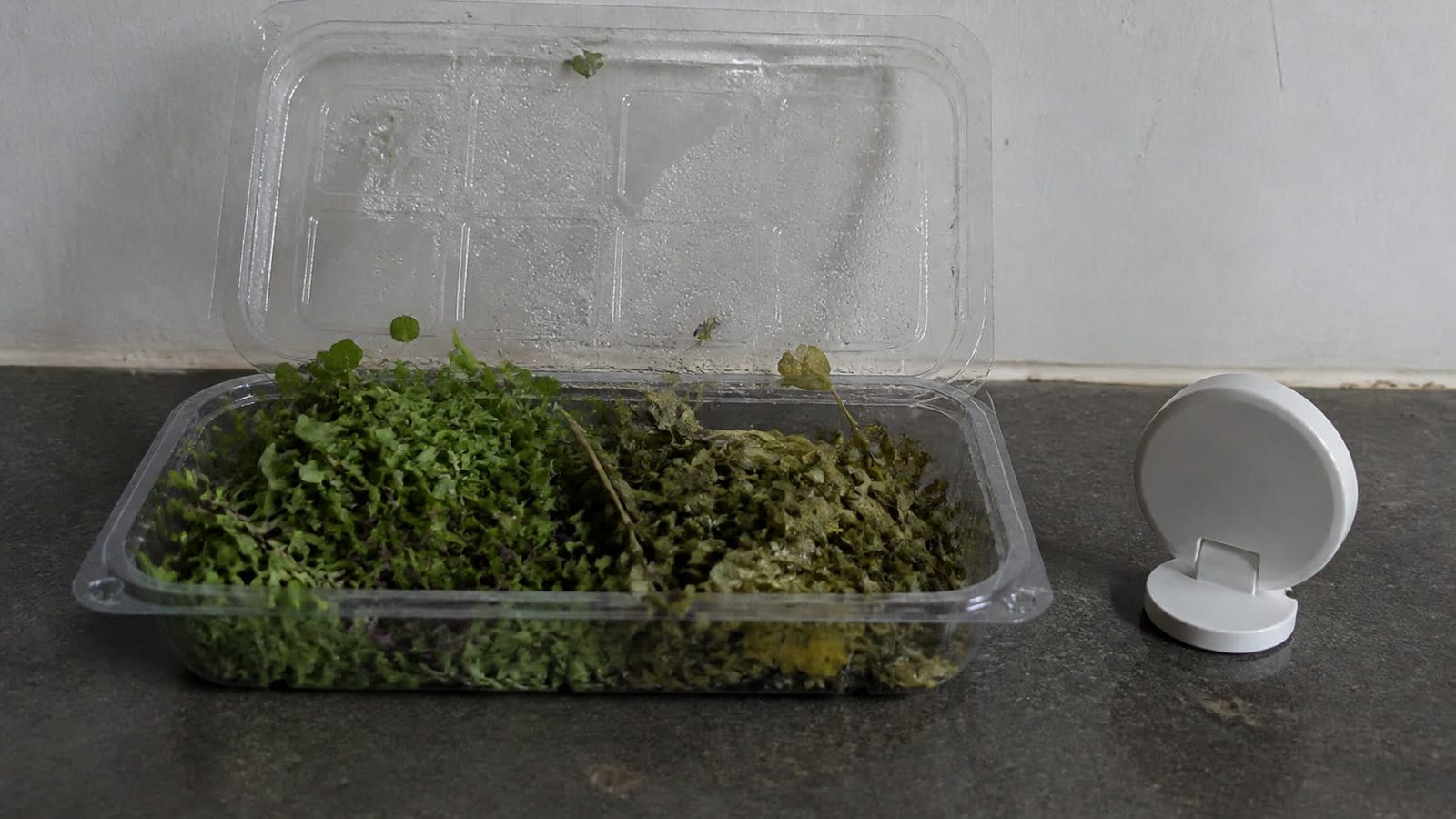
You have a box in the fridge and you are deciding whether to eat it. The short answer is that you can judge quality by looking and you cannot judge safety that way, and the two get blurred together constantly. If you are trying to make them last longer next time, storing them is the other page.
What to actually do
- Buy a fridge thermometer before anything else. In the studies that compared temperatures, a fridge at 10°C instead of 4 or 5°C cost a week or more of quality.
- If it is slimy, decaying, visibly moldy or smells off, throw it out. That is a quality decision and it is a good one.
- Do not rinse and rescue. The wash data does not support it and added moisture can shorten what life is left.
- Do not taste-test a pack you are worried about. Tasting cannot detect the hazard and it exposes you to it.
- If it looks and smells fine, that is not clearance. It means you have no reason to reject it on quality, which is a different statement from safe.
- Check the brand and lot against current recalls if your worry is contamination rather than freshness. That is the only check available to a consumer that speaks to safety at all.
- Age alone is a poor proxy. A five day old box is not automatically anything, because species, pack, storage history and even which date is printed on it all differ.
A few degrees costs a week or more
The most useful number in this literature is not about days. It is about temperature.
A 2023 study packed 15 gram packs of mustard microgreens and scored color, wilting, sliminess and off-odor at days 0, 2, 4, 7 and 14.
Hover or tap a row to highlight it.
| Storage temperature | Good-to-fair quality lasted |
|---|---|
| 5°C | 14 days, with no yellow leaves observed through day 14 |
| 10°C | 4 days |
| 15°C | 2 days |
| 20 to 25°C | Unacceptable by day 2 |
Read the first two rows against each other. A five degree difference took the same crop in the same packaging from fourteen days to four. That is not a gradual slope, it is most of the shelf life.
FDA's target refrigerator temperature is 40°F, which is 4°C. A fridge running warm at 10°C is not obviously wrong to a person opening the door, and on this evidence it costs a week or more: 7 days of visual quality for arugula, radish and red cabbage between 4°C and 10°C, and 10 days of good sensory quality for this mustard, although the same paper's discussion says its tested attributes held for 14 days at both 5 and 10°C.
So, the single most effective thing you can do about this question is buy a fridge thermometer, which is a cheaper intervention than anything else on this page. Get one that records a minimum and maximum, because the useful question is not what the door reads when you open it but whether the shelf holds its temperature overnight.
Crop matters, and the published figures disagree with each other
There is no fridge life for "microgreens". There are figures for particular crops in particular packs.
At 4°C in 51 micrometer bags, one 2022 experiment gave mungbean and Indian mustard about four days and lentil six. The same paper reports earlier visual quality comparisons at 4°C of arugula 14 days, radish 21 and red cabbage 14, and at 10°C, 7, 14 and 7.
Radish at 21 days and mungbean at four is a five-fold spread, and those are different experiments with different packs and different washing status. Do not average them and do not carry one across to the crop in your hand.
What the changes actually are
Once cut, a microgreen has no water supply and keeps respiring. Four things follow, and they are what you are looking at:
- Water loss, which reduces turgor. That is the wilting.
- Chlorophyll decline, which is the yellowing.
- Membrane breakdown, measured in studies as electrolyte leakage. That is what precedes softness and slime.
- A changing package atmosphere and microbial population.
Nobody has established which of these comes first. The studies measure several endpoints on scheduled days rather than tracking a first event, so the tidy sequence you will read elsewhere is not published anywhere.
The line that matters: quality against safety
Every visible sign is a quality sign. Not one has been validated as a safety test.
Research has measured quality and microbial load in the same experiments. In the 2022 work, sensory acceptability fell sharply by day 6 for mungbean and mustard while microbial counts were reported through day 12, and Salmonella and Listeria were not detected in those samples at all. So there is no study anywhere linking a slime score or a yellow leaf to a pathogen result.
Sliminess accompanies tissue damage, water release and spoilage organisms. At 10°C one panel recorded 25 percent sliminess with slight off-odor at fair-to-poor quality. It is a good reason to throw a pack out. It identifies no organism.
Yellowing is chlorophyll loss. At 10°C, 25 percent yellow leaves contributed to a fair-to-poor score. At 5°C none appeared through day 14. It is a quality clock, not a safety one.
And refrigeration is not sterilization. FDA is explicit that Listeria monocytogenes can grow at refrigerator temperatures, and that the longer a ready-to-eat food is stored the more opportunity it has. The 2022 experiment found several microbial counts trending upward from day 1 to day 12 at 4°C. "It stayed in the fridge" is not proof of anything.
This is the same position this site's raw safety article takes and it is FDA's: food can make somebody very sick without looking, smelling or tasting spoiled, because the bacteria that cause illness are not the bacteria that cause spoilage.
Washing it will not rescue it
The published wash results are mixed and none of them turns a bad pack into a good one.
In the 2022 study, water washing significantly reduced some Shigella and E. coli measurements in some crops and did not significantly reduce total aerobic bacteria or yeast and mold in several comparisons. The authors also note that retained moisture and handling damage can shorten shelf life, so a rinse can cost you days.
In 2014 radish work, a 100 mg/L chlorine treatment lowered aerobic mesophilic and yeast and mold populations by 0.5 log CFU/g initially, and the populations rebounded after day 7.
Half a log, temporarily. Whatever washing is for, it is not for rescuing a pack you already doubt.
How long after opening
NOT ESTABLISHED. No US agency publishes a number of days for an opened retail pack of microgreens. FDA says to use refrigerated ready-to-eat foods quickly and keep the fridge at or below 40°F, and gives no duration.
A UK figure of three days total for high-risk ready-to-eat food circulates for this, and it is guidance for food businesses rather than consumers and is not about microgreens. It should not be quietly converted into a home rule, and this page will not do it.
What nobody has measured
- Any validated visible sign of safety. No slime score, color or odor has ever been tested against a pathogen result.
- Which change happens first after packing, in any crop.
- A shelf life for most crops, in any pack, at any temperature.
- How long an opened pack keeps at home, from any agency.
- Whether the published crop differences survive a change of pack film, cultivar, washing status or cold chain.
Terms on this page
Tap a term to see what it means.
Turgor. The internal water pressure that keeps a shoot crisp and upright. Losing it is wilting.
Sources
Opened 2026-08-12.
- PLOS ONE, quality and microbial safety of mungbean, lentil and Indian mustard microgreens, 2022 (PDF) - the 4°C shelf lives of about four days for mungbean and Indian mustard against six for lentil in 51 micrometer bags, the earlier visual quality comparisons of arugula 14 days, radish 21 and red cabbage 14 at 4°C and 7, 14 and 7 at 10°C, the microbial counts measured on days 1, 2, 4, 8 and 12 with sensory quality through day 6, the mixed washing results, and that Salmonella and Listeria were not detected in those samples.
- Mustard microgreen storage temperature study, 2023 - the 15 gram packs scored at days 0, 2, 4, 7 and 14, good-to-fair quality holding to day 14 at 5°C, four days at 10°C, two days at 15°C and unacceptable by day 2 at 20 to 25°C, the 25 percent sliminess and 25 percent yellow leaves recorded at 10°C, and no yellow leaves observed at 5°C through day 14.
- Tartary buckwheat microgreen storage study, 2022 - headspace gases, weight loss, electrolyte leakage, microbial population, visual quality and off-odor measured over storage, which is the source of the deterioration mechanisms described on this page.
- FDA, selecting and serving produce safely - to choose undamaged produce, to throw away produce that looks rotten, the 40°F refrigerator target, and the position that spoilage odor, flavor or texture is a reason not to eat a food while passing those checks is not a guarantee.
- FoodSafety.gov on what to do about a recall - that a recalled product should not be eaten and should be returned or disposed of as the recall directs, which is the only safety-relevant check a consumer can actually run.
Keep reading
The journal
Can You Freeze Microgreens? What Survives Drying and Freezing, and What Does Not
A microgreen is 87 to 94 percent water, so a whole tray dries down to a couple of spoonfuls. Drying is not a kill step, freezing does not make greens keep their crunch, and only one crop has ever been measured.
Read Can You Freeze Microgreens? What Survives Drying and Freezing, and What Does NotThe journal
How Long Do Microgreens Last by Crop and Temperature
How long do microgreens last in the fridge depends on the crop and the temperature. See measured storage life by crop and what to do when no figure exists.
Read How Long Do Microgreens Last by Crop and TemperatureThe journal
How to Store Microgreens, and How Long Do They Last?
Cold, dry, unwashed and vented, and basil is the exception. Controlled studies cover about a dozen crops out of sixty-two, and they disagree on the best temperature.
Read How to Store Microgreens, and How Long Do They Last?The journal
Should You Wash Microgreens? Yes, But Not When You Think
Wash them immediately before eating and never before storing. A plain-water rinse removes half to three quarters of the bacteria, not all of it, and every shelf-life number you have ever read for microgreens silently assumes the crop was never washed.
Read Should You Wash Microgreens? Yes, But Not When You Think