Is Homegrown Safer? What the Produce Recalls Actually Change
Cal HewittPublished Updated Checked
- food safety
- evidence
- recalls
- growing
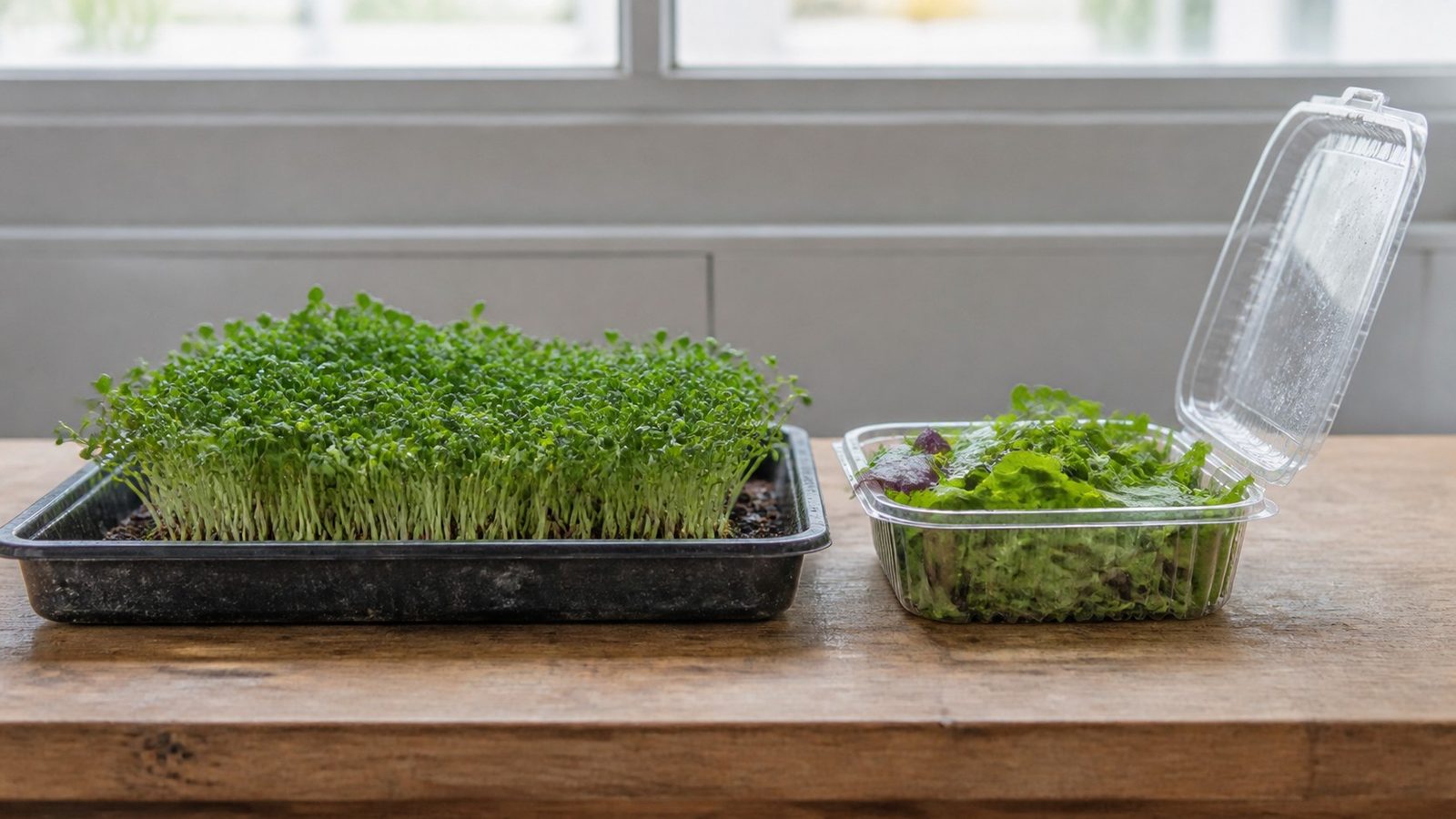
Growing your own does not remove the risk of getting sick from raw greens. What it does is move that risk onto a few things you can actually act on: the seed lot, the substrate, the water and your own handling. Those are four things you can check and change, which a bag of salad does not offer.
What actually happened, on the record
Two separate outbreaks landed within a month of each other. They are different organisms, different foods, and different sources, so it helps to keep them apart.
Hover or tap a row to highlight it.
| Cyclospora on lettuce | Salmonella on jalapenos | |
|---|---|---|
| Organism | A parasite | A bacterium (Salmonella Javiana) |
| Illnesses | 12,883 | 431 |
| Hospitalizations | 570 | 57 |
| Deaths | 2 | 0 |
| States with illnesses | 21 | 32 |
| Recall date | 2026-07-17 | 2026-08-09 |
| Status | Outbreak over | Still open |
| Source named | Iceberg lettuce from central Mexico | Jalapenos from Sinaloa, distributed by Coast Citrus |
Both sets of figures were read on 2026-09-11. The lettuce numbers are CDC's final update, published that day. The jalapeno numbers are the ones CDC and FDA have both carried since their last update on 2026-08-21, so they are three weeks old rather than wrong, and they will move again.
Important, and it is the first thing most people want to know: the lettuce outbreak is over. CDC closed it on 2026-09-11 and said so in as many words, because the best-by dates passed, the product is gone from stores and restaurants, and new infections fell from more than 1,000 on a single day at the peak to fewer than 2 a day on average through August. FDA is still working on how the lettuce became contaminated in the first place, which is a question about the supply chain and not a reason to avoid salad. The jalapeno investigation is a different matter and is still open, so the recalled-product advice below still applies to it. Neither one is a reason to stop eating vegetables. What this page answers is the question a lot of people started asking during those four weeks, which outlasts any recall: is growing it yourself actually safer?
One detail decides how you read the big number. That 12,883 is this one outbreak, counted by CDC and FDA on one consistent basis. Other, much larger figures were circulating all summer, and they were not competing counts of the same thing: 6,358 was a snapshot of this outbreak on August 5, and the numbers above 20,000 that reached the national press in mid-August were CDC's season-wide cyclosporiasis surveillance for the whole country, which includes cases from unrelated sources. This outbreak's own count went 1,644 on July 17, then 1,947 on July 24, then 6,358 on August 5, then 9,481 on August 13, and closed at 12,883. It is one outbreak growing, reported repeatedly, and then ending.
The two outbreaks are not connected
The same processor appears in both, which makes a connection look likely. The records do not show one.
Federal investigators tie the Cyclospora cases to iceberg lettuce from central Mexico. They tie the Salmonella cases to jalapenos from Sinaloa distributed by a different company, Coast Citrus. Taylor Fresh Foods appears in the second event as a downstream processor that recalled finished products containing those peppers, not as the source of the outbreak. No agency has claimed the two share a farm, a water source, or a pathogen route. The only defensible connection is that the same company's recall activity appears in both public stories.
There is also a documented history worth stating plainly rather than implying. In October 2024, federal investigators linked a 14-state E. coli outbreak, 104 illnesses, 34 hospitalizations and one death, to yellow onions distributed by the same company for McDonald's Quarter Pounders. An FDA inspection letter that November documented missing sanitation monitoring records and problems with the environmental monitoring corrective action process at one of its facilities. That is a record. It is not a mechanism for the 2026 events, and nobody has shown it is.
Why one bad field turns into 31 states
This is the part that makes bagged produce different from a head of lettuce, and it is the strongest argument for growing at least some of your own.
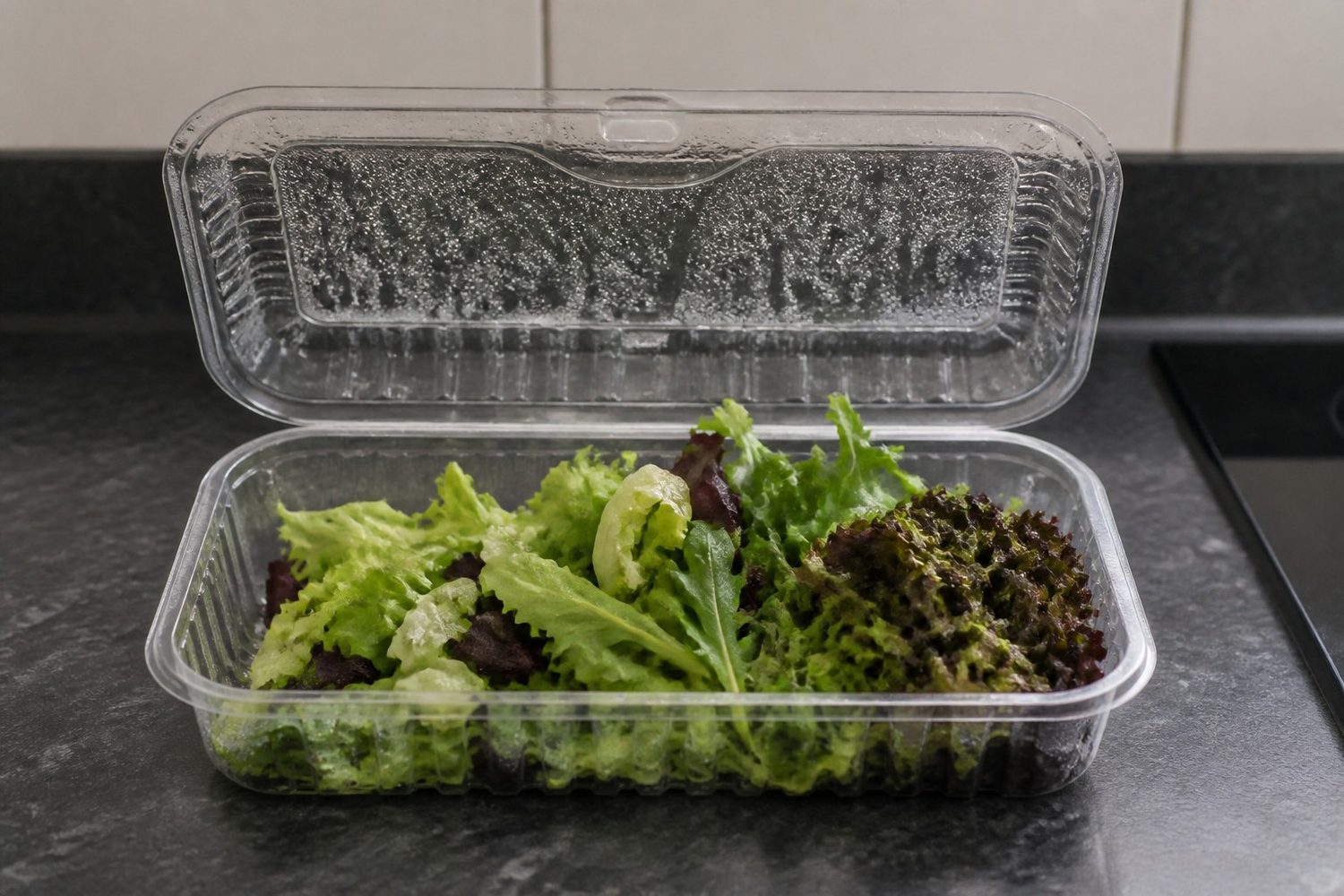
Fresh cut production gathers product from many fields and suppliers, then shreds it, moves it along conveyors, washes it in shared flume water, dries it in a centrifuge, and packs it. A peer reviewed farm to customer model represents exactly those steps and identifies cross contamination as one of the two principal dynamics. In plain terms: one contaminated input can be divided across many finished products and many destinations, and shared water and equipment can carry cells further than they started.
The scale of that shows up in this outbreak's own numbers. The early warning named five states, because that was where people had gotten sick after eating at one restaurant chain. The recalled product itself reached at least 31 states. Those are two different maps and they have been widely confused.
Washing at the plant is a reduction, not a fix. Published modeling of commercial leafy green processing uses a 1.10 to 1.46 log reduction for the preliminary spray wash. That is roughly 92 to 97 percent under the model's assumptions. The full set of interventions modeled to a 3.4 log reduction overall. A 97 percent reduction sounds like a lot until you remember it is applied to whatever arrived, and it is a system average rather than a promise about your bag. For the parasite specifically, CDC says washing alone cannot guarantee removal, and what a rinse at home actually removes is a separate question with its own numbers. Cooking to 158F, or 70C, kills it.
What growing your own actually changes
Four routes carry pathogens into a tray of microgreens: seed, growing medium, water, and handling. You get real control over some and only partial control over others. Nothing here is a kill step.
Seed is a real route, not a theoretical one. A 2024 transfer study reports pathogens moving from contaminated seed into 20 different microgreen types, and there is no regulation requiring seed sanitization for this industry. No rule requires microgreen seed to be tested for pathogens, some suppliers test every lot anyway, and "food grade" is not a certification. You can choose a supplier and a traceable, explicitly untreated lot. You cannot verify a lot is clean without testing it.
A seed recall reaching home growers is happening now. In September 2026 Berlin Seeds recalled alfalfa sprouting seed it had sold to customers in 44 states, and the same lot code, SAL2-24JB, is on a Class I recall of 43,799 lb of alfalfa seed by the wholesale supplier, for possible E. coli and Salmonella. Which bags, which dates, and what to do with the seed and anything grown from it are on the recall checking page. It is the clearest case yet for keeping the packet and writing down the lot.
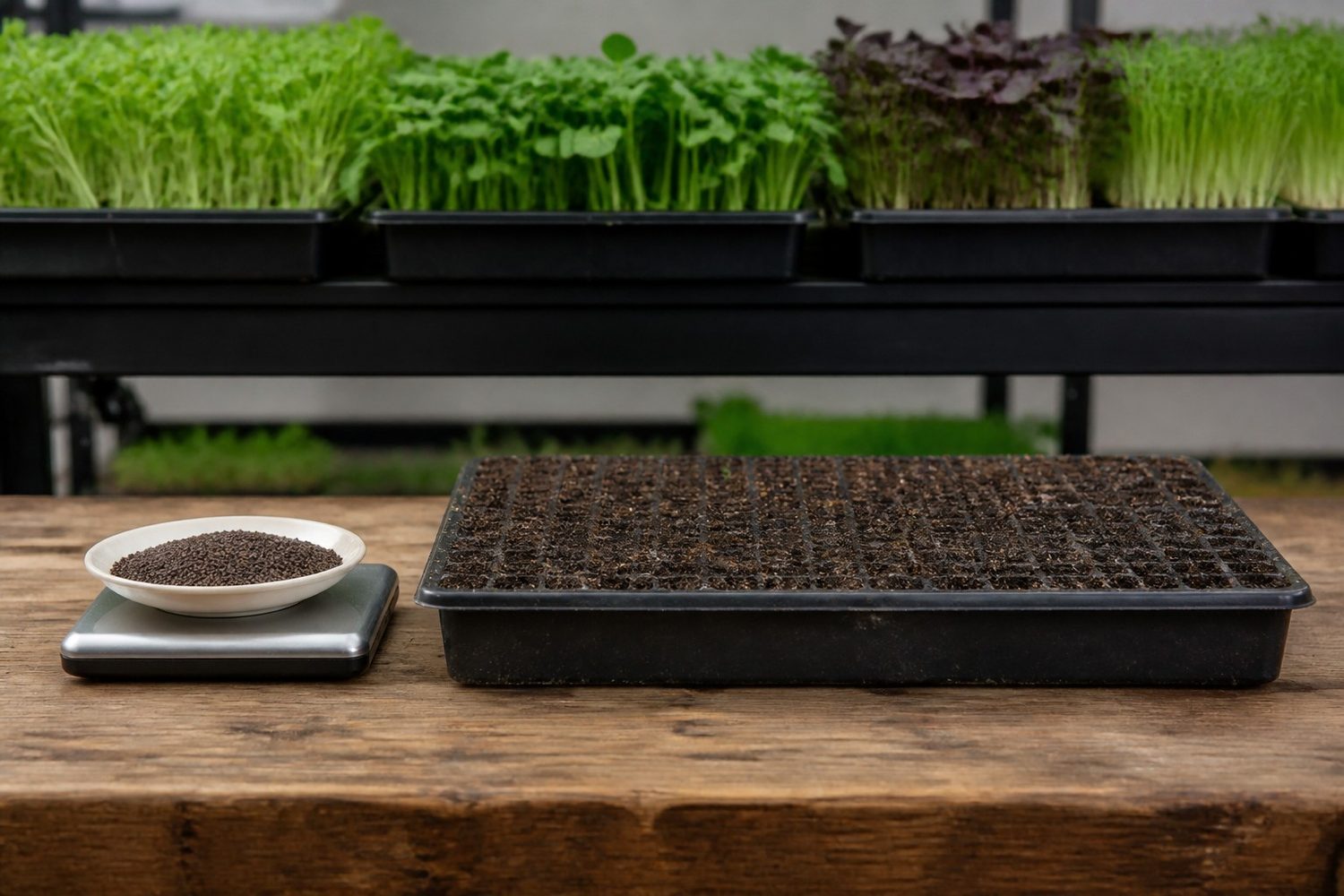
There is one measured seed treatment worth knowing about. A study aimed at home growers tested a 10 minute soak in 3 percent hydrogen peroxide followed by 60C for 20 hours. It produced reductions of 1.80 log on amaranth, 1.46 on borage, and 2.83 on carrot, and germination stayed high, in the 92 to 96 percent range depending on crop and soak. Read what that is carefully: it measured indicator organisms, not the elimination of Salmonella from every seed lot. It is a risk reduction, and a real one, not proof of safety.
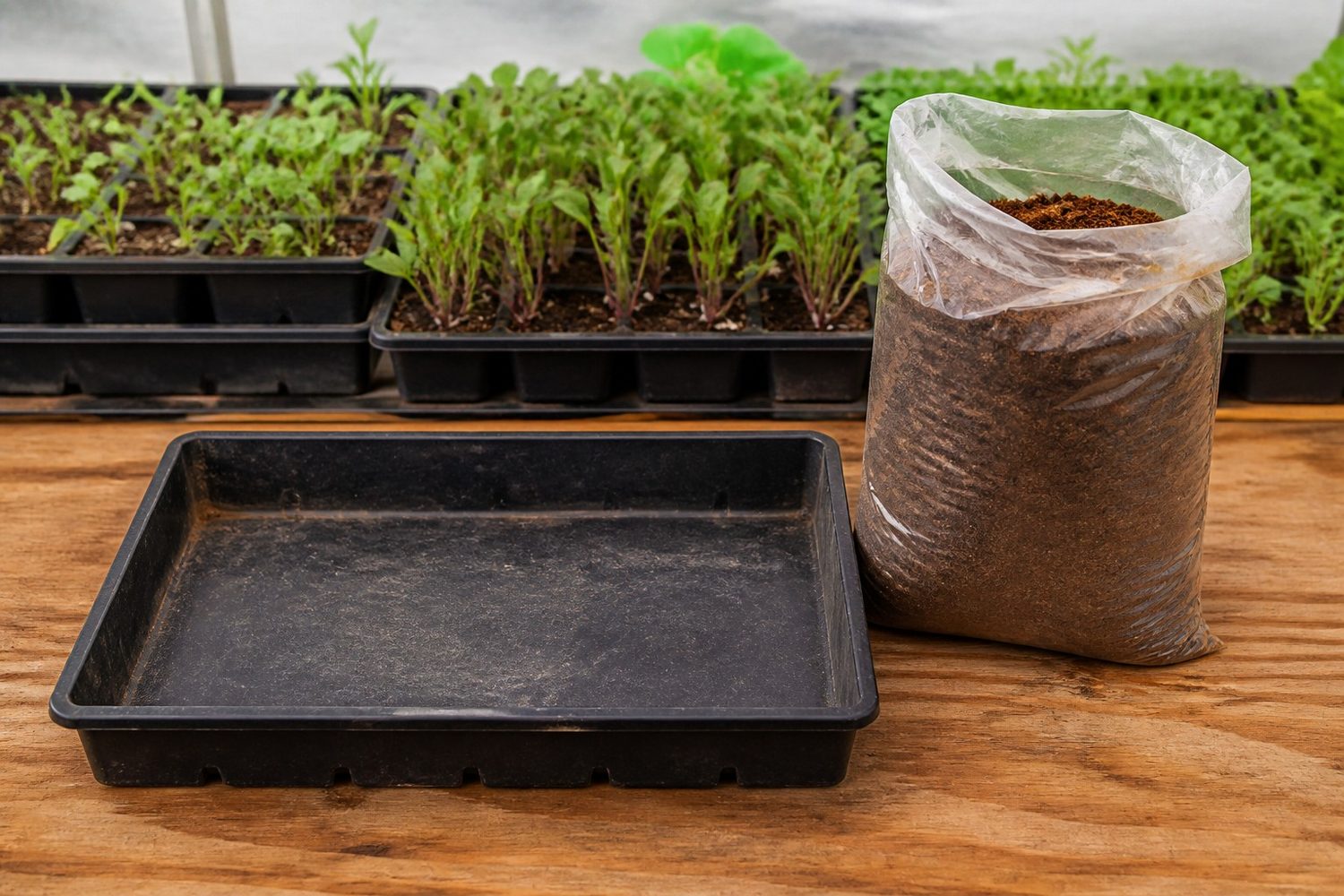
The growing medium matters, and the mats performed worst. One experiment inoculated four growing materials and followed them for 10 days. By day 10, Salmonella Javiana averaged 6.86 log CFU/mL on Biostrate and 6.15 on hemp, against 4.99 on peat and 4.67 on coco coir. Put another way, it held at roughly its starting concentration on the two mats while falling by one to two logs on coir and peat. Listeria behaved the same way: it persisted on hemp and Biostrate, dropped on peat, and fell below the detection limit on coir.
Read that study for exactly what it did, though. It measured the materials without any microgreens growing in them, and without fertilizer. So, it tells you how hospitable each material is on its own, which is genuinely useful when you are choosing one. It does not measure a growing tray, and it does not make coir or peat pathogen free.
Water can deliver a pathogen and it survives to harvest. In a daikon experiment where irrigation water was contaminated, both Salmonella and STEC were recovered at harvest, and pathogens persisted through a 14 day production period. You control your source, your storage and your containers, and water quality has a measured dose response worth reading before you worry about it. You do not control whether an organism is present without testing. And whether bottom watering beats overhead misting is simply not established: nobody has published the replicated trial that would settle it.
You can see things a bag buyer cannot. Standing water, obvious mold, rot, slime, off odors, insects, a tray handled with dirty scissors. That is genuine information and it is worth something. But looking and smelling cannot tell you whether Salmonella, pathogenic E. coli, Listeria or Cyclospora is present. Most foodborne pathogens do not announce themselves.
Where growing your own does not help
These are the places where growing your own buys you nothing, and they are the ones most worth knowing before you count on a tray.
A warm, humid, densely planted tray is a good place for a pathogen that has already arrived. The material study above is the clearest measurement of that: on the two water holding mats, both organisms were still there at close to full strength after 10 days. Separately, researchers have raised the possibility that the root zone itself contributes to survival. Be careful how far you take any of it. It is not a direct comparison against an open field, and no published number exists for a root zone versus field multiplier. None of it means a warm tray generates pathogens out of nothing. It means that if one gets in, the conditions do not discourage it.
Your kitchen has none of the machinery a plant has. A commercial operation can run incoming and finished product testing, defined wash chemistry, temperature control, written sanitation controls, pre operation checks, environmental monitoring, corrective actions, lot coding and traceback. A counter has none of those. Those are capabilities rather than guarantees, and the 2024 inspection letter shows they can fail. But the comparison is between a system that can fail and a system that does not exist.
Canada has recalled commercial broccoli microgreens for Salmonella. That is the finished crop, not seed, recorded by CFIA for an Ontario producer. Public reporting also records broccoli sprouting seed and broccoli seed recalls in November 2021. At least eight microgreen recalls are on the public record and not one reported an illness, and how to check a recall claim yourself is its own piece. No reported illness is not the same as no risk.
Nobody has documented an illness traced to home grown microgreens. That absence is weak evidence in both directions. Exposures often go unknown, people do not always seek care or get tested, and investigations rarely separate home grown from store bought unless something is left to test. "No known outbreak" should never be read as "no risk."
And none of this changes who is vulnerable. For adults over 65, children under 5, people with weakened immune systems, and in pregnancy, raw produce of any origin is a more consequential exposure. Growing it yourself does not change susceptibility and does not verify anything. For those groups, cooking is a far more reliable protection than provenance, and the decision belongs with a clinician rather than with a website.
How much can a tray actually replace
Here is the arithmetic, with every assumption on the table.
Take broccoli as a measured baseline: a published yield trial reports 11.5 oz per 1020 tray, which is 326 g, from 13 g of seed, ready in 12.5 days. Use 2.5 cup-equivalents a day as an adult vegetable target and 60 g as a working raw leafy cup-equivalent. Counting every gram of that tray as leafy green, which is generous, gives 5.43 cup-equivalents, or 2.17 adult-days from one tray. For a household of four, that is about half of one day.
Broccoli is an above-average crop, though, so that figure is generous twice over. Across the 39 crops that carry a published yield, the median tray is 7.06 oz, not 11.5. Run the same arithmetic on the median crop and one tray is closer to 1.3 adult-days. So, expect one to two days of one adult's vegetables per tray, depending on what you grow.
Hover or tap a row to highlight it.
| Broccoli, published trial | Median of the 39 costed crops | |
|---|---|---|
| Yield per tray | 11.5 oz (326 g) | 7.06 oz (200 g) |
| Cup-equivalents | 5.43 | 3.33 |
| Days for one adult at 2.5/day | 2.17 | 1.33 |
| Days for a household of four | 0.54 | 0.33 |
To cover just the leafy green portion for one adult, assumed at one cup-equivalent a day, you need 21,900 g a year. At 326 g a tray that is 67 trays a year, about 1.29 a week, and in practice you would stagger two trays a week to absorb crop failures and keep supply continuous. That is a real rotation, and it still only addresses the leafy part.
What a tray cannot replace at all is most of a vegetable diet: starchy vegetables like potatoes, corn and winter squash; mature roots like carrots, beets and turnips; fruit vegetables eaten at full size like tomatoes, peppers, cucumbers and zucchini; beans and peas as a cooked vegetable; onions and garlic; and substantial mature vegetables like broccoli heads and cabbage. A tray gives you young shoots, so treat it as a supplement to the rest.
Two things nobody can tell you from published data. There is no defensible one year cost comparison against shop bought, because the electricity rate, cultivar, substrate reuse, lighting and crop failure rate all move it and no current household price study exists. And there is no minutes-per-week figure for a household, because the published numbers are all commercial. If you want either, log your own for eight weeks.
What people are actually doing
This part is what people said, not evidence about safety. It is worth reading as a picture of a decision, not a recommendation.
The reaction has not been to stop eating vegetables. It has been to change how they buy them. On Reddit, one shopper described their local store discounting the recalled brand's salads to 50 cents and observed that "people are too scared to buy salads." Another said they had switched to a named greenhouse brand and would not buy the recalled brand again. In one thread, commenters said avoiding the processor felt impossible "unless you grow your own," while another commenter gave the more useful advice: check the official product and date range instead of treating a brand name as proof of anything.
The substitutions people name are plural: cookable vegetables and peelable fruit, greenhouse brands, local growers, and yes, home growing. One state agriculture commissioner encouraged buying local lettuce, which is a government communication rather than a measurement.
There is no published market signal yet. No national seed sales series, garden center data or trends analysis tying a rise in home growing to these recalls has been published. Anecdotes are not a market.
What the official notices do and do not say
- The lettuce reached more than five states. Five was the initial outbreak geography from one restaurant chain. Recalled product was distributed in at least 31 states.
- A recall is not an illness count. A recall is a product removal action. The 431 Salmonella illnesses are the outbreak count, and the processor said it knew of no illnesses tied specifically to its own finished products at the time of its recall.
- Not all bagged salad is implicated. The official notices name specific products, origins, lots and date ranges. They do not support a blanket judgment about a brand or a category.
- Local, greenhouse or home grown is not automatically safer. Where something was grown does not test its seed, water, substrate or handling.
- Washing does not take care of Cyclospora. CDC says washing alone cannot guarantee removal. Cooking to 158F does.
Check the dated official notice, not a label, a rumor or a thread, to decide whether something in your fridge is actually in scope.
What we would actually tell you to do
Grow some. Not because it is sterile, because it is not, but because a tray on your counter is the one part of your vegetable supply where you choose the seed lot, choose the substrate, control the water and see the crop every day. That is four decisions you do not get to make about a bag.
Then keep it in proportion. One tray is one to two days of one adult's vegetables and none of the starchy, root, fruit or mature vegetables you also need. Buy those, from whoever you trust, and use the dated recall notices when they appear.
And if you are over 65, under 5, pregnant or immunocompromised, treat raw greens of every origin as the more consequential choice they are, and cook when it matters. Provenance is not protection.
Terms on this page
Tap a term to see what it means.
Cyclospora. A parasite, not a bacterium. It causes watery diarrhea and fatigue, symptoms usually start about a week after infection, and routine stool tests do not always screen for it.
Sources
- CDC, Cyclospora outbreak linked to iceberg lettuce, advisory read 2026-09-11, which is CDC's final update for this outbreak: 12,883 cases, 570 hospitalizations, 2 deaths, 21 states, recall of 2026-07-17, the peak of more than 1,000 infections in a single day against fewer than 2 a day on average in August, and the washing and cooking guidance. The same page carried 9,481 cases, 398 hospitalizations and 17 states when this piece was first published on 2026-08-14.
- FDA, investigation of the multistate Cyclospora outbreak linked to iceberg lettuce, read 2026-09-11: status Ended with FDA's own investigation into the cause still ongoing, a last illness onset of 2026-08-17, confirmed distribution to 31 states with 8 more possible, and the earlier August 5 snapshot of 6,358 illnesses.
- FDA, outbreak investigation of Salmonella linked to jalapenos and CDC's advisory for the same outbreak, both read 2026-09-11 and both last updated 2026-08-21, agreeing exactly: 431 illnesses, 57 hospitalizations, 0 deaths, 32 states, status open, a last illness onset of 2026-08-02, Sinaloa origin and Coast Citrus as distributor. The figures at first publication on 2026-08-14 were 345, 36 and 27 states.
- FDA, Taylor Fresh Foods recalls products made with jalapeno peppers: the 2026-08-09 recall, the listed finished products, the named retailers and the Best If Used By range through 2026-08-16.
- CDC, Salmonella Javiana outbreak advisory: the additional retailers, and the groups more likely to have severe illness.
- FDA, Taylor Fresh Foods recalls iceberg lettuce from central Mexico: the lettuce recall notice itself.
- AP, on the closed 2024 E. coli investigation: the 14-state onion outbreak, 104 illnesses, 34 hospitalizations and one death.
- FDA inspection letter, November 2024: the documented sanitation monitoring and environmental monitoring findings at one facility.
- Applied and Environmental Microbiology, farm to customer model: the fresh cut process steps, the 1.10 to 1.46 log preliminary wash reduction, and the 3.4 log all-interventions result.
- Journal of Applied Microbiology, growing matrix study: the day 10 Salmonella Javiana figures of 6.86 log CFU/mL on Biostrate, 6.15 on hemp, 4.99 on peat and 4.67 on coir.
- USDA ARS, daikon microgreen transfer study: transfer from contaminated seed and water, survival through a 14 day production period, and recovery at harvest.
- Frontiers in Sustainable Food Systems, seed treatment study: the hydrogen peroxide and 60C for 20 hours results, 1.80, 1.46 and 2.83 log reductions, with germination in the 92 to 96 percent range.
- FDA, Berlin Seeds recalls alfalfa sprouting seed, published 2026-09-23, and FDA Enforcement Report record H-1341-2026, both read 2026-09-26: the retail seed recall sold to 44 states, and the supplier's Class I recall of 43,799 lb carrying the same lot code, SAL2-24JB.
- CFIA, Arcadia Microgreens broccoli microgreens recall: the Ontario recall of the finished crop for Salmonella.
- Johnny's microgreen yield trial: 11.5 oz per 1020 tray of broccoli from 13 g of seed in 12.5 days.
- Georgia Department of Agriculture consumer advisory: the state level recommendation to buy local lettuce.
- Reader reaction quoted in the "what people are actually doing" section comes from public Reddit threads read on 2026-08-14: r/HEB, r/aldi and r/Cooking. Those are opinions, not evidence about safety.
- The median yield figure of 7.06 oz is computed from the 39 crops in this directory that carry a published yield, on 2026-08-14.
Keep reading
The journal
Alfalfa Sprouting Seed Recall: What to Do With Your Seed Now
This alfalfa sprouting seed recall covers Berlin Seeds lot SAL2-24JB; find out what to do with your seed, trays, and any sprouts you already grew.
Read Alfalfa Sprouting Seed Recall: What to Do With Your Seed NowThe journal
Is That Recall Real? How to Check Before You Throw Food Out
A recall post going around may be years old, and two of the salad recalls that spread in 2026 are really from 2021 and 2023. Here is the two minute check, on the agency record, before anything goes in the bin.
Read Is That Recall Real? How to Check Before You Throw Food OutThe journal
Are Microgreens Safe From Cyclospora?
Are microgreens safe from cyclospora? Learn how the parasite spreads, what washing and cooking do and do not do, and the steps that matter at home.
Read Are Microgreens Safe From Cyclospora?The journal
How to Grow Sprouts at Home: Steps, Timing and Safety
Follow the full jar method for how to grow sprouts at home, with soak and rinse timing, harvest day, storage rules, and who should avoid eating them raw.
Read How to Grow Sprouts at Home: Steps, Timing and Safety