Microgreens and Bone Health: The Nutrient Is Real, and Nobody Mentions Warfarin
Cal HewittPublished Checked
- health
- evidence
- vitamin k
- bone
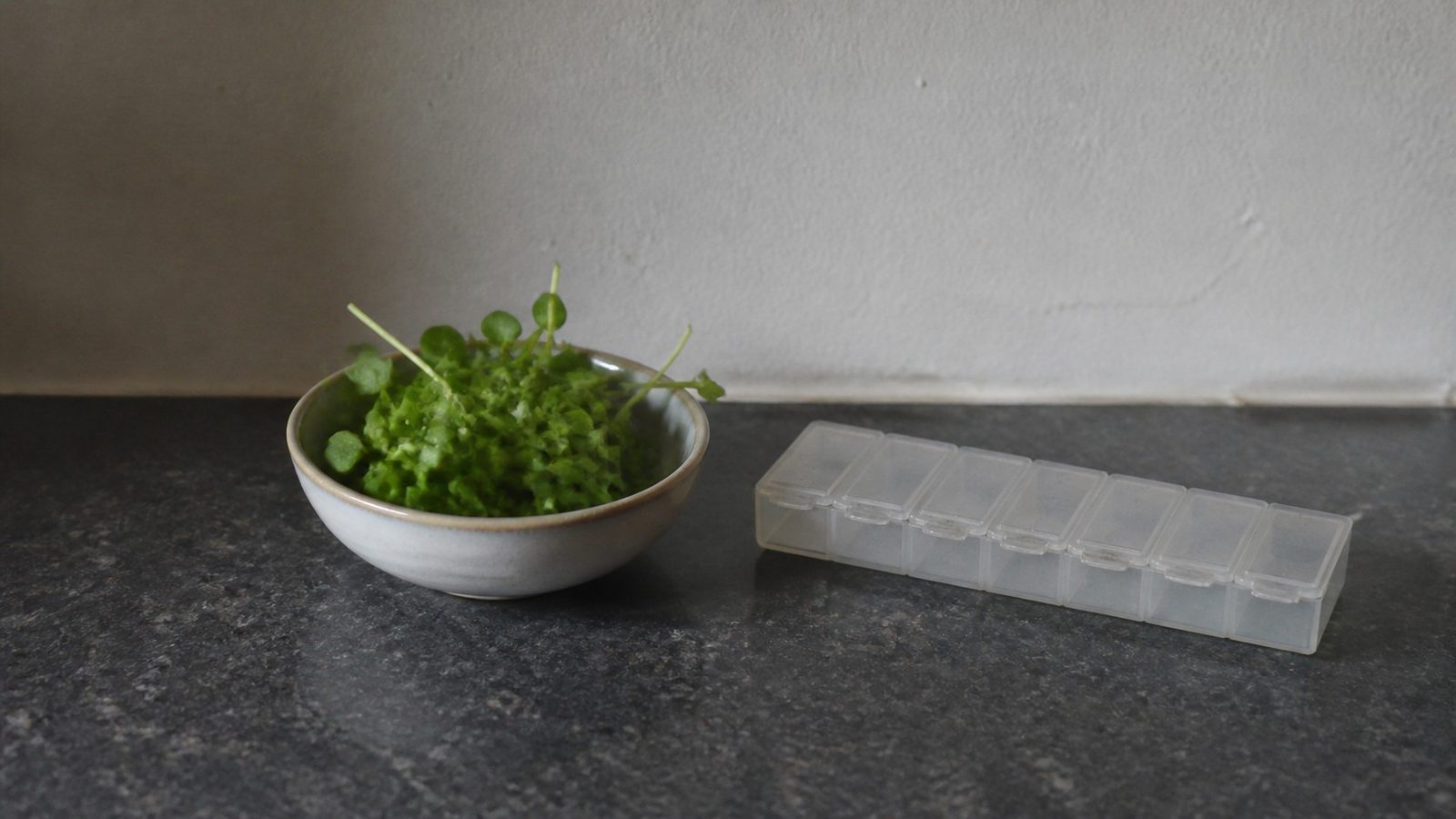
Vitamin K1 is the one nutrient microgreens genuinely deliver, and it is also the one with a real drug interaction. The pages making the bone claim are silent on that.
What to actually do
- Eat them for the vitamin K if you like them. This is the one claim in this series with a measured nutrient behind it.
- If you take warfarin, keep the amount AND the crop consistent, and tell your anticoagulation team before a deliberate change. Do not respond by cutting out greens, and do not start a vitamin K supplement.
- If you take a DOAC, this interaction is not yours, but ask rather than assume.
- Do not treat any of this as fracture prevention. No microgreen study has measured a bone outcome, and the supplement fracture signal is low certainty and does not survive removing the weaker trials.
- Do not read a K2 supplement trial as evidence for a leaf. The leaf's measured vitamin is K1.
- Do not expect a microgreen to beat a mature leaf. The highest one measured is still under raw spinach per gram.
- Ask which crop. A 15 g portion swings 6.8-fold in vitamin K depending on it, which matters for consistency and for anyone counting.
- If you have osteoporosis, this is a conversation with your clinician, and nothing here replaces the treatment you were prescribed.
The nutrient is real, and it is measured
Vitamin K1, phylloquinone, is made by plants and is the main dietary form. Green leaves dominate it. K2, the menaquinones, is mostly bacterial and comes from fermented and animal foods. They are not interchangeable, and that matters below, because most of the supplement evidence is K2 and most of the marketing is about leaves.
Microgreens have a direct measurement. A 2012 assay of 25 commercially available microgreens found phylloquinone at 0.6 to 4.1 micrograms per gram of fresh weight, with garnet amaranth the highest.
Vitamin K has an Adequate Intake rather than an RDA: 90 micrograms a day for adult women, 120 for adult men.
Hover or tap a row to highlight it.
| Portion | Vitamin K1 | Share of the 90 mcg women's AI | Share of the 120 mcg men's AI |
|---|---|---|---|
| 15 g serving | 9 to 61 mcg | 10% to 68% | 8% to 51% |
| 30 g handful | 18 to 123 mcg | 20% to 137% | 15% to 102% |
| A whole 200 g tray | 120 to 820 mcg | 133% to 911% | 100% to 683% |
A handful can be a fifth of a day's vitamin K or more than all of it. That is a genuine, measurable dietary contribution, and this page is not going to pretend otherwise.
One honest deflation. The highest microgreen in that assay, at 4.1 micrograms per gram, is still below raw spinach at about 4.8 micrograms per gram. So, microgreens are a real K1 food and they are not a uniquely concentrated one. Anyone claiming a microgreen beats a mature leaf on vitamin K is going past the measurement.
And there is no established stage effect. The 2012 study compared its results against mature-leaf figures in a database, not against the same cultivar grown on the same bench in the same lab. Crop, cultivar, light, harvest age and water content all move a fresh-weight comparison, so "microgreens have more K1 than the mature plant" is not a settled claim.
The interaction nobody in the category mentions
Warfarin is a vitamin K antagonist. It works by reducing the vitamin K available to activate clotting factors. More dietary vitamin K weakens it. Less strengthens it.
Five pages making a microgreen bone claim were opened and checked on 2026-08-12.
- Five of five made a bone claim.
- Zero of five cited a study in which microgreens were fed and a bone endpoint measured.
- Zero of five mentioned warfarin, anticoagulants or dietary consistency.
That last one is the failure that could actually hurt somebody, and it is the direct consequence of the nutrient claim being true. A page that correctly tells a reader this food is loaded with vitamin K, and does not tell them it interacts with a common blood thinner, has done the dangerous half of the job.
Current clinical guidance is consistency, not avoidance. Cambridge University Hospitals states plainly that people on warfarin do not need to avoid vitamin K foods entirely, but should eat a consistent amount, because large changes week to week can move INR and with it clotting and bleeding risk.
Here is why this crop makes consistency unusually hard.
Hover or tap a row to highlight it.
| Vitamin K1 | |
|---|---|
| Lowest crop in the assay | 9 mcg |
| Highest crop in the assay | 61 mcg |
| The swing from crop alone | 52 mcg |
A 6.8-fold difference at identical weight. The swing between the lowest and highest crop in a single 15 g portion is 52 micrograms, which is 58 percent of a woman's entire daily Adequate Intake.
And punnets are frequently mixes. A shopper eating "microgreens" consistently by weight can still be eating wildly inconsistent vitamin K, because the variable is which crop is in the box, and the box often does not say.
So, the practical advice is sharper than the general leafy-green advice. If you take warfarin, keep both the amount and the crop consistent, and treat a switch from, say, pea to amaranth as a dietary change worth mentioning, even at the same weight.
On timing, nobody can give you a number. A sudden increase tends to lower INR and a sudden decrease tends to raise it, but the guidance does not supply a validated universal timescale, because response depends on dose, baseline diet, liver function, interacting medicines and clotting factor turnover. Tell the anticoagulation team before a deliberate change, and follow their INR testing.
This does not apply to the newer anticoagulants. Apixaban, rivaroxaban, dabigatran and edoxaban do not work by antagonizing vitamin K, so they do not carry warfarin's dietary consistency interaction. Do not apply warfarin food rules to a DOAC, and do not assume the reverse either without asking your clinician.
Other situations where vitamin K status can matter: prolonged antibiotics, especially some cephalosporins; bile acid sequestrants such as cholestyramine or colestipol; orlistat; and malabsorption or impaired bile flow. That is medication management, not a reason to start a supplement.
The bone claim, and where it stops
The biochemistry is genuine. Vitamin K is a cofactor for an enzyme that adds a chemical handle to selected proteins, creating sites that bind calcium. In bone the named protein is osteocalcin, made by osteoblasts, with matrix Gla protein and others also discussed.
That is a real role. It is not evidence that extra K1 builds extra bone in someone already supplied.
No human study has fed microgreens and measured a bone marker, bone density or a fracture. Not one.
The nearest food evidence stops two rungs short. A 2020 crossover in 30 healthy adults, mean age 61.8, supplied about 200 g a day of K1-rich leafy vegetables delivering a median 164.3 micrograms of K1 for four weeks. It reduced total osteocalcin by about 14 percent, undercarboxylated osteocalcin by 31 percent and the ratio by 19 percent. It measured no bone density and no fractures.
A marker moving is not a density result, and a density result is not a fracture. That is three separate rungs and the food evidence is on the first.
The supplement literature is a different material and is shakier than it looks. A three-year trial in 452 adults aged 60 to 80 gave 500 micrograms a day of a K1 supplement with calcium and vitamin D and found no effect on bone loss or density. A 2022 review of oral vitamin K supplement trials pooled clinical fracture at odds ratio 0.44, 95 percent CI 0.23 to 0.88 and vertebral fracture at 0.42, 0.27 to 0.66, and rated both low certainty. A 2019 review found lumbar spine density differences at two years that became smaller and non-significant once high-risk-of-bias trials were removed, and a 2025 BMJ review reports the same collapse.
Those trials were largely K2-containing regimens in postmenopausal or osteoporotic women, often alongside calcium, vitamin D, hormone therapy or bisphosphonates. They are not a leaf, they are not K1, and they are not microgreens.
The observational signal is real and cannot carry the weight. In a prospective cohort, women eating lettuce at least once daily against once a week or less had a hip fracture relative risk of 0.55, 95 percent CI 0.40 to 0.78, and lettuce was the largest dietary vitamin K contributor. Association is not assignment. Lettuce intake travels with diet, activity, body size and smoking.
What "deficiency" even means here, which is less than you would think
You cannot look up a US vitamin K deficiency rate, and the reason is technical rather than evasive. Vitamin K has an Adequate Intake, not an Estimated Average Requirement, and the National Academies state explicitly that an AI cannot be used to calculate a prevalence of inadequacy.
What exists is intake distribution. Mean food intake in 2011 to 2012 was 122 micrograms a day in adult women and 138 in adult men. In a lower income subgroup from 2013 to 2016, only 27 percent of men and 45 percent of women aged 19 and over had usual total intake above their AI.
Nor is there a routine blood test for it. Clinically significant status is normally assessed by prothrombin time when there is a bleeding problem or anticoagulant use. Fasting plasma phylloquinone has a reported healthy range but is not a validated quantitative status measure, and there is no normal range for menaquinones at all.
The regulators are narrower than the marketing. EFSA permits the physiological claim that a cause and effect relationship is established between dietary vitamin K and maintenance of normal bone. That is a maintenance claim. The NIH's own consumer sheet says more research is needed to understand whether vitamin K supplements improve bone health or reduce osteoporosis risk.
What nobody has measured
- Any human microgreen study with a bone marker, bone density or a fracture.
- A K1 assay across every crop. Twenty-five varieties have been measured and the rest have not, and garnet amaranth's lead does not tell you where any other crop sits.
- A matched microgreen against mature comparison of the same cultivar, same conditions, same laboratory, reported in both fresh and dry weight.
- How much K1 humans convert to MK-4, by tissue, on ordinary diets.
- A food-based fracture trial long enough to count fragility fractures, with density and markers as secondary.
- A safe timescale for warfarin dietary change, which is why the guidance says talk to the clinic rather than wait a stated number of days.
- USDA database coverage of individual microgreens, which needs a dated crop-by-crop audit rather than an assumption either way.
Terms on this page
Tap a term to see what it means.
Vitamin K1, phylloquinone. The plant form, concentrated in green leaves. This is what a microgreen actually contains.
Sources
Opened 2026-08-12. The portion figures are arithmetic performed for this page on the measured 0.6 to 4.1 micrograms per gram range, using a 15 g serving, a 30 g handful and the median published tray yield of 7.055 oz, which is almost exactly 200 g. Recomputing at the 30 g basis reproduces the source's own 18 to 123 microgram figures exactly, which is how the conversion was checked. The 30 g handful is a seller's description of a typical portion rather than a standard or a recommendation.
- NIH Office of Dietary Supplements, vitamin K and its alternate route and food table - the K1 and K2 distinction, that MK-4 can be formed from K1 with uncertain significance, the carboxylation role, the absence of a validated status measure, the 2011 to 2012 mean intakes, the raw spinach figure of 145 micrograms per 30 g cup used for the per-gram comparison, and the medication interactions. One direct fetch returned a 403; the content was read.
- NIH ODS consumer fact sheet and the EFSA bone claim as reported by ODS - that more research is needed on supplements and bone, and that the authorized European claim is maintenance of normal bone rather than treatment or fracture prevention.
- National Academies, vitamin K Dietary Reference Intakes, 2001 - the Adequate Intake values including 90 and 120 micrograms for adult women and men, and the statement that an AI cannot be used to calculate a prevalence of inadequacy.
- USDA ARS microgreen publication record, 2012 and the 2024 microgreen review reporting its range - the 25-variety assay, the 0.6 to 4.1 micrograms per gram fresh weight phylloquinone range, and garnet amaranth as the highest. The review's direct fetch was challenge-blocked once. A 2023 Brassicaceae review describes rapini, daikon radish and broccoli as good sources without giving a measured ranking.
- USDA ARS NHANES usual intake table, 2013 to 2016 - the 27 percent of men and 45 percent of women above their AI in the lower income subgroup.
- Sim et al., leafy vegetable crossover, 2020 - 30 adults, about 200 g a day of K1-rich vegetables at a median 164.3 micrograms, four weeks, the 14, 31 and 19 percent osteocalcin changes, and the absence of any density or fracture endpoint.
- Shea et al., K1 supplement trial, 2008 - 452 adults aged 60 to 80, 500 micrograms a day of K1 with calcium and vitamin D for three years, with no effect on bone loss or density. Direct fetch was challenge-blocked once.
- Salma et al., systematic review, 2022 and its PubMed record - the pooled clinical fracture odds ratio of 0.44 and vertebral 0.42 with their intervals, both rated low certainty, the predominance of K2-containing regimens, and the insufficient evidence on femoral neck density.
- Mott et al., updated review, 2019, the 2025 BMJ osteoporosis review and a 2024 randomized trial review - that the lumbar spine density difference shrinks and loses significance when high-risk-of-bias trials are removed, that the fracture signal does the same, and that the apparent benefit primarily involves carboxylation rather than total osteocalcin. The 2019 record returned a reCAPTCHA after the abstract had been read.
- Feskanich et al., prospective cohort, 1999 and Huang et al., observational meta-analysis, 2017 - the 0.55 hip fracture relative risk for daily lettuce with its interval, and the scope of the observational intake literature. Both returned reCAPTCHAs after their abstracts were retrieved.
- Cambridge University Hospitals, dietary advice for patients taking warfarin, its oral anticoagulant guidance and practical warfarin management guidance - that consistency rather than avoidance is the instruction, the direction INR moves after a dietary change, the absence of a validated universal timescale, and that the interaction belongs to vitamin K antagonists rather than the newer anticoagulants. One direct fetch returned a challenge.
- The five pages audited for the bone claim, practice only: Kenny Fresh, Microgreens World's general nutrition page, Deliseeds, Grenny's Greens and Microgreens World's broccoli bone page, the last of which timed out on direct opening so no unverified detail from it is used. Deliseeds is also the source of the 30 g handful described as typical. Counted on 2026-08-12; a page count is not a claim about search rankings.
Keep reading
The journal
Are Microgreens Anti-Inflammatory? What the Research Really Says
Nobody has fed a person microgreens and measured their inflammation. And when researchers pooled ten broccoli sprout trials, the combined result came out at something that could be zero.
Read Are Microgreens Anti-Inflammatory? What the Research Really SaysThe journal
Are Microgreens Low FODMAP? What Monash Research Shows
Are microgreens low FODMAP? Learn what Monash sprouting research shows, which crop families deserve extra caution, and how reintroduction testing works.
Read Are Microgreens Low FODMAP? What Monash Research ShowsThe journal
Are Microgreens Safe to Eat Raw?
For most people yes, and the frightening statistics belong to sprouts. At least 15 microgreen recalls and recall warnings are on record across two countries, and no illness outbreak has been linked to any of them. No public health agency has attributed an outbreak to a microgreen. That is not the same as zero risk.
Read Are Microgreens Safe to Eat Raw?The journal
Best Microgreens for Kidney Health: Potassium by the Serving
See measured potassium and phosphorus for the best microgreens for kidney health, from lowest to highest, plus what your renal dietitian needs to know.
Read Best Microgreens for Kidney Health: Potassium by the Serving