Microgreens and Iron: You Would Need Eleven Trays a Day
Cal HewittPublished Checked
- health
- evidence
- iron
- nutrition
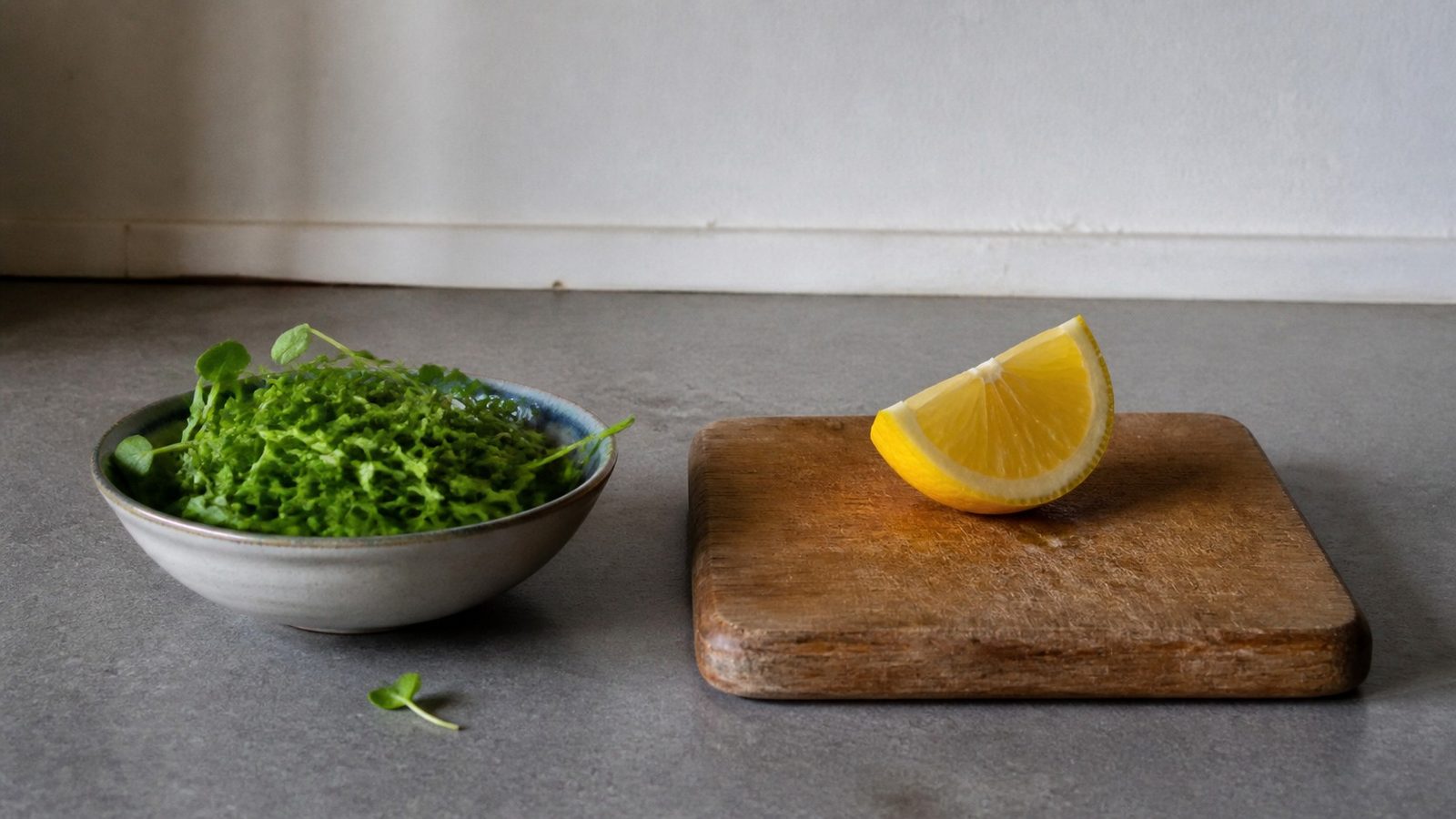
This is the claim where the arithmetic settles it before the biology gets a turn.
What to actually do
- Do not treat suspected anemia with food. Get a blood test. Ferritin plus a full blood count, and let a clinician look for the cause.
- If you have been diagnosed, take the iron you were prescribed. Oral iron is first line for most people and diet is not a substitute.
- Eat microgreens for other reasons. Vitamin K is the nutrient they genuinely deliver; iron is not.
- Put the vitamin C on the plate rather than expecting the crop to supply it. Lemon, tomato or peppers with an iron-containing meal is the mechanism that actually works.
- Keep tea and coffee away from iron-rich meals if you are trying to absorb more, since they cut it substantially.
- For iron absorption, the oxalate warnings about leafy greens do not apply. The human test that added oxalate found no effect on absorption. If you form calcium oxalate kidney stones, oxalate is a separate question for your clinician (National Kidney Foundation).
- If you are vegetarian or vegan, plan for the 1.8-fold higher requirement rather than hoping a garnish covers it.
- Do not take iron supplements without a test. Excess iron is harmful in hereditary hemochromatosis, and the adult upper limit is 45 mg a day.
What is actually in there
Thirty Brassicaceae microgreen varieties were measured by ICP-OES in 2016: iron at 0.47 to 0.84 mg per 100 g fresh weight. That is the best direct measurement available and it is a family-level range, not a crop-by-crop ranking.
Iron RDAs are 8 mg a day for adult men and postmenopausal women, and 18 mg for premenopausal women.
Hover or tap a row to highlight it.
| Portion | Iron | Share of the 8 mg men's RDA | Share of the 18 mg women's RDA |
|---|---|---|---|
| 15 g serving | 0.07 to 0.13 mg | 0.9% to 1.6% | 0.4% to 0.7% |
| 30 g portion | 0.14 to 0.25 mg | 1.8% to 3.1% | 0.8% to 1.4% |
| A whole 200 g tray | 0.94 to 1.68 mg | 11.8% to 21% | 5.2% to 9.3% |
A whole tray of microgreens is under a tenth of a premenopausal woman's daily iron.
Hover or tap a row to highlight it.
| Trays a day | |
|---|---|
| Adult men and postmenopausal women, 8 mg | 4.8 to 8.5 |
| Premenopausal women, 18 mg | 10.7 to 19.1 |
Eleven to nineteen trays a day. That is the answer on content alone, and absorption only makes it worse.
One more comparison for scale. Half a cup of cooked, drained spinach supplies 3 mg of iron. Matching that single half cup takes between 1.8 and 3.2 entire trays of microgreens.
None of that counts absorption, which comes next and only cuts one way.
Non-heme iron, and why a food table cannot tell you what you got
Plants supply non-heme iron. Heme iron is the form inside hemoglobin and myoglobin in meat, poultry and seafood. They are not interchangeable and they do not absorb alike.
Non-heme absorption ranges from about 1 percent to 30 percent or more, depending mostly on the meal and on your own iron status. Whole-diet estimates run 14 to 18 percent for mixed diets and 5 to 12 percent for vegetarian diets, which is why the requirement for a vegetarian diet is set 1.8 times higher.
So, the tray figures above are content, not delivery. How much of that 0.94 to 1.68 mg you actually take up depends on your stores, what else is on the plate, and how much inflammation you have.
The oxalate story is not what you have been told
Everyone repeats that oxalate locks up leafy green iron. The human test says otherwise.
A randomized crossover isotope study in 13 healthy women compared kale against kale plus 1.26 g of added potassium oxalate. Absorption was 10.7 percent from kale and 11.5 percent from kale plus oxalate, P=0.86. The authors concluded the added oxalate did not affect absorption.
The spinach meal in the same work absorbed 24 percent less than kale, and not significantly so.
So "oxalate blocks iron by some percentage" is not an established human result. Spinach genuinely is high in oxalate, at about 557 mg per 100 g fresh weight in a 2023 analysis of 26 Asian greens where the range starts at 6 mg in iceberg lettuce. High oxalate content is real. Oxalate as the demonstrated cause of poor iron absorption is not.
The Popeye decimal-point story is not the explanation either. It is a repeated anecdote, not the reason food tables list iron in spinach.
Phytate is a real inhibitor and mostly the wrong food group. Defined inositol phosphate additions reduced absorption by 39, 54 and 64 percent across three human experiments. Phytate is concentrated in grains, legumes, nuts and seeds. The human evidence comes chiefly from those matrices, not from leaves, so applying it to a microgreen is an assumption rather than a finding.
Across four articles checked on 2026-08-12 that make a microgreen iron claim, one distinguished non-heme iron, one mentioned oxalate, and none mentioned phytate. The one that raised oxalate asserted most microgreens have negligible amounts, without a cited assay.
The crop cannot rescue its own iron
Vitamin C is the real enhancer, and the doses are known. About 25 mg of ascorbic acid in a meal roughly doubles non-heme absorption; 50 mg gives three to six times, with a linear relation to at least 100 mg per meal.
So, can a microgreen supply its own rescue? Not at a realistic portion.
A 2019 Brassicaceae microgreen study reported vitamin C at 31 to 56 mg per 100 g fresh weight.
Hover or tap a row to highlight it.
| Portion | Vitamin C | Reaches the 25 mg dose? |
|---|---|---|
| 15 g serving | 4.6 to 8.4 mg | no |
| 30 g portion | 9.3 to 16.8 mg | no, not even at the top |
| To reach 25 mg | 45 to 81 g needed |
A 30 g portion falls short of the smallest experimental dose even at the most vitamin-C-rich end of the range. You would need 45 to 81 g, which is a quarter to nearly half a tray, at one sitting, to reach the amount that merely doubles absorption of the very small iron the same portion contains.
The useful version of this advice is about the meal, not the crop. Vitamin C from anything on the plate enhances non-heme iron. A squeeze of lemon or a tomato does the job; the microgreens do not need to do it themselves, and at realistic portions they cannot.
Working the other way: tea reduced absorption by 64 percent and coffee by 39 percent with a test meal, and 300 to 600 mg of calcium reduced it 50 to 60 percent in older test meals, though the long-term significance of the calcium effect is not settled.
Anemia is a diagnosis, and this is the part that matters
Anemia and iron deficiency are not the same thing. Iron deficiency is depleted body iron, often visible as low ferritin while hemoglobin is still normal. Iron deficiency anemia is the later state. Anemia itself is just low hemoglobin or red cells, and it can come from B12 or folate deficiency, inflammation, infection, bleeding, pregnancy, malaria, thalassemia or sickle cell disorders.
The scale is real. WHO reported for 2019 that anemia affected 40 percent of children aged 6 to 59 months, 37 percent of pregnant women and 30 percent of women aged 15 to 49. In the US, CDC reported iron deficiency in 22.5 percent of children aged 1 to 2 and 22.6 percent of females aged 12 to 49 for 2017 to March 2020.
And here is the finding that should stop anyone treating this with salad. A 2025 clinical review reports that recurrent blood loss accounted for 94 percent of cases in its cited evidence. Clinical guidance puts ferritin-based diagnosis and cause-finding first, evaluating for celiac disease, H. pylori, bleeding and, where appropriate, endoscopy.
Food cannot find a bleed. Eating more greens while an undiagnosed cause continues is not a neutral choice, because it delays the test that would find it.
No completed human trial has fed microgreens and reported ferritin, hemoglobin or any iron status outcome. One study is registered, planning 30 g a day of iron-biofortified microgreens in a smoothie for 28 days. A registration is not a result.
The nearest human evidence is not vegetables alone. A 2017 trial gave moringa leaf extract plus ferrous sulfate to 35 anemic women; hemoglobin rose, but that is a supplement added to medicinal iron. A 12-week vegetable-based diet in women with small iron stores saw ferritin fall from a median 17.3 to 11.2 micrograms per liter.
That second one is worth sitting with. The whole-diet vegetable intervention moved iron stores in the wrong direction.
What nobody has measured
- Any completed human microgreen trial reporting ferritin, hemoglobin or iron status.
- A crop-by-crop iron assay. Thirty Brassicaceae varieties give a range rather than a ranking, and every other crop is unmeasured.
- Whether a microgreen or its mature form delivers more absorbable iron. One cell and digestion model compared three crops and found no consistent direction.
- Oxalate and phytate in named microgreen crops, on the same lots as the iron.
- Fractional absorption from matched meals across several greens, which is the study that would settle whether higher content means less uptake.
- Whether preserving or removing a crop's own vitamin C changes iron absorbed from the same portion.
- Whether increasing ordinary vegetable intake alone corrects confirmed iron deficiency anemia. The one whole-diet attempt moved ferritin down.
Terms on this page
Tap a term to see what it means.
Heme iron. Iron inside hemoglobin and myoglobin in animal flesh. Absorbed far more consistently than the plant form.
Sources
Opened 2026-08-12. The portion figures are arithmetic performed for this page on the 0.47 to 0.84 mg per 100 g range, using the median published tray yield of 7.055 oz, which is almost exactly 200 g. Recomputing at the 30 g basis reproduces the source's own 0.141 to 0.252 mg and its percentage figures exactly, and the vitamin C conversion reproduces its 9 to 17 mg, which is how both were checked.
- NIH Office of Dietary Supplements, iron - the RDA table, the 14 to 18 and 5 to 12 percent whole-diet bioavailability estimates, the 1.8-fold vegetarian requirement, the enhancer and inhibitor list, the cooked spinach figure of 3 mg per half cup, the 45 mg upper limit, and the note that spinach has low bioavailability.
- National Academies, iron Dietary Reference Intakes, 2001 - the 1 to 30 percent non-heme absorption range, the vitamin C dose response of roughly twofold at 25 mg and three to sixfold at 50 mg, and the tea, coffee and calcium inhibition figures.
- Xiao et al., 30 Brassicaceae microgreen varieties, 2016, EPA HERO record - iron at 0.47 to 0.84 mg per 100 g fresh weight by ICP-OES across 10 species and six genera. A range, not a crop ranking.
- Bonsmann et al., kale and spinach isotope crossover, 2008 - 13 women completing both comparisons, 10.7 percent absorption from kale against 11.5 percent from kale plus 1.26 g potassium oxalate at P=0.86, and the non-significant 24 percent lower spinach result. The page returned a reCAPTCHA on direct opening after the indexed result had been inspected.
- Sandberg et al., inositol phosphate isotope experiments, 1999 - the 39, 54 and 64 percent absorption reductions across three human experiments.
- de la Fuente et al., Brassicaceae microgreens, 2019 - vitamin C at 31 to 56 mg per 100 g fresh weight. A reCAPTCHA blocked full page retrieval; the figures were visible in the search extract.
- WHO anaemia fact sheet, 2025 and WHO ferritin guidance, 2023 - the 2019 global prevalence figures, the definition and causes of anemia, and ferritin interpretation including that inflammation raises it.
- CDC FastStats, anemia - US iron deficiency at 22.5 percent of children aged 1 to 2 and 22.6 percent of females aged 12 to 49 for 2017 to March 2020, and the 2021 to 2023 anemia figures.
- AAFP review of iron deficiency anemia, 2025 and the AAFP summary of the AGA guideline, 2021 - that recurrent blood loss accounted for 94 percent of cases in the cited evidence, that oral iron is first line, and that ferritin-based diagnosis and evaluation for celiac disease, H. pylori and bleeding come first. This is the guidance that matters most for anyone who suspects anemia.
- ClinicalTrials.gov NCT06972927 - the registered but unreported study planning 30 g a day of iron-biofortified microgreens for 28 days with hemoglobin, serum iron and ferritin outcomes.
- Suzana et al., moringa extract trial, 2017 and a 12-week vegetable against meat diet trial - the leaf extract given alongside ferrous sulfate rather than alone, and the vegetable-based diet in which median ferritin fell from 17.3 to 11.2 micrograms per liter. The second returned a reCAPTCHA after its abstract was read.
- A 2023 analysis of 26 Asian greens - spinach at 557 mg total oxalate per 100 g fresh weight against 6 mg in iceberg lettuce. Publisher access was unavailable in the research run, so this is reported as an indexed result.
- Khoja et al., 2020 - the cell and digestion model comparing fenugreek, rocket and broccoli at both stages, returned an access error and is cited only as a blocked source, not as a basis for a ranking. A 2020 microgreen oxalate paper returned a 403 and a plant-based diet systematic review reporting 7, 11 and 15 percent deficiency in meat eaters, vegetarians and vegans returned a reCAPTCHA. A coffee inhibition record opened without rendering, so its figure is carried as a dated indexed result.
- USDA FoodData Central API guide - the scope and limits of the database, whose microgreen search returns a mix of experimental records and branded product labels rather than a generic crop composition dataset.
- The four pages audited for the iron claim, practice only: Sehat Microgreen, which calls microgreens an efficient anti-anemia food, Cleveland Clinic, Gardening Know How and Wind River Greens. Counted on 2026-08-12; a page count is not a claim about search rankings.
Keep reading
The journal
Are Microgreens Anti-Inflammatory? What the Research Really Says
Nobody has fed a person microgreens and measured their inflammation. And when researchers pooled ten broccoli sprout trials, the combined result came out at something that could be zero.
Read Are Microgreens Anti-Inflammatory? What the Research Really SaysThe journal
Best Microgreens for Kidney Health: Potassium by the Serving
See measured potassium and phosphorus for the best microgreens for kidney health, from lowest to highest, plus what your renal dietitian needs to know.
Read Best Microgreens for Kidney Health: Potassium by the ServingThe journal
Do Microgreens Help You Lose Weight? Two Claims, One Answer
One of these claims is probably true and has nothing to do with microgreens. The other was tested by injecting a compound into mice. Here is which is which.
Read Do Microgreens Help You Lose Weight? Two Claims, One AnswerThe journal
Do Microgreens Really Have 40 Times the Nutrients?
The number is real. It belongs to one nutrient in one crop. Used for microgreens as a category it is wrong in both directions, because some pairs run far above 40 and for at least one compound the mature plant is the more concentrated of the two.
Read Do Microgreens Really Have 40 Times the Nutrients?