Microgreens and Allergies: Four Crops Are Regulated Allergens
Cal HewittPublished Checked
- health
- evidence
- allergies
- food safety
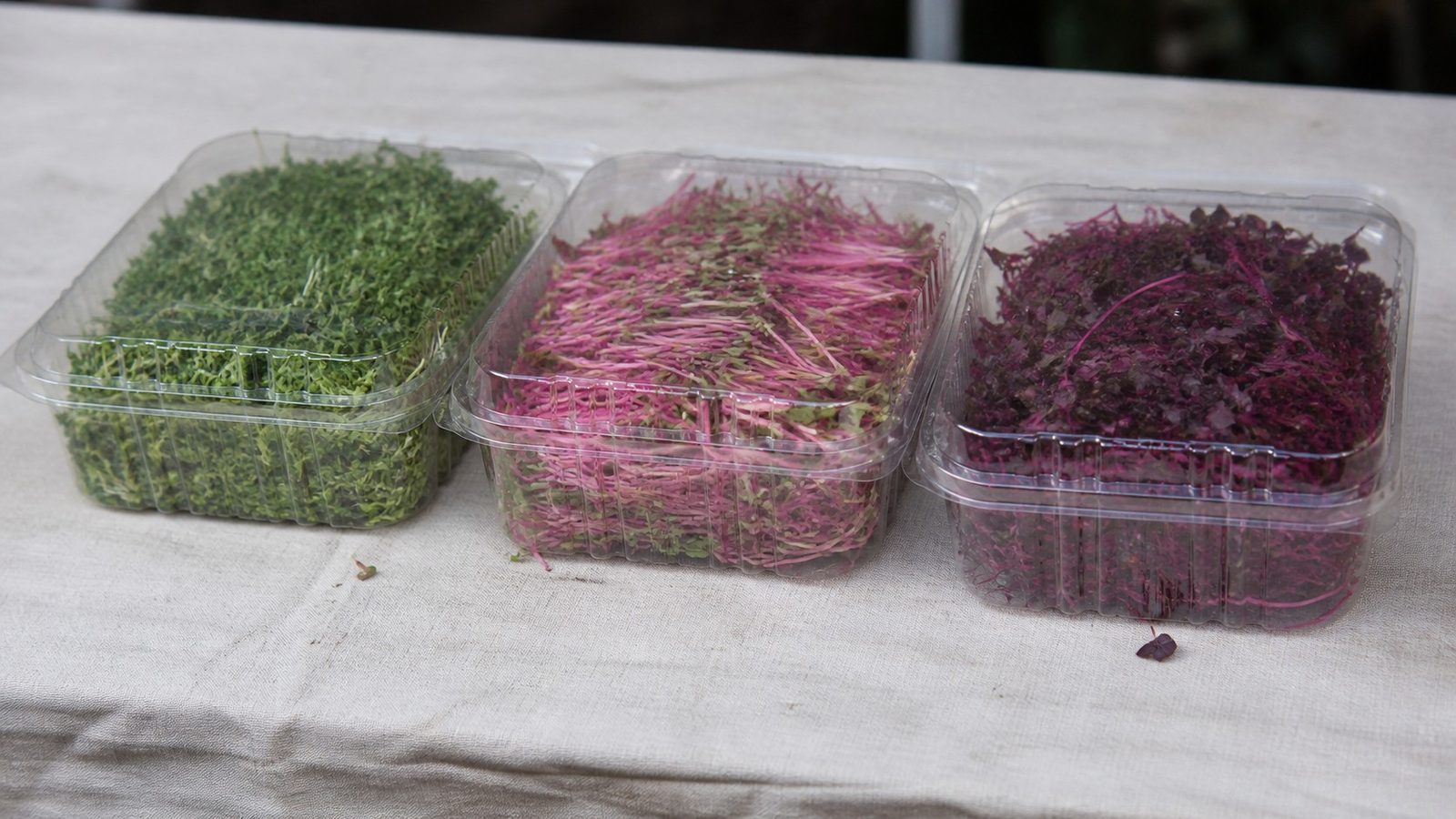
The honest answer is that nobody knows. That is not a reason to shrug, because the crops involved are regulated by name in four jurisdictions.
What to actually do
- If you have a diagnosed allergy to a plant, treat its microgreen as the same food until an allergist tells you otherwise. The inference is unproven in both directions and this is the side to err on.
- Get an actual diagnosis rather than self-diagnosing from a reaction. A history plus targeted testing, and a supervised oral food challenge where there is doubt.
- Do not eat an unnamed mixed punnet if you have any food allergy. "Microgreens" is not an ingredient, and four of the crops grown as microgreens are regulated allergens somewhere.
- Ask which crops are in the mix, and ask whether varieties share trays and handling.
- If you get mouth itching or tingling with raw plant foods, mention pollen allergy to your clinician. It is a recognized pattern and it still needs interpreting.
- Do not assume brief cooking makes a reaction go away. That advice circulates for pollen-food syndrome and it is not a general safety measure.
- If you are selling, name the crop. It costs nothing and it is the only thing that lets an allergic buyer make a decision.
- New reactions in adulthood are common. Nearly half of adults with food allergy report at least one that started as an adult.
The four crops that carry allergen labeling law
Four of the 62 crops grown as microgreens are foods that carry allergen labeling law somewhere in the world.
Hover or tap a row to highlight it.
| Crop | Botanical name | Regulated as a major allergen |
|---|---|---|
| Sesame | Sesamum indicum | United States, the ninth major allergen since January 1, 2023 |
| Mustard | Brassica juncea | Canada and the European Union |
| Buckwheat | Fagopyrum esculentum | Japan and South Korea |
| Celery | Apium graveolens | European Union |
The botanical names match the regulations exactly. Canada names Sinapis alba, Brassica hirta, B. juncea and B. nigra as its regulated mustards, and the entry here is B. juncea. The EU category is "mustard and products thereof" and "celery and products thereof". Japan lists buckwheat among its mandatory specified ingredients and Korea lists it alongside egg, milk and peanut.
Not one of those four is on the US major allergen list except sesame. So, a grower's obligation depends entirely on where they sell, and a crop that requires a declaration in Ottawa or Tokyo may require none where you are.
One species point worth being precise about. The buckwheat entry here is Fagopyrum esculentum, and Tartary buckwheat, F. tataricum, is a different species also grown as a microgreen. The regulated category is "buckwheat", so the species belongs on the product record rather than being inferred. Mizuna, usually Brassica rapa var. japonica, is Brassicaceae but is not one of Canada's named mustard species.
Being a listed major allergen is a labeling category, not a complete list of foods that can cause allergy. Plenty of unlisted foods cause reactions. The list tells you where the law bites.
What has actually been reported, by material
A targeted search for published clinical cases naming a cut microgreen as the food eaten found none.
That is an absence finding and not proof that reactions do not happen. It means nobody has written one up in a way that identifies the harvest stage.
Hover or tap a row to highlight it.
| Material | Reports located |
|---|---|
| Microgreen | 0 published clinical cases |
| Sprout | 1 cross-reactivity study line, commercial legume sprouts |
| Seed | 4 or more, across sesame, mustard, buckwheat and legume seeds |
| Mature vegetable | 3, cabbage, broccoli and lettuce |
These are counts of what this page's research summarized, not a prevalence and not a systematic review.
The seed evidence is substantial and serious. Sesame proteins bind specific IgE and tahini has caused severe systemic reactions. Mustard seed has challenge-confirmed IgE-mediated allergy and anaphylaxis. Buckwheat flour and noodles can cause severe anaphylaxis, with a higher apparent incidence in Japan and Korea, which is presumably why those two countries regulate it.
The mature vegetable reports exist and are sparse. A cabbage case described facial and throat swelling after coleslaw, with positive testing to cabbage, mustard plant, cauliflower and broccoli. A broccoli case is reported as mugwort-mustard syndrome. Lettuce has both ingestion and occupational reports.
The gap is precisely in the middle. Seed is well documented, mature vegetable is documented, and the cut shoot in between has never been written up.
The question nobody has answered
How much allergen protein is in a harvested shoot?
Nobody has measured it. No study measures clinically relevant allergen proteins or IgE-binding activity in a harvested sesame, mustard or buckwheat microgreen and compares it with its seed. General composition studies and the claim that seedlings consume their seed reserves do not answer it.
And germination has no reliable direction. A 2023 lupin experiment found decreased storage-protein bands after six or more days with degradation of some epitopes. A sesame germination study at 0, 2 and 4 days reported hydrolysis of high-molecular-weight proteins and did not establish clinical safety. Those are seed and sprout stage findings on two species, and they do not transfer.
So, both confident positions are unsupported. "The seed proteins are gone by the microgreen stage" is not established. Neither is "the shoot is as allergenic as the seed."
The prevailing advice fills that gap with an inference. The repeated claim is that because it is the same plant, someone allergic to the mature crop or the seed will react to the microgreen. One page calls it "safe to assume" for pea microgreens. That is a reasonable clinical caution and it is an inference, not a measurement, and it should be labeled as such rather than presented as a finding.
Cross-reactivity, which is real and not a family rule
Mustard allergy and other Brassicaceae is the best documented pair. In a 38-person mustard-allergy cohort, all were sensitized to other Brassicaceae and inhibition assays confirmed cross-reactivity. Health Canada says related Brassicaceae seeds contain very similar proteins, naming broccoli, cauliflower, cabbage, Brussels sprouts, turnip and canola, and warns that seeds and sprouted seeds of related Brassicaceae may be more likely to trigger a reaction in mustard-allergic people.
Neither source measured a cut broccoli, kale, radish or mizuna microgreen. So, it cannot certify shoots as reactive or as safe.
Legumes share storage proteins and clinical co-allergy is still not automatic. The most common clinical patterns are peanut with lupin, peanut with soy, and chickpea with lentil. Pea, alfalfa, clover, lentil, chickpea, fenugreek and mung bean are all Fabaceae and all grown as microgreens here. Cross-sensitization is common; co-allergy is individual.
Pollen-food allergy syndrome is a different mechanism. Pre-existing pollen IgE recognizes a similar protein in a raw plant food, usually causing rapid itch, tingle or mild swelling of lips, mouth or throat. Established pairs include birch with celery, carrot, potato, peanut and soybean; mugwort with celery, fennel, carrot and parsley; grass with tomato and potato.
Several of those are grown as microgreens, across the carrot family especially: celery, carrot, parsley, fennel and cilantro.
Two cautions on PFAS. It is usually milder, and usually is not never: older practice guidance reports systemic progression in about 1 to 2 percent of contact-reaction patients. And mouth symptoms can be the first sign of a different, primary allergy. It needs clinical interpretation rather than an assumption that a cooked form or a related crop is fine.
How common is any of this
There is no sound population estimate for leafy vegetables as a group. The closest rigorous synthesis put challenge-confirmed vegetable allergy at 0.1 to 0.3 percent, from two studies. That is not a microgreen figure and not a rate for any single leaf.
For scale, a 2015 to 2016 survey of 40,443 US adults estimated convincing food allergy at 10.8 percent, with shellfish 2.9, milk 1.9, peanut 1.8 and tree nut 1.2. Vegetables are not where the burden sits.
And adult onset is common, which surprises people. In that survey, 48.0 percent of adults with convincing food allergy reported at least one that began in adulthood, and 26.9 percent reported only adult-onset allergy. So "I have eaten this for years" is not a guarantee.
A patch-test figure worth not misreading. A selected Danish contact-allergy population had positive lettuce patch tests of 11 and 22 percent. That is a selected clinical population and a different test entirely, and it cannot be read as a public prevalence.
Growers, and the labeling question
Occupational reactions are documented for the seed and the mature crop, not for microgreen trays. Buckwheat flour exposure is associated with occupational rhinitis, conjunctivitis, contact urticaria and asthma, with a recent health food store case progressing to anaphylaxis. Lettuce farming has published occupational respiratory allergy. No documented microgreen-tray grower reaction to sesame, mustard or buckwheat foliage or seed dust was found.
Five pages about microgreens and allergy were checked on 2026-08-12. All five mentioned allergy. Two accessible pages clearly named a regulated crop, mustard and buckwheat, one named pea which is not a US major allergen, and one was blocked by an anti-bot page so nothing is inferred from it. No accessible page called microgreens hypoallergenic, which is to their credit.
They get two things right that matter. Microgreens are distinct from sprouts, which are eaten whole including the seed, and a buyer needs the precise crop rather than a generic greens label. One page treats shared growing space and cross-contact as an operational question and avoids calling anything allergen-free, which is the correct posture.
For anyone selling, the practical shape is: name the crop and its botanical name on the stall list, menu or product record; do not sell a mixed tray as an unnamed microgreen mix; keep seed lot and shared-tray records; and tell a restaurant exactly what is in the garnish and whether varieties share handling. What must appear on a retail label is a separate question with its own answer, and for a regulated packaged sale you should ask your local regulator rather than infer.
What nobody has measured
- Allergen protein or IgE-binding activity in a harvested microgreen shoot, compared against its own seed. The central gap, and it is measurable with existing methods.
- Any published clinical case identifying a cut microgreen as the food eaten.
- Whether germination reliably reduces allergenicity in sesame, mustard or buckwheat, as opposed to two species at sprout stage.
- Whether Brassicaceae cross-reactivity extends to cut broccoli, kale, radish or mizuna shoots.
- Any occupational case series in microgreen growers, identifying crop, exposure route and task.
- A population prevalence for any single leafy vegetable, let alone a microgreen.
Terms on this page
Tap a term to see what it means.
IgE. The antibody involved in immediate allergic reactions.
Sources
Opened 2026-08-12. The four-crop table was produced for this page by reading the botanical name field on all 62 variety entries and matching it against the named regulatory lists below. Where PubMed or a publisher returned a challenge, that is noted, and nothing is inferred from a page that could not be read.
- FDA on what a major food allergen is and the FASTER Act sesame page - the nine US major allergens, and sesame becoming the ninth effective January 1, 2023.
- Health Canada's allergen labeling questions and answers and its mustard priority allergen page - the named regulated mustard species including Brassica juncea, the ingredient or Contains requirement, and the warning that seeds and sprouted seeds of related Brassicaceae may be more likely to trigger a reaction.
- Regulation (EU) No 1169/2011, consolidated - Annex II, including mustard and products thereof, celery and products thereof, and lupin.
- Japan's Consumer Affairs Agency food labeling summary (PDF) and Korea's Ministry of Food and Drug Safety - buckwheat among the mandatory labeled specified ingredients, and on Korea's allergen labeling list.
- AAAAI on food allergy, its oral food challenge guide, its 2014 practice parameter (PDF) and its oral allergy syndrome table (PDF) - how allergy is diagnosed and why a test alone is not a diagnosis, the roughly 1 to 2 percent systemic progression figure in contact-reaction patients, and the established pollen and food pairs including birch with celery and carrot and mugwort with celery, fennel, carrot and parsley.
- The National Academies review, Gupta et al. on US adult prevalence with its full record, and a lettuce contact allergy review - challenge-confirmed vegetable allergy at 0.1 to 0.3 percent, the 10.8 percent convincing food allergy figure across 40,443 adults with the individual food rates, the 48.0 percent and 26.9 percent adult-onset figures, and the selected-population lettuce patch test results that cannot be generalized.
- FARRP's seed allergen resource, a sesame tahini case report, Figueroa et al. on mustard allergy and Brassicaceae cross-reactivity and a buckwheat review - the seed storage protein classes and severity, and the 38-person cohort in which all were sensitized to other Brassicaceae with inhibition-confirmed cross-reactivity.
- A cabbage anaphylaxis case and a broccoli mugwort-mustard case - the mature-vegetable reports, including the positive testing to cabbage, mustard plant, cauliflower and broccoli in one patient.
- A legume seed and sprout cross-reactivity study, a legume cross-reactivity review and a fenugreek and peanut paper - the sprout and hypocotyl findings, the peanut with lupin, peanut with soy and chickpea with lentil clinical patterns, and the in-vitro fenugreek result. All three returned reCAPTCHAs.
- A 2023 lupin germination paper and a sesame germination paper - the decreased storage protein bands and epitope degradation in one species, and the hydrolysis of high-molecular-weight sesame proteins that did not establish clinical safety. The second returned an internal error.
- A buckwheat occupational case report, a recent occupational buckwheat report and a lettuce farmer study - the occupational rhinitis, conjunctivitis, contact urticaria and asthma associated with buckwheat flour, the health food store case progressing to anaphylaxis, and published occupational respiratory allergy in lettuce farming. The last two returned reCAPTCHAs.
- The NHS on food intolerance - the distinction from allergy, and salicylates in vegetables, herbs and spices.
- Penn State Extension's microgreens primer - the definition separating sprouts, eaten whole including the seed, from microgreens, which are cut seedlings. Returned an internal error on retrieval.
- The five pages audited, practice only: NuTea Farms, which names mustard and treats cross-contact as operational, SAGreens, The Allergy Chef, the source of the "safe to assume" inference discussed above, Berkshire Microgreens, which returned an anti-bot page and is not used as evidence, and the buckwheat entry on this site. The Delaware selling guide is where celery appears as a microgreen crop. Counted on 2026-08-12; a page count is not a claim about search rankings.
Keep reading
The journal
Microgreens During Pregnancy: Safety And Nutrition
Microgreens during pregnancy: what agencies say about raw sprouts versus microgreens, past recalls, safer handling, and folate and iron per serving size.
Read Microgreens During Pregnancy: Safety And NutritionThe journal
Microgreens for Seniors: Nutrition, Safety, and Serving Size
Microgreens for seniors: what a 2025 feeding trial measured, how much vitamin C a serving gives after 50, and what CDC food safety guidance says.
Read Microgreens for Seniors: Nutrition, Safety, and Serving SizeThe journal
Are Microgreens Anti-Inflammatory? What the Research Really Says
Nobody has fed a person microgreens and measured their inflammation. And when researchers pooled ten broccoli sprout trials, the combined result came out at something that could be zero.
Read Are Microgreens Anti-Inflammatory? What the Research Really SaysThe journal
Are Microgreens Low FODMAP? What Monash Research Shows
Are microgreens low FODMAP? Learn what Monash sprouting research shows, which crop families deserve extra caution, and how reintroduction testing works.
Read Are Microgreens Low FODMAP? What Monash Research Shows