Day 8 against day 14: what you are actually trading by waiting
Cal HewittPublished Checked
- harvest
- yield
- nutrition
- succession
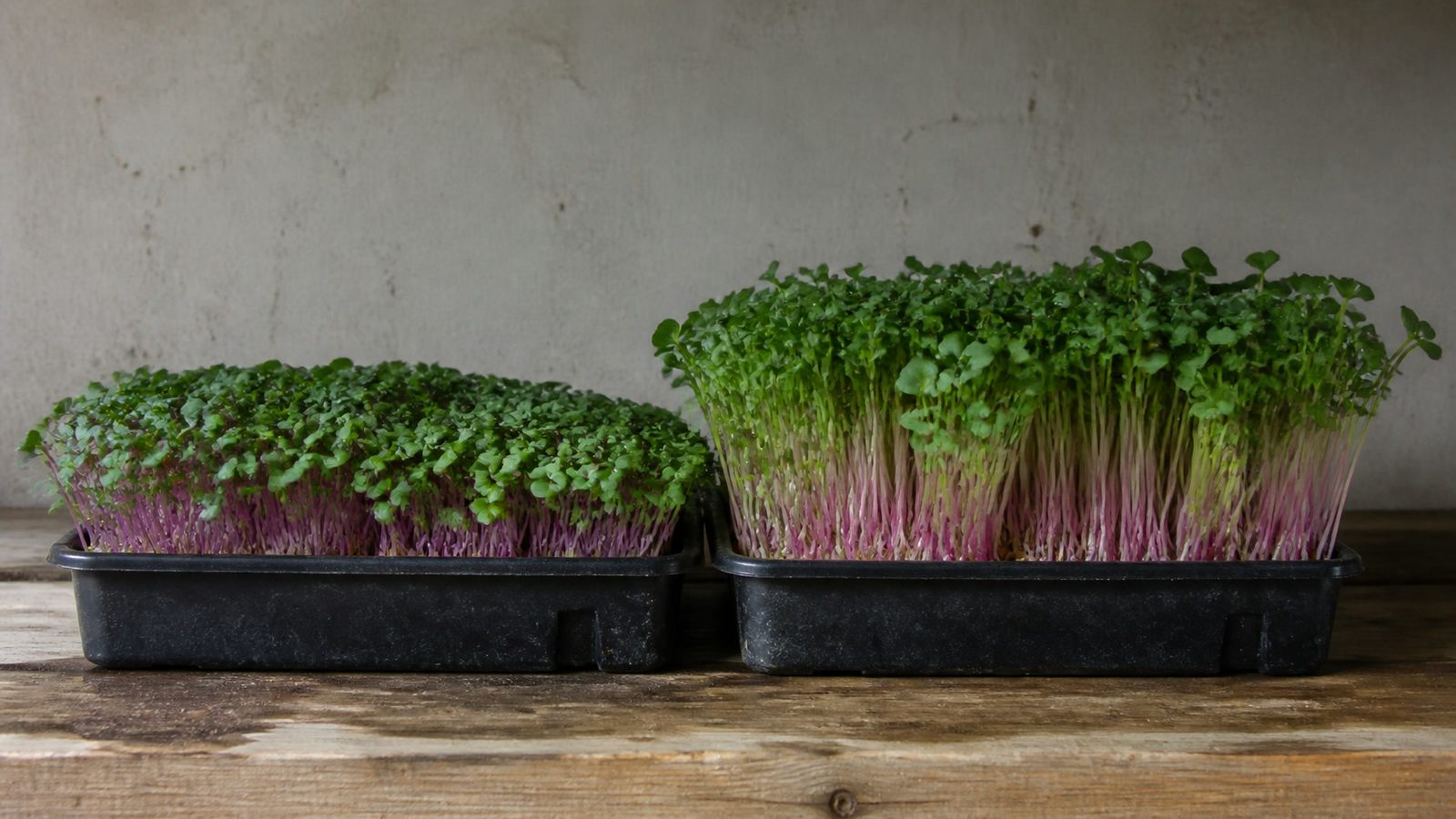
Your tray is ready and you are wondering whether another few days would be worth it. That is the question here. If you are still working out whether it is ready at all, that is the other page.
The honest headline is that the biggest published gain shrinks to almost nothing once you divide it by time.
Hover or tap a row to highlight it.
| The measurement | Figure |
|---|---|
| Mizuna fresh yield, first true leaf to second true leaf | 80.1 percent higher |
| What the crop cycle became | 7 days to 12 days |
| Trays through the same shelf, per unit time | 41.7 percent fewer |
| Yield per tray-day, which is what a shelf actually produces | 5.1 percent higher |
The first row and the last row are the same experiment. The 80.1 percent and the 7 to 12 day cycle are both published by Kyriacou and colleagues in 2021; the bottom row is arithmetic on those two numbers, and it is a calculation you can check rather than a figure anybody measured. Multiply the yield by the days: 1.801 times 7, divided by 12, is 1.051.
So, an eighty percent gain is a five percent gain, if your constraint is shelf space and time rather than seed. The authors say the same thing in their own words, that the trade has to be worked out genotype by genotype.
What to actually do
- Find your own plateau and stop there. In the one study that tested consecutive days, the gain ended on a specific day while the quality losses continued. One day past the plateau costs you something and buys nothing.
- Do the tray-day arithmetic before waiting for weight. Multiply the extra yield by the old cycle, divide by the new one. An 80 percent gain over five extra days was worth 5 percent.
- If seed is your constraint rather than space, wait. The arithmetic below assumes a shelf you want to turn over. A hobby grower with one tray and no schedule is buying the yield gain with time that costs nothing.
- If you sell on color, cut earlier than the weight says. Radish anthocyanins were 23 percent lower on day 11 than on day 9 while the tray was heavier.
- Do not choose a harvest day for nutrition. Some compounds rise, some fall, and nobody has published the total per tray for any of them.
- Distrust any bitterness or texture claim tied to a day, including the ones on the pages selling you seed. There is no sensory evidence behind any of it.
- Write down what your own crop did. Fifty-seven of the 62 crops here have no published window at all, so for most of what you grow your own notes are the best record that exists.
Where waiting genuinely pays, and where it stops
One controlled study cut the same crops on four consecutive days and measured what came out. USDA-ARS-linked work by Ortiz and colleagues grew Di Cicco broccoli and Rambo radish hydroponically, cutting broccoli on days 11 to 14 and radish on days 8 to 11.
Hover or tap a row to highlight it.
| Broccoli | Radish | |
|---|---|---|
| Best tested day | Day 13 | Day 10 |
| Against the earliest tested cut | 20 percent more yield | 20 percent more yield |
| One more day after that | No significant yield gain | No significant yield gain |
| Storage decay at 4°C | Least at the best day | Least at the best day |
| Chlorophyll | Rose, 0.62 to 0.75 mg/g at day 13 | |
| Antioxidant activity | Peaked at day 10, then fell | |
| Anthocyanins | Fell at day 11 |
Read the third row, because it is the one that decides the question. Waiting paid until a specific day and then stopped paying, while the quality measures kept falling. That is a plateau, not a slope, and it means the cost of waiting one day too long is real while the benefit is zero.
The radish anthocyanin series is the clearest trade in the literature. Across days 8, 9, 10 and 11 it ran 5,562, 5,748, 5,322 and 4,300 mg per kilogram. Yield was highest at the end of that run and pigment was lowest. If you sell radish on its color, the day that maximizes weight is not the day that maximizes what people are buying.
Nutrient concentration does not peak, and the total is unpublished
The claim that nutrients are most concentrated at first true leaf is repeated everywhere and the controlled record does not support it as a general rule. Different compounds move in different directions in the same experiment.
- Up. Total phenolics rose from cotyledon to one and a half true leaves by 57.8 percent in dill and 29.6 percent in chia. Broccoli chlorophyll rose through day 14.
- Down. Radish anthocyanins fell at day 11. Radish antioxidant activity fell after day 10.
- Barely at all. Total glucosinolates and phenolics were comparatively similar across broccoli days 11 to 14 and radish days 8 to 11.
And here is the gap that undoes most of what gets written about this. Every one of those studies reports chemistry as a CONCENTRATION, per gram of tissue. Not one reports the total per tray. A tray that is 20 percent heavier at a slightly lower concentration may contain more of a compound, less, or the same, and the arithmetic that would settle it needs matched yield and concentration in compatible units, which nobody has published.
So, a page telling you that waiting makes your crop more nutritious, or less, is telling you something that has not been measured. Concentration is not yield.
The published windows are one to four days long
This directory has a field for how long a crop stays at the right stage, and it is the emptiest field on the site.
Five of the 62 crops here have a number. Fifty-seven are unestablished. Where a number exists it is short:
Hover or tap a row to highlight it.
Set that against what the field publishes, which is "7 to 14 days". Those are two different quantities and they get used interchangeably. Seven to fourteen days is the range of dates on which a crop MIGHT be ready. The window is how long it STAYS ready once it is, and where anyone has measured it, the answer is one to four days.
Across the 61 crops here with a researched day range, the median range is 7 days wide. So the honest picture is a week of possible ready dates with a window of a day or two somewhere inside it, and for 57 crops nobody has published where.
Two of five pages examined give a numeric range at all, and zero of five publish a crop-specific validated window with measured endpoints.
What the extra days do not do, as far as anyone has measured
Bitterness. Two grower and supplier pages say crops past true leaf turn bitter, and one names radish and mustard as especially unforgiving. Both are practice. No sensory panel has ever compared the same crop at different harvest days. The panel work that exists compares different species on one day. The direction is plausible and the measurement does not exist.
Texture. No controlled harvest-age study has measured fiber, toughness, shear force or run a texture panel. The stems getting stringy is the most repeated claim on this subject and it is entirely untested.
Mold in a standing tray. No study measures preharvest tray age against disease incidence. The 2024 work measured decay after cutting, which is a different thing. Extension guidance on airflow and venting is sound and it is not evidence that an older tray molds more.
Collapse. No microgreen study defines or measures lodging by harvest age. The word is borrowed from cereal agronomy and it does not transfer to a dense tray.
All four of those are things you will read as facts. They may all be true. None of them has been measured.
What nobody has measured
- The total nutrient per tray at any harvest date, for any compound, in any crop. Every study reports concentration.
- A harvest window for 57 of the 62 crops in this directory.
- Flavor by harvest day, by any panel, in any crop.
- Texture, fiber or toughness by harvest day.
- Whether a standing tray held longer actually molds more.
- Dry matter from day 8 to day 14. The species comparison exists, at 38.55 g/kg fresh weight for broccoli to 94.34 for sunflower, but that is a comparison between crops rather than between days.
- The economics. No published trial prices bench space, lamp hours, water, labor or reject rate against harvest date, which is the calculation every commercial grower is actually making.
Terms on this page
Tap a term to see what it means.
Cotyledon. The seed leaf that emerges first and feeds early growth.
Sources
Opened 2026-08-12. The harvest window count, the day range spread and the tray-day arithmetic are this site's own, computed for this page on 2026-08-12 across the 62 crop entries here.
- Ortiz and colleagues, harvest stage in broccoli and radish microgreens, 2024 (PDF) - hydroponic Di Cicco broccoli cut days 11 to 14 and Rambo radish days 8 to 11, the 20 percent yield gain to day 13 and day 10, the absence of a significant further gain the following day, broccoli chlorophyll rising from 0.62 to 0.75 mg per gram fresh weight, radish antioxidant activity peaking at day 10, the radish anthocyanin series of 5,562, 5,748, 5,322 and 4,300 mg per kilogram across days 8 to 11, and the least visual decay at the best-tested day over 16 days of storage at 4°C.
- Kyriacou and colleagues, first against second true leaf in four brassica microgreens, 2021 - the 80.1 percent mizuna fresh yield increase, the crop cycle lengthening from 7 to 12 days, the 41.7 percent reduction in turnover, the finding that the cost and benefit must be worked genotype by genotype, and the largely genotype-dependent mineral and carotenoid results. The publisher page returned HTTP 429 and the PubMed record returned a CAPTCHA on direct open.
- Barut Gök and colleagues, cotyledon against 1.5 true leaves, 2024 and the article PDF - total phenolics rising 57.8 percent in dill and 29.6 percent in chia between the two stages, across dill, chia, garden cress, radish and red beet.
- Di Gioia and colleagues, 17 microgreen species, 2023 - dry matter at one commercial stage running from 38.55 g per kg fresh weight in broccoli to 94.34 in sunflower, average 56.90. A comparison between species rather than between harvest days, and used here only to show that the day comparison does not exist.
- Microgreens production review, 2024 - the sensory panel comparing six species at one stage, with flavor the strongest predictor of overall eating quality, which is the evidence that exists in place of a by-day panel.
- Microgreens review, 2025 - the broad 7 to 21 days after germination category reported in the wider literature in place of a validated window.
- USDA Agricultural Research, microgreens, 2014 - the description of microgreens as typically cut 7 to 14 days after germination with developed cotyledons before expanded true leaves, and the cotyledon and true leaf terminology used throughout this page.
- University of Maryland Extension, growing microgreens and baby greens indoors - airflow and venting guidance, used here as sound extension advice and explicitly not as evidence about tray age and mold.
- University of Nevada Extension - seed, water, temperature, humidity and handling as the food safety factors, used for the same distinction.
- Grower and supplier pages, used as practice only and as the source of the five-page audit: True Leaf Market's starter guide, which says crops grown beyond true leaves may develop a bitter flavor, and Wind River Greens on when to harvest, which claims later stems turn fibrous and bitter and names radish and mustard as especially unforgiving.
Keep reading
Growing guides
What one shelf actually produces, and the rack depth a 1020 really needs
The 48 by 18 inch rack recommended for four 1020s per shelf is 2 to 3 inches too shallow to hold one without overhang. A 16-position rack in 8 square feet returns about 8 ounces a day at a median crop rate.
Read What one shelf actually produces, and the rack depth a 1020 really needsGrowing guides
Do microgreens regrow after cutting?
A normal microgreen cut removes the growing point, so there is usually nothing left to regrow from. Roots do not make a new shoot; a surviving node does. The one documented path takes 3 to 4 weeks, about twice as long as sowing a fresh tray.
Read Do microgreens regrow after cutting?Growing guides
How fast do microgreens grow? Take the number from your crop, not from a general range
Of the 61 microgreen crops that publish a harvest range, only 15 fit entirely inside the usual 7 to 14 days. The real spread is 4 to 35 days, and the shelf cost between the fastest and slowest crop is 36.6-fold.
Read How fast do microgreens grow? Take the number from your crop, not from a general rangeGrowing guides
Do microgreens need fertilizer? It is worth 8 to 47 percent of the yield and up to 227 times the nitrate
In one peat trial, taking the feed away cost cabbage 7.9 percent of its yield and arugula 47.4 percent, while cutting nitrate in the cut crop by 98 to 227 fold. Feeding is the largest lever anyone has measured on either number.
Read Do microgreens need fertilizer? It is worth 8 to 47 percent of the yield and up to 227 times the nitrate