What one shelf actually produces, and the rack depth a 1020 really needs
Cal HewittPublished Checked
- method
- yield
- succession
- equipment
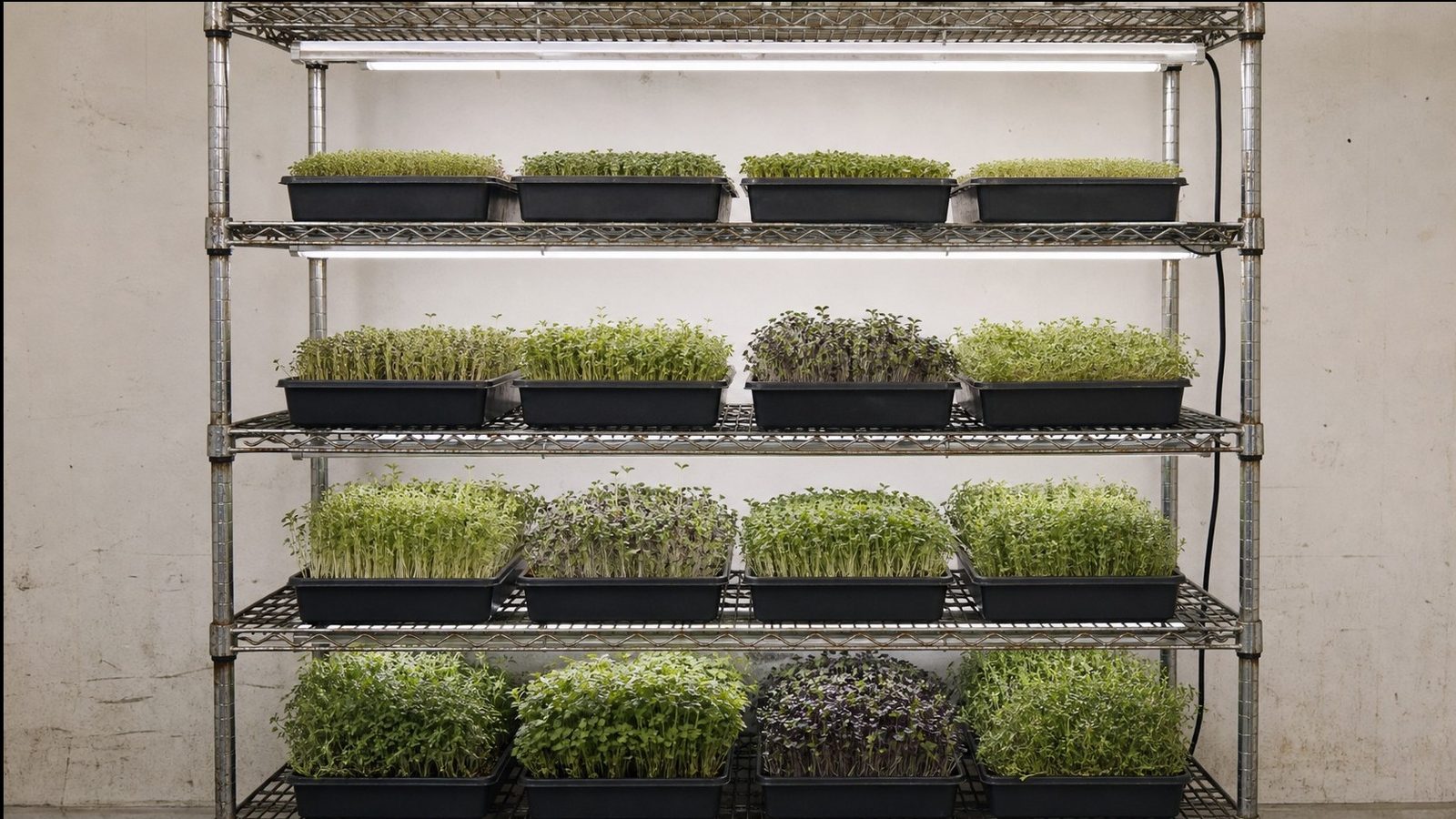
Start with the geometry, because the standard recommendation does not survive a tape measure.
A widely circulated commercial layout puts a 48 by 18 by 72 inch wire rack under four 1020 trays per shelf, with 12 inches between shelves and five growing tiers. Four trays across a 48 inch shelf works. Four nominal 10 inch tray widths is 40 inches, and even at a real measured outside width of 10.75 inches it is 43 inches. Both fit inside 48.
The depth does not. A 1020's other dimension is 20 inches nominal, and one supplier's measured outside footprint is 21.125 inches. On an 18 inch deep rack that overhangs the front or back edge by 2 inches at nominal and 3.1 inches at that measured size, on every tray, on every shelf.
Hover or tap a row to highlight it.
| Measurement | Figure | The question it answers |
|---|---|---|
| Measured outside footprint | 21.125 x 10.75 in, 227.1 in² | Will it physically sit on the shelf |
| Nominal growing rectangle | 10 x 20 in, 200 in², 1.389 ft² | What every published per-tray rate is written against |
| Measured inside floor | 187.6 to 192.6 in² | What actually holds medium and seed |
So, the tray is bigger than nominal on the outside and smaller than nominal on the inside, and the gap runs in opposite directions depending on which number you needed. There is more on the inside floor and what it does to a seeding rate in tray setup and drainage. This page is about the outside, because that is the number that decides whether the rack you bought fits the trays you own.
Measure the rack depth against your actual tray before buying either. A 24 inch deep rack takes a 1020 with room; an 18 inch one does not.
What to actually do
- Measure your rack depth against your actual tray before you buy either. The common 18 inch recommendation overhangs a 1020 by 2 to 3 inches.
- Plan at two tray positions per square foot as a starting figure, and treat it as a rack density rather than a room density. Nobody has published an aisle allowance.
- Compute your own shelf output as positions times your measured oz per tray-day. At the median rate, 16 positions is about 8 oz a day and 3.5 lb a week.
- Keep the blackout stage off the lit rack. It is the cheapest capacity you will ever add, and the model that splits the two shows exactly why.
- Give the wash station real space and real time. Ten minutes a tray is the only measured figure and it is two thirds of a whole tray's labor budget.
- Reverse-plan every crop separately from its delivery date. A 5.5 day spread across five crops means one sow day cannot serve them.
- Do not improvise a mix to simplify the schedule. Buy one formulated to finish together, or run the crops apart.
- Write the harvest stage on the schedule, not just the day. Three extension sources use three different definitions.
- Log seed, blackout in and out, rack in and out, harvest and wash complete. The reset column is the one nobody publishes and the one that limits your turnover.
What a shelf actually returns, in the unit that makes it comparable
The one extension budget that publishes a rack assumption uses a four level stainless unit at four 1020s per shelf: 16 growing positions, charged against 8 square feet.
That is two tray positions per square foot, which is the only defensible density figure in the reviewed literature, and it comes with a caveat the budget itself does not resolve: it never says whether those 8 square feet are floor footprint or allocated area, and it publishes no rack dimensions, aisle width or headroom.
To turn positions into output, use the tray-day. Across the 39 crops that publish both a harvest range and a yield, the median works out at 0.500 ounces per tray-day, as how fast do microgreens grow sets out.
Hover or tap a row to highlight it.
| Period | Output at 0.500 oz per tray-day |
|---|---|
| Per day | 8 oz |
| Per week | 3.5 lb |
| Per week, per square foot of the 8 ft² | 7 oz |
Sanity check that against the same budget's own yields, which run 8.0 to 15.0 ounces per 1020 across its five modeled crops. The median published tray is 7.055 oz, so the budget's range sits entirely above it. The budget is modeling better-than-median crops, which is what a planning budget should do and is also why its output numbers should not be read as a floor.
None of this is a labor figure. Labor and time per tray works through that from the same budget's 15 minutes per tray. What belongs here is one number that bears on space rather than wages: one documented operation measured about 10 minutes to wash a single tray, and longer after pea roots. That is two thirds of the entire 15 minute per tray allowance consumed by washing alone, which is why the wash station is a capacity constraint and not an afterthought.
Rack occupancy is not days to harvest
A tray does not sit in one place for its whole life, and planning as though it does overstates your capacity.
A peer reviewed vertical farm model splits the cycle explicitly: 7 days germination, then 7 days lit cultivation, then harvest. Its facility carries 126 tray positions across one cycle rather than simultaneously, which is the whole point. The germination stage can sit stacked in the dark on a fraction of the footprint; only the lit stage needs a tier with a fixture over it.
So, a rack with 16 lit positions supports more than 16 trays in flight, provided the blackout stage lives somewhere else. See the blackout period for what that stage is doing.
Track it as stages, not as a single date. Seed date, blackout in and out, lit rack in and out, harvest, wash complete, next sowing. The reset time between wash complete and next sowing is the column nobody publishes, and it is the one that decides whether a position turns over cleanly.
Shelf pitch follows the fixture, not a rule. UC ANR puts fluorescent and specialized grow lights 6 to 12 inches above the greens unless the maker says otherwise. Virginia Tech specifies the light at the canopy instead, at a general daily light integral of 9 to 16 mol per m² per day, with its own facility running about 250 µmol per m² per second for 18 hours. Those are not in conflict, they are different instructions: one sets a distance, the other sets an intensity at the leaf. The 12 inch shelf spacing in the commercial layout is a proposal from a supplier, not a measured clearance. See lighting.
Succession: nobody publishes an interval, and one rhythm cannot serve five crops
Succession sowing is well documented as a principle and completely unspecified for microgreens. Extension sources say regular interval planting gives a continuous harvest, and that staggered sowings or different maturity dates keep supply going. No reviewed source prescribes "sow every X days" for this crop.
It cannot, because the crops finish on different days. The same budget models radish at 8.0 days, cabbage at 10.0, pea at 11.5, broccoli at 12.5 and a mix at 13.5. A separate commercial sequence records arugula at 12 days seed to harvest, made of 3 to 4 stacked germination days and four more in blackout.
Across just those five modeled crops the spread is 5.5 days. Force them all onto a Monday sow and they land across most of a week. Reverse-plan each crop from its own delivery date instead, using its own documented harvest range from the directory, and the arithmetic is: committed weekly quantity divided by your measured yield per tray, placed backward from the delivery day, plus your own reset capacity.
Do not solve it by mixing species in one tray. Maryland cautions against it directly because germination and growth rates differ, and UC ANR notes that commercial mixes are formulated to sprout together. A mix is a product someone designed, not a shortcut you can improvise, and the same budget treats its mix as the slowest thing it grows at 13.5 days.
And say which harvest stage you mean, or the schedule is meaningless. Maryland puts microgreens at 2 to 3 inches, 7 to 21 days and baby greens at 4 to 6 inches, 21 to 40 days. Kentucky specifies first true leaf at 1.5 to 2 inches, many crops at 7 to 14 days. UC ANR says first true leaves at 2 to 4 inches. Three reputable sources, three different finish lines, which is the same problem the how fast page documents and the reason a "10 day crop" is not a comparable unit.
What nobody has measured
- An aisle or access allowance for a microgreen rack, so no defensible pounds per floor square foot exists.
- A trays-per-worker capacity. One budget assumes 15 minutes a tray without naming tasks; one operation measured its own wash at 10.
- Reset time between a washed tray and the next sowing.
- A succession interval for any crop, which is why it has to be computed backward from your own committed quantity.
- Large infrequent sowings against small frequent ones at equal weekly demand, measuring labor, spoilage, failure and margin.
- Whether the 8 square feet in the one published budget is floor footprint or allocated area.
Terms on this page
Tap a term to see what it means.
Tray position. One slot on a rack that can hold one tray. The unit space is planned in, distinct from the number of trays in flight.
Sources
Opened 2026-08-11. The overhang arithmetic, the two-positions-per-square-foot density and the output table are computed from the published figures and shown in full so they can be checked. The 0.500 oz per tray-day median and the 7.055 oz median tray were computed from the published days-to-harvest and yield figures across all 62 crops. Labor is owned by this site's labor and time per tray guide and is not re-derived here.
- University of Missouri Extension, microgreens enterprise budget (PDF) - a four level stainless shelf unit at four 1020 trays per shelf for 16 growing positions with four lights and four fans, 8 square feet of greenhouse infrastructure charged, 15 minutes of labor per tray, modeled yields of 8.0 to 15.0 ounces per 1020, and modeled harvest days of 8.0 for radish, 10.0 cabbage, 11.5 pea, 12.5 broccoli and 13.5 for a mix. No rack dimensions, aisle width or headroom are published.
- Scientific Reports, vertical farm lifecycle model, 2023 - an explicit 7 days germination plus 7 days lit cultivation split, 126 tray positions across one plant growth cycle rather than simultaneously, and cleaning included at seeding, harvest and packaging without a time attached.
- Farm Garden Trust, controlled environment agriculture report, 2021 (PDF) - one aeroponic microgreen operation washing each tray in about 10 minutes and sometimes longer, especially after pea roots, alongside about 30 minutes to seed its germination trays and about an hour for a harvest.
- University of Maryland Extension, growing microgreens and baby greens indoors - microgreens defined at 2 to 3 inches and 7 to 21 days against baby greens at 4 to 6 inches and 21 to 40 days, the caution not to mix species because germination and growth rates differ, and soaking of pea, sunflower, corn, chickpea, beet, chard, cilantro, mung bean or buckwheat seed for 6 to 12 hours to accelerate germination.
- University of Kentucky Extension, microgreens (PDF) - first true leaf stage at 1.5 to 2 inches with many crops at 7 to 14 days, continuous succession described as necessary given the short turnaround, and labor identified as varying considerably by system and scale with harvest and handling the most intensive steps.
- UC Agriculture and Natural Resources, growing microgreens - fluorescent and specialized grow lights placed 6 to 12 inches above the greens unless the fixture maker specifies otherwise, harvest at first true leaves and 2 to 4 inches, and that commercial mixes are formulated to sprout at the same time.
- Virginia Cooperative Extension, introduction to microgreen production - a general daily light integral of 9 to 16 mol per m² per day with its own center running about 250 µmol per m² per second for 18 hours, substrate preparation and moistening before sowing, covers and blackout for species that benefit, cleaning between cycles, and the instruction to let market feedback adjust crop choice and timing.
- University of Missouri Extension, succession sowing - regular interval planting as the mechanism for a continuous harvest.
- Cornell Cooperative Extension, succession planting - staggered sowings or differing maturity dates as the way to make supply continuous.
- Paperpot Co., arugula microgreens growers notes (PDF) - practice from a supplier: a 48 by 18 by 72 inch NSF wire rack described as fitting four 1020s per shelf, 12 inches between shelves for five growing shelves on a six shelf rack, an arugula sequence of 3 to 4 stacked germination days plus four more in blackout to a 12 day seed to harvest target, stopping watering 24 to 48 hours before harvest, and dumping, rinsing, sanitizing and drying trays afterward. The figures are attributed to Scintilla Farms and scaled by a seller.
- SunBlaster, microgreen trays and domes - manufacturer specification: 10 by 20 inches described as the greenhouse industry standard tray size, with a shallow tray at 10 x 20 x 1.25 inches.
- Optimize Organics, 1020 microgreen tray - manufacturer specification read 2026-08-11: a nominal 1020 measuring 21.125 by 10.75 by 1.25 inches across the top, which is the 227.1 square inch external footprint used in the overhang arithmetic above.
Keep reading
Growing guides
Day 8 against day 14: what you are actually trading by waiting
The largest yield gain in the harvest-stage literature is 80.1 percent. Divide it by the five extra days it cost and it is worth 5.1 percent. Nutrient concentration does not peak; some compounds rise, some fall, and nobody reports the total per tray.
Read Day 8 against day 14: what you are actually trading by waitingGrowing guides
Do microgreens need fertilizer? It is worth 8 to 47 percent of the yield and up to 227 times the nitrate
In one peat trial, taking the feed away cost cabbage 7.9 percent of its yield and arugula 47.4 percent, while cutting nitrate in the cut crop by 98 to 227 fold. Feeding is the largest lever anyone has measured on either number.
Read Do microgreens need fertilizer? It is worth 8 to 47 percent of the yield and up to 227 times the nitrateGrowing guides
Do microgreens regrow after cutting?
A normal microgreen cut removes the growing point, so there is usually nothing left to regrow from. Roots do not make a new shoot; a surviving node does. The one documented path takes 3 to 4 weeks, about twice as long as sowing a fresh tray.
Read Do microgreens regrow after cutting?Growing guides
Growing a mix: one blend has a one-day harvest window and another keeps for three days
One commercial brassica blend's five components overlap on exactly one harvest day, and a three-crop spicy blend keeps only 2 to 3 days because of its cress, while another component lasts 14.
Read Growing a mix: one blend has a one-day harvest window and another keeps for three days