Growing Microgreens for Profit: A Weekly Production Plan
Cal HewittPublished Checked
- selling microgreens
- business planning
- economics
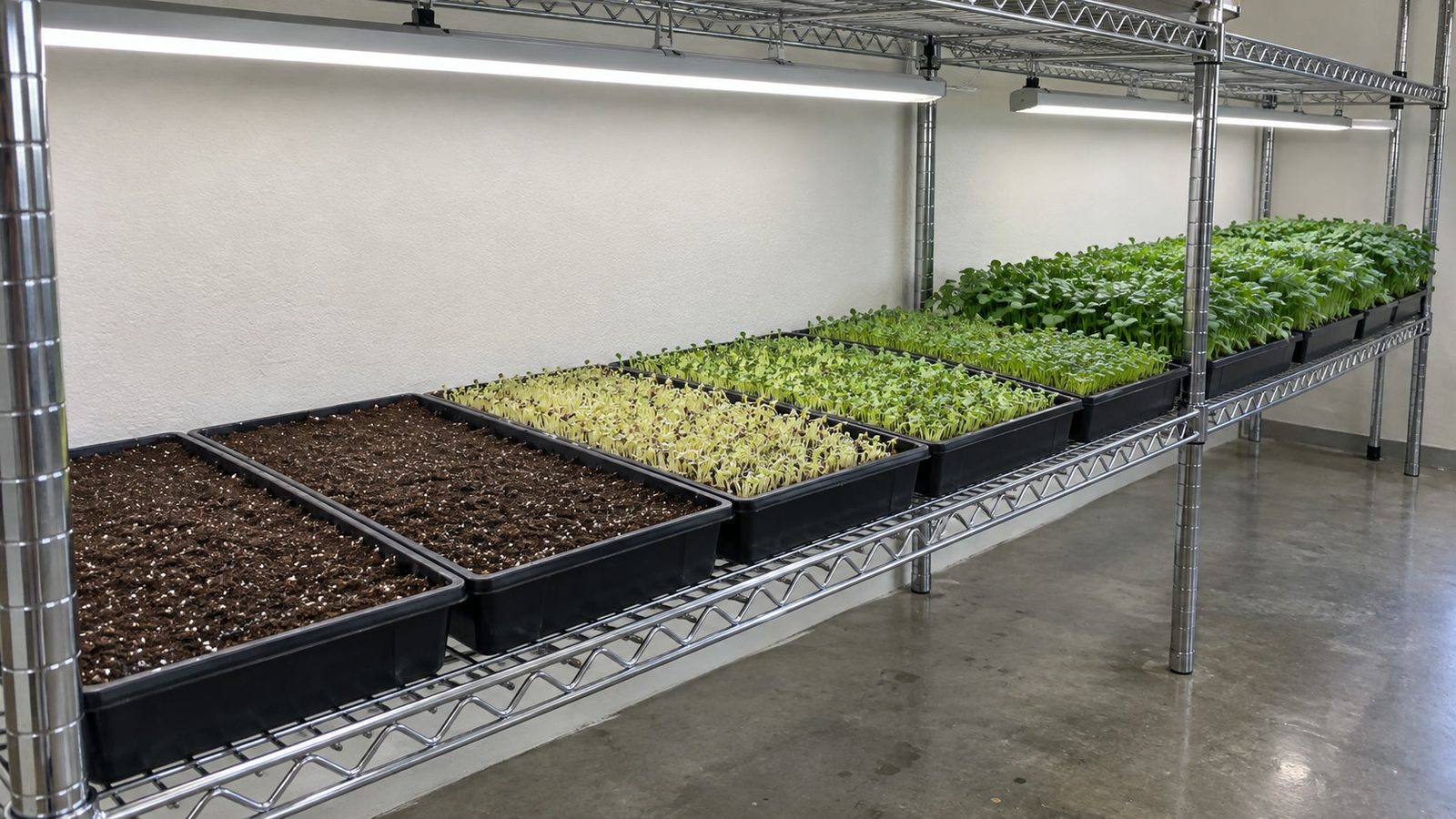
Take your standing weekly order and turn it into trays by crop, using a measured yield per tray and rounding up. Add a buffer sized from the trays you've lost before, then run the same weekly rhythm of sowing, harvest, cooling and delivery so the crop is cold and packed on delivery day.
At Penn State Extension's measured yield, a 1 lb weekly order of arugula takes 4 trays and a 5 lb order takes 16, before any buffer. The sections below work that out crop by crop, set the week, and name the records that make next week's count closer. Whether the order pays is a separate question, covered in are microgreens profitable.
Start with grams per tray
Every tray count starts from the grams of saleable greens a tray gives you. Until you have your own weights, borrow a measured figure and note how it was grown.
The most directly comparable set comes from Penn State Extension. Over 2016 to 17, it grew crops in a greenhouse without supplemental light, sowing 10 to 15 g of seed in a 12 x 20 in 10-row seeding tray on a two-week cycle, and averaged 147.6 g a tray of arugula, 164.5 g of basil, 46.8 g of cilantro, 154.6 g of Russian kale, 117.9 g of Toscano kale, 201 g of Red Rain mustard and 121.8 g of Daikon radish.
Note the tray. It is 12 x 20 in, not the 10 x 20 in flat many growers sow. If your trays are 10 x 20 in, or you grow under lights, treat these yields as a starting point and replace them with your own tray weights as soon as you have them.
Trays per order, crop by crop
A pound is 453.6 g and 5 lb is 2,268 g. Divide the order weight by the grams per tray, then round up to a whole tray, because a part tray can't be sown and rounding down leaves the order short.
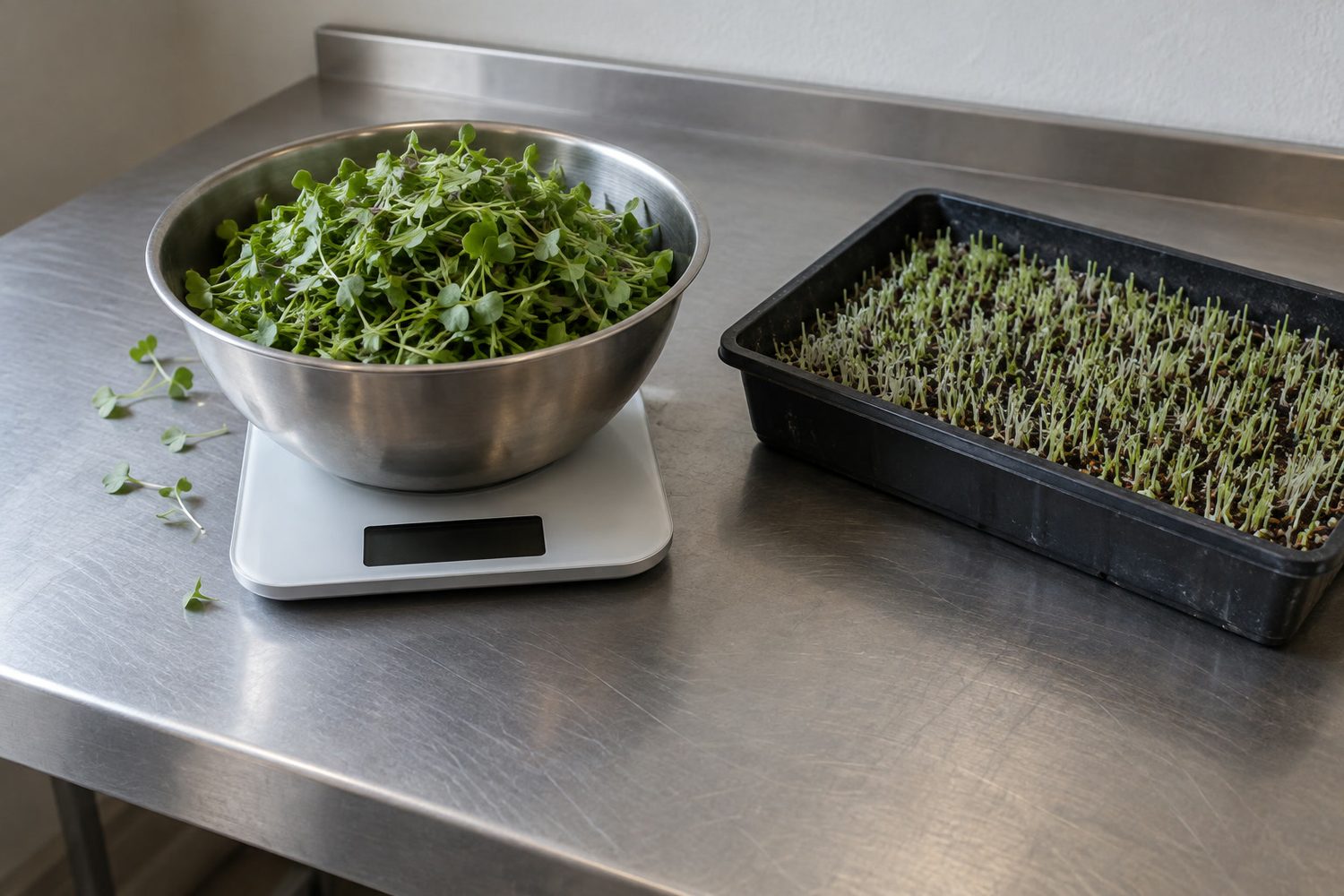
For arugula, 453.6 ÷ 147.6 = 3.07, which rounds up to 4 trays for a 1 lb order. For 5 lb, 2,268 ÷ 147.6 = 15.37, which rounds up to 16 trays. The same division gives every row below. These are trays before any buffer.
Hover or tap a row to highlight it.
| Crop | Penn State yield per tray | 1 lb order (453.6 g) | Trays to sow | 5 lb order (2,268 g) | Trays to sow |
|---|---|---|---|---|---|
| Arugula | 147.6 g | 3.07 | 4 | 15.37 | 16 |
| Basil | 164.5 g | 2.76 | 3 | 13.79 | 14 |
| Cilantro | 46.8 g | 9.69 | 10 | 48.46 | 49 |
| Russian kale | 154.6 g | 2.93 | 3 | 14.67 | 15 |
| Toscano kale | 117.9 g | 3.85 | 4 | 19.24 | 20 |
| Red Rain mustard | 201 g | 2.26 | 3 | 11.28 | 12 |
| Daikon radish | 121.8 g | 3.72 | 4 | 18.62 | 19 |
At 46.8 g a tray, cilantro ties up 49 trays for a 5 lb order, so check its shelf space before you accept a large standing order. Crop choice itself is covered in which crops to sell.
Crops grown on other protocols
Broccoli and pea shoots have published tray yields too, but each comes from a different trial with its own tray and seed rate, so keep them in their own column and never mix them into the Penn State table.
Johnny's 2017 greenhouse trial in Maine grew broccoli at 11.5 oz a tray from 13 g of seed, in a "1020 flat" whose dimensions it did not state (Johnny's trial chart). A 1 lb order is 16 oz, and 16 ÷ 11.5 = 1.39, so sow 2 trays. For 5 lb, 80 ÷ 11.5 = 6.96, so sow 7.
For pea shoots, one farm's grant report gives a figure. Fat Peach Farm in Madbury, New Hampshire, working with UNH Cooperative Extension in winter 2020 to 21, grew 17.28 oz of pea shoots on a stated 10 x 20 in tray from 6.8 oz of seed soaked for 8 hours (SARE FNE20-966). That works out to 1 tray for a 1 lb order and 5 trays for 5 lb.
No sunflower yield measured on a stated tray at a stated seed rate has been published. Sow a few trays at your own rate, weigh what you cut, and set your count from those weights.
The same crop can come in very differently from one protocol to the next. Johnny's Daikon radish averaged 8 oz (227 g) a tray against Penn State's 121.8 g. At Johnny's figure a 1 lb radish order needs 2 trays; at Penn State's it needs 4. A tray count only holds when the source's seed rate, tray and growing conditions match yours. For yield per shelf area and succession, see yield, space and succession.
Sizing your sowing buffer
Sow a little extra, and record for each crop what you lose to failed trays and to yellow leaves, hulls and damaged stems. Set your buffer from those records.
Two growers describe how they handle it. ECO City Farms in 2015 expected 4 lb of radish seed to yield 15 lb of microgreens, but sowed 5 lb "for security," which is 25% more seed (ECO City Farms guide). That is one farm's seed margin on one crop, not a rule for saleable weight. Food Peddlers, describing its system in 2019, says it always sows more than it needs, rounds tray counts up to multiples of three to match its stack size, and slows crops that come ready early by holding them in a walk-in cooler (Food Peddlers interview).
To size your own, log every tray sown and every tray that failed or came up short, by crop. Divide failed trays by trays sown over your last several weeks to get a failure share, then divide the order's tray count by the share that succeeds. Say your log shows 2 failed radish trays out of the last 20. That is a 10% failure share, so 90% succeed, and a 5 lb order's 19 trays ÷ 0.9 = 21.1, which rounds up to 22.
Once you have a few weeks of saleable weight per tray for a crop, use that number in place of the published yield. It already folds in short trays and grade-out, so the buffer you add on top can be smaller.
Timing the sow so harvest lands on delivery day
Work backward from delivery. Start with the delivery day, step back to the harvest and cooling day before it, then subtract the crop's growing days, including covered or blackout time, and one more day for crops that need a soak.
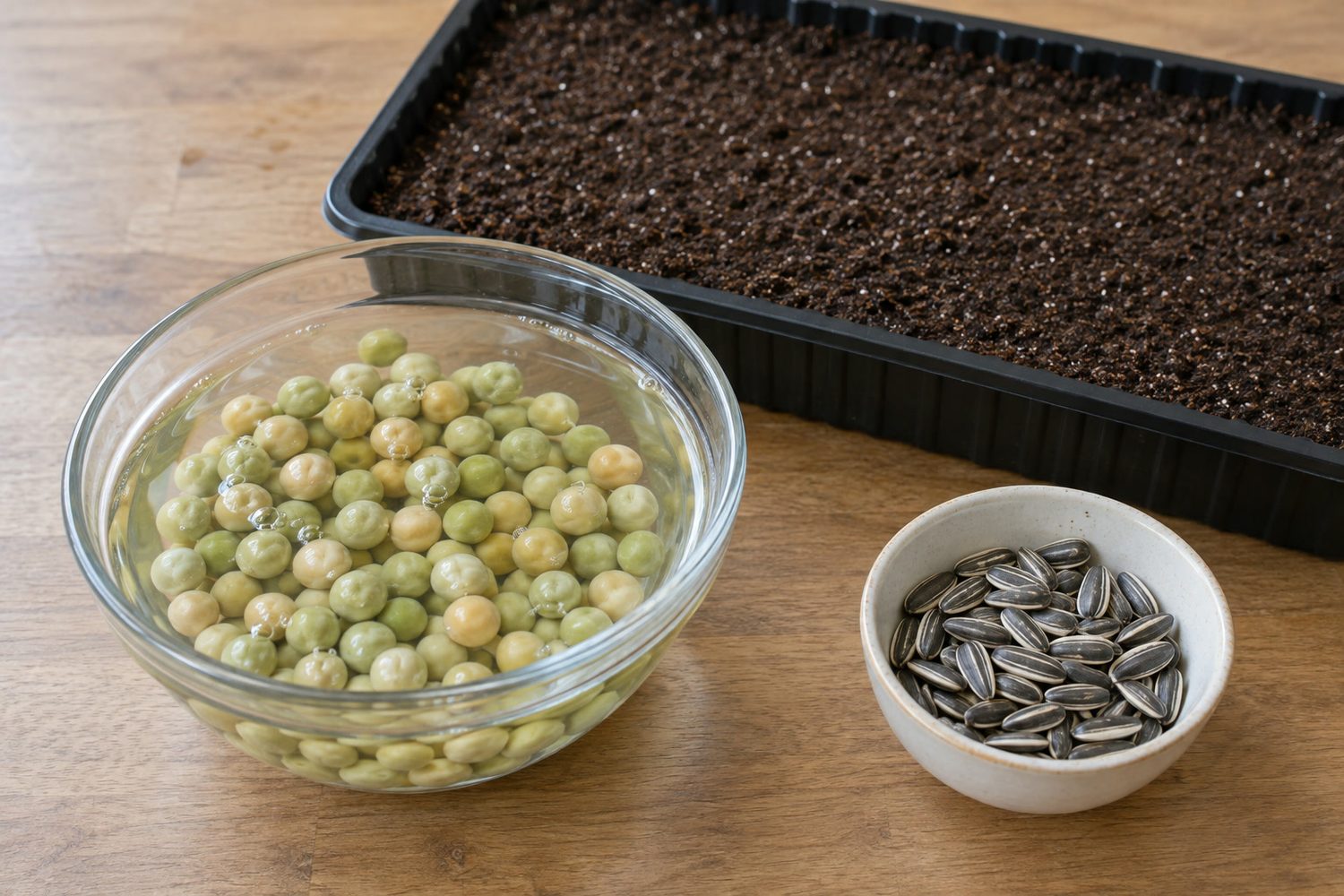
For growing days, USU Extension lists harvest windows on a 1020 tray at set temperatures: arugula 6 to 8 days, radish 8 to 12 days, pea 8 to 10 days after a 6-hour presoak, sunflower 9 to 10 days, basil 12 to 16 days and cilantro 21 to 28 days. Your room will shift those. ECO City Farms' hoophouse went from 5 to 7 days between seeding and harvest to 11 to 14 days over October and November 2015, and Food Peddlers (2019) keeps its harvest days fixed and moves sow dates closer when warm weather speeds growth.
Write the sow day for each crop next to its tray count; crops sharing a delivery will have different sow days.
A working week, two ways
Neither is a universal calendar, but both are built around fixed pickup and harvest days.
ECO City Farms sold 8 oz bags to a produce distributor that picked up weekly. In summer 2015 it seeded on Wednesday, harvested on Monday or Tuesday, and had the crop packed for pickup the next day. From fall, as growing days stretched, it began seeding twice a week. During a heat-mat installation in late 2015 it told the distributor it would supply only every other week; that schedule was temporary, and weekly pickup was the normal arrangement (ECO City Farms guide).
Food Peddlers, in 2019, harvested on Tuesday and Friday, did most of its sowing on Monday with some on Tuesday, and noted that soaking peas can need a Sunday visit (Food Peddlers interview).
Pick your delivery days first, set harvest the day before or the morning of each delivery, and let each crop's growing days place its sow day. Put soak days on the calendar too; they are the ones that land on a weekend.
Cooling and holding until pickup
Get the crop cold as soon as it is cut and packed. Penn State recommends dark storage at 41°F (5°C), says microgreens ideally go to market right after harvest, and reports that dark storage at 41°F can extend shelf life to as much as 10 to 14 days, against 2 to 4 days at room conditions (Penn State). ECO City Farms' distributor asked for the greens to be stored at 38 degrees after harvest and before pickup.
Crop-by-crop shelf life is published for only some crops, and Virginia Cooperative Extension notes the ideal storage temperature can vary by species. Don't promise a customer a number of days for a crop you haven't held and checked yourself. Handling after harvest is covered in how to store microgreens.
Harvest and packing time
Harvest labor decides how many trays you can cut before delivery. The Fat Peach Farm report (2020 to 21) names harvest and packing as its biggest variable cost, at 15 minutes per microgreen tray and 5 minutes per pea shoot tray (SARE FNE20-966). At that rate, the 16 arugula trays for a 5 lb order take 4 hours. Penn State's course estimate on its 12 x 20 in tray is faster: 4.0 minutes a tray to harvest with scissors, 1.3 minutes with electric clippers, and 1.7 minutes a tray for packing and distribution.
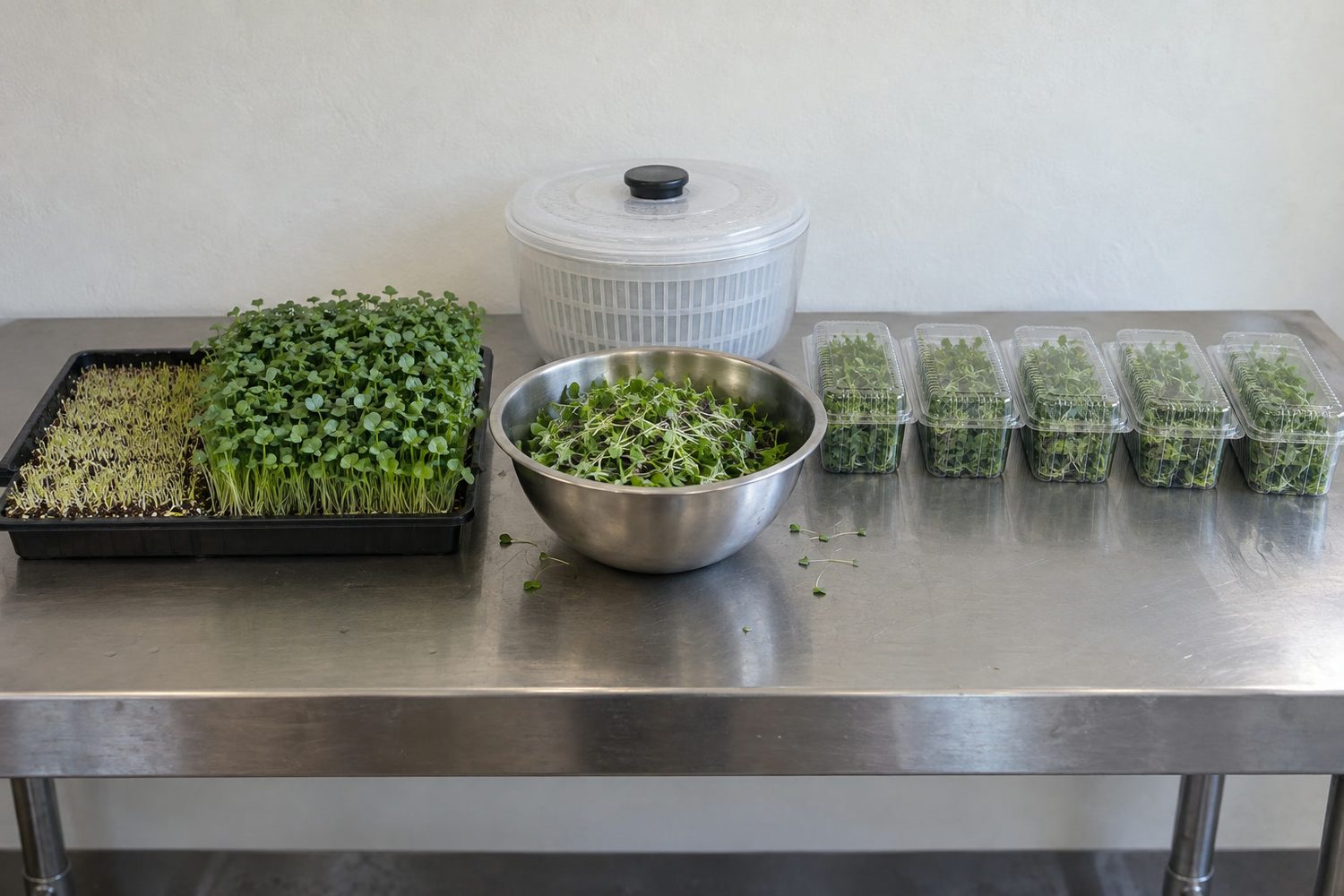
Time your own harvest for a few weeks and put the minutes in your log. The rest of the labor picture is in labor and time per tray.
What to write down each week
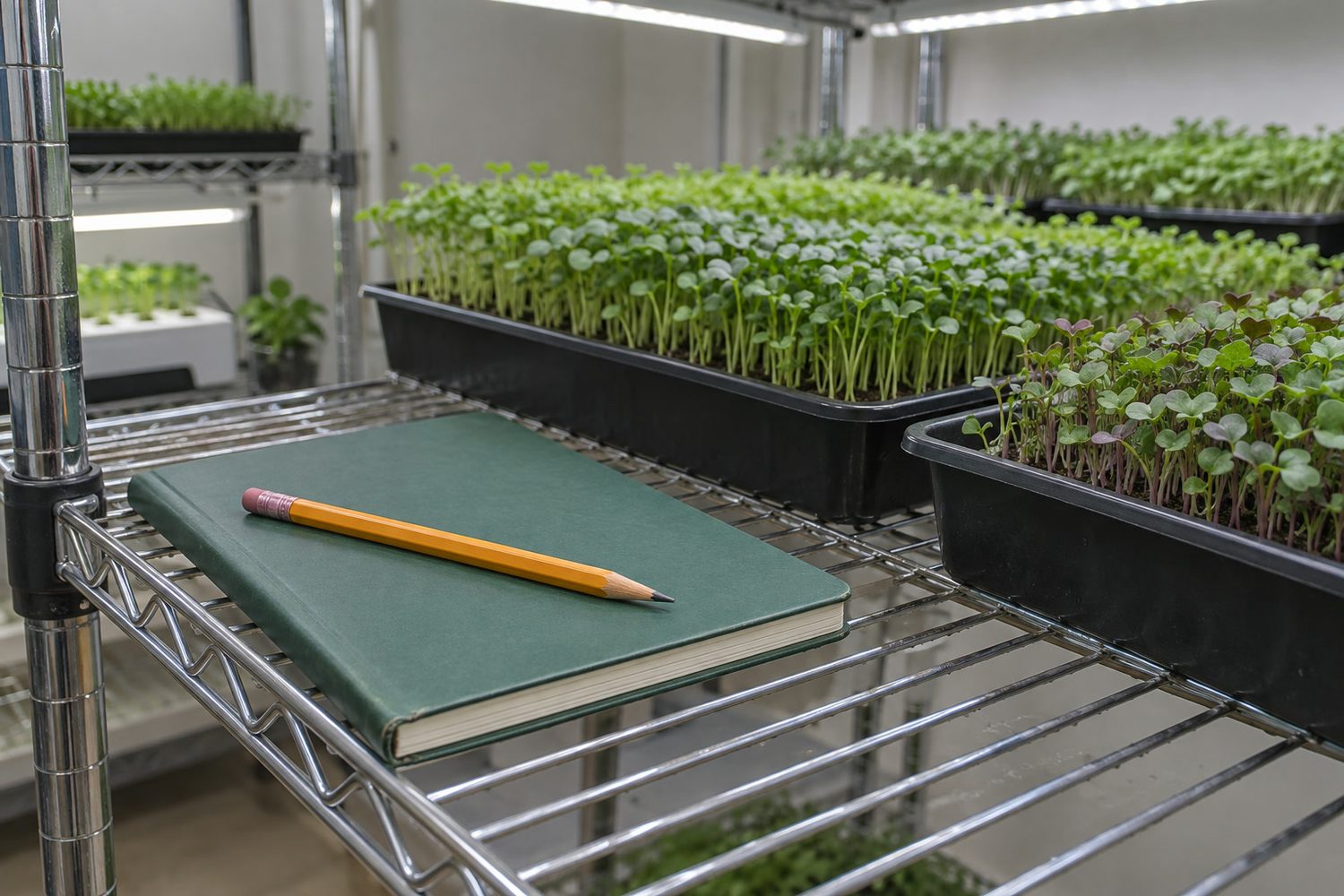
A production log is what turns borrowed yields into your own. For every tray, record the sow date, crop, seed lot, tray and media, seed amount, harvest date and harvest weight, pack date and customer, plus any loss and its cause. ECO City Farms logged seeding date, media, tray size, number of trays, applied heat, seed quantity, harvest yield and harvest date, and used those notes to troubleshoot in 2015. Food Peddlers (2019) updates the yield in its planning sheet when tray weights differ from it after a few weeks.
That log is good practice, not a federal requirement. Under the FDA Produce Safety Rule, a farm averaging $25,000 or less a year in produce sales over the previous three years, adjusted for inflation, is not a covered farm, and a farm with the qualified exemption keeps mainly records showing it is eligible (21 CFR Part 112). No federal rule requires sowing or yield logs. Your coverage depends on your own sales, so confirm it with FDA or your state's produce safety program.
Planning tools and their prices
A spreadsheet with customers as rows and crops as columns is enough to start; that is how Food Peddlers described turning orders into sow dates in 2019. If you want software, these are the vendors' own offers as displayed on September 13, 2026:
- Microgreen Manager offers Hobby at $0 (20 manual plantings a month, no orders), Startup at $15 a month and Pro at $25 a month with unlimited orders and plantings; the vendor says annual billing saves 17%.
- Tend offers a free plan, Pro at $30 a month and Ultimate at $75 a month, with lot traceability, orders and harvest planning on Pro; Tend says it is in beta.
- Farmbrite, per its own pricing page, offers Grower plans for crop-only farms at $29 a month or $290 a year, and $39 a month or $390 a year with orders, invoicing and pick-lists added. It is general farm software, not built for microgreens.
Reading your records before you expand
What can limit a small operation is shelf space, light, cooler space, harvest labor and delivery time. Your own records show which binds first, and that is what should trigger a second rack, a dedicated room or a hire.
In 2020 to 21, Fat Peach Farm planned 24 trays a week with 48 in production, fit only 36 tray positions once cords and plugs were accounted for, and found the room ran well above its 75 to 78°F range with all lights on (SARE FNE20-966). That is shelf space and light binding at once. ECO City Farms, as fall growing days lengthened in 2015, added bed area and moved to seeding twice a week to keep up with its orders.
Be careful counting rack turns from a budget. Missouri Extension's G693 budget assumes a tray position is resown the day it is harvested, all year, so its cycles equal 365 divided by growing days: radish at 8.0 days runs 46 cycles, and a microgreen mix at 13.5 days runs 27 (G693). That leaves no idle days, blackout staging or failed trays. Its yield and day pairs match Johnny's 2017 averages, though G693 names no yield source. Count your own turns from your log instead.
Each week, jot down shelf slots used, cooler space and temperature, harvest minutes, delivery minutes, and any order that went out short or late. The column that fills first is your next addition. Starting-out decisions sit in starting a microgreens business, and margins in profit and margins.
Frequently asked questions
These cover points that come up once the weekly plan is running.
Should I sow the same extra for every season?
No. Food Peddlers said in 2019 that winter prompts it to over-sow, and in summer it moves sow dates closer because crops grow faster. It also notes sunflower can pass from perfect to poor in a single summer day, so watch its harvest day closely.
How densely should I sow to hit a tray yield?
Johnny's says small seed is commonly sown at 10 to 12 seeds per square inch and medium or large seed at 6 to 8, and warns that overly dense sowing cuts airflow and raises disease risk. Penn State adds that lower seeding rates are generally used in summer than in winter.
Can I reuse growing media between cycles?
Penn State says media can be reused, but new media each cycle is better for keeping disease down. University of Maryland Extension suggests either fresh medium or a 50:50 mix of screened old and new.
What should go on a packed order's label?
In 2015, ECO City Farms' distributor required a label with the harvest date and lot. Its lot sheet also carried the packed date, bag size, quantity, buyer and pickup date, which ties each bag back to your production log. Recurring delivery setups are covered in subscriptions and delivery.
Next week's sow
Write down each crop on the order, its weight, and grams per tray from your log or the closest matching published figure. Divide, round up, add your buffer, and mark the sow day by counting back from delivery. After harvest, weigh the trays and put the numbers in the log, so the following week starts from your own yields.
Sources
Prices, stock and specifications are as the linked pages showed them on 2026-09-13.
Keep reading
The journal
Buying a Microgreens Business for Sale: What to Check First
Thinking about a microgreens business for sale? Learn how sellers state cash flow, what SBA loans require in 2026, and what to check before you buy.
Read Buying a Microgreens Business for Sale: What to Check FirstThe journal
How to Write a Microgreens Business Plan Step by Step
Build your microgreens business plan section by section, from executive summary to financial plan, with startup costs itemized by scale and source.
Read How to Write a Microgreens Business Plan Step by StepThe journal
Microgreen Growers Insurance: Costs, Limits and Markets
Selling microgreens at a market or restaurant? See what microgreen growers insurance covers, who requires it, and what policies cost by limit, state and year.
Read Microgreen Growers Insurance: Costs, Limits and MarketsThe journal
Microgreens Business Startup Costs Before Your First Sale
Microgreens business startup costs, from extension enterprise budgets to insurance rates and per-tray supplies, broken down by starter and commercial scale.
Read Microgreens Business Startup Costs Before Your First Sale