Are Microgreens Profitable? What the Numbers Show
Cal HewittPublished Checked
- selling microgreens
- economics
- business planning
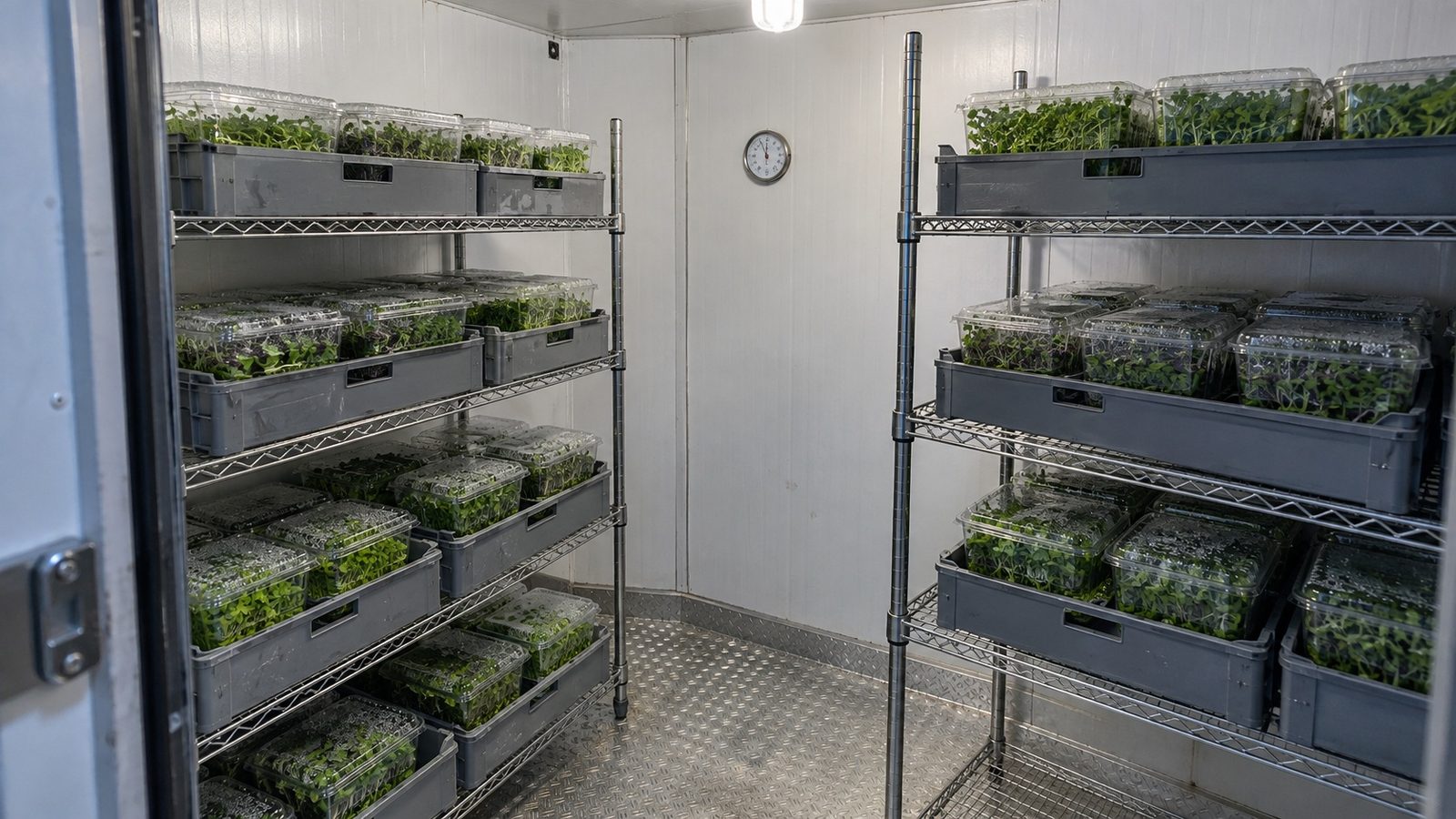
Some small microgreen operations make money and many bring in modest sales. The national figures count revenue, not profit after paying for your own labor. In a survey published in January 2021, 99 of the 124 growers who picked a revenue bracket reported under $10,000 a year in gross microgreen revenue.
Individual growers who have posted their numbers range from about $150 a week in gross sales on 20 to 25 trays to $75,000 in a year on 130 trays a week. Whether your operation is profitable comes down to a calculation you run on your own costs and hours, laid out at the end.
Gross revenue, profit and net return are different numbers
Gross revenue is the money customers paid before anything came out of it. Profit is what's left after seed, growing media, packaging, lights, electricity, water, delivery, market fees and the equipment you bought to start. Net return goes one step further and also charges your own hours at a wage, because the time you spend seeding, harvesting and making deliveries is time you aren't paid for anywhere else.
Weekly sales of $150 can be a good return on a spare room or a poor one, depending on the costs and hours behind it. Keep the three terms separate as you read the figures below, because each source uses only one of them.
What the national grower survey shows: revenue brackets, not profit
Misra and Gibson's survey, published in January 2021, is a national survey of US microgreen growers, and on income it asked about gross revenue only. It didn't ask about profit, net income or whether growers paid themselves. It collected 176 responses between October 2018 and March 2019, recruited through online groups, supplier lists and LocalHarvest, so it's a convenience sample of growers who chose to answer rather than a count of everyone selling.
Of the 124 respondents who chose a revenue bracket, the answers fell like this:
Hover or tap a row to highlight it.
| Annual gross microgreen revenue | Growers |
|---|---|
| Under $5,000 | 71 |
| $5,000 to $9,999 | 28 |
| $10,000 to $24,999 | 10 |
| $25,000 to $49,999 | 9 |
| Above $50,000 | 6 |
That puts 99 of the 124 under $10,000 a year in gross sales, before any costs came out. Because the survey never asked about expenses, it can't tell you how many of them made money.
What the 2024 federal census counts, and who it leaves out
The 2024 Census of Horticultural Specialties, issued by USDA in February 2026 and covering calendar year 2024, lists microgreens as their own crop. It counts 516 operations nationwide with 2.924 million square feet under protection and $86.378 million in microgreen sales, made up of $77.070 million wholesale and $9.309 million retail (USDA NASS, Table 15). Divided out, that's an average of about 5,667 square feet and $167,399 in microgreen sales per operation.
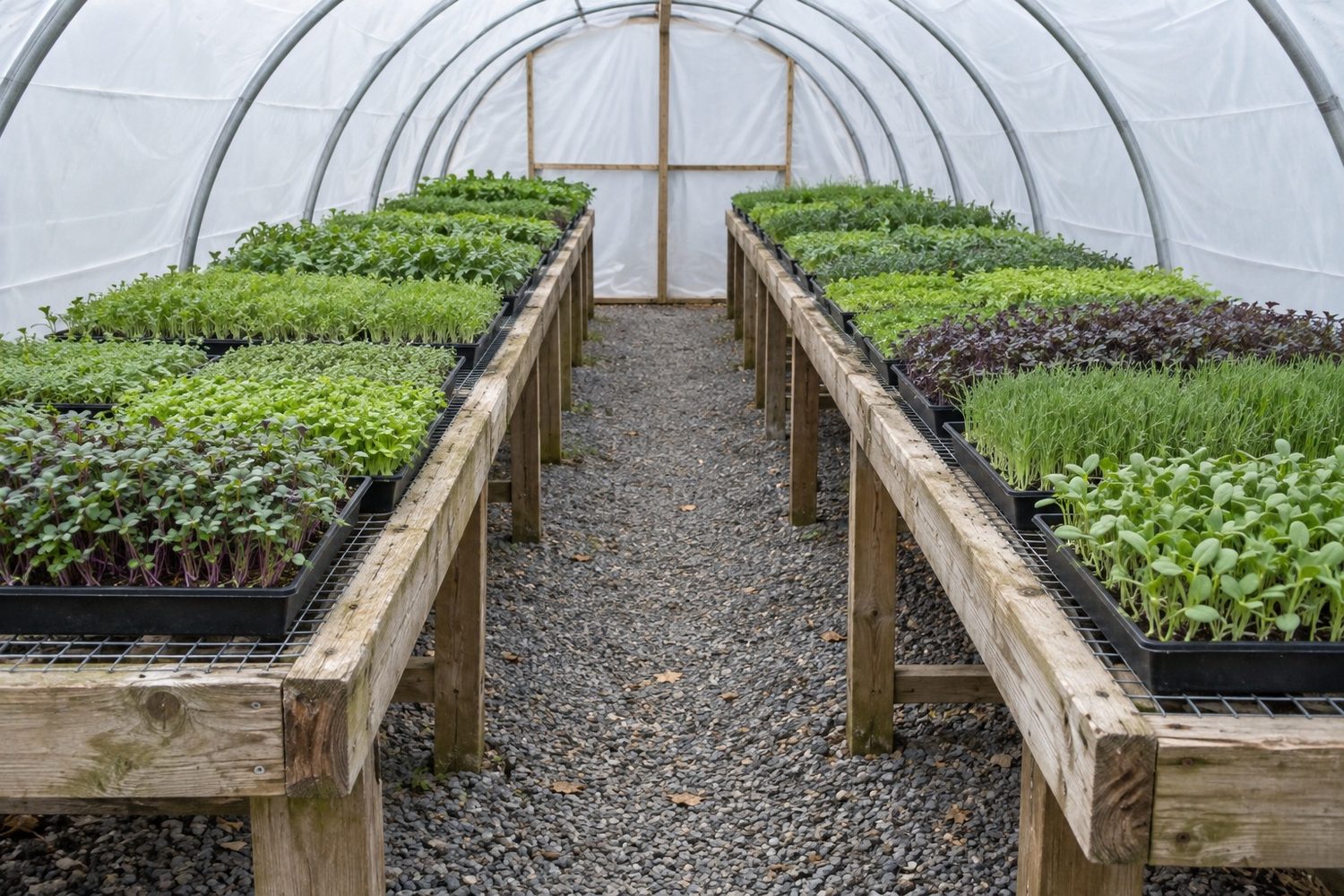
Two limits change what those averages mean for you. The census includes only operations that sold $10,000 or more of horticultural products in 2024, and only crops grown under glass or other protection. Most growers in the Misra and Gibson survey reported microgreen revenue below that line, so the 516 describes the larger end of the business, not a typical home or garage setup. The figures are also sales, not profit; the census doesn't publish costs, net income or owner pay for microgreens. To compare your own space with that average, start with microgreens yield per square foot.
The share of growers who turn a profit is not measured
Neither the survey nor the census asks growers whether they make a profit after paying for their own labor, so the only profit figure that fits your operation is the one you work out from your own records.
The closest numbers cover much broader groups, and they give a sense of scale rather than a forecast. USDA's Economic Research Service found that in 2019, 51% of all US farm households had positive net returns; among farms with less than $10,000 in annual gross sales, 39% did, compared with 85% of farms selling $1 million or more (USDA ERS). That covers every kind of farm, not microgreens. For businesses in general, the Bureau of Labor Statistics reports five-year survival of 57.3% for US start-up establishments that opened in 2018 (BLS). Neither predicts how a microgreen operation will do, but both show that a positive return is far from certain for small operations and new businesses.
One New Hampshire farm's budget: startup recovered in year one, on paper
Fat Peach Farm in Madbury, New Hampshire, worked with UNH Cooperative Extension on a SARE-funded winter pilot in 2020 to 2021, and its final report includes a budget. It says startup costs of $2,326.04 "could be recovered in year one," with net income, meaning returns less fixed and variable costs, of $1,577 from 12 microgreen trays a week and $1,090 from 6 pea shoot trays a week (SARE final report).
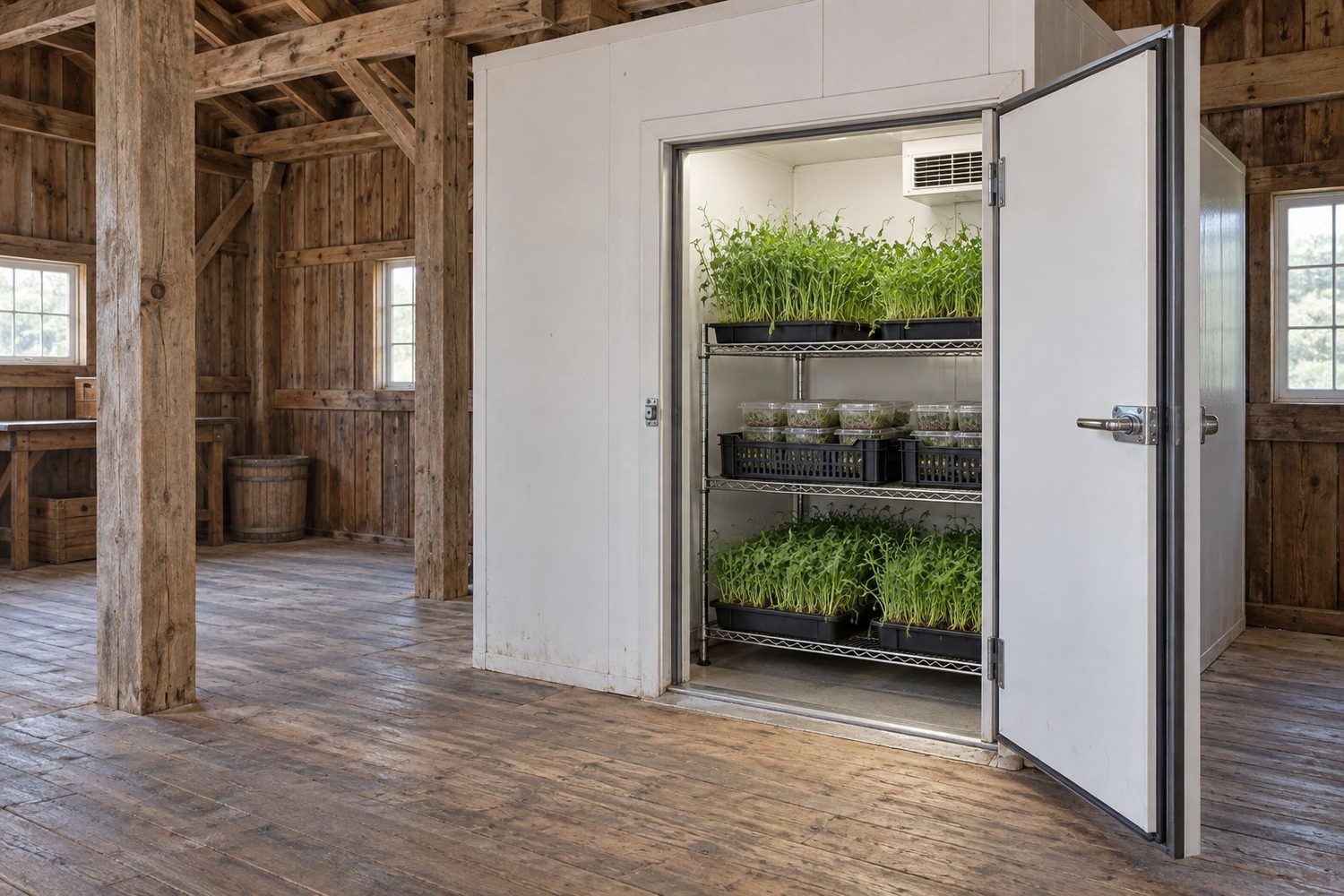
Read those numbers closely before borrowing them. The microgreens alone, at $1,577, don't cover the $2,326.04 startup; year-one recovery depends on both enterprises together, which add up to $2,667. The report names harvest and packing labor, at 15 minutes a microgreen tray, as the biggest variable cost, but it doesn't state the hourly wage behind that cost. It's one farm's budget for one season, not a record of what the owners took home. For itemized per-tray costs on your own crops, use microgreen profit and margins and labor and time per tray.
One Quebec operator's break-even: 30 to 40 sold trays a week
One operator who ran a two-person microgreen business on Montreal's south shore from 2018 to 2020 recalled becoming profitable at 30 to 40 trays sold a week, after a startup cost of about $5,000 (two-year operator's account). The post doesn't name the currency, though a Quebec business was most likely working in Canadian dollars. The operator didn't state a wage for their own labor, so "profitable" here means sales covered the costs they counted, not that their hours were paid too. They also noted that seed and soil costs climb as volume grows.
Note the word sold: a tray you grow and can't sell still costs you seed, media and time. Treat 30 to 40 as one person's recollection of one business, not a threshold; your break-even depends on your prices, costs and buyers. The partners stopped after an argument between them and for family reasons.
What individual growers report at different scales
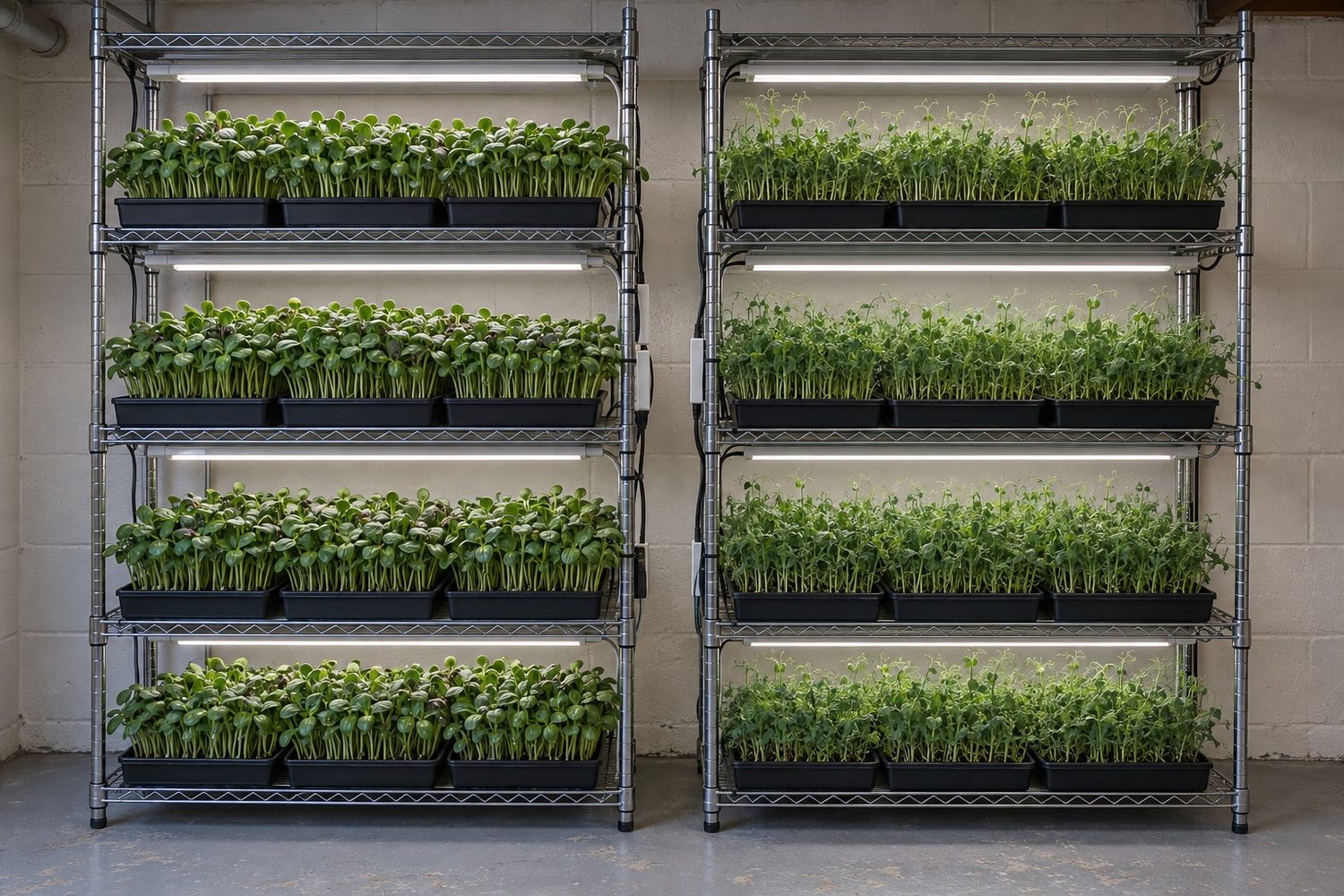
Each row below is one person's self-reported, unaudited account, with the year and whether they described the figure as gross or net.
Hover or tap a row to highlight it.
| Year | Grower | Trays a week | What they reported |
|---|---|---|---|
| 2022 | One seller, six months in | 20 to 25 | About $150 a week, gross |
| 2022 | One seller, two years in | About 100 | $1,600 to $2,000 a week, gross |
| 2024 | One two-person farm | 130 | $75,000 in the prior year, reads as gross |
| 2024 | One Nova Scotia restaurant seller | 10 to 15 | $15 a tray (Canadian); less per hour than a full-time job |
| 2024 | One market seller | Not stated | $350 gross a market day; about $5 a tray in operating costs |
The first two come from a December 2022 thread about weekly tray counts. The original poster's roughly $150 a week at 20 to 25 trays, six months in, was gross sales by their own confirmation; in a May 2026 update they were still running it on the side at roughly $1,000 a month, without saying whether that was sales or profit. A different grower in the thread reported the 100-tray figure after two years (2022 thread).
The two-person farm said in 2024 that it made $75,000 "just on microgreens" the year before, without saying revenue or profit (2024 account). The same author had written in May 2023 of costs around $5 a tray against a gross target of about $10 a tray (same author, 2023), which fits the $75,000 being sales before costs and before any pay for two people's work.
The last two posted in a 2024 thread about rack revenue (2024 thread). The Nova Scotia grower sold 10 trays a week in winter and 12 to 15 in summer to restaurants, and said the work paid less per hour than their full-time job. The market seller worked a five-hour market every other Saturday, and their $5 a tray leaves out the racks, lights, fans, dehumidifier and trays bought up front.
None of these tells you what's typical. Growers who kept going are more likely to post than growers who stopped, and none of these accounts reports income after paying the owner a wage. The Nova Scotia seller's hourly comparison is the question each one leaves for you to answer. To see how crop choice moves the figures, which crops to sell and the most profitable microgreens go crop by crop.
How long payback took, and how much a model swings
Payback periods vary a lot, so work yours out from your own costs and sales. The New Hampshire budget projected year-one recovery using microgreens and pea shoots together, and the Quebec operator gave a tray count but no date. Alberta Agriculture's June 2018 analysis is a model rather than a farm, and its tables print no currency: its concept business, 960 trays a month on a $109,284 investment (a second table carries $109,584), was projected to pay that back in about three years (Alberta Agriculture).
The same model shows how far a result swings on assumptions. For one modeled crop, changing the product form and the price moved modeled annual profit from $6,297.60 to $25,881.60, and modeled basil could lose $9,323.52. The factsheet's own caution is to "be sure your markets will accept that pricing." Build your timeline from your own startup costs and the sales you can line up, test prices with your buyers before you rely on any projection, and use starting a microgreens business, a written microgreens business plan and pricing and what to charge for the details.
Prices buyers have paid
Two public price reports give a sense of range from different buyers. USDA Market News' Iowa farm-to-school report, dated February 28, 2025, lists local school purchases of 19 pounds of microgreens at $10.00 to $11.50 a pound, a weighted average of $11.03 (USDA AMS). Colorado State University's June 8, 2024 report from the Cortez farmers market recorded microgreens at $2 to $3 an ounce (Colorado State).
One is a school buyer paying by the pound in one state, and the other is market shoppers paying by the ounce in one town, so neither is a national price. Check what buyers pay near you, in the channel you plan to use, because that's the price your numbers have to work with.
Why some growers stopped
Fewer growers write about stopping than about selling, and the reasons given are mostly time, space and buyers. Each of these is one account.
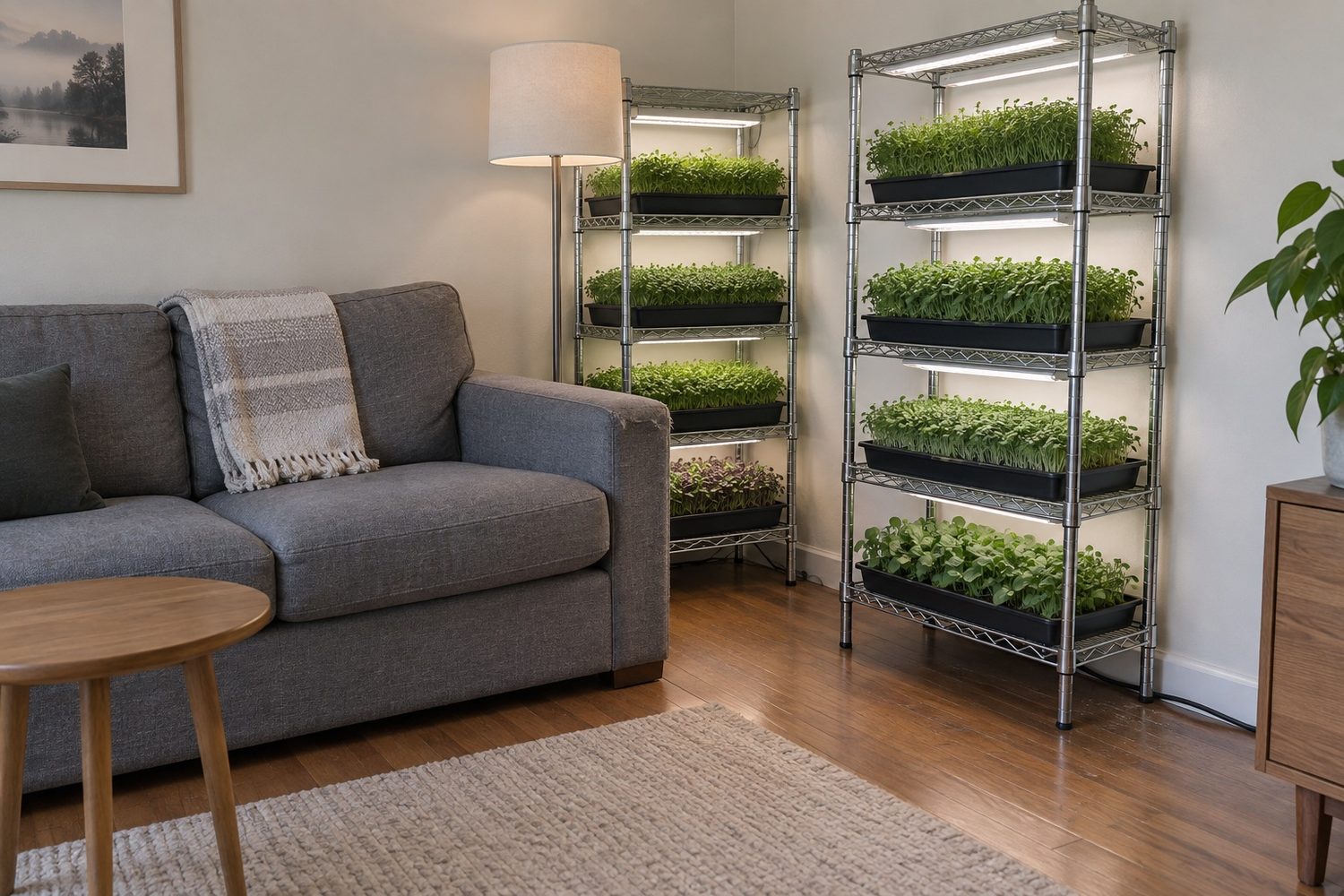
- An Asheville restaurant grower said in 2024 that the business was profitable, but they sold it because the racks were taking over the house (2024 thread).
- A commenter in the same 2024 thread said their four-person mushroom and microgreen farm switched to mushrooms after about a year, because reliable microgreen customers and shelf life were both hard to manage.
- A 2023 grower who couldn't make restaurant sales work named too few routine visits and poor follow-through on leads, an uneven, underlit setup that left much of the crop unsellable, and life changes including a move, a salaried job, travel and school (2023 thread).
- The Quebec operator stopped after an argument with their business partner and for family reasons.
Sales that run through one channel also carry a risk no grower controls. After the April 2020 stay-at-home order, Sacramento Sprouting Co. reported its business down 90% (Sacramento Bee). In Australia, Pocket Herbs cut its staff from about 25 to eight after its restaurant orders dropped to nothing in March 2020 (ABC News). If most of your sales go to one type of buyer, write down what you would do if that buyer closed for a month.
Questions growers ask about microgreen profit
Do restaurants or farmers markets pay better?
Track your sales and costs separately for each sales channel, so you can see which one pays. Among beginning farms of all kinds, ERS found that 54.3% of those with direct-to-consumer sales in 2007 still reported sales in 2012, against 47.4% of those without (USDA ERS). That measures survival, not profit, and it isn't specific to microgreens.
What hourly wage should I charge for my own time?
There's no standard wage for a microgreen owner's labor. University of Missouri Extension's July 2024 microgreen budget pays labor at $20 an hour (MU Extension G693), which gives you one published figure to start from. Another fair test is the one the Nova Scotia seller used: compare what an hour of microgreen work pays with what an hour of your other work pays.
Should I find buyers before I buy equipment?
Virginia Tech Extension advises settling your target market before production, because it shapes your facility, quantity, species, handling and price (Virginia Tech). University of Minnesota Extension suggests testing products and prices at a farmers market and asking prospective customers about price, pack size, quality and consistency (UMN Extension).
What costs catch new sellers off guard?
The Quebec operator named packaging for cut greens as an unexpected expense, and said they sometimes had to discount stock close to its expiry (two-year operator's account). Record both from your first week of sales.
Can I judge a microgreen business for sale by its revenue?
Not by revenue alone. One indoor operation listed for sale in Oliver, British Columbia, as of September 2026, claimed CAD $100,000 to $250,000 in sales revenue and under CAD $50,000 in cash flow, without saying whether the owner's labor was already charged (listing). Cash flow isn't automatically profit or owner pay, and buying a microgreens business covers what to ask for instead.
The calculation to run for your own operation
The number that answers whether your microgreens are profitable is net return after all costs, including your own labor, tracked by crop and by sales channel, alongside the hours you put in. University of Maryland Extension recommends recording what sold, where, how much and at what price, along with expenses and labor hours, then reviewing what made money (UMD Extension). University of Minnesota Extension notes that the best numbers for your farm are your own records (UMN Extension).
Run it for each crop and each channel over a set period, such as a month:
- Add up the sales you were paid for. Leave out trays you grew but didn't sell.
- Subtract direct costs: seed, growing media, packaging, delivery and any market fees.
- Subtract your share of overhead: electricity, water, and the cost of your racks, lights and trays spread over the months you expect them to last. Electricity and water costs shows how to estimate the utilities.
- Divide what's left by the hours you spent seeding, watering, harvesting, packing, making deliveries and selling. That's what the work paid you per hour.
- Go back to the step 3 figure and subtract your hours multiplied by the wage you'd accept for the work. What remains is your net return after labor.
If step 5 comes out positive, that crop and channel are paying for your time and more. If step 3 is positive but step 5 is not, your sales cover your costs but not your time at that wage. If the hourly figure from step 4 is below what your other work pays, you're in the position the Nova Scotia seller described. Keep these records for a few months before you add racks or trays, and let your own figures, rather than anyone else's, decide whether to grow.
Sources
Prices, stock and specifications are as the linked pages showed them on 2026-09-13.
Keep reading
The journal
Buying a Microgreens Business for Sale: What to Check First
Thinking about a microgreens business for sale? Learn how sellers state cash flow, what SBA loans require in 2026, and what to check before you buy.
Read Buying a Microgreens Business for Sale: What to Check FirstThe journal
Growing Microgreens for Profit: A Weekly Production Plan
Plan growing microgreens for profit with tray counts per crop, a buffer from your own records, and a weekly sowing and harvest schedule you can repeat.
Read Growing Microgreens for Profit: A Weekly Production PlanThe journal
How to Write a Microgreens Business Plan Step by Step
Build your microgreens business plan section by section, from executive summary to financial plan, with startup costs itemized by scale and source.
Read How to Write a Microgreens Business Plan Step by StepThe journal
Microgreen Growers Insurance: Costs, Limits and Markets
Selling microgreens at a market or restaurant? See what microgreen growers insurance covers, who requires it, and what policies cost by limit, state and year.
Read Microgreen Growers Insurance: Costs, Limits and Markets