Microgreens vs Mushrooms: On Labor Per Pound the Two Overlap, and the Farm-to-Farm Spread Is 10.9-Fold
Cal HewittPublished Checked
- comparison
- selling microgreens
- economics
- business planning
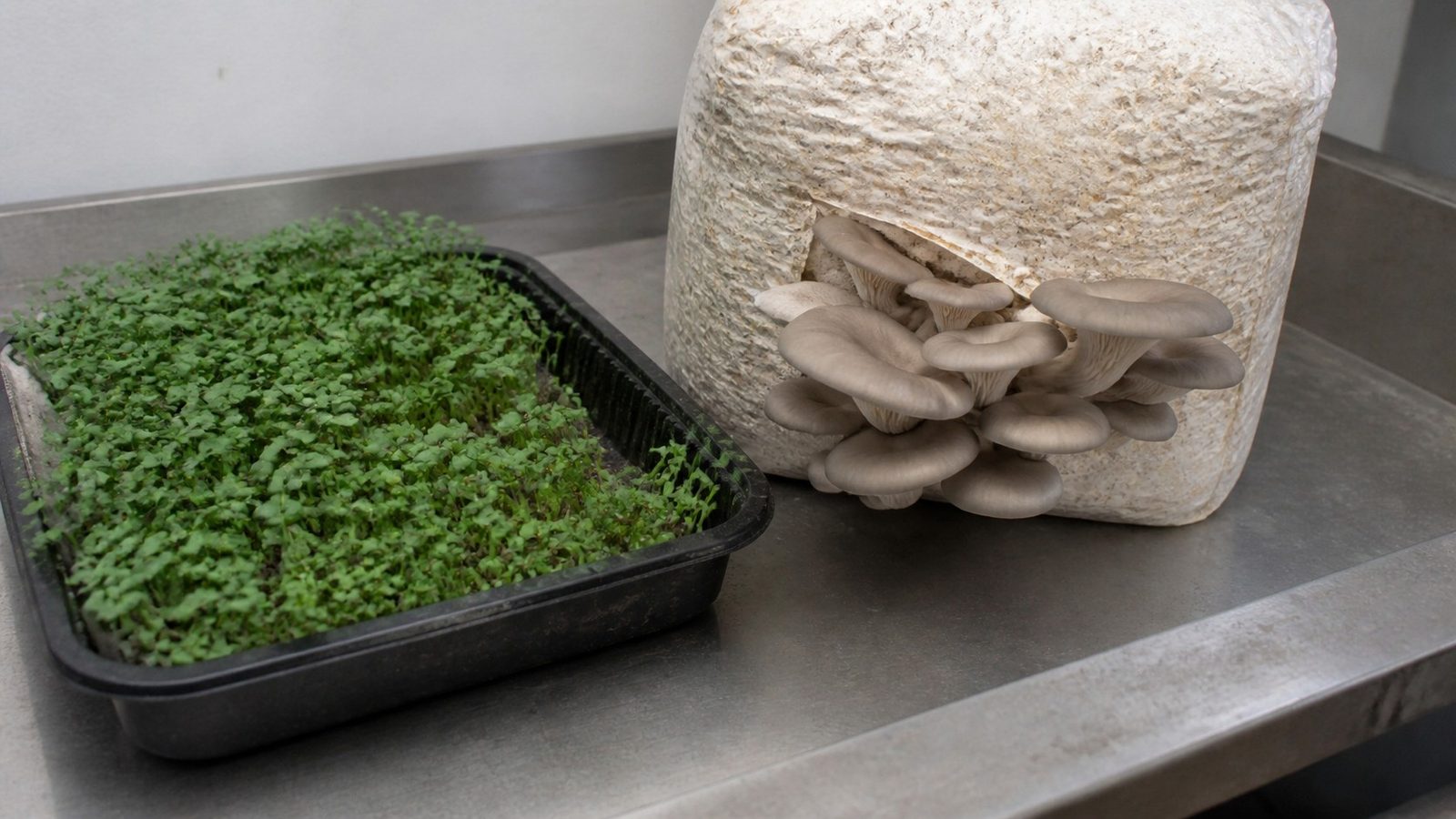
This is a business comparison, not a nutrition one. Which is the better indoor crop to grow and sell is a real question, and almost every page answering it compares two numbers that are not on the same axis.
There is no published matched-condition trial measuring both crops' yield, labor, costs, losses and sales from the same indoor area. Nothing below is a crop-versus-crop result derived from one experiment, because no such experiment exists. What the separate figures can do is share a unit and see what survives. On one unit, the answer is unusually clear.
What to actually do
- Validate your buyers before you pick a crop. The best mushroom dataset available ranges from 0.66 to 1.36 lb per block and 0.14 to 1.52 labor hours per pound. That variation is large enough to swamp any generic online profitability ranking.
- Convert everything to labor hours per saleable pound. It is the only unit both crops currently publish, it is the majority of operating cost, and it is the one that showed the two crops in the same class.
- Never divide a mushroom efficiency figure by a microgreen one. One denominator is the seed that becomes the food, the other is the wood the fungus eats.
- Decide what a cycle means before you count turns. A tray yields once. A block yields until you decide to stop, which is a management choice, not a crop property.
- Price your own bill of materials. Cornell excluded capital costs because five farms reported $694.85 to $10,665. A headline setup price is not a plan. For a microgreen pilot, standard 1020 trays plus a rack, light, timer, watering, seed, medium, harvest tools and cold storage is the honest list.
- Get the state answer, not the internet answer. Cultivated and wild mushrooms are treated differently, permits are state by state, and your market has its own vendor rules on top.
- Do not read the enoki outbreak as a mushroom risk rate. It is an imported product event, and the local block on your rack is a different supply chain.
- If you run both, segregate the rooms and share only the cooler, the pack area and the route.
Labor per pound is the one unit both crops publish, and it matches
Cornell has real multi-farm mushroom labor data. Across five participating farms, labor averaged 0.56 hours per pound, ranging 0.14 to 1.52, and labor was 67% of operating cost.
The microgreen side converts onto the same unit. The only institutional per-tray times published divide into a median tray of 7.055 oz, which is 0.4409 lb.
Hover or tap a row to highlight it.
| Source | Figure | Hours per pound |
|---|---|---|
| Penn State Extension, electric clippers | 6.8 min per tray | 0.257 |
| Penn State Extension, scissors | 9.5 min per tray | 0.359 |
| Missouri Extension budget assumption | 15 min per tray | 0.567 |
| Cornell, five mushroom farms, mean | measured | 0.56 |
| Cornell, five mushroom farms, range | measured | 0.14 to 1.52 |
Every microgreen figure falls inside the mushroom range, and the Missouri budget figure sits 1.2% from the mushroom mean. On the input that Cornell says is 67% of operating cost, the two crops are indistinguishable.
The spread is the finding, not the match. Mushroom farm-to-farm variation is 10.9-fold, from 0.14 to 1.52 hours per pound. The whole spread between the three microgreen figures is 2.21-fold. The gap between two mushroom farms is roughly five times any gap between the crops. Which crop you pick is not what decides your labor cost. How you run the room is.
Two honest limits on that comparison, and they matter. Cornell's number is measured across five real operations. The Penn State figures are course estimates of production tasks only (planting, irrigation, harvest, packing and distribution), and the Missouri figure is a budget input assumption, not a measurement. So, the units finally match and the evidence quality does not. The overlap is a strong hint that the crops are in the same labor class. It is not a measured tie.
The efficiency numbers are not on the same axis at all
This is where the comparison usually breaks, and the break is invisible unless you read the denominators.
Biological efficiency, the mushroom industry's conversion metric, is fresh mushroom mass divided by dry substrate mass. The microgreen equivalent is fresh cut shoot divided by dry seed mass, and it runs a median of 9.24 grams per gram across the 39 crops publishing both figures. Written as a percentage that is 924%.
Cornell's block dataset gives 0.88 lb of fresh mushrooms from a 5 lb block, which is 17.6% on a wet-block basis. That is not biological efficiency, because BE needs the dry substrate mass and the dataset does not publish enough detail to compute it.
Hover or tap a row to highlight it.
| Figure | Value | What the denominator actually is |
|---|---|---|
| Microgreen conversion, fresh shoot over dry seed | 924% | The dry seed, which becomes the plant you eat |
| Cornell block, wet basis | 17.6% | The wood and supplement the fungus eats and leaves behind |
| The apparent gap if you divide them | 53-fold | Meaningless |
Both numbers are real and the 53-fold is nonsense. A seed is the organism. A substrate block is the food source. Dividing one ratio by the other compares a plant to its own lunch. If anyone needs a genuine shared metric, both crops have to publish seed or substrate dry mass, harvest fresh and dry mass, cultivar and cycle, and nobody does.
A cycle is not a cycle, because mushrooms fruit more than once
"Both are two-week crops" is the other unit error, and it is a big one.
A microgreen tray yields once. Sow, grow, cut, strip, reset. Cornell teaching material puts the range at 7 to 21 days, with fast brassicas at the short end and pea, sunflower, herbs and a first-true-leaf harvest at the long end.
A mushroom block yields repeatedly. Oyster on sawdust incubates 10 to 20 days and on straw 14 to 28, then initiates and fruits, and straw or sawdust substrates can keep producing for 4 to 8 weeks through later flushes. Cornell's research blocks stayed in fruiting for eight full weeks, while many farms in the same study pulled blocks after the first major harvest.
So, the two crops do not even agree on what a cycle is. For microgreens it is the whole life of the tray. For mushrooms it is a management decision about when to stop, and the same block is a different economic object depending on that choice.
Which is why annual turns cannot be inferred from cycle length for either crop. A 7 to 21 day microgreen crop does not prove 17 to 52 sellable turns, because cleaning, reset and unsold product all consume the calendar. Mushroom blocks occupy incubation and fruiting capacity for weeks. Turns per year is an output of your room and your sales, not of your crop's biology.
The number everybody quotes has no method behind it
One widely shared comparison claims a 10 m² mushroom room yields 10 kg after 10 hours against 8 kg of microgreens after eight hours, then calls microgreens "considerably more profitable."
It gives no farm name, no cycle definition, no substrate or tray count, no crop or strain, no growing conditions, no unit costs, no sales evidence and no accounting treatment. It also asserts that a 200 ft² mushroom area produces 800 lb per crop and 5,000 lb per year, with nothing attached.
Its one useful line is not the comparison. It is the caution that microgreens can be hard to sell in volume, which is a market observation and is consistent with everything below.
The claim that microgreens are inherently more profitable per unit of space and time is the most repeated unsupported statement in this subject. It typically sets an asserted microgreen retail price against an asserted mushroom yield, ignores unsold product and ignores the later flushes. No matched experiment or economic dataset supports it.
Cornell's own data is the counterweight. Its five farms show both loss and profit, and no clear winner between buying ready-to-fruit blocks and making blocks on site: making blocks shifts cost toward labor, buying them shifts it toward materials. Cornell explicitly calls its scenario values projections, and excluded capital and fixed costs because the reported totals ranged from $694.85 to $10,665 and were too heterogeneous to combine. That range is a warning about every headline setup price you will read.
Observed prices, converted to one unit, and what survives
These are dated observations of what was listed, not demand evidence and not price targets.
Virginia's May 2026 state market report lists $18/lb mushrooms at one Richmond market, $13/qt mushrooms at another, and $5 for 1.5 oz of organic microgreens at a third. A Georgia listing showed broccoli microgreens, 1.5 oz, at $5.
Hover or tap a row to highlight it.
| Comparison | Microgreens | Mushrooms | Multiple |
|---|---|---|---|
| Across three different Virginia markets | $5 per 1.5 oz = $53.33/lb | $18/lb | 2.96x |
| One seller listing both products | $2/oz = $32/lb | $20/lb | 1.60x |
| The third Virginia listing | not comparable | $13 per quart | cannot convert |
The one-seller row is the only near-like-for-like here, because it holds the seller, the market and the date constant, and it gives 1.60x, not 2.96. The two multiples disagree by nearly a factor of two, which is what happens when the first comparison also changes seller, market, and organic status.
The quart figure cannot be converted at all. It is a volume and mushrooms are sold by mass elsewhere on the same report, so there is no density to bridge it. An unconvertible unit is not a small problem to round past; it is a number that has to be left out.
A cross-check against a known retail band. One grower's three pack sizes span $27.22 to $45.36 a pound. The $32/lb one-seller listing sits inside that band. The $53.33/lb organic 1.5 oz pack sits above it, which is exactly what a small pack does to a per-pound price. The observations are internally consistent, and none of them is a market average.
Rules, licensing and the wild mushroom question
Federal selling requirements turn on the product and the operation, not on which crop it is.
Fresh microgreens are produce, and Produce Safety Rule coverage depends on food type, sales and buyers. Farms under the adjusted $25,000 produce-sales threshold are not covered, and qualified exemptions carry recordkeeping and farm name and address disclosure requirements. Cultivated mushrooms generally sell as produce too.
The real asymmetry is wild product. No federal rule found requires an indoor cultivated-mushroom seller to hold a wild-mushroom identification credential. State rules differ and there is no single national permit rule, so a national list would mislead. New York is a verified example: no license is required to sell mushrooms cultivated under controlled conditions, provided they are sanitary and excess dirt is removed and they are not cut or processed at market without a permitted food-service operation. It separately bars sale of wild-foraged mushrooms unless the vendor is a certified expert mushroom forager.
Organic mushroom claims also carry a mushroom-specific federal production standard covering substrate and spawn, which has no microgreen equivalent.
None of this is legal advice, and farm size, processing, state rules, buyer standards and whether product is cut or packed can all change what applies. Check your own state agency and your own market's vendor rules.
The outbreak records are not symmetrical, and neither is the reason
Mushrooms have a documented outbreak with deaths. FDA's March 2020 enoki investigation linked Listeria monocytogenes to imported Korean enoki, recording by 9 June 2020 36 illnesses, 31 hospitalizations and four deaths, with illness onsets from 23 November 2016 to 13 December 2019. FDA also posted a 14 May 2026 recall of 528 cases of 150 g enoki after an FDA sample tested positive, with no illnesses reported.
Read that carefully before drawing a crop conclusion. It is a specific imported product event. It is not evidence that a locally cultivated oyster mushroom carries that rate, and the enoki supply chain is not the block on your own rack.
Microgreens have one too: a 2018 recall for possible L. monocytogenes, with no illnesses reported, which sits in the sprout comparison alongside the full sprout record. Neither crop is clean and neither has a rate. What both have is one documented event apiece and no denominator.
**And Listeria survives refrigeration**, which is the practical note for both crops: cold chain limits growth and does not sterilize.
Losses, shelf life and demand are all open
Loss rates. No comparable published loss percentage exists for either crop. Mushroom mechanisms are documented, including molds and bacteria competing in poorly cleaned or inoculated substrate, overheating, and delayed colonization; a 40-bag Cornell observation found top-spawned bags took ten extra days, which adds contamination opportunity without being a failure-rate study. Microgreen losses plausibly come from poor germination, damping off, uneven irrigation and unsold perishables. Those are mechanisms. Neither crop has a measured category rate.
Shelf life. Not established as category-wide days for either. It depends on species, maturity, washing, package atmosphere, product temperature and cold-chain breaks. The only defensible operational conclusion is that both are perishable and both need a refrigerated, fast-turn channel. Do not compare an unwashed living microgreen tray with a packed chilled mushroom using one generic number.
Demand. No comparable demand series, repeat-order dataset or buyer survey isolates local microgreens against local specialty mushrooms in one market. Price listings prove availability, not demand. Cornell found mushroom farms producing 50+ lb a week were consistently profitable in its small sample, which describes operations that already had sales rather than promising that sales exist.
Can one building do both
Yes, and not in one uncontrolled room.
They can share a building, a cooler and a customer route. They should not share a grow space. Microgreens generally want lower humidity with light and airflow; fruiting mushroom rooms want high humidity, fresh-air exchange, and they shed spores. Cornell documents higher contamination risk and closer environmental monitoring in indoor mushroom rooms.
The popular claim that mushroom CO2 improves the microgreens is practice, not an established economic or food-safety benefit. A Paris operation growing both is cited as proof that co-location works, and it does prove co-location is possible. It publishes no crop-level yield, labor, cost, waste or profit, so it is not a financial result and not a shared-room protocol.
Segregate incubation and fruiting from the greens, and treat the shared parts as the shared parts: cold storage, packing, delivery and the customer list.
What nobody has measured
- A matched-rack trial reporting both crops as fresh product per m² of productive rack footprint per day, plus crop loss, under stated conditions.
- A microgreen labor figure at Cornell's scale: multi-farm, per cycle, with tray count, crop mix, wash, pack and delivery included. It is the single most valuable missing number in this comparison.
- Multi-farm loss logs for either crop, at lot level, with cause codes.
- A year of capacity and sell-through logs to turn cycle length into real annual turns.
- Dated local wholesale invoices rather than retail listings and "contact us for wholesale pricing."
- A matched postharvest study holding specified packs at stated temperatures with sensory, weight and microbial endpoints.
- Audited dual-crop case studies publishing separate room conditions, contamination logs, output, sales by channel and allocation of shared overhead.
- Systematic exit interviews with former growers of both crops. Everything currently written about why people quit is mechanism, not data.
Terms on this page
Tap a term to see what it means.
Spawn. A carrier such as grain or sawdust already colonized by mushroom mycelium, used to inoculate the production substrate. The mushroom equivalent of buying seed, except it is already alive.
Sources
Opened 2026-08-11. Three conversions here were computed for this page. Labor hours per pound divides each published per-tray time by the median published tray of 7.055 oz, or 0.4409 lb. The 17.6% block figure divides Cornell's 0.88 lb mean harvest by its 5 lb block and is explicitly a wet-block basis rather than biological efficiency, which the dataset does not publish enough detail to compute. The price multiples convert each listing to dollars per pound; the quart listing is left out because no density bridges volume and mass. The 924% microgreen conversion is the median across the 39 of 62 variety entries publishing both a seed rate and a yield.
- Cornell Small Farms, indoor mushroom grower scenario research report - five participating farms averaging 0.88 lb fresh mushrooms per 5 lb block with a range of 0.66 to 1.36, labor averaging 0.56 hours per pound with a range of 0.14 to 1.52, labor at 67% of operating cost, research blocks held in fruiting for eight full weeks while many farms removed blocks after the first major harvest, capital and fixed costs excluded because reported totals ran from $694.85 to $10,665, both loss and profit across the sample, no clear winner between ready-to-fruit and on-site blocks, farms producing 50+ lb a week consistently profitable in that small sample, and the scenario values described by Cornell as projections.
- Cornell Small Farms, seven stages of cultivation - oyster incubation of 10 to 20 days on sawdust and 14 to 28 on straw, straw and sawdust substrates producing for 4 to 8 weeks through later flushes, substrate treatment by steam sterilization for supplemented sawdust and pasteurization, fermentation or lime treatment for straw, documented loss mechanisms, and the 40-bag observation that top-spawned bags took ten extra days.
- Cornell Cooperative Extension, specialty mushroom guidance - humidity, temperature and airflow as the critical fruiting variables with light affecting form rather than supplying energy, incubation near 70°F and below 80°F externally for 5 to 10 lb supplemented sawdust bags because the core runs hotter, fruiting as the stricter phase, spawn and substrate definitions, and higher contamination risk with closer environmental monitoring in indoor mushroom rooms.
- Cornell Small Farms, producing specialty mushrooms outdoor against indoor systems - oyster, shiitake and lion's mane as the usual indoor specialty choices, oyster suited to straw or sawdust and shiitake and lion's mane doing best on sawdust, and the equipment a pilot needs.
- Cornell, growing microgreens teaching material - the 7 to 21 day microgreen range, with fast brassicas at the short end and pea, sunflower, herbs and a first-true-leaf harvest extending it.
- University of Minnesota Extension, FSMA and the Produce Safety Rule - coverage turning on food type, sales and buyers, the adjusted $25,000 produce-sales threshold below which a farm is not covered, and the recordkeeping and farm name and address disclosure requirements attached to qualified exemptions.
- New York State Department of Agriculture and Markets, guidance on sanitary regulations for farmers markets (PDF) - no license required to sell mushrooms cultivated under controlled conditions provided they are sanitary with excess dirt removed and are not cut or processed at market without a permitted food-service operation, and the separate bar on selling wild-foraged mushrooms unless the vendor is a certified expert mushroom forager.
- 7 CFR 205.210 - the mushroom-specific federal organic production standard covering substrate and spawn.
- FDA, outbreak investigation of Listeria monocytogenes in enoki mushrooms, March 2020 - imported Korean enoki, 36 illnesses, 31 hospitalizations and four deaths recorded as of 9 June 2020, illness onsets from 23 November 2016 to 13 December 2019, and the note that Listeria can survive refrigeration.
- FDA, IQ Produce LLC enoki mushroom recall - the 14 May 2026 recall of 528 cases of 150 g enoki after an FDA sample tested positive for L. monocytogenes, with no illnesses reported.
- Virginia Department of Agriculture and Consumer Services, May 2026 farmers market report (PDF) - $18 per pound mushrooms at Birdhouse Market in Richmond, $13 per quart mushrooms at Burke Market, and $5 for 1.5 oz organic microgreens at Lakeside Farmers Market, three different markets on one report.
- Observed listings, used only as dated observations of what was offered: a Georgia listing of AquaTerra Farm broccoli microgreens at 1.5 oz for $5 and Wild Easton's of Door County, Wisconsin, the one seller publicly listing both products, at $2 per ounce for microgreens and $20 per pound for mushrooms, and asking buyers to make contact for wholesale pricing rather than publishing a wholesale quote.
- Practice, audited 2026-08-11 as a record of what is published rather than as evidence: GroCycle's mushrooms against microgreens comparison, the source of the 10 m² room claim of 10 kg mushrooms after 10 hours against 8 kg microgreens after eight hours, the "considerably more profitable" verdict, the unsourced 200 ft² figures of 800 lb per crop and 5,000 lb a year, the shared-room CO2 claim, the "both sell themselves" claim, and the Paris dual-crop operation cited without crop-level yield, labor, cost, waste or profit. Its caution that microgreens can be hard to sell in volume is the one line here that is not a comparative claim.
Keep reading
The journal
Buying a Microgreens Business for Sale: What to Check First
Thinking about a microgreens business for sale? Learn how sellers state cash flow, what SBA loans require in 2026, and what to check before you buy.
Read Buying a Microgreens Business for Sale: What to Check FirstThe journal
Growing Microgreens for Profit: A Weekly Production Plan
Plan growing microgreens for profit with tray counts per crop, a buffer from your own records, and a weekly sowing and harvest schedule you can repeat.
Read Growing Microgreens for Profit: A Weekly Production PlanThe journal
How to Write a Microgreens Business Plan Step by Step
Build your microgreens business plan section by section, from executive summary to financial plan, with startup costs itemized by scale and source.
Read How to Write a Microgreens Business Plan Step by StepThe journal
Microgreen Growers Insurance: Costs, Limits and Markets
Selling microgreens at a market or restaurant? See what microgreen growers insurance covers, who requires it, and what policies cost by limit, state and year.
Read Microgreen Growers Insurance: Costs, Limits and Markets