Microgreens Side Hustle: A Weekly Time and Income Breakdown
Cal HewittPublished Checked
- business planning
- economics
- selling microgreens
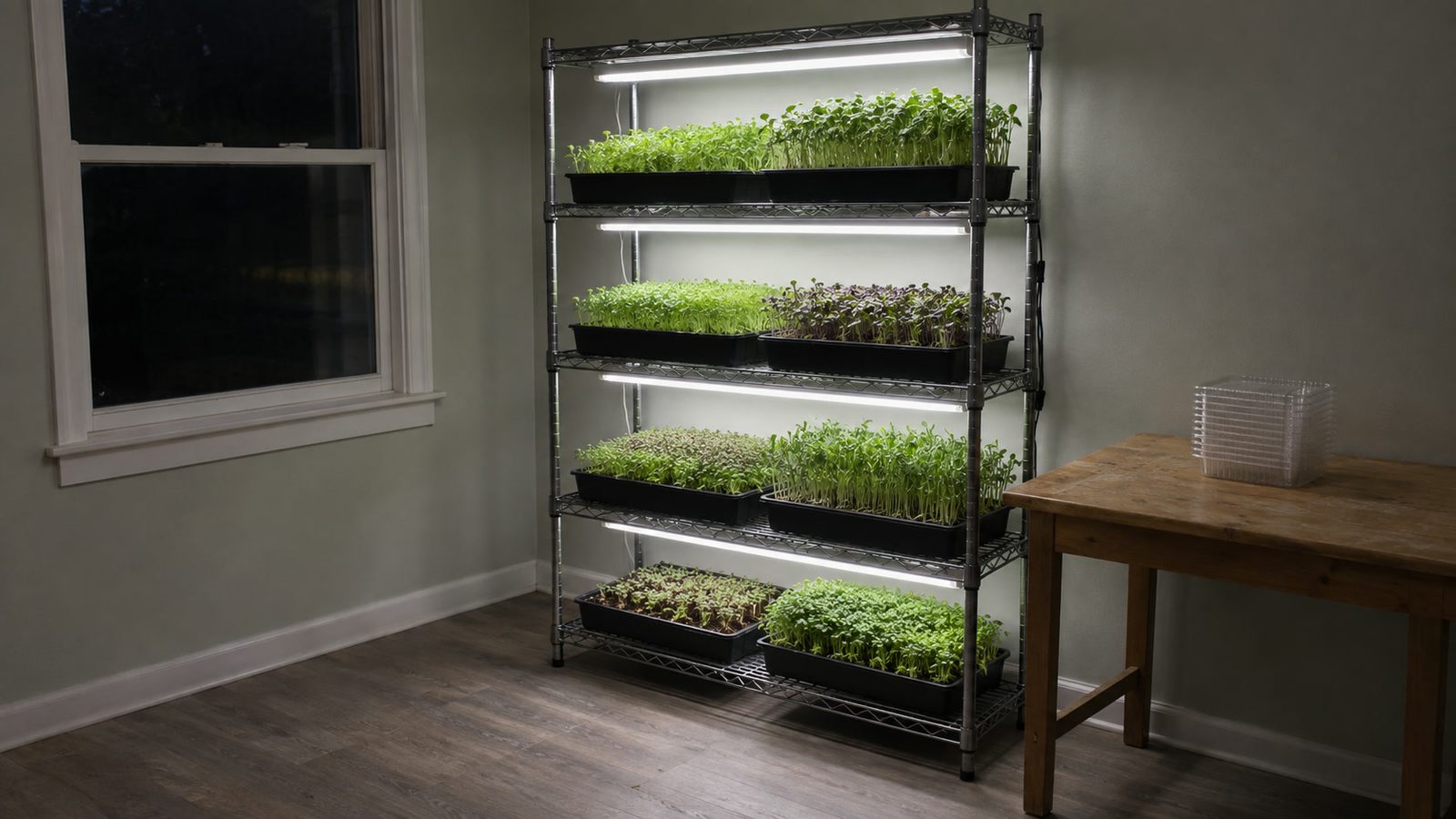
Weekly hours for a small microgreens business run beside a job vary, and in the one detailed account selling and delivery took about as much time as growing. That grower, a UK seller supplying restaurants, a hotel and a wholesaler, broke a week down task by task and put it at about 10 hours, with four of them spent on delivery alone.
The income figures attached to part-time accounts are self-reported, mostly gross sales, and none has been checked against books. Below is where the hours go, block by block, and whose numbers are whose.
Where the growing hours go
The growing side is the part with published minutes. Penn State Extension lists per-tray task estimates of 3.3 minutes for planting, 0.5 minutes for irrigation and fertilization, 4 minutes for harvest with scissors or 1.3 minutes with electric clippers, and 1.7 minutes for packing and distribution, costed at $12 an hour (Penn State Extension, updated December 16, 2025). Added together, that comes to about 9.5 minutes of hands-on time per tray with scissors and about 6.8 minutes with clippers. Those minutes were estimated from students in a Penn State course rather than clocked on a working farm, so treat them as a starting point and not as your number.
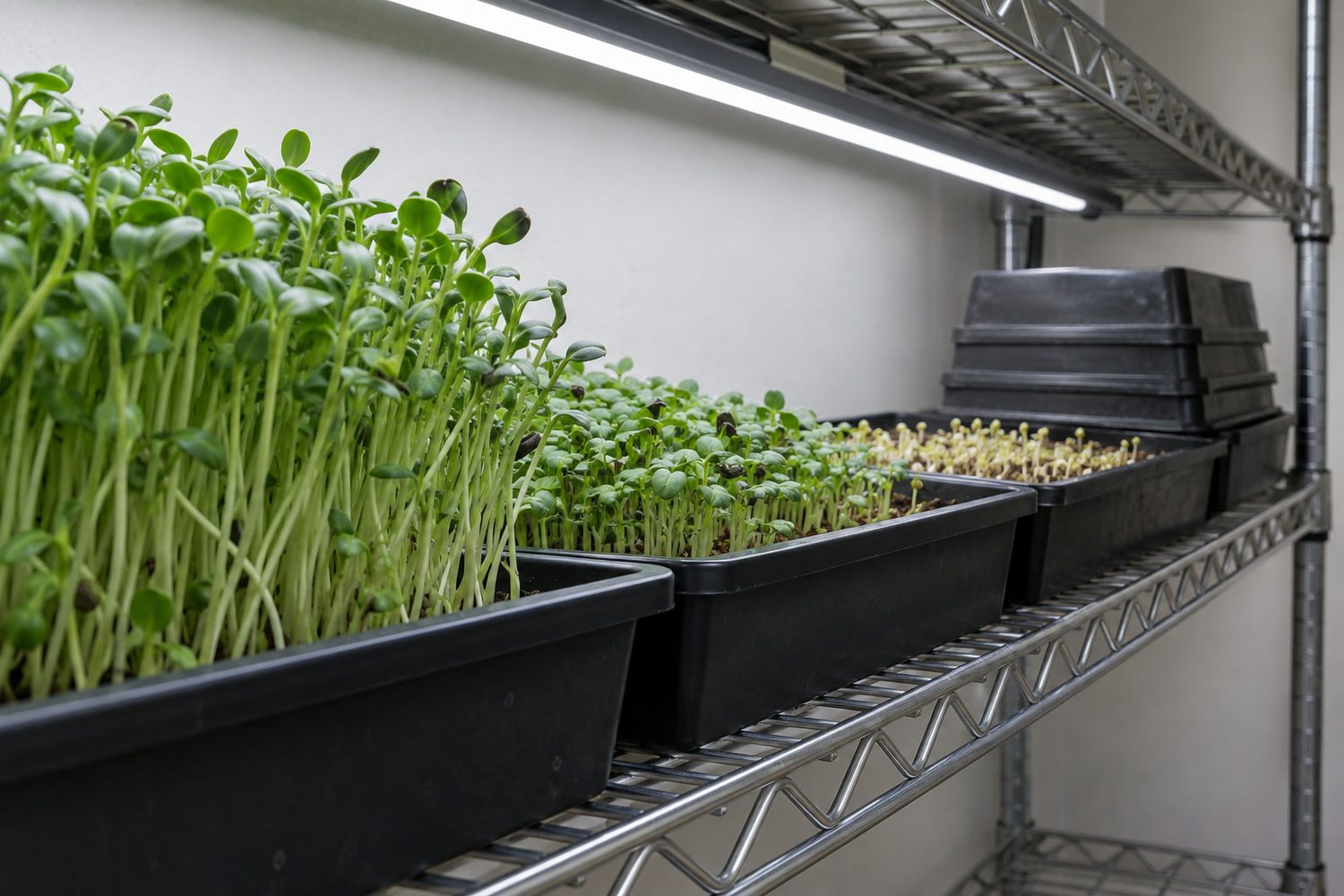
To turn them into a week, multiply each task by the trays you plan to seed, then time yourself on your first few batches and replace the estimates with what you actually record. The harvest line is the only one on the list with a choice built into it: 4 minutes a tray with scissors against 1.3 with electric clippers. Our labor and time per tray guide works through the per-tray math in more detail, so it isn't rebuilt here.
Timing matters as much as minutes. There's no universal calendar, because varieties grow at different speeds. A microgreens equipment maker's scheduling guide suggests planning backwards from the day you've promised delivery, with pea and sunflower generally running longer than radish or arugula (Rooted Robotics). In practice, your delivery or market day goes on the calendar first, each crop is seeded far enough ahead to be ready for it, trays get checked daily, and harvest and packing happen right before the drop.
One grower reported that unsold experimental greens were poor after 24 hours in their refrigerator (r/microgreens, March 2021). It's a single observation, not a shelf-life study, but it shows why your harvest evening has to sit next to your sales day. Virginia Tech Extension says food safety standards belong in your harvesting protocol but assigns no minutes to that work (Virginia Tech Extension), so time your own washing and packing.
Where the selling and delivery hours go
Track the minutes you spend selling, because it's the part most easily left out when a grower adds up the week. The clearest breakdown comes from a remote UK grower who reported about £900 a month in revenue from local restaurants, an event hotel that takes about 40% of sales, and one wholesaler (r/microgreens, June 2024). Their week ran like this: one hour planting, two hours harvesting and packing, one to two hours of maintenance, cleanup and tray washing, and four hours of delivery, plus about an hour of stock, ordering and record keeping that they say they don't track.
They total it as 10 hours, and four of those are delivery. The post gives no tray count, so you can't convert it into time per tray, but it's the most complete look at how one part-time week splits.
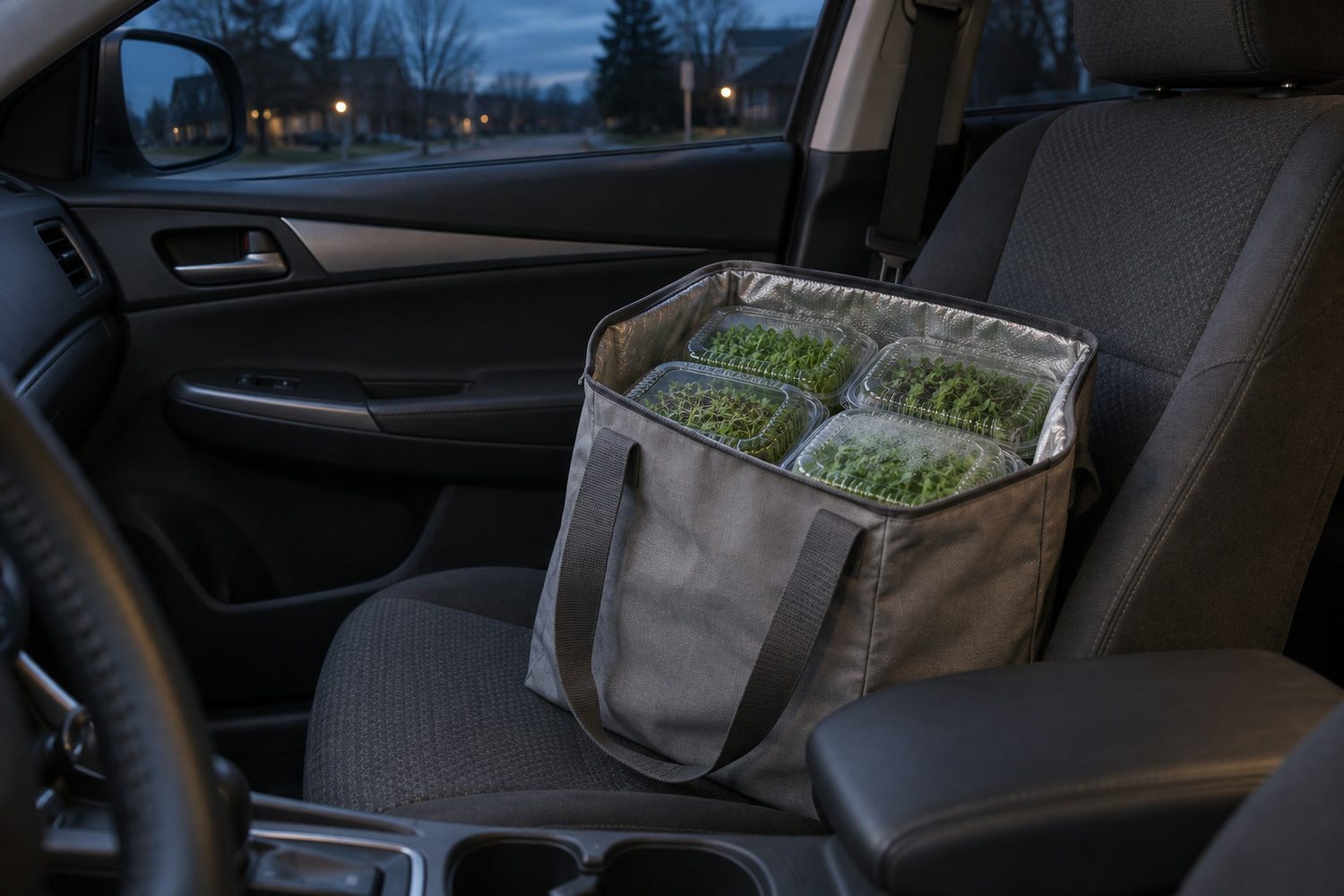
Restaurant sales add work that never touches a tray. A grower selling about 100 trays a week to chefs and restaurants advised sampling chefs, going back for a follow-up visit a week after dropping samples, and sending out a "Fresh Sheet" on Mondays (r/microgreens, 2022). In the same thread, a different grower at 20 to 25 trays a week described texting buyers a weekly menu. Neither gave a total for sales time. Budget for it anyway, because every sample run, menu and follow-up visit comes out of the same evenings as your seeding.
Markets have firmer numbers, though none of them are specific to microgreens. University of Maryland Extension's illustrative farmers-market budget assigns 7.5 labor hours to one market day: an hour to pack coolers, six hours to set up, work and tear down, and half an hour to unpack, with transportation time and mileage on top (University of Maryland Extension).
Cornell Small Farms, drawing on a survey of New York State market farmers, put a market at about seven hours away from the farm once an hour of setup, an hour of teardown and roughly an hour for an average 17-mile trip are added to a 3 to 4 hour market; the setup and teardown hours are the authors' assumptions (Cornell Small Farms). A microgreens vendor described something close to that: four market hours plus three for setup and teardown, before travel (r/microgreens).
Delivery also decides which days you're tied to. A market farmer who owns microgreen equipment but doesn't grow them wrote that a seller would have sellable greens two or three times a week and that deliveries take at least a day (side-business forum thread). That's one person's account, but it fits the UK grower's four delivery hours.
A part-time week, laid out in blocks
The table below puts the documented figures into the blocks a working week breaks into. Each figure stays with the source it came from.
Hover or tap a row to highlight it.
| Block | What goes in it | Documented figure | Whose figure |
|---|---|---|---|
| Growing | Soaking, seeding, watering, daily checks | 3.3 min planting and 0.5 min irrigation per tray; about 1 hour of planting a week | Penn State course estimates; the UK grower |
| Harvest and pack | Cutting, washing, packing, labeling | 4 min harvest with scissors or 1.3 min with clippers, plus 1.7 min packing, per tray; about 2 hours a week | Penn State course estimates; the UK grower |
| Cleanup | Tray washing, sanitation, maintenance | 1 to 2 hours a week | The UK grower |
| Selling and delivery | Samples, menus, follow-up visits, routes, markets | 4 hours of delivery a week; 7.5 hours per market day | The UK grower; University of Maryland Extension (not microgreen-specific) |
| Admin | Stock, ordering, records | About 1 hour a week, untracked | The UK grower |
To build your own version, start with the selling and delivery block, since your channel sets the day everything else works back from. Set your harvest and packing block right before it, fill in the growing block with Penn State's minutes times your tray count, and add cleanup and admin last, because those are the blocks that quietly drop out of an estimate.
Weekly hours at 10, 25 or 50 trays depend on your setup, so don't borrow someone else's number. Log every task's start and stop time for 30 days, from seeding and watering through harvest, packing, sanitation, sales messages, invoicing, travel and market setup. Record trays harvested, units sold, waste and the channel for each sale. At the end of the month, you'll have your own week instead of an estimate.
What growers have reported earning, and who reported it
Each figure below belongs to one person and one business, and none of them has been audited.
The largest numbers all come from a single Reddit author. In a December 2022 post, he reported $1,400 a week in revenue from 10 to 13 hours for August 2021, with 90% of sales going to grocery stores (his December 2022 post). In the same post he called $62,000 his 2021 income from the microgreen business while separately reporting education and kit income, and he describes selling consultations, access to a paid Discord community and starter kits, along with seed and equipment commissions.
In a June 2023 thread he described a first year of over $60,000, later called that figure gross, said $48,000 was "extra money," and gave 10 to 15 hours a week (r/microgreens, June 2023). Those hours were his household's combined time: his 2022 post says his wife left her job to run the business, and in 2023 he said he still works offshore and pays three employees to run a 2,800 square foot facility that has expanded beyond microgreens.
Read the $1,400 a week, the $62,000 and the $60,000 as one person's account of one mixed business, not as what microgreens alone pay for a few evenings a week.
The roughly 100-tray grower from the restaurant thread reported $1,600 to $2,000 a week in gross sales to chefs and restaurants, and gave no hours total (r/microgreens, 2022). That grower works alone, with a partner who sometimes washes trays, and answered a since-deleted question with "I'd say full time job." In the same thread, the 20 to 25 tray grower said they "make roughly $150/week," with trays selling at $25 to $35 and extra used for samples and personal use, then confirmed "That's my gross sales." On May 7, 2026, that same poster said the business was "still on the side," selling through a wholesale co-op and several weekly restaurants and "tracking roughly $1k/month."
A different poster reported 1 to 2 hours a day and about €250 a week in March 2021 (r/microgreens, March 2021). They didn't give a tray count, a sales channel or operating costs, or say whether that amount was revenue or profit, though they did list a startup outlay of about 80 to 100 euros for a rack, lights, trays and seed.
The UK grower with the task breakdown reported about £900 a month in revenue, cost of goods sold of roughly 15%, and a self-reported "tidy £700 a month after costs," without itemizing those costs (r/microgreens, June 2024). It is the one account here that ties revenue to a task list, and it still gives no scale.
None of these figures is checked net income
Most of the numbers above are gross revenue, which means sales before costs, fees, taxes or your own labor come out. Cost of goods sold covers only the direct inputs for the crop you sold, such as seed, growing media and packaging, and it isn't the same as all your business costs. What you actually want to know is your net operating result, which is sales minus your cash operating costs and a fair share of overhead, and your owner hourly return, which is that net result divided by every hour you worked, including selling and delivery.
No account we located supplies all three pieces, revenue, complete costs and total owner hours, at one defined scale. That means there's no trustworthy income-per-hour figure to hand you, and Penn State's $12 an hour is a labor cost assumption in a production budget, not a statement of what a grower earns.
You can work out your own. During the same 30 days, record every sale, refund, fee, mile driven, input purchase, utility bill, market fee and equipment repair, then subtract costs and overhead from sales and divide by all of your hours. Our profit and margins guide covers pricing and margin math, and the electricity and water costs guide helps you put a figure on the utility line.
Taxes, licenses and your day job
Once sales start, the IRS side applies even at small scale. The IRS says net self-employment earnings of $400 or more require a return, even when the work is part-time or temporary (IRS gig work guidance). For regular farming operations, IRS Publication 225 says farm income and expenses are generally reported on Schedule F, and that its records "must accurately support the income, expenses, and credits you report"
(IRS Publication 225). The IRS separates a business, run to make a profit, from a hobby, and says no single factor decides; hobby income is still reportable (IRS hobby or business guidance). Our federal tax and business structure guide goes further. This is general federal information, not tax advice.
Licensing sits with your state and local government. The IRS Schedule F instructions note that a farming activity may bring state and local taxes and requirements such as licenses and fees, and tell you to check with those offices (IRS Schedule F instructions). The starting a microgreens business guide points you toward the state coverage on this site.
Your employer's rules matter too. There's no single US moonlighting rule, so read your employment agreement and handbook for outside-work, conflict-of-interest, confidentiality and company-property terms before you sell. The IRS confirms you can be an employee and self-employed at the same time.
Frequently asked questions
These cover a few points the sections above don't.
Is there a reliable income per hour for part-time microgreens?
Not directly, but the UK grower's figures allow a partial calculation. About £900 a month over 9 to 10 stated hours a week works out to £20.77 to £23.08 of revenue per stated hour, or £17.65 to £19.62 after roughly 15% cost of goods sold. Their own "£700 a month after costs" at 10 hours a week is about £16.15 an hour, still before tax and any sales time they didn't list.
How much do most small microgreen operations bring in?
A peer-reviewed survey of 176 US growers, published in Food Protection Trends in January 2021, found that 99 of the 124 growers who chose a revenue bracket reported under $10,000 a year in gross microgreen revenue (Food Protection Trends survey). That's revenue, not profit, and the respondents aren't a census of every grower. The survey didn't ask about hours worked or net income.
Will I owe estimated tax on microgreen sales if I already have withholding from a job?
You may. The IRS says self-employed people may owe quarterly estimated tax, normally due April 15, June 15, September 15 and January 15, and that extra withholding from your wages can cover tax on side income instead. Keep your sales records and receipts even if no 1099 ever arrives.
Which sales channel takes the least time?
Track your net dollars per labor hour for each channel, so you can see which one pays. Forum advice favors pre-sold subscriptions, repeat buyers and a convenient pickup point over individual delivery, because output is known ahead of time and delivery adds at least a day. Cornell found surveyed market farmers attended 2.5 markets a week, spending 17 to 18 hours weekly away from the farm.
Where to start
Start with a month of records rather than a projection. Seed a tray count you can sell, time every task including the drive, and keep every receipt. The starting a microgreens business guide and the labor and time per tray guide are the next places to go for the setup and per-tray detail.
Sources
Prices, stock and specifications are as the linked pages showed them on 2026-09-12.
- Penn State Extension
- Rooted Robotics
- r/microgreens, March 2021
- Virginia Tech Extension
- r/microgreens, June 2024
- r/microgreens, 2022
- University of Maryland Extension
- Cornell Small Farms
- r/microgreens
- side-business forum thread
- his December 2022 post
- r/microgreens, June 2023
- IRS gig work guidance
- IRS Publication 225
- IRS hobby or business guidance
- IRS Schedule F instructions
- Food Protection Trends survey
Keep reading
The journal
Buying a Microgreens Business for Sale: What to Check First
Thinking about a microgreens business for sale? Learn how sellers state cash flow, what SBA loans require in 2026, and what to check before you buy.
Read Buying a Microgreens Business for Sale: What to Check FirstThe journal
Growing Microgreens for Profit: A Weekly Production Plan
Plan growing microgreens for profit with tray counts per crop, a buffer from your own records, and a weekly sowing and harvest schedule you can repeat.
Read Growing Microgreens for Profit: A Weekly Production PlanThe journal
How to Write a Microgreens Business Plan Step by Step
Build your microgreens business plan section by section, from executive summary to financial plan, with startup costs itemized by scale and source.
Read How to Write a Microgreens Business Plan Step by StepThe journal
Microgreen Growers Insurance: Costs, Limits and Markets
Selling microgreens at a market or restaurant? See what microgreen growers insurance covers, who requires it, and what policies cost by limit, state and year.
Read Microgreen Growers Insurance: Costs, Limits and Markets