Buying Microgreens: The Same $6 Buys 60 Grams or 100
Cal HewittPublished Checked
- buying
- price
- shopping
- evidence
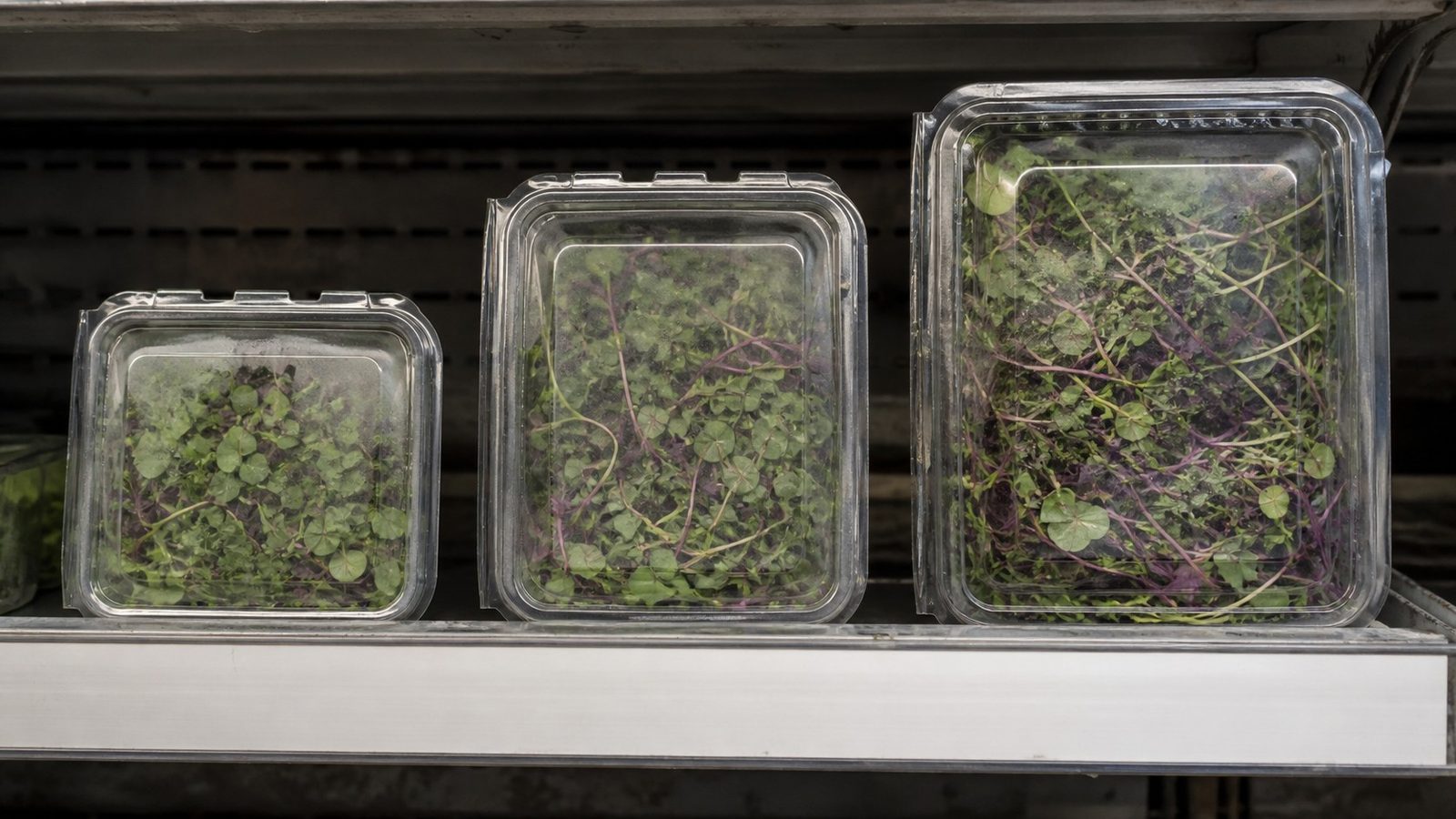
One grower sells three packs at six dollars each: 60 grams, 75 grams and 100 grams. Converted to a common unit, that is $45.36, $36.29 and $27.22 a pound.
The 60 gram pack costs 67% more per pound than the 100 gram pack, from the same seller, on the same day, at the same sticker price. That single decision is worth more than choosing which channel to shop in, and almost nothing on a shelf tells you it is happening.
What to actually look for in the shop
- Cold. Refrigerated display, and refrigerate it promptly at home at or below 40°F.
- No damage and no obvious decay. Federal shopper guidance is to choose produce that is not bruised or damaged. Bright color is not a shelf-life measurement.
- The pack weight, not the pack price. This is the whole article. Work out the price per ounce before you decide, because the sticker hides a 67% difference.
- A pre-washed claim, if you want one. Printed or absent, not assumed.
Every observed consumer price, converted
Prices for this crop are quoted in ounces, grams, unstated clamshells and per pound, which makes them almost impossible to compare on a shelf. So here they all are on one basis.
Hover or tap a row to highlight it.
| Where | What | Per pound | Per ounce |
|---|---|---|---|
| Farm direct | Perro DFW weekly 4-variety pack, 335 g, $20 | $27.08 | $1.69 |
| Farm direct | Perro DFW 100 g pea or sunflower, $6 | $27.22 | $1.70 |
| Subscription | microGREEN FX 8 oz sweet pea, $16 | $32.00 | $2.00 |
| Supermarket shelf | H-E-B 80 Acres Super-Punch mix, 2 oz, $4.48 | $35.84 | $2.24 |
| Supermarket shelf | H-E-B 80 Acres arugula, 2 oz, $4.48 | $35.84 | $2.24 |
| Farm direct | Perro DFW 75 g crunchy mix, $6 | $36.29 | $2.27 |
| Subscription | microGREEN FX 8 oz weekly, $20 | $40.00 | $2.50 |
| Delivery platform | Instacart H-E-B Micro-topia, 2 oz, $5.29 | $42.32 | $2.65 |
| Farm direct | Perro DFW 60 g pack, $6 | $45.36 | $2.83 |
| Delivery platform | Publix broccoli, 2 oz, $5.69 | $45.52 | $2.85 |
| Online seller | Farmoponics popcorn shoots, about 2 oz, $6.99 | $55.92 | about $3.50 |
These are prices posted by sellers on dated pages, not a price survey. Location, tax, delivery minimums and stock all move them.
Two things that fall out of the table
First: farm-direct is not reliably cheaper. It supplies both the cheapest row at $27.08 and nearly the dearest at $45.36. The same seller occupies both ends. So "buy direct from the grower to save money" is not what the observed prices say. Buy the right pack from the grower and you save; buy the small pack and you pay supermarket prices or worse.
Hover or tap a row to highlight it.
| Channel | From | To |
|---|---|---|
| Farm direct | $27.08 | $45.36 |
| Subscription | $32.00 | $40.00 |
| Supermarket shelf | $35.84 | $35.84 |
| Delivery platform | $42.32 | $45.52 |
| Online seller | $55.92 | $55.92 |
Second: the shopper's world is far narrower than the seller's. Converted the same way, seller-quoted prices span 8.3-fold, from $12.00 to $100.00 a pound. What a shopper can actually pay spans about 2-fold, $27.08 to $55.92.
The seller spread is about four times wider than the buying one. The bottom is a farmers-market figure from a government report, and the top is one Arkansas farm's 4 oz price for premium crops such as amaranth and shiso.
Where they are actually sold
Five routes are documented: supermarket produce departments, natural and health-food shops, farmers markets, direct farm pickup or delivery, and online recurring delivery. A National Library of Medicine consumer page points shoppers at natural-food markets and farmers markets; a large seed supplier describes growers selling through farmers markets, natural-food stores and grocery stores.
Nobody publishes which chains stock them. No national or regional chain-by-chain availability dataset turned up, and the retailer pages themselves say prices and stock vary by store, curbside and delivery. A national product page cannot tell you whether your branch has it, so a search for local microgreens is a store or producer question for your own postcode, not a brand question.
The 2 ounce clamshell is the format that keeps appearing on supermarket listings. Direct sellers use a different logic entirely, pricing 60, 75, 100 and 335 gram packs, which is where the pack-size lever comes from.
Living trays, which are rarer than they look
A 2021 peer-reviewed survey of 175 US microgreen farms found 32 of them, 21%, selling a living tray, meaning the crop alive and unharvested in its growing container.
That measures what growers offer, not what shelves carry. A university dissertation records living microgreens appearing in some restaurants and grocery stores, and is careful to ask whether their apparently longer shelf life is real rather than assuming it. So, a living tray is a genuine format with an unverified shelf-life advantage, not a standard supermarket option.
Finding a local grower, in the order that works
- Search the USDA Agricultural Marketing Service National Farmers Market Directory by place. It gives location, hours, offerings and payment information.
- Open the market's vendor list, or phone and ask specifically for microgreens. A directory listing does not promise a microgreen vendor on any given date.
- Search your state agriculture department's local-product directory if it has one. Texas runs a searchable product and business directory plus a certified-farmers-market search; Illinois runs a product logo program that identifies state products but did not return a searchable grower result.
- Check the grower's own order page for delivery radius and pickup. One Austin seller delivers within that metro; a Pennsylvania seller limits free delivery to the southeast of the state. Those radii are the real constraint.
- Then check the refrigerated produce section near you.
Nobody publishes what share of farmers markets have a microgreen vendor, or the season by state, so step 2 cannot be skipped. Indoor production means the crop can run year-round; it does not mean a market will list it.
What the label does and does not tell you
Required, under the federal packaged-food rules: a statement of identity, a net-quantity declaration, and the name and place of business of the responsible firm. That is roughly it.
Not federally required: a harvest date, a packed-on date, or a use-by date. Federal guidance is explicit that quality-based date labels are not required on packaged food except infant formula, and treats "Best if Used By" as a voluntary quality phrase. A date on a clamshell is a manufacturer's choice, and what sellers actually print is unpublished; the retailer pages opened here showed product and size rather than any date field.
An organic claim is about production and handling under the National Organic Program, verified by an authorized certifying agent. It is not a claim about nutrient level, local origin, freshness, food safety or growing medium. Raw farm crops can carry "100 percent organic" when compliant; the "organic" tier means at least 95% organic ingredients for multi-ingredient products.
A "no need to wash" or pre-washed claim is worth reading and worth trusting only when it is printed. Federal guidance says packaged produce that is pre-washed and ready to eat will say so on the package. Do not infer washing from silence. One retailer listing carries a "No Need to Wash" claim, which is a seller statement about its process rather than proof of it. Absent that claim, rinse gently under running water just before use, with no soap and no produce wash. Washing has its own page.
The traceability gap, which is a definitional one
The federal Food Traceability List names fresh leafy greens and fresh sprouts. It does not explicitly name microgreens.
Whether a given microgreen product is covered depends on how it is classified and which exemptions apply. That is worth knowing rather than alarming: this crop sits in a definitional gap between two listed categories, which is the same gap that lets a jar of sprouts be sold as microgreens.
And internal traceability records are not a consumer-visible lot code. Even where records exist, they are kept by the firms, not printed on the pack.
What to actually do
- Compare per ounce, every time. Divide the price by the weight before you choose. On the observed prices that is worth more than any other decision a shopper makes.
- Buy the largest pack you will actually eat. The saving is real and immediate; the waste if you overbuy is not, because this crop does not keep. Storage is covered here.
- Do not assume farm-direct is cheaper. It spans the whole range. Ask for the larger pack or the multi-variety pack, which is where its advantage actually sits.
- Treat delivery platforms as a convenience purchase. Both observed platform prices sit in the upper half of the table.
- Use the USDA directory, then phone the market. The listing does not promise a vendor.
- Read the date as a manufacturer's opinion, because federally it is voluntary, and judge the pack by cold, damage and decay instead. Telling a bad pack from a fine one is its own question.
- If you want the cost of a serving rather than a pound, the serving-size guide does that arithmetic and finds retail running 16 to 21 times the seed cost per ounce.
What is still genuinely unknown
- Which chains stock microgreens, and where. No availability dataset exists in the opened material.
- What share of farmers markets have a microgreen vendor, and in what season.
- How far this crop travels from farm to sale. No distance dataset exists, and a "farm-direct" claim describes one seller's route.
- Whether direct is fresher than retail. No study samples the same varieties from both channels with harvest and purchase dates recorded. The postharvest research shows temperature and time matter, which is not the same finding.
- What date codes clamshells actually carry. Web listings cannot answer it; a photographed multi-state package audit could.
- Whether living trays really do last longer. The one academic mention of them raises the question rather than settling it.
Terms on this page
Tap a term to see what it means.
Clamshell. The hinged clear plastic box most retail microgreens are sold in. Its weight is printed; its price per ounce is not.
Sources
Opened 2026-08-11 and 2026-08-12. Prices are dated snapshots of seller and retailer pages, not a price survey, and every conversion to a common unit is arithmetic performed for this page. The delivery-platform and online-seller rows are carried across from the serving-size guide, which observed them on 2026-08-11.
- MedlinePlus on microgreens - the consumer-facing channels and basic storage advice, from a National Library of Medicine service.
- Johnny's Selected Seeds microgreens brochure (PDF) - a supplier's description of the channels growers sell through. Channel practice, not an outlet count.
- Retail listings, observed 2026-08-11: H-E-B 80 Acres Super-Punch mix, 2 oz at $4.48, H-E-B 80 Acres arugula, 2 oz at $4.48, and the same brand's arugula at Kroger, which also carries the "No Need to Wash" claim. Both retailers state that prices vary by store and fulfillment method.
- Direct-seller listings, observed 2026-08-11: Perro DFW's order page for the 60 g, 75 g and 100 g packs at $6 each and the 335 g weekly pack at $20, microGREEN FX subscriptions at $20 for 8 oz weekly and $16 for sweet peas, and OZO for metro-area farm-direct delivery. These are the sellers' own posted prices and freshness claims.
- Journal of Food Protection survey of 175 microgreen farms, 2021 - that 32 respondents, 21%, sold a living tray, with the definition used.
- Phoenix Microgreens ordering page for the living-plant retail format, and a University of Maryland dissertation recording living microgreens in some restaurants and stores while asking whether their longer shelf life is real.
- USDA AMS National Farmers Market Directory - the directory behind step one, and what a listing does and does not promise. Plus the Texas GO TEXAN product and business directory, the Texas certified farmers markets search with its seasonality caution, and the Illinois Department of Agriculture product programs, which established the program but returned no searchable grower result.
- FDA Food Labeling Guide (PDF) and the 2023 Title 21 CFR volume (PDF) - the Part 101 requirements for identity, net quantity and responsible firm.
- FDA on food date labels - that quality date labels are not federally required except on infant formula, and that "Best if Used By" is a voluntary quality phrase.
- USDA AMS organic labeling requirements and 7 CFR 205.301 - the label tiers and what certification actually covers.
- FDA on selecting and serving produce safely - that pre-washed ready-to-eat packaged produce will say so, the advice to wash under running water without soap or produce wash, and FDA's seven tips for cleaning fruits and vegetables for choosing undamaged produce and refrigerating at or below 40°F.
- FDA on tracking and tracing food, the Food Traceability List and 21 CFR Part 1, Subpart S - that the list names fresh leafy greens and fresh sprouts without explicitly naming microgreens, and that traceability records are internal rather than consumer-visible.
- Berba and Uchanski postharvest study - the temperature and visual-quality work behind the point that cold matters and channel is not itself evidence of freshness.
- FDA non-emergency reporting - the route for a consumer complaint about a product.
Keep reading
The journal
Why Microgreens Are Expensive: You Are Mostly Buying the Box
In the only full published tray budget, labels, packaging and marketing are 50 to 60 percent of what a tray costs to produce. Growing the plant is 17 to 23 percent, and the seed is under 10.
Read Why Microgreens Are Expensive: You Are Mostly Buying the BoxThe journal
How Much Do Restaurants Pay for Microgreens?
Learn what restaurants pay for microgreens, with distributor and grower offer prices, grams per plate, plate cost math and where it lands in food cost.
Read How Much Do Restaurants Pay for Microgreens?The journal
Microgreen Prices Where You Live: A Buyer's Guide
Wondering what microgreen prices are near you? Compare regional market reports and retail prices, then use a step by step method to survey your own area.
Read Microgreen Prices Where You Live: A Buyer's GuideThe journal
Have These Gone Bad? Judging a Box of Microgreens in the Fridge
A warm fridge costs days: arugula, radish and red cabbage lost a week of quality at 10C against 4C, and one mustard study lost ten. And no visible sign has ever been validated as a safety test.
Read Have These Gone Bad? Judging a Box of Microgreens in the Fridge